
Does the Quran Say the Earth Is Flat or Round?
| Key Takeaways |
| The Quran does not say the earth is flat — Islamic scholars have affirmed the earth’s spherical shape for over a thousand years. |
| The Arabic verb kawwara in Surah Az-Zumar 39:5 describes the wrapping of night over day, which scholars cite as Quranic evidence for a spherical earth. |
| Islamic scholars distinguish between the earth’s locally flat appearance and its globally spherical reality — a distinction that aligns with modern science. |
Does the Quran say the earth is flat? The answer, according to over a millennium of Islamic scholarship, is a clear no. The Quran does not describe a flat earth — and the Muslim scholars have consistently affirmed the earth’s spherical nature, grounding this position in Quranic verses, rational analysis, and observable reality.
The confusion arises from a small number of Quranic verses that describe the earth as spread out or flattened. When read in isolation, without the Arabic linguistic context or the broader scholarly tradition, these verses can seem to contradict modern cosmology.
Does the Quran Say the Earth Is Flat?
No. The Quran does not say the earth is flat. Islamic scholars unanimously affirm the earth’s spherical shape, and they draw evidence for this directly from the Quran itself.
The most cited verse is in Surah Az-Zumar:
يُكَوِّرُ اللَّيْلَ عَلَى النَّهَارِ وَيُكَوِّرُ النَّهَارَ عَلَى اللَّيْلِ
“He wraps the night over the day and wraps the day over the night.” (Quran 39:5)
The Arabic verb يُكَوِّرُ (yukawwiru) comes from the root kaf-waw-ra, which means to wrap, coil, or wind something around a spherical object — the same word used for wrapping a turban around the head. This verb linguistically implies a spherical surface. Night and day can only wrap continuously around each other if the earth beneath them is a sphere rotating in relation to the sun.
The Permanent Committee for Scholarly Research and Ifta — one of the most authoritative Islamic scholarly bodies in the world — was formally asked: is the earth spherical or flat? Their answer:
“The earth is spherical as a whole, flat in its parts.” (Fatawa al-Lajnah al-Da’imah, 26/414).
What the “Flat” Verses in the Quran Actually Mean
Several Quranic verses describe the earth using Arabic words that relate to being spread out, leveled, or flattened. The most frequently cited is in Surah Al-Ghashiyah:
وَإِلَى الْأَرْضِ كَيْفَ سُطِحَتْ
“And at the earth — how it is spread out?” (Quran 88:20)
To an untrained reader, suthihat (spread out) might seem like a Quranic declaration of a flat earth. But classical Islamic scholars explain this apparent contradiction with clarity.
Sheikh Muhammad ibn Salihal-Uthaymeen — one of the most revered scholars of the 20th century — addressed this directly in his collected works (Majmu’ Fatawa wa Rasa’il al-Uthaymeen, 8/644). He wrote:
“The earth is round yet flat — because it is spherical, but due to its enormous size, its curvature is not visible. The verse does not contradict reality; the error lies in the misunderstanding. The one who thinks ‘spread out’ contradicts ‘spherical’ has made a mistake in comprehension.”
The key insight is this: the Quran’s description of the earth as spread out is a description of human perceptual experience, not a cosmological statement. A person standing on the surface of the earth perceives it as flat — because the earth is so vast that its curvature cannot be seen by the naked eye at ground level.
The Quran speaks to that lived reality. Meanwhile, other verses — like the one describing day and night wrapping over each other — address the earth’s actual cosmological form.
This is not a case of the Quran operating simultaneously on multiple registers: addressing immediate human experience and pointing toward underlying cosmic reality.
Learn More About Islam
Discover the beauty, teachings, and wisdom of Islam in a clear and welcoming way. Start exploring and deepen your understanding today.
Learn MoreHow Did Islamic Scholars Understand Earth’s Shape Through the Ages?
The Islamic scholarly tradition’s engagement with cosmology goes back to the earliest centuries of Islam. Muslim scientists and theologians — working within the framework of revealed knowledge and rational inquiry — consistently affirmed a spherical earth long before this became a settled matter in European intellectual culture.
The medieval Islamic scholar and polymath Ibn Hazm al-Andalusi cited the consensus of scholars on the earth’s spherical nature in his works.
Al-Biruni, the 11th-century Muslim scientist, even calculated the earth’s circumference with remarkable accuracy using Islamic geometric methods.
The great scholar Ibn Taymiyyah addressed cosmological questions within the framework of affirming that empirical observation and Quranic guidance are never in genuine conflict.
What makes the Islamic position distinct is its grounding in a coherent hermeneutic principle: apparent contradictions between Quranic language and observable reality are always resolved through deeper understanding of the Arabic text, not by discarding either revelation or observation.
Read Also: Contradictions in the Quran Explained
Is Believing in a Flat Earth Required in Islam?
No. Islam has never required belief in a flat earth — Islamic scholars rejected this claim based on Quranic evidence and rational observation long before the modern era. Studying the physical world, including its true shape, is considered in the Islamic tradition an act of contemplating Allah’s creation and is fully consistent with Islamic faith.
Read Also: The Quran and Modern Science
Learn More About Islam
Discover the beauty, teachings, and wisdom of Islam in a clear and welcoming way. Start exploring and deepen your understanding today.
Learn MoreRead Also: Embryology in the Quran
Learn More Authentic Knowledge About Islam & Quran with Salam
If this has sparked questions — about the Quran, about Islamic belief, or about what it means to live as a Muslim — the Salam Center is here to walk that journey with you.
Visit the Salam Platform to explore hundreds of articles on Islamic belief, the Quran, and the lives of the prophets. Browse the Salam blog for in-depth reading on topics just like this one.
Have a question you’d like to discuss with someone directly? Reach out to us — our team is available for sincere seekers, those considering Islam, and new Muslims navigating their early journey.

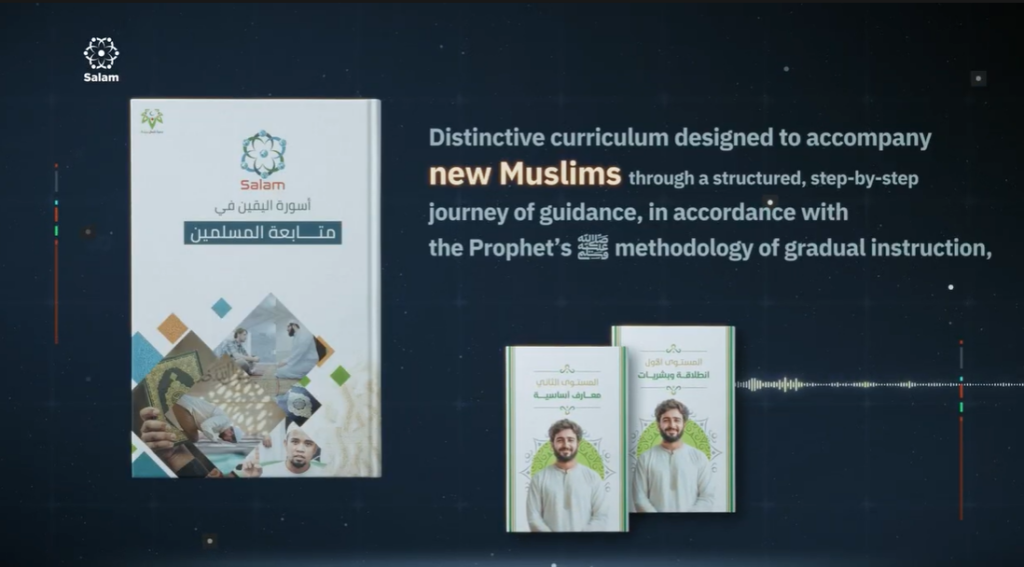
For new Muslims especially, we invite you to explore Asawirat Al-Yaqeen (Bracelets of Certainty) — the Salam Center‘s structured curriculum for the post-conversion phase:
- A four-stage educational journey grounded in the methodology of Ahl al-Sunnah wal-Jama’ah
- Covers foundational pillars, faith, ethics, Seerah, and contemporary life rulings
- Uses compassionate, therapeutic language that builds confidence and clarity
- Already completed by over 114,000 new Muslims across 140 countries
- Designed to take you from your first days as a Muslim to a grounded, empowered life of faith
Reach out directly to the Salam Center team to start the Asawirat Al-Yaqeen (Bracelets of Certainty) program for FREE.
Summary
Islamic scholarship unanimously affirms the earth’s spherical nature, citing Quranic evidence including Surah Az-Zumar 39:5, where the Arabic verb yukawwiru — meaning to wrap around a sphere — describes the interplay of night and day. The Permanent Committee for Scholarly Research and Ifta formally ruled the earth “spherical as a whole, flat in its parts.”
Verses describing the earth as “spread out” refer to the human perceptual experience of standing on a vast curved surface — a distinction Ibn al-Uthaymeen articulated with scholarly precision. Far from contradicting science, the Quran’s multilayered language invites reflection on the universe Allah created.
Frequently Asked Questions
Does the Quran say the earth is flat?
No. The Quran does not say the earth is flat. Islamic scholars — including the Permanent Committee for Scholarly Research and Ifta — have unanimously affirmed the earth is spherical, citing Quranic evidence like Surah Az-Zumar 39:5, where the verb yukawwiru describes wrapping night and day around a spherical surface.
What does Quran 88:20 mean when it says the earth is “spread out”?
Quran 88:20 describes the earth as suthihat (spread out), which reflects how the earth appears to human perception at ground level — flat and vast. Sheikh Ibn al-Uthaymeen explained that this does not contradict the earth being spherical; the earth’s immense size means its curvature is simply invisible to a person standing on its surface.
Does the Quran say the earth is round?
Yes, the Quran says the earth is round. Surah Az-Zumar 39:5 uses the verb yukawwiru — to wrap or coil around a sphere — to describe how night and day alternate. This verb linguistically implies a spherical surface. Many classical scholars and the Permanent Committee for Scholarly Research and Ifta cite this verse as Quranic support for the earth’s spherical shape.
What do Islamic scholars say about the shape of the earth?
Islamic scholars have unanimously held that the earth is spherical. The Permanent Committee for Scholarly Research and Ifta issued a formal ruling stating: “The earth is spherical as a whole, flat in its parts.” Sheikh Ibn al-Uthaymeen similarly affirmed this in Majmu’ Fatawa wa Rasa’il, noting that apparent flatness is a perceptual experience, not the earth’s cosmological reality.
Curious about Islam?
Journey towards clarity and purpose. Our team is here to support you in your search for truth and spiritual guidance.
Embrace the Truth