Does the Quran Say to Kill Enemies?
The Quran permits fighting — but only under defined conditions, against those actively waging war, and never as blanket permission to kill people because of their faith. Every verse commonly cited to suggest otherwise was revealed in response to a specific historical situation: broken treaties, active persecution, or armed aggression against the early Muslim community.
Understanding why a verse was revealed, known in Islamic scholarship as asbab al-nuzul, is not an optional add-on. It is the discipline that separates a text read in context from a text used as a weapon, whether by those attacking Islam or those distorting it in Islam’s name.
Does The Quran Command Muslims To Kill Their Enemies?
No single verse in the Quran instructs Muslims to kill people simply because they are non-Muslim or personal adversaries. The Quran’s language on fighting is consistently tied to combat situations — self-defense, repelling aggression, or responding to those who broke agreements and took up arms first. Quran 2:190 states this principle directly:
وَقَاتِلُوا فِي سَبِيلِ اللَّهِ الَّذِينَ يُقَاتِلُونَكُمْ وَلَا تَعْتَدُوا ۚ إِنَّ اللَّهَ لَا يُحِبُّ الْمُعْتَدِينَ
“Fight in the way of Allah those who fight you but do not transgress. Indeed, Allah does not like transgressors.” (Quran 2:190)
Two restrictions sit inside this single sentence. The fighting is directed at those who fight you — an active party in conflict, not a general category of people. And the command carries an explicit ceiling: do not transgress limits.
According to the classical commentator Ibn Kathir, this transgression includes mutilating the dead, killing those who take no part in battle, and destroying what serves no military purpose.
That is not a modern gloss layered onto the verse. It is the recorded position of early scholars reading the text in its own century.
This is the same principle explored in how Islam views other religions more broadly — coexistence is the default; conflict is the exception requiring specific justification.
What Is The Sword Verse And What Does It Actually Say?
Quran 9:5, often called the “Sword Verse,” is the single most frequently misquoted verse in the entire Quran — cited by critics as proof of blanket hostility and by extremists as license for indiscriminate violence, while both groups skip the seven verses that precede it. Read in isolation, the line commands slaying idolaters wherever found.
Read as it was revealed, it addresses one specific group: Meccan polytheists who had signed treaties with the Muslim community and then broken them through armed betrayal.
The opening of Surah At-Tawbah makes this explicit before verse 5 ever arrives:
- Quran 9:1 — This is a declaration of the dissolution of treaties with the polytheists.
- Quran 9:2 — Those under treaty are given four months of safe passage to reconsider their position.
- Quran 9:4 — Excepted entirely are those who kept their agreements fully and never supported anyone against the Muslims; their treaties stand.
Only after these exceptions does verse 5 address what happens to the remaining group — those who broke faith and fought.
The Verse of the Sword in Its Sequence
| Verse | Core Content |
| 9:1–2 | Treaties dissolved; four-month grace period announced publicly |
| 9:4 | Treaty-honoring parties explicitly excluded from any action |
| 9:5 | Consequence applies to those who broke the treaty and remain hostile |
| 9:6 | Anyone from that same group seeking protection must be granted safe passage to hear the Quran, then escorted to safety |
| 9:7 | Question posed: how can there be a covenant with those who have already broken faith and fought? |
The classical jurist Ibn al-‘Arabi al-Maliki (d. 1240 CE) summarized the verse’s scope directly in his legal commentary Ahkam al-Quran: what is meant is fighting the polytheists who are fighting the Muslims — not polytheists as a category.
Verse 9:6, which immediately follows, reinforces this by commanding protection and safe conduct for anyone from that same hostile group who asks for it.
A verse that guarantees safety to the very people it supposedly targets cannot reasonably be read as a call for their indiscriminate killing.
This context connects directly to why Muslims believe in the Quran as a coherent, internally consistent revelation — a text where verses interpret each other rather than standing as isolated slogans.
Learn More About Islam
Discover the beauty, teachings, and wisdom of Islam in a clear and welcoming way. Start exploring and deepen your understanding today.
Learn MoreDoes Islam Value Human Life As Sacred?
Quran 5:32 states one of the strongest affirmations of human life’s sanctity found in any scripture, framing the unjust killing of even one person as equivalent to killing all of humanity. The verse reads:
مِنْ أَجْلِ ذَٰلِكَ كَتَبْنَا عَلَىٰ بَنِي إِسْرَائِيلَ أَنَّهُ مَن قَتَلَ نَفْسًا بِغَيْرِ نَفْسٍ أَوْ فَسَادٍ فِي الْأَرْضِ فَكَأَنَّمَا قَتَلَ النَّاسَ جَمِيعًا وَمَنْ أَحْيَاهَا فَكَأَنَّمَا أَحْيَا النَّاسَ جَمِيعًا
“Because of that, We decreed upon the Children of Israel that whoever kills a soul unless for a soul or for corruption [done] in the land – it is as if he had slain mankind entirely. And whoever saves one – it is as if he had saved mankind entirely.” (Quran 5:32)
This verse is not addressed only to Muslims. It describes a principle Allah decreed for the Children of Israel, situating the sanctity of life as a value that predates and transcends any single community.
Ibn Kathir’s tafsir explains the reasoning plainly: there is no difference between one life and another, so unjustly ending any single life carries the moral weight of ending all lives.
The only exceptions named are judicial — retribution for murder through due process, or punishment for active corruption that threatens a whole society, both requiring legitimate authority rather than personal vengeance.
Da’wah workers frequently cite this verse in the aftermath of terrorist attacks precisely because it demolishes, on textual grounds, any claim that indiscriminate killing carries religious sanction.
What Do Authentic Hadiths Say About Killing Civilians?
The Prophet Muhammad (PBUH) explicitly and repeatedly forbade the killing of women, children, the elderly, and non-combatants in war, a prohibition recorded across multiple authenticated collections. Ibn ‘Umar narrated:
“The Messenger of Allah (ﷺ) forbade the killing of women and children.” — Sahih Muslim 1744
This is not an isolated report. The same prohibition appears in Sahih al-Bukhari, Sunan Abi Dawud, Jami’ at-Tirmidhi, and Sunan Ibn Majah, which together represent some of the most rigorously verified hadith literature in existence.
Abu Dawud additionally records the Prophet’s instruction to commanders before deployment:
“Do not kill a decrepit old man, or a young infant, or a child, or a woman; do not be dishonest about booty, but collect your spoils, do right and act well, for Allah loves those who do well.” — Sunan Abi Dawud
Classical scholarship across all four Sunni schools of jurisprudence treats this as a settled ruling: those not engaged in combat — women, children, the elderly, clergy, and the incapacitated — are not legitimate targets under any circumstance. Certainty here matters more than volume: one rigorously authenticated hadith, cited correctly, carries more weight in Islamic law than a hundred repetitions of a verse stripped of its surrounding text.
The Discipline Of Distinguishing Combat Ethics From License
Islamic legal tradition (fiqh) treats the rules of qital, or armed conflict, as a specialized field bound by conditions: a legitimate cause, authorization by rightful leadership, distinction between combatants and civilians, and proportionality in response.
None of these conditions are footnotes. They are the framework itself. A verse addressing a treaty-breaking army in 7th-century Arabia cannot be lifted out of that framework and applied to a private individual today acting without authority, without a declared state of war, and without any of the accompanying restrictions the same texts impose.
This is also where the nine core Islamic principles become relevant — justice (‘adl) sits among them as a foundational value, not an afterthought bolted onto military ethics.
Read Also: Does the Quran Say the Universe Is Expanding?
Why Do Critics And Extremists Both Misread The Same Verses?
Both anti-Islam polemicists and violent extremists rely on an identical method — isolating a verse from its surrounding text and its historical occasion — even though they reach opposite conclusions about what that isolation proves. A critic quotes 9:5 to argue the Quran sanctions killing non-Muslims broadly. An extremist quotes the same fragment to justify killing non-Muslims broadly.
Neither reading survives contact with verse 9:4, which comes immediately before and exempts treaty-keepers by name, or verse 9:6, which comes immediately after and commands protection for anyone from the same group who asks for safety.
Consider a parallel case: a legal statute authorizing lethal force against an invading army would never be read as authorizing violence against any stranger encountered on the street. Removing the who, when, and why from any legal or scriptural text produces a false reading regardless of the source.
Read Also: What Does the Quran Say About Eating Pork?
Does This Apply To How Islam Views Other Faiths Generally?
The Quran’s baseline instruction toward people of other faiths is coexistence and kind conduct, not hostility, provided no active conflict exists. Quran 60:8 states this directly:
“Allah does not forbid you from those who do not fight you because of religion and do not expel you from your homes – from being righteous toward them and acting justly toward them. Indeed, Allah loves those who act justly.” (Quran 60:8)
This verse was revealed during a period of active tension between the early Muslim community and Meccan polytheists, which makes its content more significant rather than less.
Even amid conflict with some parties, the ruling for those not engaged in hostility is justice and kindness — the exact opposite of a permanent state of war implied by selective quotation of combat-specific verses.
This principle extends into how the Quran addresses the Bible and earlier scripture, treating the People of the Book with a distinct legal and social status rooted in shared monotheistic heritage rather than adversarial default.
Read Also: What Does the Quran Say About Cheating on Your Wife?
Learn More About Islam
Discover the beauty, teachings, and wisdom of Islam in a clear and welcoming way. Start exploring and deepen your understanding today.
Learn MoreReady To Explore Islam With Clarity And Sincerity?
Questions like this one deserve honest, sourced answers — not soundbites pulled from either side of an argument.
The Salam Platform exists to walk through exactly these questions with patience and evidence.
Curious about the broader picture of Islamic belief? The Salam blog covers everything from core theology to comparative religion.
If you’re personally exploring faith, considering the Shahada, or simply want to talk something through, reach out directly — no pressure, no assumptions.

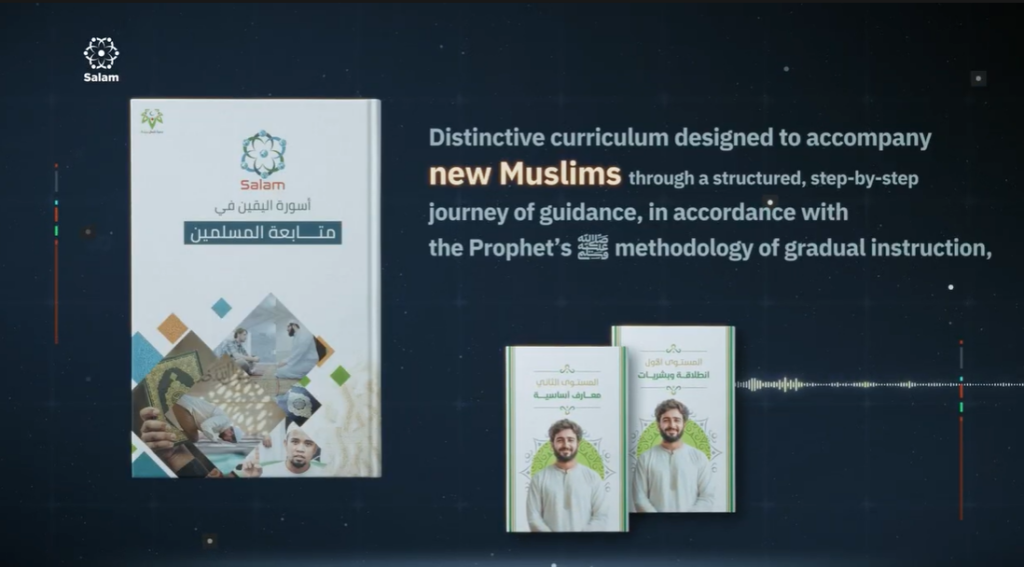
For those who have already taken their shahada, the Salam Center team offers structured post-conversion support through Asawirat Al-Yaqeen (Bracelets of Certainty), a four-stage program built specifically for new Muslims:
- Stage One covers foundational practice — prayer, purification, and the meaning of faith’s declaration
- Stage Two addresses repentance and the life of the Prophet Muhammad (PBUH)
- Stage Three focuses on personal conduct, family life, and daily ethics
- Stage Four engages contemporary questions and theological depth
Whatever stage you’re at — curious, convinced, or newly practicing — there’s a place to start.
Reach out directly to the Salam Center team to start the Asawirat Al-Yaqeen (Bracelets of Certainty) program for FREE.
Summary
Verses describing combat in the Quran address specific historical conflicts involving broken treaties and active aggression, never blanket permission to kill based on religious identity. Authenticated hadith reinforce this by explicitly prohibiting the killing of women, children, and non-combatants, while Quran 5:32 frames unjust killing as equivalent to destroying all of humanity.
Reading these texts accurately requires attending to their revealed context rather than isolated fragments quoted by critics or extremists alike. Approaching the Quran on its own terms — verse alongside verse, ruling alongside restriction — reveals a framework built on justice, proportion, and the sanctity of life, not indiscriminate violence toward anyone outside the faith.
Frequently Asked Questions
Does the Quran say to kill all non-Muslims?
No. No verse commands killing non-Muslims as a category. Combat verses like Quran 9:5 address specific treaty-breaking combatants during the early Islamic period, with treaty-keepers explicitly exempted in the preceding verse, Quran 9:4.
What is the Sword Verse in the Quran?
Quran 9:5 is commonly called the “Sword Verse.” Read alongside verses 9:1–9:7, it addresses Meccan polytheists who broke signed treaties and attacked Muslims first — not disbelievers generally, and not those who honored their agreements.
Do authentic hadiths prohibit killing civilians?
Yes. Sahih Muslim 1744 records the Prophet Muhammad (PBUH) explicitly forbidding the killing of women and children, a ruling repeated across Sahih al-Bukhari, Sunan Abi Dawud, and other authenticated collections, and upheld unanimously across the four Sunni schools of law.
Does the Quran value human life as sacred?
Yes, explicitly. Quran 5:32 states that unjustly killing one soul is equivalent to killing all of humanity, a principle framed as decreed by Allah for the Children of Israel and reaffirmed as a universal value within the Quran itself.
Curious about Islam?
Journey towards clarity and purpose. Our team is here to support you in your search for truth and spiritual guidance.
Embrace the Truth