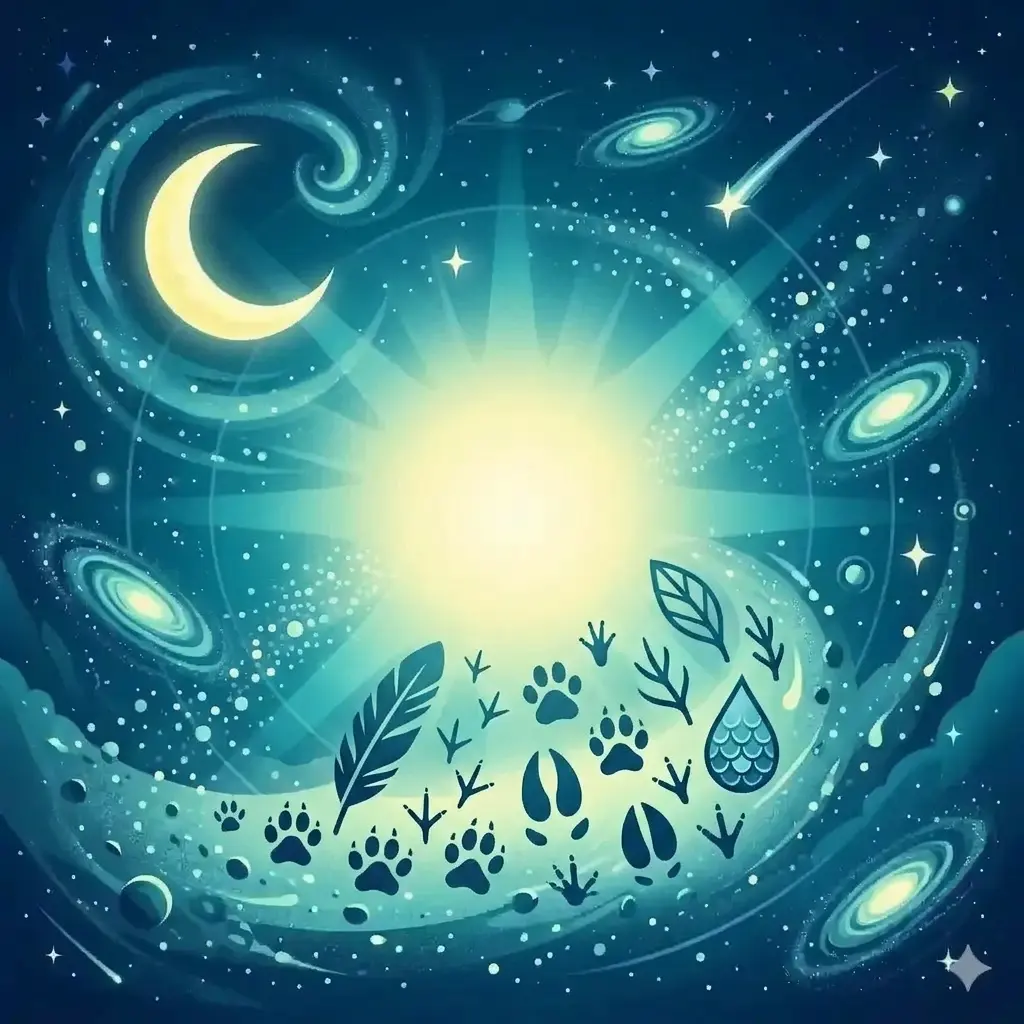
Do Animals Believe In Allah?
| Key Takeaways |
| In Islam, every creature in existence — from the largest whale to the smallest ant — exists in a state of continuous submission and worship of Allah. |
| The Quran uses the word tasbih (glorification) to describe a universal act of worship that encompasses all living beings, including animals. |
| Animals operate within a divinely assigned nature called fitra — an innate orientation toward Allah that requires no rational choice, because it is woven into their very existence. |
| Islamic theology distinguishes between the worship of rational beings (humans and jinn), who are accountable for their choices, and the worship of creation at large, which is instinctive and constant. |
The question feels philosophical at first glance — do animals believe in Allah? Do birds and wolves and fish have any connection to the divine? The Islamic answer is goes far deeper than most people expect.
Animals do not believe in Allah the way a conscious human chooses to have faith. Their relationship with their Creator is more fundamental than belief. It is built into the fabric of their existence. They submit. They glorify. They worship — not through words or rituals, but through the very fact of being what they are, doing what they were created to do.
This is one of the most profound dimensions of the Islamic worldview: the universe is not a collection of indifferent matter with a few spiritually conscious beings scattered through it. The entire creation — animate and inanimate alike — exists in an unbroken state of worship. Animals are not on the outside of this reality. They are among its most faithful participants.
Do Animals Believe in Allah?
Yes, animals believe in Allah. Animals, in the Islamic worldview, exist in an unbroken state of glorification and submission to Allah — a form of worship encoded into their nature and affirmed explicitly across multiple Quranic verses. Their tasbih is real, continuous, and divinely acknowledged.
The Quran Establishes That All Creation Glorifies Allah Continuously
The Quran does not leave this as an abstract idea. It states it directly, repeatedly, and without qualification.
وَإِن مِّن شَيْءٍ إِلَّا يُسَبِّحُ بِحَمْدِهِ وَلَٰكِن لَّا تَفْقَهُونَ تَسْبِيحَهُمْ
“And there is not a thing except that it exalts Allah by His praise, but you do not understand their exaltation.” (Quran 17:44)
“There is not a thing” — nothing is excluded. The trees, the rivers, the bacteria in the soil, the eagle circling above the mountain. All of them are engaged in tasbih, the ongoing glorification of Allah.
The reason humans do not comprehend it is not because it doesn’t exist — it is because the mode of that glorification is beyond ordinary human perception.
Animals are explicitly included. Several other verses make this specific:
أَلَمْ تَرَ أَنَّ اللَّهَ يَسْجُدُ لَهُ مَن فِي السَّمَاوَاتِ وَمَن فِي الْأَرْضِ وَالشَّمْسُ وَالْقَمَرُ وَالنُّجُومُ وَالْجِبَالُ وَالشَّجَرُ وَالدَّوَابُّ وَكَثِيرٌ مِّنَ النَّاسِ
“Do you not see that to Allah prostrates whoever is in the heavens and whoever is on the earth and the sun, the moon, the stars, the mountains, the trees, the moving creatures, and many of the people?” (Quran 22:18)
The Arabic word al-dawabb — translated here as “moving creatures” — refers specifically to animals. They prostrate before Allah. Their sujood is not identical to the prostration a Muslim performs in prayer, but it is real, recognized, and explicitly affirmed by the Quran itself.
This is why, when exploring the nature of Allah in Islam, the Islamic conception goes far beyond a God who simply created the universe and stepped back. Allah is in an active, living relationship with every creature He brought into being.
What Does Fitra Mean for the Animal Kingdom?
Islamic theology introduces the concept of fitra — the primordial, God-given nature with which every being is created.
1. The Innate Orientation Encoded in Every Creature
For humans, fitra is the natural inclination toward recognizing Allah, which can be distorted by upbringing, environment, or choice. For animals, something structurally similar is at work, but without the possibility of deviation.
A bird migrates across thousands of kilometers to a precise location. A bee constructs a geometrically perfect hexagonal comb. A mother wolf nurses her young with fierce, instinctive devotion.
From an Islamic standpoint, these are not mere evolutionary behaviors. They are expressions of a divinely encoded program — the animal fulfilling its role in Allah’s creation with complete fidelity.
The Prophet Muhammad (PBUH) addressed fitra in the famous narration: “Every child is born upon the fitra“ (Sahih Muslim 2658).
Scholars have extended the principle to note that animals, unlike humans, never leave their fitra. They cannot. They were not given the rational faculty that allows humans to stray from it, nor the corresponding moral accountability.
2. The Distinction Between Chosen Worship and Cosmic Worship
Here is where Islamic theology draws a line that matters enormously. The Quran speaks of two kinds of worship.
There is the worship of the rational servant — the human or jinn who understands, chooses, and submits. This is the worship of taklif, of moral obligation and divine accountability. It carries the weight of Paradise and Hell because it is freely given.
Then there is the worship of the natural world — what classical scholars call al-‘ibadah al-kawniyyah, cosmic or existential worship. Animals belong to this category. Their worship is not chosen; it is constitutional. It flows from what they are, not from any deliberation they make.
Ibn al-Qayyim al-Jawziyyah, the 14th-century scholar and student of Ibn Taymiyyah, explored this distinction at length in his work Miftah Dar al-Sa’adah. He described the universe as a vast community of worshippers — each category of creation glorifying Allah according to its nature and capacity, with no hierarchy of spiritual worth implied.
Have Questions About Islam?
Our team is ready to answer your questions clearly and respectfully. Ask freely and receive honest guidance.
Ask Us NowAnimals in the Quran and Sunnah as Witnesses to Divine Reality
The Quran does not treat animals as background scenery. Several animals appear as active participants in significant Quranic events, endowed with communication, perception, and purposeful action.
1. The Hoopoe, the Ant, and the Bee
The hoopoe (hudhud) in Surah An-Naml brought Prophet Sulayman (AS) intelligence about the Queen of Sheba’s people and their worship of the sun instead of Allah — demonstrating an awareness of tawhid (monotheism) that put some humans to shame.
The ants in the same surah warned their community of Sulayman’s approaching army, displaying social intelligence and organized existence.
The Quran devotes an entire surah, An-Nahl (The Bee), to the bee — presenting it as a direct recipient of divine instruction:
وَأَوْحَىٰ رَبُّكَ إِلَى النَّحْلِ أَنِ اتَّخِذِي مِنَ الْجِبَالِ بُيُوتًا وَمِنَ الشَّجَرِ وَمِمَّا يَعْرِشُونَ
“And your Lord inspired the bee, ‘Take for yourself among the mountains, houses, and among the trees and in that which they construct.'” (Quran 16:68)
The word used is awha — inspiration, divine communication. The bee receives a form of guidance directly from Allah. The result is honey: a substance the Quran describes as containing healing for humanity.
The bee worships through its work, and that work serves creation. This is the architecture of Islamic theology around animals — purposeful, connected, divinely embedded.
2. Animals Hear What Humans Cannot
A powerful Hadith establishes that the spiritual reality animals inhabit is more active than human senses reveal:
“When a rooster crows, it has seen an angel. When a donkey brays, it has seen a devil.” (Sahih Bukhari 3303)
This narration tells us something significant. Animals perceive dimensions of spiritual reality that fall outside ordinary human sight.
They operate within a world that is simultaneously physical and profoundly spiritual — aware of the presence of angels, responsive to the unseen. Their glorification of Allah is not a poetic figure of speech. It happens in a real, experiential context.
This understanding is inseparable from the broader question of faith in Islam — which recognizes that the unseen (al-ghayb) is real, vast, and populated with realities that transcend ordinary human perception.
Read also: How to Believe in God?
Animals Will Be Gathered on the Day of Judgment
One of the most remarkable — and least widely known — aspects of the Islamic position on animals is that their story does not end at death.
A Detail That Most People Have Never Heard
The Prophet Muhammad (PBUH) described what will happen to animals on the Day of Judgment:
“Rights will be restored to their owners on the Day of Resurrection, even the hornless sheep will receive justice from the horned sheep.” (Sahih Muslim 2582)
Animals will be resurrected. Justice will be administered between them. A sheep that was wronged by another in this world will receive recompense before Allah.
Then, once divine justice has been fulfilled, they will return to dust — since they carry no moral accountability requiring eternal consequence.
But their resurrection itself is a statement: they matter. Their lives, their suffering, their existence before Allah — it is all recorded and it all counts.
This places animals within the full moral and spiritual architecture of the Islamic worldview. They are not merely resources for human use. They are beings with a standing before their Creator.
Read also: I Believe In God But Not Christianity Or Jesus
Islam’s View of Animals Sets It Apart from Both Materialism and Mythology
Western secular materialism tends to view animals as sophisticated biological machines — products of evolutionary processes with no inherent spiritual dimension.
Animals in Islam’s View Neither Soulless Objects nor Gods
Ancient mythologies went to the opposite extreme, sometimes deifying animals as gods or manifestations of divine power.
Islam stakes a position that is distinct from both. Animals are created beings, not divine. They will never be worshipped — monotheism in Islam is absolute, and directing any act of worship toward a creature is shirk (associating partners with Allah), the gravest of all errors.
But neither are animals spiritually empty. They are worshippers. They are a community with a relationship to their Creator. They will stand, in some form, before Allah on the Last Day.
This framework also shapes how Muslims treat animals. The Prophet (PBUH) warned severely against cruelty:
“A woman entered Hellfire because of a cat — she neither fed it nor let it go free to eat from the earth.” (Sahih Bukhari 3482)
An animal’s worship of Allah does not make it sacred in a way that prohibits its use by humans for food, labor, or benefit — Islam permits these clearly. But it does mean that cruelty, neglect, and abuse of animals carry real moral weight, because the animal being harmed is a worshipper of Allah.
The Oxford Centre for Islamic Studies has noted in its research on Islamic environmental ethics that this theological grounding — the understanding of creation as a worshipping community — provides a uniquely coherent foundation for animal welfare and environmental stewardship, one that is not dependent on the shifting frameworks of secular ethics.
Have Questions About Islam?
Our team is ready to answer your questions clearly and respectfully. Ask freely and receive honest guidance.
Ask Us NowRead also: 12 Quotes About Believing in Allah
Explore Further Authentic Knowledge About Islam with Salam
If this article opened a door for you, there is much more to explore. The Salam blog covers a wide range of topics — from Islamic theology and ethics to answers on the most frequently asked questions about the Prophet Muhammad (PBUH) and the Quran.
You can explore the Salam Platform at your own pace, following whatever questions feel most pressing to you.
If you have a specific question not addressed here — whether about Islam’s view of creation, how to take your first steps toward the faith, or simply something you’ve been curious about — Reach out directly. Someone will respond with care and without judgment.
Frequently Asked Questions
Do animals have souls in Islam?
Yes, animals possess a form of soul (ruh) in Islam — though Islamic scholars distinguish between the human soul, which carries moral accountability and the potential for eternal consequence, and the animal soul, which does not. Ibn al-Qayyim al-Jawziyyah discussed this distinction in his works, noting that animals will be resurrected on the Day of Judgment for justice to be administered between them, after which they return to dust. Their soul is real enough to sustain worship and to give their lives standing before Allah, but it does not carry the weight of the obligations placed on humans.
Are animals held accountable by Allah for their actions?
Animals are not morally accountable (mukallaf) in the Islamic sense. Accountability in Islamic theology requires rational capacity (’aql) and the ability to choose between obedience and disobedience. Animals were not given this faculty. They act entirely within their divinely assigned nature, which means they cannot sin and are not subject to punishment. However, justice between animals themselves will be administered on the Day of Judgment — a sheep wronged by another will receive recompense — before they are returned to dust.
Does Islam teach that animals pray or worship Allah?
Yes — the Quran states explicitly that animals perform sujood (prostration) before Allah and engage in tasbih (glorification). This worship is not identical in form to human prayer, but it is real worship conducted in modes appropriate to each creature’s nature. As Quran 22:18 confirms, moving creatures (al-dawabb) are among those who prostrate to Allah. The Prophet (PBUH) also described roosters as crowing when they see angels — indicating that animals inhabit a spiritually active reality and respond to it directly. This is consistent with the broader understanding of Allah in Islam as the Lord of all creation, not merely of humanity.
Why doesn’t Islam consider animals equal to humans spiritually?
Islam places humans in a position of khilafah — stewardship and moral trusteeship over the earth — because humans were given reason, choice, and prophetic guidance. This is a responsibility, not simply a privilege. Animals occupy a different but equally purposeful role: they worship through their nature, serve the ecosystem, and reflect divine wisdom in their design. The Quran explicitly describes humans as being given a special trust (amanah) that the heavens, earth, and mountains declined to bear (Quran 33:72). Animals are not lesser worshippers — they are complete worshippers within their own category. Ranking is not the framework; purpose is.
Does the Islamic view of animals have any connection to environmental ethics?
The Islamic view of animals as worshippers carries direct implications for how creation should be treated. Cruelty to animals is a serious moral failing in Islam — the Prophet (PBUH) warned that a woman entered Hell for imprisoning a cat until it died (Sahih Bukhari 3482). If animals are worshippers of Allah, harming them without necessity carries a weight that secular frameworks struggle to articulate.
Are there animals mentioned by name in the Quran?
Multiple animals appear by name in the Quran, often in spiritually significant roles. The bee receives divine inspiration (wahy) in Surah An-Nahl. The hoopoe conveys prophetic intelligence in Surah An-Naml. The ants communicate and warn their community. A crow teaches humanity its first burial rite in Surah Al-Ma’idah. A whale shelters Prophet Yunus (AS) at a moment of divine mercy. These appearances are not incidental. They demonstrate that animals are active participants in the divine narrative — not passive elements of human backstory.
Curious about Islam?
Journey towards clarity and purpose. Our team is here to support you in your search for truth and spiritual guidance.
Embrace the Truth