
I Believe In God But Not Christianity Or Jesus
| Key Takeaways |
| Believing in one God while rejecting the Trinity and the divinity of Jesus is precisely the theological position Islam has held since its revelation 1,400 years ago. |
| Islam teaches that Jesus (Isa, peace be upon him) was a noble prophet and messenger of Allah — honored, not divine, and never crucified according to the Quran. |
| The Quran explicitly affirms that Allah is singular, without partners, sons, or equals — a concept called Tawhid, the absolute oneness of Allah. |
| Islam views the Bible as a previously revealed scripture that has undergone human alteration over centuries, which explains the doctrinal differences between its current form and Quranic revelation. |
| Millions of people worldwide have arrived at Islam precisely from the position you are in — believing in one God but finding the Christian theological framework unconvincing. |
You already believe in God. You sense that something vast and purposeful underlies all of existence — a Creator, a Sustainer, an ultimate reality behind everything you see. But when you look at Christianity, the theology doesn’t hold.
The Trinity feels philosophically tangled. The idea that God became a man, died, and rose again to forgive humanity’s sins — it doesn’t sit right with you. And Jesus, however admirable a figure, doesn’t seem to be God.
That intuition has a name.
In Islamic theology, it’s called fitrah — the innate, uncorrupted disposition with which every human being is born, oriented naturally toward the oneness of Allah. The Quran states:
فَأَقِمْ وَجْهَكَ لِلدِّينِ حَنِيفًا ۚ فِطْرَتَ اللَّهِ الَّتِي فَطَرَ النَّاسَ عَلَيْهَا
“So direct your face toward the religion, inclining to truth. [Adhere to] the fitrah of Allah upon which He has created [all] people.” (Quran 30:30)
Islam doesn’t ask you to abandon your belief in God — it asks you to complete it.
The Theological Position You Already Hold Has a Name in Islam
The belief that Allah is one — absolutely, completely, without division or partner — is called Tawhid. It is the single most foundational concept in Islam, and it is precisely the belief you are already articulating when you say you believe in God but cannot accept the Trinity or the divinity of Jesus.
Monotheism in Islam is not simply a theological preference among options. The Quran frames Tawhid as the primordial truth — the message every prophet in human history was sent to deliver.
Abraham declared it. Moses declared it. Jesus declared it. And Muhammad (PBUH) declared it as the final, uncorrupted restatement of that same eternal message.
The Quran puts it with remarkable directness:
قُلْ هُوَ اللَّهُ أَحَدٌ اللَّهُ الصَّمَدُ لَمْ يَلِدْ وَلَمْ يُولَدْ وَلَمْ يَكُن لَّهُ كُفُوًا أَحَدٌ
“Say, ‘He is Allah, [who is] One, Allah, the Eternal Refuge. He neither begets nor is born, nor is there to Him any equivalent.'” (Quran 112:1–4)
Four verses. The entire doctrine of divine oneness, laid out with the kind of precision a philosopher and a child can both understand.
Allah does not beget a son.
Allah has no equal.
Allah depends on nothing and nothing is comparable to Him.
If that resonates with what you already believe, you are closer to Islam than you may realize.
Why Islam Rejects the Divinity of Jesus?
Islam’s position on Jesus is one of the most misunderstood aspects of the religion among Western audiences. Rejecting the divinity of Jesus does not mean dismissing him. The Quran speaks of Jesus — called Isa ibn Maryam — with extraordinary reverence.
Jesus was born of a virgin.
Jesus performed miracles by Allah’s permission: healing the blind, raising the dead, speaking as an infant in the cradle.
The Quran calls him a Ruhun minhu — a spirit from Allah — and Kalimatullah — the Word of Allah.
Jesus is one of the five greatest prophets in Islamic tradition, known collectively as Ulul Azm (the Prophets of Firm Resolve).
And yet, precisely because of this reverence, Islam insists he was human. Allah says in the Quran:
مَّا ٱلْمَسِيحُ ٱبْنُ مَرْيَمَ إِلَّا رَسُولٌ قَدْ خَلَتْ مِن قَبْلِهِ ٱلرُّسُلُ وَأُمُّهُۥ صِدِّيقَةٌ ۖ كَانَا يَأْكُلَانِ ٱلطَّعَامَ ۗ ٱنظُرْ كَيْفَ نُبَيِّنُ لَهُمُ ٱلْـَٔايَٰتِ ثُمَّ ٱنظُرْ أَنَّىٰ يُؤْفَكُونَ
“The Messiah, son of Mary, was not but a messenger; [other] messengers have passed on before him. And his mother was a supporter of truth. They both used to eat food. Look how We make clear to them the signs; then look how they are deluded..” (Quran 5:75)
The logic here is theologically precise. If Jesus were Allah, he would be subject to none of the limitations of creation. But he ate food, he slept, he was born of a mother.
These are not the attributes of the divine. They are the attributes of a created, honored human being — which is exactly what Islam says he was.
The Quran also explicitly states that Jesus himself never claimed divinity. When asked on the Day of Judgment whether he told his followers to worship him and his mother as gods, the Quran depicts his answer:
وَإِذْ قَالَ ٱللَّهُ يَٰعِيسَى ٱبْنَ مَرْيَمَ ءَأَنتَ قُلْتَ لِلنَّاسِ ٱتَّخِذُونِى وَأُمِّىَ إِلَٰهَيْنِ مِن دُونِ ٱللَّهِ ۖ قَالَ سُبْحَٰنَكَ مَا يَكُونُ لِىٓ أَنْ أَقُولَ مَا لَيْسَ لِى بِحَقٍّ ۚ إِن كُنتُ قُلْتُهُۥ فَقَدْ عَلِمْتَهُۥ ۚ تَعْلَمُ مَا فِى نَفْسِى وَلَآ أَعْلَمُ مَا فِى نَفْسِكَ ۚ إِنَّكَ أَنتَ عَلَّٰمُ ٱلْغُيُوبِ ﴿١١٦﴾ مَا قُلْتُ لَهُمْ إِلَّا مَآ أَمَرْتَنِى بِهِۦٓ أَنِ ٱعْبُدُوا۟ ٱللَّهَ رَبِّى وَرَبَّكُمْ ۚ وَكُنتُ عَلَيْهِمْ شَهِيدًا مَّا دُمْتُ فِيهِمْ ۖ فَلَمَّا تَوَفَّيْتَنِى كُنتَ أَنتَ ٱلرَّقِيبَ عَلَيْهِمْ ۚ وَأَنتَ عَلَىٰ كُلِّ شَىْءٍ شَهِيدٌ
“And [beware the Day] when Allah will say, “O Jesus, Son of Mary, did you say to the people, ‘Take me and my mother as deities besides Allah?'” He will say, “Exalted are You! It was not for me to say that to which I have no right. If I had said it, You would have known it. You know what is within myself, and I do not know what is within Yourself. Indeed, it is You who is Knower of the unseen. (116) I said not to them except what You commanded me – to worship Allah, my Lord and your Lord. And I was a witness over them as long as I was among them; but when You took me up, You were the Observer over them, and You are, over all things, Witness. (117)” (Quran 5:117)
This is the Islamic Jesus: a prophet who submitted entirely to Allah, called people to His oneness, and was raised to Allah before his enemies could crucify him.
Honoring him means following what he actually taught — and what he actually taught, according to the Quran, was pure monotheism.
Have Questions About Islam?
Our team is ready to answer your questions clearly and respectfully. Ask freely and receive honest guidance.
Ask Us NowHow Does Islam Explain the Discrepancy Between the Bible and Pure Monotheism?
A natural question arises here: if Jesus taught monotheism, how did Christianity arrive at the Trinity? Islam has a clear, coherent answer — one that doesn’t require you to dismiss the original revelation of the Gospel, only to recognize what happened to it afterward.
Islam teaches that Allah sent revealed scriptures to various prophets — the Torah to Moses, the Psalms to David, the Gospel (Injil) to Jesus. These were genuine divine revelations in their original form.
The problem is human custodianship. Over centuries, through translation, political pressure, selective compilation, and theological agenda, those original texts were altered.
Scholars refer to this process in Islamic terminology as Tahrif — corruption or distortion of scripture.
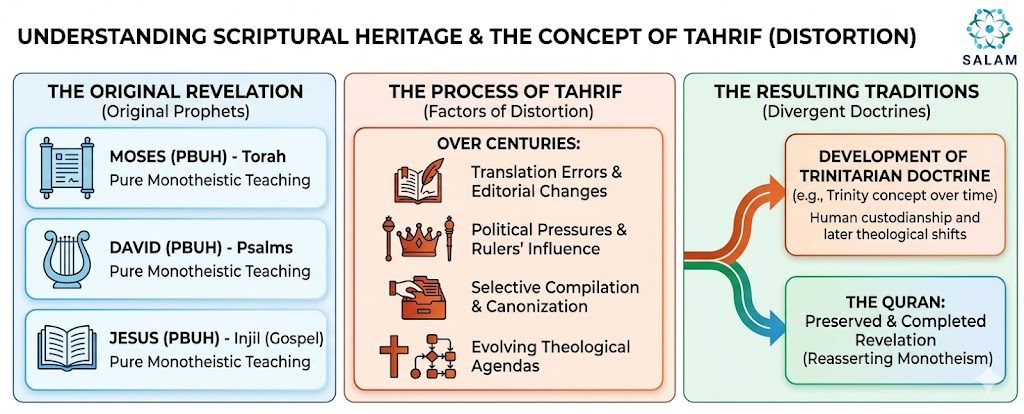
This is not a fringe position. Biblical scholars themselves — working outside any Islamic framework — have documented the textual evolution of Christian doctrine. The doctrine of the Trinity, for instance, was not formally codified until the Council of Nicaea in 325 CE, nearly three centuries after Jesus.
Scholars at institutions like the Oxford Centre for Islamic Studies and in the wider field of comparative religion have extensively examined how early Christian communities held divergent views on the nature of Jesus long before Trinitarian theology became the official orthodoxy.
Islam’s answer is the Quran — preserved with a rigor no other scripture can claim. The Quran was memorized by thousands during the Prophet’s (PBUH) lifetime, committed to writing under his direct supervision, and has remained textually identical for 1,400 years. As elaborated in the question of why Muslims believe in the Quran, its preservation is itself one of the signs of its divine origin.
Read also: How to Believe in God?
Who Allah Actually Is?
One concern people sometimes carry from a Christian background is whether the Allah of Islam is the same as the God they’ve always believed in. The answer is yes — with one critical clarification. The Arabic word Allah is simply the proper name for the one Creator. Arab Christians use the same word. It is not a different deity; it is the same God of Abraham, described with greater precision and without the theological additions that accumulated in later religious traditions.
How Islam views the nature of God is one of the most compelling aspects of the faith for people coming from monotheistic backgrounds.
Allah in Islam is not a distant, abstract philosophical concept. Allah is closer to each person than their jugular vein, as the Quran states. Allah hears. Allah responds. Allah loves those who turn to Him. Allah forgives repeatedly, without requiring an intermediary or a sacrifice.
The Prophet Muhammad (PBUH) described Allah’s mercy in terms that leave little room for ambiguity. In an authenticated Hadith recorded in Sahih Muslim, he said:
“Allah is more loving and kinder to His servants than a mother to her child.”
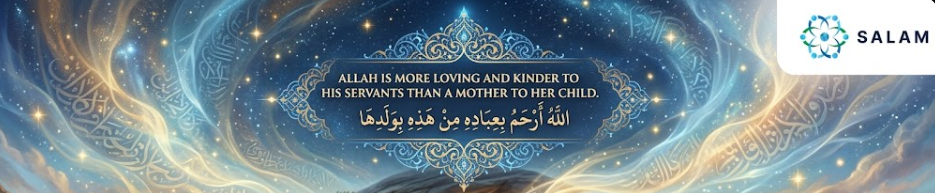
The relationship Islam envisions between a human being and their Creator is direct, personal, and profoundly merciful.
There are no priests to mediate that relationship. No confessional booth. No institutional structure standing between you and Allah. You speak to Him directly — in prayer, in private supplication, in moments of gratitude or distress. That directness is a defining feature of Islamic spirituality.
Read also: Do Animals Believe In Allah?
Islam’s View of Other Religions and Where You Currently Stand
Islam does not view all religions as equally valid paths to the same destination. But it does view sincere monotheists — people who believe in one God and live with moral integrity — with profound respect.
The Quran distinguishes carefully between different religious communities, and the category of Ahl al-Kitab (People of the Book) — which includes Jews and Christians — is treated with a level of theological seriousness absent from how Islam regards polytheism.
Your current position is, from an Islamic perspective, genuinely significant. You have arrived at the truth of divine oneness through your own reflection. You have rejected what Islam would call Shirk — the association of partners with Allah — even within a religious tradition that surrounds you. That is not a small thing.
Understanding how Islam views other religions helps clarify this: Islam’s concern with Christianity is not with its ethical teachings or its reverence for Jesus, but with the theological overlay — the Trinity, the incarnation, the atonement — that Islam holds to be human additions obscuring the original monotheistic message.
The question Islam puts to you is straightforward. You already believe Allah is one. You already reject the idea that He has a son. The next step is simply to ask: what did Allah reveal, and through whom? That question leads directly to the Prophet Muhammad (PBUH) and the Quran.
Read also: 12 Quotes About Believing in Allah
What Does Entering Islam Require?
The act of entering Islam is the Shahada: the testimony that there is no god but Allah, and that Muhammad is His messenger. Spoken sincerely, from the heart, with genuine conviction, this declaration is the doorway. That’s it.
The principles of Islam elaborate what follows — prayer, fasting, charity, pilgrimage — but these are the practices that grow from a living faith, not prerequisites for entry. The Prophet (PBUH) said, as recorded in Sahih Bukhari: “Islam is built upon five [pillars]…” — and the Shahada is the first and foundational one. Everything else builds on it.
What Islam asks of you, practically, is to direct your worship entirely toward Allah — without intermediary, without image, without partner.
Five daily prayers. A life oriented consciously toward your Creator. A moral framework that is comprehensive, humane, and grounded in divine wisdom rather than cultural trend.
For someone who already believes in one God and already finds the Christian theological framework unconvincing, the distance is shorter than it might appear.
Understand Faith in Islam Beyond Ritual
One aspect of Islam that surprises many people approaching it from outside is the depth of its conception of Iman — faith. Faith in Islam is not simply a declaration or a feeling. It is a compound of conviction in the heart, affirmation on the tongue, and expression in action. These three dimensions reinforce each other.
Faith in Islam encompasses belief in Allah, His angels, His revealed books, His messengers, the Day of Judgment, and divine decree. It is a comprehensive worldview — an orientation toward all of reality, not just a private spiritual opinion.
A Muslim doesn’t compartmentalize faith into Sunday morning. It runs through everything: how they speak, how they deal with others, how they respond to hardship.
The great medieval scholar Ibn Qayyim al-Jawziyyah wrote extensively on the relationship between Tawhid and human flourishing, arguing that orienting the heart toward the oneness of Allah is not merely a religious obligation but the deepest source of psychological peace and meaning available to a human being.
When a person’s worship is undivided, their inner life becomes coherent in a way that divided or confused worship cannot produce.
This is the invitation Islam extends. You sense it already — the belief in something ultimate, singular, and real. Islam gives that intuition a complete, coherent, and livable form.
Have Questions About Islam?
Our team is ready to answer your questions clearly and respectfully. Ask freely and receive honest guidance.
Ask Us NowContinue Your Journey With Salam
If what you’ve read here resonates, there’s much more to explore.
The Salam blog covers the full range of questions people bring to Islam — from theology and history to misconceptions and personal stories of people who’ve walked exactly the path you’re walking now.
Browse at your own pace. Read what speaks to you. There’s no pressure, no timeline, and no prerequisite belief required to engage.
If you have a specific question — about theology, about prayer, about what entering Islam involves, or about anything else the article didn’t address — Reach out directly. Real people respond, and no question is too basic or too challenging to ask.
The Salam Platform exists for exactly this moment — when a person is thinking seriously about God and wants honest, grounded answers.
Frequently Asked Questions
Can someone believe in God and still find a place in Islam without accepting Jesus as divine?
Yes — and in fact, rejecting the divinity of Jesus is a prerequisite for Islamic monotheism, not an obstacle to it. Islam holds that Jesus was one of the greatest prophets ever sent, but attributing divinity to any created being constitutes Shirk, the one category of wrong that Allah has declared He will not forgive if a person dies upon it (Quran 4:48).
Someone who believes in one God and rejects the divinity of Jesus is already aligned with the central theological pillar of Islam. The path forward is simply to affirm that alignment explicitly through the Shahada.
Is the God of Islam the same God that Christians and Jews worship?
No, Islam insists God has no son, no partner, no physical form, and no need for incarnation. These are additions Islam holds were introduced into Christian theology centuries after Jesus — not part of the original revelation he delivered. Jews, Christians, and Muslims all trace their theological lineage to Abraham, which is why the Quran addresses all three traditions with theological seriousness.
What does Islam actually say the Gospel of Jesus taught?
Islam teaches that the original Injil — the Gospel revealed to Jesus — was a pure monotheistic message. Jesus called his people to worship Allah alone, follow the divine law, and prepare for the Day of Judgment. The Quran quotes him saying, in his own words, that his message was to worship "Allah, my Lord and your Lord" (Quran 5:117). Islam holds that this original revelation was subsequently altered through human transmission — a process documented even within Western biblical scholarship.
What Christians have today is not the original Gospel but a later literary and theological construct that absorbed Hellenistic philosophical categories, including ideas about divine personhood and the nature of the logos that were foreign to the original Semitic monotheistic context.
How is the Quran different from the Bible, and why do Muslims trust it so completely?
The Quran’s preservation is one of the strongest arguments for its divine origin. From the moment of its revelation, it was memorized verbatim by thousands of companions, recited publicly in the Prophet’s (PBUH) presence for correction, and committed to writing under his direct supervision. Today, millions of Muslims worldwide — huffaz — have memorized the entire text.
There is one version of the Quran in the world, in one language, with no competing manuscripts containing substantive textual variants. The contrast with the Bible — which exists in thousands of manuscript variants, translated through multiple languages, compiled through contested canonical processes — is stark.
This is why Muslims speak of the Quran not as a human record of revelation but as the direct, preserved word of Allah. You can explore this further in the question of what Muslims believe about the Quran.
Where does someone start if they want to learn more about Islam from this position?
Start with the Quran itself — specifically Surah Al-Ikhlas (Chapter 112), which is four verses and encapsulates the entire doctrine of divine oneness. Then explore the Seerah — the life of the Prophet Muhammad (PBUH) — to understand the human being through whom this revelation came.
Engage with the core principles of Islamic belief to understand what the faith actually asks of you intellectually and practically. And ask questions directly — Islam has no clergy class that mediates access to knowledge. Any serious student of the tradition can speak with you. The position you’re already in — believing in one God, rejecting theological additions — is a profoundly honest starting point.
Curious about Islam?
Journey towards clarity and purpose. Our team is here to support you in your search for truth and spiritual guidance.
Embrace the Truth