
How to Believe in God?
| Key Takeaways |
| Believing in Allah begins with honest intellectual inquiry — not blind acceptance — and Islam actively encourages this. |
| The Quran presents rational arguments for Allah’s existence drawn from observable creation, not from mythology or tradition alone. |
| Moving from intellectual acknowledgment to sincere conviction requires engaging the heart, not just the mind. |
| The Islamic concept of Tawhid — the absolute oneness of Allah — resolves philosophical contradictions that polytheism and atheism cannot answer. |
| Genuine faith in Islam is a living state, built and maintained through deliberate practice, reflection, and community. |
The question of how to believe in Allah, or what believing in Allah actually means in Islam, deserves a serious answer. Many people encounter the phrase “belief in God” and assume it refers to a vague spiritual sentiment — a feeling, perhaps, or a cultural habit. In Islam, it is something far more precise, far more demanding, and far more liberating.
This article walks through what this belief means, what it requires, what it rests on, and how anyone — regardless of their background — can arrive at it.
Believe in God in Islam
Muslims believe in one God — Allah — with an uncompromising, undiluted conviction that sits at the center of every practice, every prayer, and every moral decision in a Muslim’s life.
The Arabic word Allah is not a tribal name for a regional deity. It is the proper name of the one Creator of all existence, the same God that Abraham, Moses, and Jesus called upon — a point the Quran makes explicitly and repeatedly.
1. Examine What You Already Assume About Belief
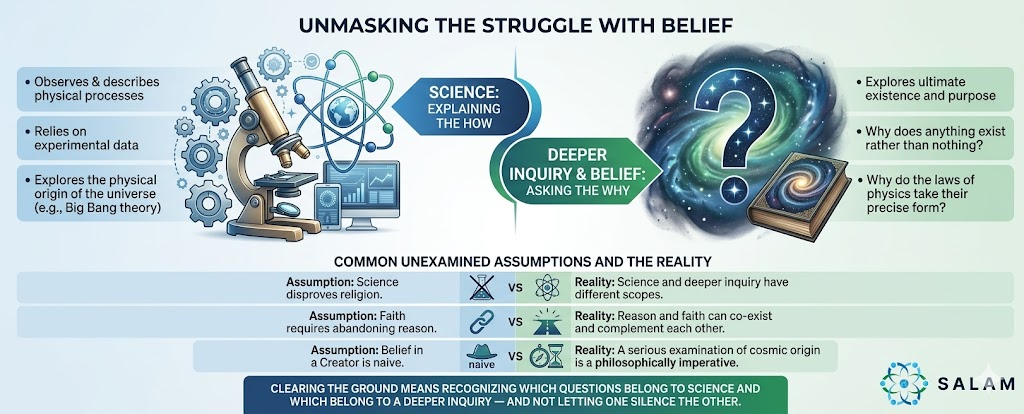
Most people who struggle with belief are not actually struggling with the evidence. They are struggling with assumptions they picked up without ever choosing them — that science has disproved religion, that faith requires abandoning reason, or that believing in a Creator is somehow intellectually naive.
None of these assumptions survive serious examination. Science describes how natural processes work. The question of why anything exists at all — why there is something rather than nothing — falls entirely outside its scope.
A physicist can describe the Big Bang in extraordinary detail and still have no answer to why the laws of physics exist, why they take the precise form that permits life, or why matter and energy appeared in the first place.
The philosopher and cosmologist are confronted here with a question that the laboratory cannot answer. Clearing the ground means recognizing which questions belong to science and which belong to a deeper inquiry — and not letting one silence the other.
2. Follow the Argument From Creation to a Creator
Once the intellectual space is open, the primary argument presents itself naturally. Everything that exists and had a beginning had a cause. The universe had a beginning — this is the consensus of modern cosmology, confirmed by the expansion of the universe and corroborated by the Big Bang model. If the universe began, something outside it caused it to begin.
That cause must be uncaused — eternal — otherwise you simply push the question back without answering it. It must be immensely powerful, since it brought all of physical existence into being.
And it must be in some sense volitional — capable of choosing to create — because a mindless force governed by physical laws cannot precede the physical laws themselves.
The Quran articulates this with striking economy:
أَمْ خُلِقُوا مِنْ غَيْرِ شَيْءٍ أَمْ هُمُ الْخَالِقُونَ
“Were they created by nothing, or were they themselves the creators?” (Quran 52:35)
The verse simply names the only two alternatives to a Creator and lets the reader recognize their absurdity. Both are rationally untenable. This is the Quran addressing the intellect directly, not demanding submission before understanding.
3. Look at the Design Embedded in Creation
The argument from existence leads naturally to a second observation: the universe is not merely here, it is calibrated with breathtaking precision for the existence of conscious life. Physicists call this the fine-tuning problem.
The fundamental constants of nature — the strength of gravity, the charge of electrons, the ratio of matter to antimatter after the Big Bang — are set to values so exact that any significant deviation would produce a universe of nothing but diffuse gas, or one that collapsed before a single star could form.
This is not a religious claim invented to support belief. It is a recognized puzzle in theoretical physics, discussed in departments at institutions like Oxford’s Faculty of Philosophy and the University of Cambridge’s Department of Applied Mathematics and Theoretical Physics.
The Quran invites exactly this kind of observation:
إِنَّ فِي خَلْقِ السَّمَاوَاتِ وَالْأَرْضِ وَاخْتِلَافِ اللَّيْلِ وَالنَّهَارِ لَآيَاتٍ لِّأُولِي الْأَلْبَابِ
“Indeed, in the creation of the heavens and the earth and the alternation of the night and the day are signs for those of understanding.” (Quran 3:190)
The Arabic word ayat — signs — is the same word used for the verses of the Quran itself. Creation and revelation are parallel modes of communication from the same Source.
Have Questions About Islam?
Our team is ready to answer your questions clearly and respectfully. Ask freely and receive honest guidance.
Ask Us Now4. Understand Who Allah Is
Believing in a creator is only the first threshold. The question then becomes: what is this Creator like? Here, Islam’s answer is unique and philosophically rigorous. Tawhid — the absolute, undivided oneness of Allah — is not simply a theological preference. It is the only logically coherent position.
Multiple gods, each with distinct wills, would produce conflict — the universe would reflect that contradiction in its laws, yet the laws of physics are seamlessly unified.
A god who is part of creation cannot have created it.
A god with human-like needs or limitations is not the uncaused cause the argument from existence demands.
The Quran summarizes what the mind, pushed to its conclusions, arrives at:
قُلْ هُوَ اللَّهُ أَحَدٌ اللَّهُ الصَّمَدُ لَمْ يَلِدْ وَلَمْ يُولَدْ وَلَمْ يَكُن لَّهُ كُفُوًا أَحَدٌ
“Say, ‘He is Allah, [who is] One, Allah, the Eternal Refuge. He neither begets nor is born, nor is there to Him any equivalent.'” (Quran 112:1–4)
This is why the nature of Allah in Islamic theology is not described through images or metaphors that diminish Him to human scale.
Allah is beyond analogy — and that beyondness is itself a mark of intellectual honesty about what the First Cause must actually be.
For those familiar with the comparative question, understanding how Islam views the beliefs of other religious traditions can also clarify what makes the Islamic conception of Allah distinctive and why it matters.
5. Engage the Fitrah — The Inner Witness
The Arabic concept of Fitrah refers to the innate human disposition toward recognizing a Creator. The Prophet Muhammad (PBUH) described it clearly:
“Every child is born upon the Fitrah (i.e. to worship none but Allah Alone), then his parents make him a Jew, a Christian, or a Magian.” (Sahih al-Bukhari, Hadith 1358)
This is a profound psychological observation. The instinct to recognize something greater than the self — the sense that existence has meaning, that injustice demands an ultimate reckoning, that beauty points beyond itself — is not culturally programmed. It is prior to culture. It is what the child has before the world begins to layer its interpretations on top.
Engaging the Fitrah means quieting the noise long enough to hear it. Spend time in a natural environment with no agenda. Sit with the question of your own existence — not anxiously, but with genuine curiosity.
Many people who have committed to this kind of honest introspection report that the sense of a Creator’s presence was already there, waiting beneath the layers.
This is the meeting point of reason and heart — and in Islam, both matter. Faith in Islam is Iman with the heart, affirmation with the tongue, and action with the limbs. All three dimensions are engaged progressively, beginning here.
Read also: Do Animals Believe In Allah?
6. Engage the Quran as Evidence
The intellectual case for a Creator is strong. But what makes Islam specifically compelling — beyond theism in general — is the Quran. Approaching it as evidence means reading it with the same critical attention you would give any extraordinary claim.
The Quran was revealed to an illiterate man in 7th-century Arabia, in a culture with no tradition of monotheistic scripture.
It contains descriptions of embryonic development, atmospheric phenomena, and cosmological realities that were not part of any available human knowledge at the time of its revelation.
More than that, its literary form is itself an argument — the Quran openly challenges any who doubt its divine origin to produce even a single chapter comparable to it, a challenge that has stood for fourteen centuries.
وَإِن كُنتُمْ فِي رَيْبٍ مِّمَّا نَزَّلْنَا عَلَىٰ عَبْدِنَا فَأْتُوا بِسُورَةٍ مِّن مِّثْلِهِ
“And if you are in doubt about what We have sent down upon Our Servant, then produce a surah the like thereof.” (Quran 2:23)
This challenge — the Tahaddi — is unique in the history of religious texts. The Quran presents itself as self-evidencing. You can explore what Muslims believe about the Quran and why Muslims find the Quran convincing as a divine text as part of this step.
Read also: I Believe In God But Not Christianity Or Jesus
7. Move From Knowledge to Conviction Through Practice
Knowing about Allah and knowing Allah are two different states. The movement from the first to the second happens through practice — not through waiting for certainty to arrive on its own.
The Prophet Muhammad (PBUH) said:
“Whoever loves for Allah’s sake, hates for Allah’s sake, gives for Allah’s sake, and withholds for Allah’s sake has perfected faith.” (Sunan Abi Dawud, Hadith 4681)
This tells you something important: faith grows through action. Begin speaking to Allah directly — in whatever language is natural to you — with honesty and without performance. Ask Him to increase your certainty.
This is itself a form of Dua (supplication), and the Quran records that Ibrahim (Abraham), peace be upon him, one of the greatest believers in history, made precisely this request:
رَبِّ أَرِنِي كَيْفَ تُحْيِي الْمَوْتَىٰ ۖ قَالَ أَوَلَمْ تُؤْمِن ۖ قَالَ بَلَىٰ وَلَٰكِن لِّيَطْمَئِنَّ قَلْبِي
“‘My Lord, show me how You give life to the dead.’ He said, ‘Have you not believed?’ He said, ‘Yes, but [I ask] only that my heart may be satisfied.'” (Quran 2:260)
The request for deeper, settled conviction — Tuma’ninah — is itself honored in the Quran. Seeking certainty is not a sign of weak faith; it is part of the journey.
Read also: 12 Quotes About Believing in Allah
8. Declare the Testimony of Faith and Enter Islam
If the journey through these steps has brought you to genuine conviction — if your intellect is satisfied, your heart is moved, and you want to formalize your submission to Allah — the act of entering Islam is simple and profound.
The Shahada, the declaration of faith, consists of two affirmations:
أَشْهَدُ أَنْ لَا إِلَٰهَ إِلَّا اللَّهُ وَأَشْهَدُ أَنَّ مُحَمَّدًا رَسُولُ اللَّهِ
Ash-hadu an la ilaha illa Allah, wa ash-hadu anna Muhammadan rasulu Allah.
“I bear witness that there is no deity worthy of worship except Allah, and I bear witness that Muhammad is the Messenger of Allah.”
Spoken sincerely, with full understanding and conviction, this declaration makes a person Muslim. The Prophet (PBUH) described the effect of sincere faith:
“If anyone testifies that none has the right to be worshipped but Allah Alone Who has no partners, and that Muhammad is His slave and His Apostle, and that Jesus is Allah’s slave and His Apostle and His Word… Allah will admit him into Paradise.” (Sahih al-Bukhari, Hadith 3435)
This is the gateway. Everything that follows — the five pillars, the Sunnah, the community, the ongoing growth in Iman — builds from here. Understanding the core principles of Islam and what Muslims believe as a next step will give the new believer a comprehensive foundation.
The Islamic scholarly tradition, preserved through institutions like Al-Azhar University in Cairo — the oldest continuously operating university in the world and the foremost center of Sunni Islamic scholarship — has guided millions through this transition across fourteen centuries. That tradition is fully available to you.
Have Questions About Islam?
Our team is ready to answer your questions clearly and respectfully. Ask freely and receive honest guidance.
Ask Us NowContinue Your Journey to Believe in God with Salam
If this article has opened something in you — a question, a curiosity, or the beginning of a conviction — there is much more to explore.
The Salam blog carries in-depth articles on Islamic belief, the nature of Allah, the Quran, the life of the Prophet (PBUH), and answers to the questions that seekers most often bring.
If you have a specific question this article did not answer — or if you are considering taking the Shahada and want to speak with someone — Reach out directly. There is no pressure and no judgment. Every question is welcome.
The Salam Platform exists for exactly this moment in your journey.

Frequently Asked Questions
Can a person come to believe in Allah through reason alone, without any religious texts?
Reason alone can bring a person to conclude that a Creator exists. What revelation adds is the specific knowledge of who this Creator is, what He wills, and how to relate to Him — knowledge that reason cannot generate on its own. So reason opens the door; the Quran tells you what is on the other side.
What if I feel nothing emotionally when I try to believe — is that a problem?
Emotional feeling follows sincere action in most cases — it rarely leads. Many of the greatest figures in Islamic history, including the Companions of the Prophet (PBUH), described a gradual deepening of conviction rather than a sudden overwhelming experience. The Quran addresses exactly this: "Indeed, it is by the remembrance of Allah that hearts find rest." (Quran 13:28). The prescription is practice — prayer, reflection, Quran recitation — not waiting for feeling to arrive uninvited. Trust the process; the emotional dimension follows.
Does Islam require me to abandon science or critical thinking to believe in Allah?
Islam requires the opposite. The Quran uses the word Aql — reason and intellect — repeatedly, and directs human beings to observe, reflect, and conclude. The Prophet Muhammad (PBUH) encouraged the pursuit of knowledge. The perceived conflict between science and faith is largely a product of Western historical experience — specifically, the conflict between the Church and early European scientists — and has no equivalent origin in Islamic civilization. Islamic scholars were astronomers, physicians, mathematicians, and philosophers precisely because their faith directed them toward understanding creation. The Islamic approach to belief has always integrated reason and revelation as complementary, not competing.
How is believing in Allah different from believing in the God of Christianity or Judaism?
The three traditions share a common root — all trace their lineage to Ibrahim (Abraham), peace be upon him. But the Islamic concept of Allah differs in a critical theological dimension: absolute, uncompromised Tawhid. Islam rejects any association of partners with Allah — which includes the Christian doctrine of the Trinity — and affirms that He is entirely unlike His creation in every attribute. Monotheism in its purest form, as Islam presents it, holds that Allah has no son, no consort, no equal, and no human incarnation. This is not merely a doctrinal difference; it shapes the entire relationship between the human being and the Divine — one of direct access, with no intermediaries, clergy, or intercessors standing between you and Allah.
Is it possible to believe in Allah but not fully understand everything about Islam yet?
Absolutely. The Quran describes the early Muslim community as people whose faith grew progressively — "That they may increase in faith along with their [present] faith." (Quran 48:4). Belief is a beginning, not a completed state. Islam recognizes that human beings learn gradually, and the tradition is designed to support that gradual deepening. Beginning with sincere conviction in Allah’s oneness and the prophethood of Muhammad (PBUH) is the necessary foundation; everything else is built on top of it over a lifetime. Scholars at institutions like Al-Azhar University have written extensively on how new Muslims should approach learning — with patience, sound guidance, and step-by-step progression.
What is the difference between believing in Allah and merely believing that He exists?
The Arabic term Iman captures a distinction that English tends to blur. Believing that something exists is merely intellectual acknowledgment — even Iblis (Satan) knows Allah exists. True Iman is conviction that transforms the inner self and produces action: love for Allah, reliance on Him, fear of displeasing Him, and submission to His guidance. The Prophet (PBUH) defined the highest expression of this as Ihsan — worshipping Allah as though you see Him, and knowing that even if you do not see Him, He sees you. (Sahih Muslim, Hadith 8). The goal of this entire journey is that deeper state — not just assent, but a living relationship with the Creator.
Curious about Islam?
Journey towards clarity and purpose. Our team is here to support you in your search for truth and spiritual guidance.
Embrace the Truth