
What Does the Quran Say About Divorce?
The Quran addresses divorce with a rare combination of realism and restraint. The Quran permits divorce, but it frames the act as spiritually costly and procedurally deliberate rather than casual or convenient. Marriage in Islam is described as a covenant of tranquility, love, and mercy, and its dissolution is never treated lightly.
Surah An-Nisa opens the broader discussion of family law by insisting that men live with their wives in kindness, noting that a husband may dislike something in his wife while Allah places abundant good within it. That verse sets the tone for everything the Quran says afterward about separation: even when a marriage ends, dignity does not.
Does the Quran allow divorce in Islam?
Yes, the Quran permits divorce as a last resort in Surah Al-Baqarah 2:229, but Prophet Muhammad (PBUH) described it as the most hated of all lawful acts (Sunan Abi Dawud 2178), meaning it is legislated but never encouraged casually.
1. The Quran Establishes a Two-Stage Process for Revocable Divorce
Surah Al-Baqarah 2:229 sets the foundational rule: a husband may pronounce revocable divorce only twice, and after either pronouncement he must either keep his wife with kindness or release her with grace. This is not a technicality. It is a built-in circuit breaker against rash decisions made in anger.
الطَّلَاقُ مَرَّتَانِ ۖ فَإِمْسَاكٌ بِمَعْرُوفٍ أَوْ تَسْرِيحٌ بِإِحْسَانٍ
“Divorce is twice. Then, either keep [her] in an acceptable manner or release [her] with good treatment.” (Quran 2:229)
The First and Second Pronouncements Remain Revocable
After the first or second pronouncement of divorce, the marriage is not automatically over. The husband retains the right to take his wife back during her waiting period, and this reconciliation does not require a new marriage contract or a new dowry.
The Quran frames this window as an opportunity for genuine repair, not a loophole for control — a spouse cannot be indefinitely threatened with divorce and reconciliation as a form of harm, a point the Quran addresses directly later in Surah Al-Baqarah.
Financial Fairness Applies Throughout the Process of the Divorce
The same verse states plainly that it is not lawful for a husband to take back anything he has given his wife once divorce is pronounced, except in the specific case where the wife herself initiates separation and offers compensation.
Learn More About Islam
Discover the beauty, teachings, and wisdom of Islam in a clear and welcoming way. Start exploring and deepen your understanding today.
Learn More2. A Waiting Period Called Iddah Must Be Observed Before Divorce Is Final
Surah At-Talaq opens with a direct command from Allah regarding the timing and conduct of divorce, addressed first to the Prophet (PBUH) and through him to the entire believing community.
يَا أَيُّهَا النَّبِيُّ إِذَا طَلَّقْتُمُ النِّسَاءَ فَطَلِّقُوهُنَّ لِعِدَّتِهِنَّ وَأَحْصُوا الْعِدَّةَ
“O Prophet, when you [Muslims] divorce women, divorce them for [the commencement of] their waiting period and keep count of the waiting period” (Quran 65:1)
The iddah typically spans three menstrual cycles for women who menstruate, though the Quran specifies different durations for pregnant women (until delivery) and women past menstruation, detailed later in the same surah.
During this waiting period, the wife generally remains in the marital home, and the husband is instructed not to expel her unless she has committed a clearly established immorality.
Why the Waiting Period Exists
| Purpose of Iddah | Quranic Basis |
| Confirms whether the wife is pregnant, protecting lineage and paternity rights | Surah At-Talaq, general context |
| Provides a cooling-off period against decisions made in anger | Surah Al-Baqarah 2:228–2:229 |
| Allows reconciliation without a new marriage contract | Surah Al-Baqarah 2:229 |
| Honors the emotional and social transition of ending a covenant | Surah Al-Baqarah 2:231 |
This structure connects to the Quran’s broader claim of internal coherence, a theme covered in depth in what Muslims believe about the Quran. Every ruling on divorce ties back to protecting the family unit even while permitting its dissolution.
3. The Third Pronouncement Makes Divorce Final and Irrevocable
Once a husband has pronounced divorce three separate times across three distinct occasions, the marriage cannot be resumed by simple reconciliation. Surah Al-Baqarah 2:230 states this without ambiguity:
فَإِن طَلَّقَهَا فَلَا تَحِلُّ لَهُ مِن بَعْدُ حَتَّىٰ تَنكِحَ زَوْجًا غَيْرَهُ
“And if he has divorced her [for the third time], then she is not lawful to him afterward until [after] she marries a husband other than him.” (Quran 2:230)
This ruling is frequently misunderstood outside Islamic scholarship. It is not designed to punish the original couple or force an artificial remarriage.
Classical scholars, including those cited in the tafsir literature surrounding this verse, explain that any arrangement engineered specifically to enable reunion — sometimes called a “trickery marriage” — is explicitly condemned in authentic hadith.
The Prophet (PBUH) cursed those who arrange or participate in such fictitious contracts, according to narrations transmitted through multiple Companions.
The rule exists to make the third pronouncement genuinely weighty, discouraging the casual, repeated use of divorce as a threat.
Read Also: Is There a Punishment for Not Wearing a Hijab in the Quran?
4. Arbitration Is Commanded Before Separation When Reconciliation Seems Possible
Before divorce becomes the final answer, the Quran instructs families to attempt structured mediation. Surah An-Nisa 4:35 lays out this process directly:
وَإِنْ خِفْتُمْ شِقَاقَ بَيْنِهِمَا فَابْعَثُوا حَكَمًا مِّنْ أَهْلِهِ وَحَكَمًا مِّنْ أَهْلِهَا إِن يُرِيدَا إِصْلَاحًا يُوَفِّقِ اللَّهُ بَيْنَهُمَا ۗ إِنَّ اللَّهَ كَانَ عَلِيمًا خَبِيرًا ﴿٣٥﴾
“And if you fear dissension between the two, send an arbitrator from his people and an arbitrator from her people. If they both desire reconciliation, Allah will cause it between them. Indeed, Allah is ever Knowing and Acquainted [with all things].” (Quran 4:35)
This verse assigns responsibility to the extended family, not just the couple in isolation. One arbitrator represents the husband’s side, one represents the wife’s, and both work toward genuine reconciliation before the matter proceeds further.
The verse closes with a reassurance that Allah facilitates reconciliation when both parties sincerely desire it — reinforcing that Islamic family law treats marital conflict as something communities help resolve, not something a couple must navigate entirely alone.
This communal responsibility echoes broader Quranic teaching, discussed further in what the Quran says about other religions and its emphasis on justice extending to every layer of society.
Read Also: Beautiful Quran Verses About Marriage
5. Kindness and Fairness Govern Every Stage of Separation
The Quran repeatedly returns to a single ethical demand throughout its divorce legislation: whatever happens between a husband and wife, it must happen with fairness. Surah Al-Baqarah 2:231 restates this principle after outlining the waiting period rules:
وَإِذَا طَلَّقْتُمُ النِّسَاءَ فَبَلَغْنَ أَجَلَهُنَّ فَأَمْسِكُوهُنَّ بِمَعْرُوفٍ أَوْ سَرِّحُوهُنَّ بِمَعْرُوفٍ ۚ وَلَا تُمْسِكُوهُنَّ ضِرَارًا لِّتَعْتَدُوا ۚ وَمَن يَفْعَلْ ذَٰلِكَ فَقَدْ ظَلَمَ نَفْسَهُ
“And so, when you divorce women and they reach the end of their waiting term, then either retain them in a fair manner or let them go in a fair manner. And do not retain them to their hurt or by way of transgression. And whoever does that has certainly wronged himself.” (Quran 2:231)
This closes off a specific abuse that existed in pre-Islamic Arabia: repeatedly divorcing and then reconciling with a wife purely to prolong her uncertainty or punish her, never intending genuine reconciliation.
The Quran explicitly forbids using revocation as a tool of harm. Anyone doing so, the verse warns, wrongs their own soul before wronging their spouse.
This ethical thread connects to Islam’s broader theological framework, where every ruling traces back to a coherent vision of justice rooted in faith in Islam and its emphasis on accountability before Allah, not merely before human courts.
Read Also: Quran Verses About Strength in Hard Times
Learn More About Islam
Discover the beauty, teachings, and wisdom of Islam in a clear and welcoming way. Start exploring and deepen your understanding today.
Learn MoreGet Guidance And Support From Salam Platform
Questions about Islamic family law often lead to bigger questions about faith itself, and that is exactly the space Salam Center was built for.
Explore more articles on the Salam blog covering Islamic beliefs, comparative religion, and the life of Prophet Muhammad (PBUH).
If you have specific questions about divorce, marriage, or entering Islam, the Salam Center team welcomes direct conversation.
Reach out directly — our team is ready to listen, guide, and welcome you.

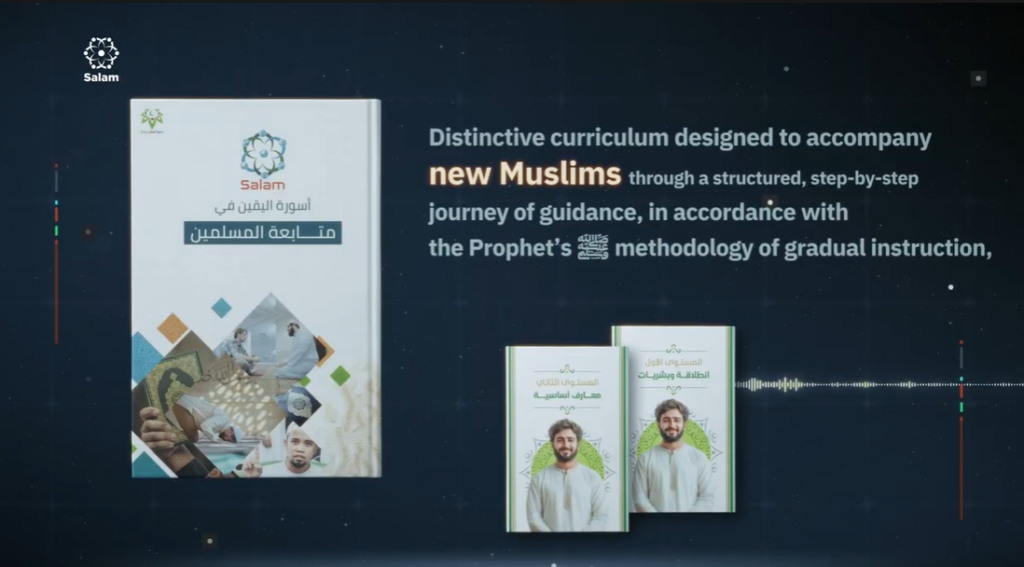
Curious about what comes after taking Shahada? The Asawirat Al-Yaqeen (Bracelets of Certainty) program offers new Muslims a structured four-stage path:
- Foundational knowledge of prayer, purification, and the pillars of faith
- Guidance on repentance and understanding the Seerah of the Prophet (PBUH)
- Etiquette, family rulings, and daily life guidance rooted in the Sunnah
- Advanced study of contemporary issues and theological evidence
Reach out directly to the Salam Center team to start the Asawirat Al-Yaqeen (Bracelets of Certainty) program for FREE.
Summary
The Quran treats divorce as a permitted but heavily regulated last resort, building in waiting periods, arbitration, and financial fairness at every stage. Women retain an independent right to seek separation through khula, a precedent drawn directly from the Prophet’s own rulings.
Every provision, from the two-pronouncement limit to the iddah requirement, protects dignity on both sides of a difficult transition. Anyone exploring these teachings will find a legal system built on mercy, not punishment, guiding families through one of life’s hardest moments.
Curious about Islam?
Journey towards clarity and purpose. Our team is here to support you in your search for truth and spiritual guidance.
Embrace the Truth