
What Does the Quran Say About Hijab?
| Key Takeaways |
| The Quran commands believing women to cover their adornments and draw their outer garments around themselves in two distinct verses in Surah An-Nur and Surah Al-Ahzab. |
| The Quranic instruction for hijab is addressed to the Prophet (PBUH) to convey to believing women, establishing it as a divine command rather than a cultural tradition. |
| Islamic scholars have reached scholarly consensus (ijma’) that covering the hair and body is an obligation for Muslim women. |
| The wisdom behind hijab — dignity, protection, and clarity of identity — is explicitly stated in the Quran itself, making the reasoning inseparable from the ruling. |
The Quran addresses hijab directly — not through inference or later tradition, but through clear, revealed commands in two specific chapters. For anyone asking what the Quran says about hijab or searching for where in the Quran it mentions wearing hijab, the answer begins with Surah An-Nur (Chapter 24) and Surah Al-Ahzab (Chapter 33).
Where in the Quran Does it Say to Wear Hijab?
The Quran commands hijab in two specific verses: Surah An-Nur 24:31 and Surah Al-Ahzab 33:59. The first instructs believing women to draw their head coverings (khimar) over their chests and not expose their adornments. The second commands them to draw their outer garments (jilbab) over themselves when in public.
The First Quranic Verse on Hijab Appears in Surah An-Nur
Surah An-Nur, verse 31, contains the most detailed Quranic instruction concerning what Muslim women are commanded to cover:
وَقُل لِّلْمُؤْمِنَاتِ يَغْضُضْنَ مِنْ أَبْصَارِهِنَّ وَيَحْفَظْنَ فُرُوجَهُنَّ وَلَا يُبْدِينَ زِينَتَهُنَّ إِلَّا مَا ظَهَرَ مِنْهَا ۖ وَلْيَضْرِبْنَ بِخُمُرِهِنَّ عَلَىٰ جُيُوبِهِنَّ
“And tell the believing women to reduce [some] of their vision and guard their private parts and not expose their adornment except that which [necessarily] appears thereof and to wrap [a portion of] their headcovers over their chests.” (Quran 24:31)
Several elements of this verse carry precise legal weight. The word khumur (خُمُر) is the plural of khimar — a head covering. The verse instructs that this covering be drawn over the juyub (جُيُوب), meaning the chest openings of garments. This means the command to cover is explicit for both the head and the chest.
The verse also opens by addressing the believing women specifically through the Prophet (PBUH), establishing this as a divine address — not a social custom or regional practice.
The command to “not expose their adornment” is further qualified by the scholars to mean that the face may be exposed according to one scholarly position, while another position holds that even the face must be covered.
Both positions rest on authenticated scholarly evidence, and this is a recognized difference of opinion within Ahlus Sunnah.
Importantly, the verse immediately preceding this one — verse 30 — commands believing men to lower their gazes first. The Quran establishes male responsibility before female obligation, framing modesty as a shared ethical commitment within the community.
Learn More About Islam
Discover the beauty, teachings, and wisdom of Islam in a clear and welcoming way. Start exploring and deepen your understanding today.
Learn MoreThe Second Quranic Verse on Hijab Comes from Surah Al-Ahzab
The second primary Quranic text on hijab appears in Surah Al-Ahzab, verse 59:
يَا أَيُّهَا النَّبِيُّ قُل لِّأَزْوَاجِكَ وَبَنَاتِكَ وَنِسَاءِ الْمُؤْمِنِينَ يُدْنِينَ عَلَيْهِنَّ مِن جَلَابِيبِهِنَّ ۚ ذَٰلِكَ أَدْنَىٰ أَن يُعْرَفْنَ فَلَا يُؤْذَيْنَ
“O Prophet, tell your wives and your daughters and the women of the believers to bring down over themselves [part] of their outer garments. That is more suitable that they will be known and not be abused.” (Quran 33:59)
The word jalabeeb (جَلَابِيب) is the plural of jilbab — a large outer garment that covers the entire body. The command here is to draw it downward over the body when in public.
The wisdom is stated explicitly in the verse itself. Allah says this makes the women “known” — recognized as believing, modest women — “and not be abused.”
The Quran therefore does not leave the rationale unstated. The covering serves as a marker of identity and dignity, protecting women from being mistaken for or treated as otherwise.
This is one of the clearest examples in the Quran where the command and its purpose are revealed together, allowing Muslims to understand not just what is commanded but why.
What Do Authentic Hadiths Clarify About the Quran’s Hijab Command?
The Sunnah of the Prophet (PBUH) provides essential detail for implementing the Quranic commands. When Surah An-Nur verse 31 was revealed, the women of Madinah responded with immediate compliance.
Imam al-Bukhari records that Aisha (may Allah be pleased with her) described the women of the Ansar:
“May Allah have mercy on the women of the Ansar. When the verse ‘…and to wrap their headcovers over their chests’ was revealed, they tore their wrappers and covered themselves with them.” This narration demonstrates the companions’ understanding that the verse was a binding command.
A foundational Hadith on the scope of the covering was recorded by Imam Abu Dawud in his Sunan.
The Prophet (PBUH) said to Asma’ bint Abi Bakr (may Allah be pleased with her):
“O Asma’, when a woman reaches the age of menstruation, it is not proper that anything should be seen of her except this and this” — pointing to his face and hands. (Sunan Abu Dawud)
This Hadith is cited by scholars as the evidentiary basis for the position that the face and hands may remain uncovered.
These narrations from the Sunnah function as the practical application of the Quran’s command — clarifying what “not expose their adornment” means in lived practice.
The Hijab Verse Was Revealed in a Specific Historical Context That Clarifies Its Universal Application
Surah Al-Ahzab verse 59 was revealed during the Madinan period of the Prophet’s (PBUH) life. Understanding the history of the Quran and its Madinan revelations is important here: the Madinan chapters typically contained detailed legal rulings for the Muslim community’s daily life. The hijab verse was a legislative revelation, not a narrative one.
The immediate historical context involved the growing Muslim community in Madinah, where social clarity and protection for women in public spaces was a real and practical need. The Quran addressed this by instituting the outer covering.
Scholars of usul al-fiqh note that while a cause of revelation provides context, the ruling itself is general — applying to all believing women in all times and places, not only to the women of Madinah in the 7th century.
This principle — “the ruling follows the generality of the wording, not the specificity of the cause” — is a foundational rule of Quranic interpretation held by all four major schools of Islamic law and is not a contested matter within orthodox scholarship.
How Does the Quran Frame Hijab Within a Broader Vision of Dignity?
The Quran’s treatment of hijab is never isolated. It sits within a broader framework that the Quran consistently presents when addressing the ethics of interaction, modesty, and social cohesion.
The same passage in Surah An-Nur also commands women to draw their coverings over their chests, forbids them from striking their feet to draw attention to hidden adornments, and explicitly names the categories of men in whose presence the covering may be relaxed — such as husbands, fathers, and other specified relatives.
This layered, nuanced legal framework reveals that the Quran’s concern is not restriction for its own sake. The concern is the cultivation of a society in which dignity is protected and the moral environment is sound.
The Islamic understanding of hijab is therefore inseparable from the Islamic understanding of the human being — created with dignity, accountable before Allah, and guided by revelation toward a life of purpose and honor.
Read Also: What Does the Quran Say About Female Education?
Learn More About Islam
Discover the beauty, teachings, and wisdom of Islam in a clear and welcoming way. Start exploring and deepen your understanding today.
Learn MoreWhat to Do Next — Your Journey with the Salam Platform
If this article has opened a sincere question in your heart — about Islam, about the Quran, or about what it means to live by its guidance — the Salam Center is here to walk alongside you.
Explore more on the Salam Platform, where every article is written to serve your genuine search for truth.
Browse the Salam blog for structured, evidence-grounded answers to the questions that matter most.
Have a specific question? Want to learn more about Islam or take your next step? Reach out directly — the Salam Center team is ready to listen and respond with care.

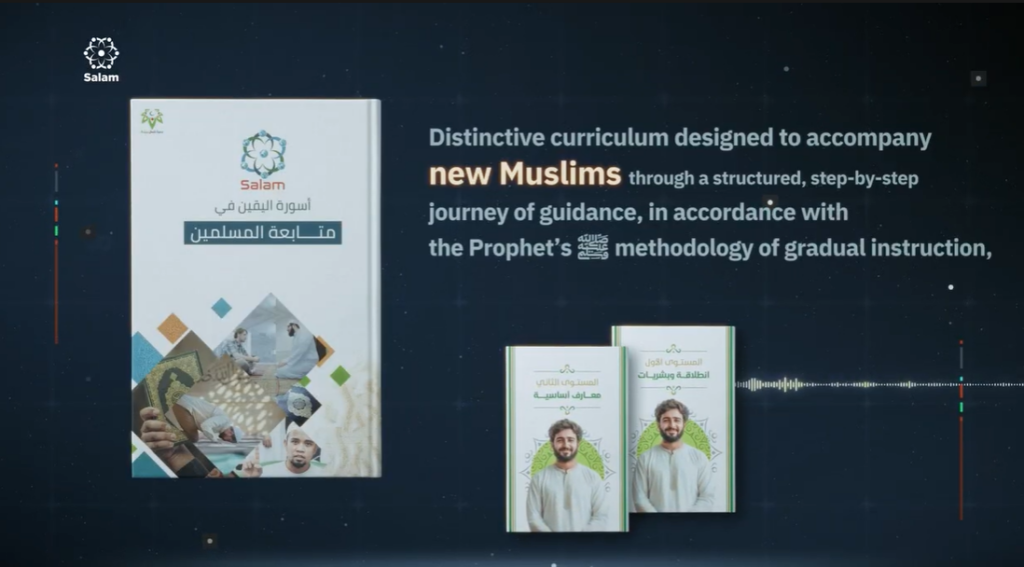
For those who have already entered Islam and are looking for structured post-conversion support, the Asawirat Al-Yaqeen (Bracelets of Certainty) program offers a complete, four-stage educational journey designed specifically for new Muslims:
- Stage One — The foundational pillars, the Shahada, purification, and prayer
- Stage Two — The six pillars of Iman, zakat, fasting, and Hajj
- Stage Three — Tawbah, major sins, and the Seerah of the Prophet (PBUH)
- Stage Four — Ethics, family life, contemporary rulings, and a life roadmap based on Surah Al-Asr
Over 114,588 new Muslims across 140 countries have completed this curriculum. Ask us about enrolling.
Reach out directly to the Salam Center team to start the Asawirat Al-Yaqeen (Bracelets of Certainty) program for FREE.
Summary
The Quran commands hijab explicitly in two chapters — Surah An-Nur (24:31) and Surah Al-Ahzab (33:59) — using precise terms for head covering and outer garments. Scholars of all four major schools of Islamic jurisprudence have confirmed this as an established obligation, grounded in unambiguous divine text. The command carries both a ruling and a wisdom, and both belong to the same revelation that invites every sincere seeker toward clarity, dignity, and truth.
Frequently Asked Questions
What does the Quran mean by “khimar” and “jilbab” in the hijab verses?
Khimar (خِمَار) refers to a head covering, and jilbab (جِلْبَاب) refers to a large outer garment worn over clothing. Both terms appear in the Quranic hijab verses with explicit commands. Imam al-Qurtubi, in Al-Jami’ li Ahkam al-Quran, analyzed these words and confirmed that they denote coverings for the head and full body respectively.
Is hijab a Quranic obligation or a cultural tradition?
Hijab is a Quranic obligation, not a cultural tradition. The command appears in direct divine address in two Madinan chapters of the Quran. Scholars of all four major schools of Islamic jurisprudence — Hanafi, Maliki, Shafi’i, and Hanbali — have classified it as obligatory based on these unambiguous verses and authenticated Hadiths.
Does the Quran also command modesty for men?
Yes — Surah An-Nur 24:30 commands believing men to lower their gazes before the women’s verse appears. This sequencing is deliberate. The Quran establishes male responsibility for guarding the gaze as the first ethical boundary, framing modesty as a mutual obligation within the Islamic community rather than a burden placed on women alone.
Curious about Islam?
Journey towards clarity and purpose. Our team is here to support you in your search for truth and spiritual guidance.
Embrace the Truth