
How Many Surahs Are in the Quran?
| Key Takeaways |
| The Quran contains exactly 114 surahs, arranged mostly in descending order of length rather than by chronology of revelation. |
| Of the 114 chapters, 86 are classified as Meccan and 28 as Medinan, based on where and when each was revealed to Prophet Muhammad (PBUH). |
| Surah Al-Fatiha opens the Quran with seven verses, while Surah An-Nas closes it as the 114th and final chapter. |
| The Quran is also divided into 30 equal parts called Juz’, a structure used for recitation during Ramadan and daily study. |
| Surah lengths vary dramatically — from Al-Baqarah with 286 verses to Al-Kawthar and two other surahs with just three verses each. |
| Every surah opens with the Basmalah except Surah At-Tawbah, the ninth chapter, which begins directly with its subject matter. |
The Quran, the final revelation given to Prophet Muhammad (PBUH), consists of 114 surahs (chapters), a number fixed since the age of the Companions and never altered in any authentic copy since. Each surah is further divided into ayahs, or verses, ranging from as few as three to as many as 286.
Scholars of Ulum al-Quran (Quranic sciences) note this ordering was established through tawqif — direct instruction, not personal opinion — meaning the Companions arranged the mushaf according to what they had learned directly from the Prophet (PBUH) himself.
How many surahs are in the Quran?
The Quran contains exactly 114 surahs, ranging from three verses to 286 verses each. This number has remained fixed and unchanged since the era of the Prophet Muhammad’s (PBUH) Companions, documented consistently in every authentic mushaf since.
The Quran describes its own preservation in unmistakable terms:
إِنَّا نَحْنُ نَزَّلْنَا الذِّكْرَ وَإِنَّا لَهُ لَحَافِظُونَ
“Indeed, it is We who sent down the Qur’an and indeed, We will be its guardian.” (Quran 15:9)
This verse underlies why Muslims hold that the number, order, and wording of the 114 surahs have remained untouched across fourteen centuries — a fact central to how Islam views the nature of the Quran as a preserved revelation rather than a human compilation subject to drift or editorial change.
The 114 surahs divide into Meccan and Medinan revelations
Islamic scholarship classifies every surah according to where it was revealed relative to the Prophet’s migration (Hijrah) from Makkah to Madinah in 622 CE. Of the 114 surahs, the majority — 86 chapters — are Meccan, revealed before the Hijrah, while 28 are Medinan, revealed afterward.
This distinction is not merely geographical trivia. It carries real interpretive weight in Islamic jurisprudence and theology.
1. Meccan surahs focus on core belief
Meccan surahs generally address foundational matters of faith: the Oneness of Allah (Tawhid), the reality of the afterlife, the stories of earlier prophets, and warnings against idolatry. They tend to be shorter, delivered in forceful, rhythmic Arabic suited to a fledgling community facing persecution.
This is where the deep questions about how Islam views the nature of God are most concentrated, since the earliest revelations were primarily concerned with establishing correct belief before addressing social legislation.
2. Medinan surahs address a growing community
Medinan surahs, revealed after the Muslim community gained a stable home in Madinah, tend to be longer and address law, social organization, and relations with other communities. Surah Al-Baqarah, the longest chapter in the Quran, is Medinan and covers everything from ritual law to civil transactions.
Scholars such as Jalal al-Din al-Suyuti, author of the classical work Al-Itqan fi Ulum al-Quran, documented this Meccan-Medinan classification meticulously, cross-referencing narrations from the Companions to determine the circumstances of revelation (asbab al-nuzul) for each chapter.
Learn More About Islam
Discover the beauty, teachings, and wisdom of Islam in a clear and welcoming way. Start exploring and deepen your understanding today.
Learn MoreSurah lengths vary widely across the Quran’s structure
The 114 surahs are not uniform in size. Al-Baqarah, the second chapter, contains 286 verses and stands as the longest surah in the Quran, while three surahs — Al-Kawthar, Al-Asr, and An-Nasr — each contain only three verses, making them the shortest.
This variation is intentional rather than arbitrary. Classical scholars of Quranic sciences divided the chapters into four broad categories based on length, a system attributed in some narrations to descriptions the Prophet (PBUH) gave of what he had been granted:
- Al-Sab’ al-Tiwal (The Seven Long Surahs): the lengthiest chapters, including Al-Baqarah, Aal-Imran, and An-Nisa
- Al-Mi’in: surahs containing roughly one hundred verses or more
- Al-Mathani: chapters shorter than the Mi’in but still substantial
- Al-Mufassal: the many short chapters concentrated toward the end of the mushaf, frequently recited in daily prayer
This length-based arrangement is why the Quran does not read chronologically from first revelation to last.
The very first verses revealed to the Prophet (PBUH), the opening of Surah Al-Alaq, appear near the end of the mushaf as chapter 96, while Al-Fatiha — revealed early but placed first for its role as an opening supplication — sits at the very beginning.
Read Also: How Many Ayahs Are in the Quran?
Every surah has a name rooted in its content or context
Each of the 114 surahs carries a name, typically drawn from a distinctive word, story, or theme within the chapter rather than functioning as a formal title in the modern sense. Surah Al-Baqarah (“The Cow”) takes its name from the account of the cow mentioned in its narrative.
Surah Al-Kahf (“The Cave”) references the story of the sleepers who took refuge in a cave. Surah Maryam is named for the mother of Prophet Isa (Jesus), reflecting the surah’s extended treatment of her story.
These names were transmitted alongside the text itself and are documented in the earliest tafsir literature, including the monumental commentary of Ibn Kathir, Tafsir al-Quran al-Azim, which remains one of the most widely referenced explanations of the Quran across the Muslim world today.
Read Also: How Many Juz Are in the Quran?
A list of Quran surahs follows a consistent, memorized sequence
Because the order of the 114 chapters was fixed early and preserved without variation, Muslims worldwide use the identical sequence regardless of language, printing location, or school of thought. A list of surahs in the Quran typically opens as follows:
The complete list of 114 surahs in the Quran
| # | Surah Name | Meaning | Verses | Revelation |
| 1 | Al-Fatiha | The Opening | 7 | Makkah |
| 2 | Al-Baqarah | The Cow | 286 | Madinah |
| 3 | Aal-Imran | The Family of Imran | 200 | Madinah |
| 4 | An-Nisa | The Women | 176 | Madinah |
| 5 | Al-Ma’idah | The Table Spread | 120 | Madinah |
| 6 | Al-An’am | The Cattle | 165 | Makkah |
| 7 | Al-A’raf | The Heights | 206 | Makkah |
| 8 | Al-Anfal | The Spoils of War | 75 | Madinah |
| 9 | At-Tawbah | The Repentance | 129 | Madinah |
| 10 | Yunus | Jonah | 109 | Makkah |
| 11 | Hud | Hud | 123 | Makkah |
| 12 | Yusuf | Joseph | 111 | Makkah |
| 13 | Ar-Ra’d | The Thunder | 43 | Madinah |
| 14 | Ibrahim | Abraham | 52 | Makkah |
| 15 | Al-Hijr | The Rocky Tract | 99 | Makkah |
| 16 | An-Nahl | The Bees | 128 | Makkah |
| 17 | Al-Isra | The Night Journey | 111 | Makkah |
| 18 | Al-Kahf | The Cave | 110 | Makkah |
| 19 | Maryam | Mary | 98 | Makkah |
| 20 | Ta-Ha | Ta-Ha | 135 | Makkah |
| 21 | Al-Anbiya | The Prophets | 112 | Makkah |
| 22 | Al-Hajj | The Pilgrimage | 78 | Madinah |
| 23 | Al-Mu’minun | The Believers | 118 | Makkah |
| 24 | An-Nur | The Light | 64 | Madinah |
| 25 | Al-Furqan | The Criterion | 77 | Makkah |
| 26 | Ash-Shu’ara | The Poets | 227 | Makkah |
| 27 | An-Naml | The Ants | 93 | Makkah |
| 28 | Al-Qasas | The Narrations | 88 | Makkah |
| 29 | Al-Ankabut | The Spider | 69 | Makkah |
| 30 | Ar-Rum | Rome | 60 | Makkah |
| 31 | Luqman | Luqman | 34 | Makkah |
| 32 | As-Sajdah | The Prostration | 30 | Makkah |
| 33 | Al-Ahzab | The Combined Forces | 73 | Madinah |
| 34 | Saba | Sheba | 54 | Makkah |
| 35 | Fatir | The Originator | 45 | Makkah |
| 36 | Ya-Sin | Ya-Sin | 83 | Makkah |
| 37 | As-Saffat | Those Ranged in Ranks | 182 | Makkah |
| 38 | Sad | Sad | 88 | Makkah |
| 39 | Az-Zumar | The Troops | 75 | Makkah |
| 40 | Ghafir | The Forgiver | 85 | Makkah |
| 41 | Fussilat | Explained in Detail | 54 | Makkah |
| 42 | Ash-Shura | The Consultation | 53 | Makkah |
| 43 | Az-Zukhruf | The Gold Adornments | 89 | Makkah |
| 44 | Ad-Dukhan | The Smoke | 59 | Makkah |
| 45 | Al-Jathiyah | The Kneeling Down | 37 | Makkah |
| 46 | Al-Ahqaf | The Wind-Curved Sandhills | 35 | Makkah |
| 47 | Muhammad | Muhammad | 38 | Madinah |
| 48 | Al-Fath | The Victory | 29 | Madinah |
| 49 | Al-Hujurat | The Private Apartments | 18 | Madinah |
| 50 | Qaf | Qaf | 45 | Makkah |
| 51 | Adh-Dhariyat | The Winnowing Winds | 60 | Makkah |
| 52 | At-Tur | The Mount | 49 | Makkah |
| 53 | An-Najm | The Star | 62 | Makkah |
| 54 | Al-Qamar | The Moon | 55 | Makkah |
| 55 | Ar-Rahman | The Most Merciful | 78 | Madinah |
| 56 | Al-Waqi’ah | The Inevitable | 96 | Makkah |
| 57 | Al-Hadid | Iron | 29 | Madinah |
| 58 | Al-Mujadila | The Pleading Woman | 22 | Madinah |
| 59 | Al-Hashr | The Gathering | 24 | Madinah |
| 60 | Al-Mumtahanah | The Examined One | 13 | Madinah |
| 61 | As-Saff | The Ranks | 14 | Madinah |
| 62 | Al-Jumu’ah | Friday | 11 | Madinah |
| 63 | Al-Munafiqun | The Hypocrites | 11 | Madinah |
| 64 | At-Taghabun | Mutual Loss and Gain | 18 | Madinah |
| 65 | At-Talaq | Divorce | 12 | Madinah |
| 66 | At-Tahrim | The Prohibition | 12 | Madinah |
| 67 | Al-Mulk | The Sovereignty | 30 | Makkah |
| 68 | Al-Qalam | The Pen | 52 | Makkah |
| 69 | Al-Haqqah | The Sure Reality | 52 | Makkah |
| 70 | Al-Ma’arij | The Ascending Stairways | 44 | Makkah |
| 71 | Nuh | Noah | 28 | Makkah |
| 72 | Al-Jinn | The Jinn | 28 | Makkah |
| 73 | Al-Muzzammil | The Enshrouded One | 20 | Makkah |
| 74 | Al-Muddaththir | The Cloaked One | 56 | Makkah |
| 75 | Al-Qiyamah | The Resurrection | 40 | Makkah |
| 76 | Al-Insan | Man | 31 | Madinah |
| 77 | Al-Mursalat | Those Sent Forth | 50 | Makkah |
| 78 | An-Naba | The Great News | 40 | Makkah |
| 79 | An-Nazi’at | Those Who Tear Out | 46 | Makkah |
| 80 | Abasa | He Frowned | 42 | Makkah |
| 81 | At-Takwir | The Overthrowing | 29 | Makkah |
| 82 | Al-Infitar | The Cleaving Asunder | 19 | Makkah |
| 83 | Al-Mutaffifin | Defrauding | 36 | Makkah |
| 84 | Al-Inshiqaq | The Sundering | 25 | Makkah |
| 85 | Al-Buruj | The Mansions of the Stars | 22 | Makkah |
| 86 | At-Tariq | The Nightcomer | 17 | Makkah |
| 87 | Al-A’la | The Most High | 19 | Makkah |
| 88 | Al-Ghashiyah | The Overwhelming | 26 | Makkah |
| 89 | Al-Fajr | The Dawn | 30 | Makkah |
| 90 | Al-Balad | The City | 20 | Makkah |
| 91 | Ash-Shams | The Sun | 15 | Makkah |
| 92 | Al-Layl | The Night | 21 | Makkah |
| 93 | Ad-Duha | The Morning Hours | 11 | Makkah |
| 94 | Ash-Sharh | The Relief | 8 | Makkah |
| 95 | At-Tin | The Fig | 8 | Makkah |
| 96 | Al-Alaq | The Clot | 19 | Makkah |
| 97 | Al-Qadr | The Night of Decree | 5 | Makkah |
| 98 | Al-Bayyinah | The Clear Proof | 8 | Madinah |
| 99 | Az-Zalzalah | The Earthquake | 8 | Madinah |
| 100 | Al-Adiyat | The Chargers | 11 | Makkah |
| 101 | Al-Qari’ah | The Striking Hour | 11 | Makkah |
| 102 | At-Takathur | Rivalry in World Increase | 8 | Makkah |
| 103 | Al-Asr | The Declining Day | 3 | Makkah |
| 104 | Al-Humazah | The Slanderer | 9 | Makkah |
| 105 | Al-Fil | The Elephant | 5 | Makkah |
| 106 | Quraysh | Quraysh | 4 | Makkah |
| 107 | Al-Ma’un | Small Kindnesses | 7 | Makkah |
| 108 | Al-Kawthar | Abundance | 3 | Makkah |
| 109 | Al-Kafirun | The Disbelievers | 6 | Makkah |
| 110 | An-Nasr | The Divine Support | 3 | Madinah |
| 111 | Al-Masad | The Palm Fibre | 5 | Makkah |
| 112 | Al-Ikhlas | Sincerity | 4 | Makkah |
| 113 | Al-Falaq | The Daybreak | 5 | Makkah |
| 114 | An-Nas | Mankind | 6 | Makkah |
This fixed Quran chapter sequence is what allows a Muslim reciting from memory in Jakarta to follow along with a printed mushaf produced in Madinah without a single discrepancy in order or wording.
Read Also: How Many Pages Is The Quran?
Learn More About Islam
Discover the beauty, teachings, and wisdom of Islam in a clear and welcoming way. Start exploring and deepen your understanding today.
Learn MoreContinue exploring the Quran and Islamic belief
Curious about what shapes Islamic belief beyond the Quran’s structure? There is much more to discover.
Explore the Salam blog for articles covering the Quran, the life of Prophet Muhammad (PBUH), and the foundations of Islamic faith.
Read about the 9 Islam principles that anchor Muslim belief and practice.
Have a specific question about Islam, the Quran, or the path to faith? Reach out directly — the Salam Center team welcomes sincere inquiry.

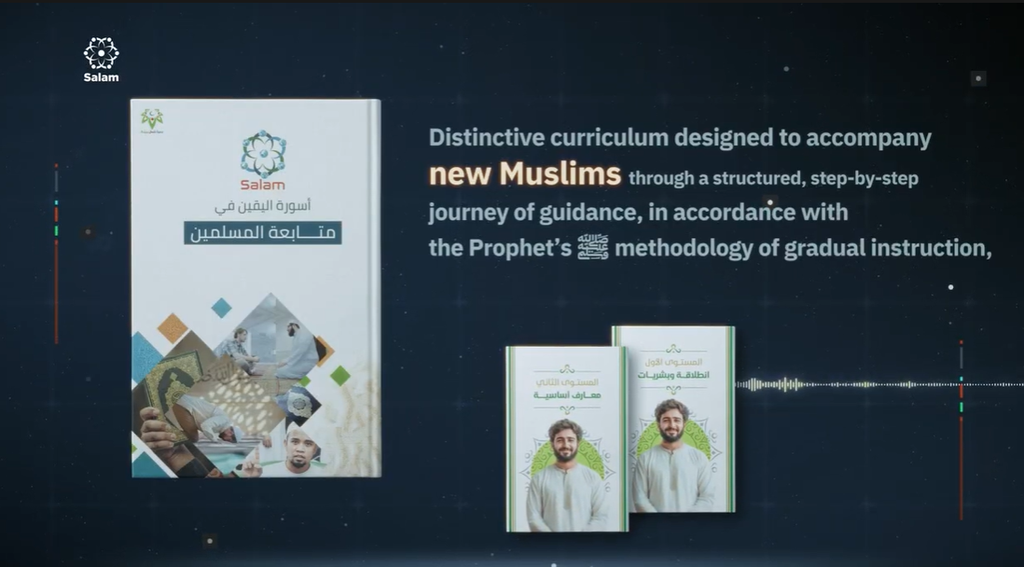
If you are exploring conversion or have recently embraced Islam, learn about Asawirat Al-Yaqeen (Bracelets of Certainty), our structured post-conversion learning journey:
- A four-stage curriculum guiding new Muslims from foundational pillars to advanced theological understanding
- Level 1 begins with the Shahada, prayer, and purification — no prior knowledge assumed
- Progresses through repentance, the Prophet’s biography, moral etiquette, and practical life rulings
- Concludes with contemporary issues, comparative theology, and a life roadmap grounded in Surah Al-Asr
- Delivered with structured lessons designed to sustain engagement and understanding
Whether you’re a curious seeker or a new Muslim building your foundation, the Salam Platform is here to walk alongside you.
Reach out directly to the Salam Center team to start the Asawirat Al-Yaqeen (Bracelets of Certainty) program for FREE.
Summary
The Quran’s structure rests on 114 fixed surahs, arranged largely by descending length and split between 86 Meccan and 28 Medinan revelations. This order, transmitted since the Prophet’s time, remains identical across every printed and recited copy worldwide today.
From Al-Fatiha’s seven opening verses to An-Nas’s closing plea for refuge, each surah occupies a deliberate place within a text Muslims regard as divinely preserved. Exploring this structure opens a clearer path toward understanding the Quran’s broader message and history.
Frequently Asked Questions
What is the shortest surah in the Quran?
Three surahs tie as the shortest in the Quran: Al-Kawthar, Al-Asr, and An-Nasr, each containing only three verses. Al-Kawthar (108) is most commonly cited as “the shortest” due to its brief, concentrated wording addressing abundance and gratitude.
What is the longest surah in the Quran?
Surah Al-Baqarah, the second chapter, is the longest in the Quran with 286 verses. It is a Medinan surah covering extensive legal, theological, and narrative content, including the well-known account referenced in its very title, “The Cow.”
Which surah is recited in every unit of daily prayer?
Surah Al-Fatiha, the Quran’s opening chapter, is recited in every rak’ah of the five daily prayers. The Prophet (PBUH) called it “the greatest surah in the Quran” (Sahih al-Bukhari 4474), and its seven verses are foundational to valid Islamic prayer.
Are the 114 surahs arranged in the order they were revealed?
No, the 114 surahs are not arranged chronologically by revelation; they follow a structure based largely on descending length. The first revealed verses appear in Surah Al-Alaq (chapter 96), while Al-Fatiha, revealed early, was placed first as the Quran’s opening.
Curious about Islam?
Journey towards clarity and purpose. Our team is here to support you in your search for truth and spiritual guidance.
Embrace the Truth