
What Is the Last Surah of the Quran?
| Key Takeaways |
| An-Nas (Chapter 114) is the last surah in the Mus’haf’s standard written arrangement. |
| An-Nasr (Chapter 110) is the last surah revealed to Prophet Muhammad (PBUH) in its entirety. |
| The Companion Ibn Abbas narrated in Sahih Muslim that An-Nasr was the final complete surah sent down. |
| The Quran’s written order was fixed under the direction of the Prophet (PBUH) himself, not arranged by chronology of revelation. |
| An-Nasr’s revelation signaled to the Companions that the Prophet’s (PBUH) death was approaching. |
Muslims often ask about “the last surah of the Quran” without realizing the question actually has two different, equally valid answers. Everything depends on what “last” means.
If the question refers to the Quran’s written arrangement — the Mus’haf every Muslim reads — the answer is Surah An-Nas, chapter 114, the final chapter on the last printed page.
If the question refers to chronological revelation — which surah was the final one sent down to the Prophet Muhammad (PBUH) during his lifetime — the answer is different: Surah An-Nasr, chapter 110.
What is the last surah of the Quran?
The last surah of the Quran depends on which “last” is meant: An-Nas is the final chapter in the Mus’haf’s written order, while An-Nasr is recognized as the final complete surah revealed to the Prophet Muhammad (PBUH). These are two separate facts answering two separate questions, and conflating them is one of the most common points of confusion for new readers of the Quran.
In terms of physical placement, An-Nas sits as chapter 114 — the very last surah when the Quran is read from Al-Fatihah through to its final page. This is the order every printed mushaf follows worldwide, regardless of language or region.
In terms of revelation, فhe Companion Abdullah ibn Abbas — one of the most trusted transmitters of Quranic knowledge among the Sahabah — stated plainly that An-Nasr was the last surah revealed to the Prophet (PBUH) as a complete unit. This is recorded with a sound chain in Sahih Muslim, and it remains the dominant scholarly position on the matter.
The last surah in the Quran’s written order is An-Nas
Surah An-Nas, “Mankind,” closes the Quran as chapter 114 in the Mus’haf that Muslims read today. It is a short surah of six verses, paired closely in theme and structure with the surah before it, Al-Falaq, chapter 113.
Together these two chapters are known as al-Mu’awwidhatayn, “the two surahs of refuge,” because both open with a call to seek protection in Allah from harm.
قُلْ أَعُوذُ بِرَبِّ النَّاسِ
“Say, ‘I seek refuge in the Lord of mankind.'” (Quran 114:1)
This closing position in the Mus’haf is not accidental, and it is not tied to when the surah was revealed.
The order readers follow today was set under the direct guidance of the Prophet (PBUH) himself, who instructed his scribes on precisely where each newly revealed passage belonged within the growing text.
This arrangement was later preserved without alteration when the Caliph Uthman ibn Affan standardized the single authoritative copy of the Mus’haf, distributing it to the major cities of the early Muslim world.
The order is therefore a matter of tawqifi — fixed by prophetic instruction — rather than a sequence editors assembled afterward based on chronology.
An-Nasr is recognized as the last complete surah revealed
Surah An-Nasr, “Divine Support,” is identified in authentic hadith as the final surah revealed to the Prophet Muhammad (PBUH) in its entirety. It is a brief surah — only three verses — yet it carries profound weight in Islamic history, because its revelation was understood by the Companions as a quiet announcement of the Prophet’s (PBUH) approaching death.
إِذَا جَاءَ نَصْرُ اللَّهِ وَالْفَتْحُ ﴿١﴾ وَرَأَيْتَ النَّاسَ يَدْخُلُونَ فِي دِينِ اللَّهِ أَفْوَاجًا ﴿٢﴾ فَسَبِّحْ بِحَمْدِ رَبِّكَ وَاسْتَغْفِرْهُ ۚ إِنَّهُ كَانَ تَوَّابًا ﴿٣﴾
“When the victory of Allah has come and the conquest, (1) And you see the people entering into the religion of Allah in multitudes, (2) Then exalt [Him] with praise of your Lord and ask forgiveness of Him. Indeed, He is ever Accepting of repentance. (3).” (Quran 110:1-3)
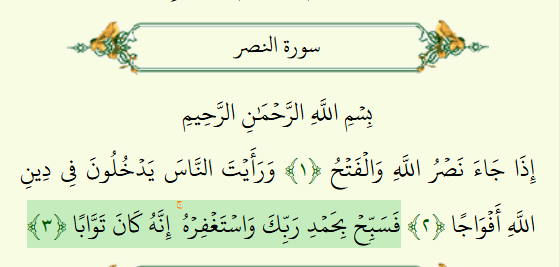
The Companion Ubaydullah ibn Abdullah ibn Utbah reported that Ibn Abbas asked him directly, “Do you know the last surah which was revealed in the Quran as a whole?” When he answered correctly with An-Nasr, Ibn Abbas confirmed, “You have told the truth.” Sahih Muslim
A separate, equally authentic account deepens the picture. Ibn Abbas later recalled that Umar ibn al-Khattab used to invite him into gatherings with senior Companions who had fought at the Battle of Badr, despite his young age.
When some of the elders questioned this, Umar asked the group to interpret the meaning of An-Nasr’s opening verse. Most gave a surface-level reading about future conquests.
Ibn Abbas alone recognized its deeper significance, replying that it was a sign of the Prophet’s (PBUH) approaching death — an interpretation Umar affirmed as correct. This account is preserved in Sahih al-Bukhari.
When An-Nasr was first revealed and recited among the Companions, most rejoiced at the news of the coming conquest of Makkah. The Prophet’s (PBUH) uncle Al-Abbas wept instead, having grasped its true meaning. The Prophet (PBUH) confirmed his understanding was correct.
Learn More About Islam
Discover the beauty, teachings, and wisdom of Islam in a clear and welcoming way. Start exploring and deepen your understanding today.
Learn MoreScholars differ on the very last verse revealed
Islamic scholarship distinguishes between the last complete surah revealed and the last individual verse revealed, and on this second question, opinions vary. This is not a contradiction within the tradition — it reflects the honest reality that several Companions reported hearing different portions of revelation in the Prophet’s (PBUH) final months, and none of these reports fully overrides another with absolute certainty.
The majority of scholars, including a position attributed to the hadith master Ibn Hajar al-Asqalani, hold that the final individual verse revealed was Al-Baqarah 2:281:
وَاتَّقُوا يَوْمًا تُرْجَعُونَ فِيهِ إِلَى اللَّهِ ۖ ثُمَّ تُوَفَّىٰ كُلُّ نَفْسٍ مَّا كَسَبَتْ وَهُمْ لَا يُظْلَمُونَ
“And fear a Day when you will be returned to Allah. Then every soul will be compensated for what it earned, and they will not be treated unjustly.” (Quran 2:281)
Other Companions reported differently. Ibn Abbas himself, in a separate narration, identified the verse prohibiting riba (usury) in Al-Baqarah 2:278 as the final revelation. Aishah, the Mother of the Believers, held that the closing portion of Surah Al-Ma’idah was the last to descend.
Al-Bara ibn Azib reported that the last complete surah revealed was At-Tawbah, with the final verse concerning inheritance for a person without direct heirs, found in An-Nisa 4:176.
The 15th-century scholar Jalal ad-Din as-Suyuti, who compiled a comprehensive survey of these narrations in his work on Quranic sciences, noted that nothing has been soundly established from the Prophet (PBUH) himself that settles this question with finality.
Each Companion reported what they personally witnessed or last heard, and since revelation could occur on the same day through multiple channels, more than one report can be accurate without contradiction.
This diversity of narration is itself part of the honest historical record surrounding why Muslims believe in the Quran as a text whose transmission was documented with unusual scholarly rigor from the very beginning.
Read Also: What Is the Longest Ayah in the Quran?
The Quran’s order was not arranged by revelation sequence
The Quran’s 114 surahs were never intended to follow the chronological order in which they were revealed, and understanding this resolves most confusion about “the last surah.” Revelation began with the opening verses of Surah Al-Alaq in the cave of Hira and continued for twenty-three years, delivered in fragments responding to specific events, questions, and needs of the growing Muslim community. Yet the surahs were not compiled into the Mus’haf in that historical sequence.
Instead, the Prophet (PBUH) himself directed the placement of each verse and surah as it arrived, instructing his scribes on exactly where within the developing text a given passage belonged.
This means the order found in every Mus’haf today — from Al-Fatihah at the opening to An-Nas at the close — reflects prophetic instruction, not later editorial judgment about chronology.
Some of the longest surahs, such as Al-Baqarah, appear early in the Mus’haf despite containing verses revealed across nearly the entire Madinan period, including some of the very last verses sent down. Some of the shortest surahs, like Al-Alaq, contain the first words of revelation yet sit near the end of the printed text.
The Quran was never meant to be read primarily as a historical chronicle unfolding start to finish. It was arranged, under prophetic guidance, to be recited, memorized, and reflected upon as a unified whole — a pattern consistent with the broader principles of Islamic belief, where form and content consistently serve worship and reflection rather than mere narrative sequence.
Readers curious about how the full compilation process unfolded, from individual revelation to the standardized Mus’haf under Uthman, can explore the history of the Quran in greater depth.
Read Also: What Is the Longest Surah in the Quran?
An-Nasr’s revelation marked the completion of the Prophet’s mission
The revelation of An-Nasr is remembered in Islamic tradition as a moment when the Prophet’s (PBUH) mission reached its intended fulfillment, shortly before his death. According to accounts preserved by early scholars including Ibn Kathir, An-Nasr was revealed during the Farewell Pilgrimage, in the tenth year after the Hijrah. The Prophet (PBUH) performed this pilgrimage once, and it would be his last.
Umm Habibah, one of the Mothers of the Believers, reported that upon the surah’s revelation, the Prophet (PBUH) indicated he would depart the world within that same year. His daughter Fatimah wept upon hearing this.
Reports place the interval between this revelation and the Prophet’s (PBUH) passing at approximately three months, matching the historical gap between the Farewell Pilgrimage and his death.
The surah’s brief three verses carry an instruction that Muslims continue to apply directly in daily worship — glorifying Allah, praising Him, and seeking His forgiveness in moments of completion and success, rather than treating achievement as self-generated.
This theme of returning credit to Allah rather than to oneself echoes throughout Quranic teaching on the nature of Allah and His sole right to praise, a foundation of the monotheism at the center of Islamic creed.
Read Also: The Shortest Surah in the Quran
Learn More About Islam
Discover the beauty, teachings, and wisdom of Islam in a clear and welcoming way. Start exploring and deepen your understanding today.
Learn MoreYour Path to Deeper Authentic Knowledge Starts Here with Salam
Questions like this one often open the door to bigger ones — about how the Quran came together, what Muslims believe about its preservation, and what a life shaped by its guidance actually looks like.
The Salam Platform welcomes that curiosity, whatever stage it’s coming from.
If you’re exploring Islam for the first time, the Salam blog has a growing library of honest, evidence-based answers to the questions people actually ask.
Reach out directly — our team is ready to listen, guide, and welcome you.

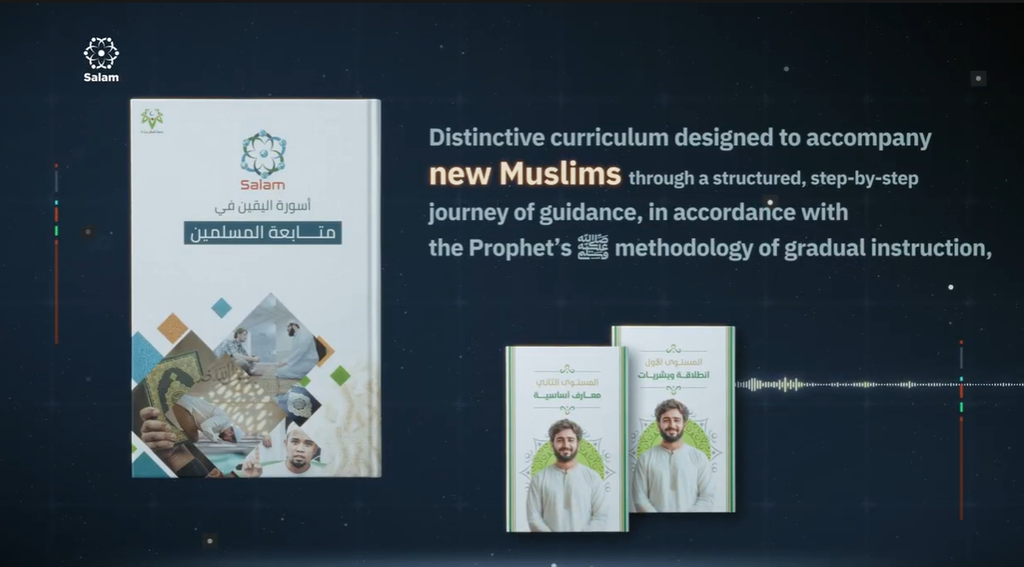
If you’re already on the path — newly returned to faith, or newly arrived at it — the Salam Center team built something specifically for you: Asawirat Al-Yaqeen (Bracelets of Certainty), a structured four-stage program for new Muslims that moves at a steady, supportive pace:
- Stage One covers the foundations: the Shahada, wudu, ghusl, and salah
- Stage Two builds deeper: repentance, and the life of the Prophet Muhammad (PBUH)
- Stage Three strengthens daily practice: etiquette, family life, and everyday rulings
- Stage Four addresses harder questions: contemporary issues, evidences, and a clear roadmap forward
Reach out directly to the Salam Center team to start the Asawirat Al-Yaqeen (Bracelets of Certainty) program for FREE.
Summary
The Quran’s final chapter by written order, An-Nas, and its final complete surah by revelation, An-Nasr, answer two distinct questions that are often mistaken for one. Both rest on authentic hadith transmission, while scholars continue to hold differing, well-documented views on which individual verse was the very last sent down.
Understanding this distinction reflects something larger about the Quran itself: a text whose structure, preservation, and history were handled with a level of documented care that new readers rarely expect.
Frequently Asked Questions
What is the 114th and final surah of the Quran?
The 114th and final surah in the Quran’s written order is An-Nas, “Mankind.” It closes the Mus’haf with a short six-verse call to seek refuge in Allah from harmful whispers, paired closely with the preceding surah, Al-Falaq (Quran 114:1).
Was An-Nasr the last surah revealed to the Prophet?
Yes. Ibn Abbas confirmed in an authentic narration recorded in Sahih Muslim that An-Nasr was the last complete surah revealed to the Prophet Muhammad (PBUH), shortly before his death during the tenth year after the Hijrah.
Why isn’t the Quran arranged in the order it was revealed?
The Prophet (PBUH) personally directed the placement of each revealed passage within the growing text as it arrived, rather than leaving the order to reflect chronology. This arrangement was preserved intact when Caliph Uthman standardized the Mus’haf for the wider Muslim world.
Which verse do most scholars consider the last revealed in the Quran?
Most scholars, citing a position associated with Ibn Hajar al-Asqalani, hold that Al-Baqarah 2:281 was the last individual verse revealed, describing the Day when every soul returns to Allah for a just reckoning (Quran 2:281).
Curious about Islam?
Journey towards clarity and purpose. Our team is here to support you in your search for truth and spiritual guidance.
Embrace the Truth