
Is Moses in the Quran?
| Key Takeaways |
| Moses (Musa, peace be upon him) is the most frequently mentioned prophet in the Quran, appearing in over 30 surahs across more than 136 verses. |
| The Quran presents Moses as a messenger sent to both the Children of Israel and to Pharaoh, carrying the divine message of pure monotheism. |
| Islam regards Moses as one of the five greatest messengers (Ulul Azm), alongside Noah, Abraham, Jesus, and Muhammad (peace be upon them all). |
| The Quran confirms that Moses received the Torah (Tawrah) as divine revelation, and Muslims are required to believe in the original Torah as a scripture from Allah. |
| The story of Moses in the Quran is not a repetition of the biblical account but a distinctive, divinely revealed narrative with its own theological depth and emphasis. |
Yes — Moses is in the Quran, and his presence is more extensive than that of any other prophet. He is named Musa in Arabic, and Allah mentions him more than any other figure in the entire Quran.
Moses’ story spans dozens of chapters, from his miraculous birth through his confrontation with Pharaoh, his reception of divine revelation on Mount Sinai, and his long, patient leadership of the Children of Israel.
For Muslims, Moses is not a figure borrowed from another tradition — he is a prophet fully within the chain of Islam’s own revealed history, sent by the same Allah who sent Muhammad (peace be upon him).
Is Moses in the Quran?
Yes, Moses — known in Arabic as Musa ibn Imran — appears in the Quran 136 times by name and is referenced across more than 30 surahs (chapters). Allah addresses him by name in the Quran more than any other prophet, making his story the single most detailed prophetic narrative in the entire scripture. Moses occupies a central place in the Quran’s theology of prophethood.
The Quran describes Moses as a Kalimullah — one whom Allah spoke to directly, without an intermediary angel. This title distinguishes him with singular honor in Islamic theology.
وَكَلَّمَ اللَّهُ مُوسَىٰ تَكْلِيمًا
“And Allah spoke to Moses with [direct] speech.” (Quran 4:164)
This verse alone signals the magnitude of Moses’s station. He is not simply recounted as a historical figure in the Quran — his story is told and retold across multiple surahs to draw out different moral, theological, and practical lessons for humanity.
1. The Birth of Moses and His Divine Protection
The story of Moses begins with a remarkable act of divine care. Pharaoh — Fir’awn in Arabic — had decreed the killing of all newborn sons of the Children of Israel, driven by fear of a prophecy that a child from among them would end his rule.
Into this climate of terror, Moses was born. Allah inspired his mother with one of the most extraordinary commands given to any human being:
وَأَوْحَيْنَا إِلَىٰ أُمِّ مُوسَىٰ أَنْ أَرْضِعِيهِ ۖ فَإِذَا خِفْتِ عَلَيْهِ فَأَلْقِيهِ فِي الْيَمِّ وَلَا تَخَافِي وَلَا تَحْزَنِي ۖ إِنَّا رَادُّوهُ إِلَيْكِ وَجَاعِلُوهُ مِنَ الْمُرْسَلِينَ
“And We inspired to the mother of Moses: ‘Suckle him; but when you fear for him, cast him into the river and do not fear and do not grieve. Indeed, We will return him to you and will make him [one] of the messengers.'” (Quran 28:7)
She placed the infant Moses in a basket and set him on the Nile. By Allah’s precise arrangement, the basket arrived at the very palace of Pharaoh, and Pharaoh’s wife — moved by love for the child — convinced her husband to keep him.
Moses was thus raised in the house of his greatest enemy, yet protected entirely by Allah’s plan. His own mother was unknowingly brought back to nurse him, reuniting her with her son before the royal court even knew who she was.
This episode is one of the Quran’s most striking illustrations of divine providence: that Allah’s decree operates through the very schemes of those who oppose it.
Learn More About Islam
Discover the beauty, teachings, and wisdom of Islam in a clear and welcoming way. Start exploring and deepen your understanding today.
Learn More2. Moses Receives His Prophethood at Mount Sinai
Moses left Egypt after an incident in which he accidentally killed an Egyptian man while defending an Israelite, and lived for years in Midian, working for a righteous man and marrying his daughter.
Then, while journeying with his family through the desert, he saw a fire on the slope of a mountain. When he approached:
فَلَمَّا أَتَاهَا نُودِيَ يَا مُوسَىٰ إِنِّي أَنَا رَبُّكَ فَاخْلَعْ نَعْلَيْكَ ۖ إِنَّكَ بِالْوَادِ الْمُقَدَّسِ طُوًى وَأَنَا اخْتَرْتُكَ فَاسْتَمِعْ لِمَا يُوحَىٰ
“But when he came to it, he was called, ‘O Moses, Indeed, I am your Lord, so remove your sandals. Indeed, you are in the sacred valley of Tuwa. And I have chosen you, so listen to what is revealed [to you].'” (Quran 20:11–13)
At this moment, Moses received his mission: to go to Pharaoh and call him to worship Allah alone. He was given two miracles as signs — his staff transformed into a serpent, and his hand emerged luminously white when withdrawn from his garment.
These were not tricks of nature but divine proofs, meant to establish the truth of his message before the most powerful ruler on earth.
Moses asked Allah to send his brother Aaron (Harun) with him as a companion and helper, and Allah granted this:
وَاجْعَل لِّي وَزِيرًا مِّنْ أَهْلِي هَارُونَ أَخِي اشْدُدْ بِهِ أَزْرِي
“And appoint for me a minister from my family — Aaron, my brother. Increase through him my strength.” (Quran 20:29–31)
3. Moses Confronts Pharaoh with the Message of Monotheism
The confrontation between Moses and Pharaoh is one of the Quran’s grand moral dramas. Pharaoh had declared himself a deity before his people
— أَنَا رَبُّكُمُ الْأَعْلَىٰ, “I am your lord, most high” (Quran 79:24)
— and his entire power rested on maintaining this claim.
Moses came to him with the opposite message: that no human being possesses lordship, that sovereignty belongs to Allah alone.
The Quran records Moses saying to Pharaoh:
وَتِلْكَ نِعْمَةٌ تَمُنُّهَا عَلَيَّ أَنْ عَبَّدتَّ بَنِي إِسْرَائِيلَ
“And is this a favor of which you remind me — that you have enslaved the Children of Israel?” (Quran 26:22)
Pharaoh summoned the greatest sorcerers in Egypt to defeat Moses in a public contest. The sorcerers cast their ropes and staffs, producing the illusion of serpents.
Moses’s staff — by Allah’s command — swallowed all of it. The sorcerers, who were experts in their craft and recognized a genuine miracle, immediately fell prostrate:
فَأُلْقِيَ السَّحَرَةُ سُجَّدًا قَالُوا آمَنَّا بِرَبِّ هَارُونَ وَمُوسَىٰ
“And the magicians fell down in prostration. They said, ‘We have believed in the Lord of Aaron and Moses.'” (Quran 20:70)
Pharaoh threatened them with death. They did not waver.
This episode is one of the Quran’s most powerful testimonies to how divine truth, when witnessed clearly, transforms even hardened hearts in an instant.
4. The Nine Signs and the Exodus
Allah sent Moses with nine distinct signs to Pharaoh and his court: the staff, the luminous hand, drought and crop failure, floods, locusts, lice, frogs, blood, and ultimately the parting of the sea. Each sign was meant to awaken Pharaoh and his people, but each time relief came, they returned to their arrogance.
وَلَقَدْ أَخَذْنَا آلَ فِرْعَوْنَ بِالسِّنِينَ وَنَقْصٍ مِّنَ الثَّمَرَاتِ لَعَلَّهُمْ يَذَّكَّرُونَ
“And We certainly seized the people of Pharaoh with years of famine and a decrease in fruits that perhaps they would be reminded.” (Quran 7:130)
Finally, Allah commanded Moses to lead the Children of Israel out of Egypt by night. Pharaoh pursued them with his army to the shores of the sea. As the army closed in, Moses struck the water with his staff:
فَأَوْحَيْنَا إِلَىٰ مُوسَىٰ أَنِ اضْرِب بِّعَصَاكَ الْبَحْرَ ۖ فَانفَلَقَ فَكَانَ كُلُّ فِرْقٍ كَالطَّوْدِ الْعَظِيمِ
“Then We inspired to Moses: ‘Strike with your staff the sea,’ and it parted, and each portion was like a great towering mountain.” (Quran 26:63)
The Children of Israel crossed. Pharaoh and his army followed — and the sea closed over them. In his final moment, Pharaoh declared belief, but it was not accepted: the Quran states that Allah preserved his body as a sign for those who come after (Quran 10:92), a statement that many scholars connect to Pharaoh’s mummified remains.
5. Moses and the Torah as a Divine Revelation in Islam
On Mount Sinai, Moses spent forty nights in the presence of Allah and received the Tawrah — the Torah — as divine revelation. Belief in the Torah as a scripture from Allah is one of the principles of Islam and an essential element of Islamic faith.
Muslims do not reject the Torah; they affirm its divine origin while recognizing that the scripture as it exists today has undergone human alteration over centuries. Those curious about the Quran’s own nature and preservation can explore what Muslims believe about the Quran.
وَكَتَبْنَا لَهُ فِي الْأَلْوَاحِ مِن كُلِّ شَيْءٍ مَّوْعِظَةً وَتَفْصِيلًا لِّكُلِّ شَيْءٍ
“And We wrote for him on the tablets [something] of all things — instruction and explanation for all things.” (Quran 7:145)
The giving of the Torah to Moses is why he is called Kalimullah — the one to whom Allah spoke. His direct reception of revelation without the mediation of an angel distinguishes him among all the prophets.
6. Moses in the Context of Islamic Monotheism
The entire mission of Moses was built on the foundation of pure monotheism — the absolute oneness of Allah. This is the central message of every prophet in Islam, from Adam to Muhammad (peace be upon them all).
Moses’s conflict with Pharaoh was essentially a conflict between tawhid (monotheism) and shirk (polytheism). Pharaoh’s society was built on the worship of created beings — ultimately of Pharaoh himself — and Moses came to uproot that entirely.The Islamic understanding of God in Islam makes clear that Allah has no partners, no sons, and no rivals.
The story of Moses in the Quran is in many ways a living demonstration of this reality: that those who claim divinity are mortal, that their power is borrowed, and that it ends when Allah wills it to end.
This is also why the story of Moses figures so prominently in Surah Al-Baqarah, Al-A’raf, Yunus, Hud, Ta-Ha, Ash-Shu’ara, Al-Qasas, and many other chapters. Each retelling focuses on a different dimension of his mission, drawing different lessons for the Muslim community.
Why Is Moses Mentioned So Often in the Quran?
Classical scholars of tafsir have offered several reasons for the repeated narration of Moses’s story in the Quran. Each retelling of Moses’s story serves a distinct rhetorical and theological function — some emphasize his courage, others his humility, others the divine power behind his miracles, and others the consequences awaiting those who deny clear signs.
There is also a profound parallel the Quran draws between the community of Moses and the early Muslim community. Both faced overwhelming adversaries. Both were commanded to patience and steadfastness. Both were promised that ultimate victory belongs to those who remain faithful to Allah’s commands.
The nature of God in Islam — as the All-Powerful, All-Knowing, and Just — is illustrated through Moses’s story in ways that no abstract theological statement could achieve.
The reader sees divine power in the parting of the sea, divine mercy in the return of the infant to his mother, divine justice in the drowning of Pharaoh’s army.
Read Also: What Does the Quran Teach?
Learn More About Islam
Discover the beauty, teachings, and wisdom of Islam in a clear and welcoming way. Start exploring and deepen your understanding today.
Learn MoreRead Also: Are Adam and Eve in the Quran?
Learn More About Islam and the Prophets with Salam
If the story of Moses in the Quran has stirred genuine curiosity about Islam — its beliefs, its prophets, its scripture — the Salam Center is here to walk with you.
Explore further on the Salam Platform or read more on the Salam blog.
Have a specific question about Islam? Want to speak with someone directly? Reach out directly — our team is here for sincere conversations, without pressure.
Read Also: Is Abraham in the Quran?

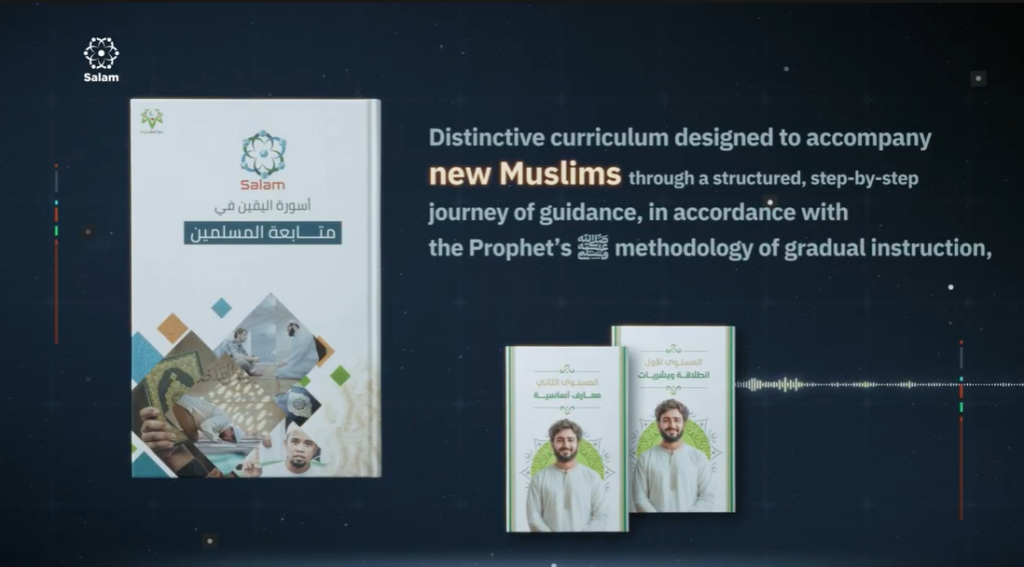
For those who have already taken their shahada and want a structured, supported path forward, the Asawirat Al-Yaqeen (Bracelets of Certainty) program offers exactly that:
- A progressive four-stage curriculum covering creed, worship, character, and life rulings — designed specifically for new Muslims
- Lessons on prophethood, including the role of Moses, Jesus, and all the messengers in the Islamic faith framework
- Interactive assessments and professional lesson design to keep learning engaging
- A global community — the program has guided over 114,588 new Muslims across 140 countries
- Multilingual access — currently being developed into a smart application and interactive website for learners worldwide
If you are a new Muslim or considering Islam, this program is one of the most meaningful steps you can take.
Reach out directly to the Salam Center team to start the Asawirat Al-Yaqeen (Bracelets of Certainty) program for FREE.
Summary
Moses — Musa (peace be upon him) — stands as the most mentioned prophet in the Quran, referenced across more than thirty chapters and directly addressed by Allah in a way accorded to no other figure. His mission encapsulates the core message of Islam: that Allah alone is worthy of worship, that tyranny has limits, and that divine help reaches those who trust fully in their Lord.
The story of Moses is not ancient history sealed in the past. It is a living testimony, repeated throughout the Quran because its lessons renew with every generation — for the believer facing hardship, for the seeker weighing truth, and for any soul wondering whether a single person, armed with divine conviction, can stand against the greatest power on earth and prevail.
Frequently Asked Questions
How many times is Moses mentioned in the Quran?
Moses (Musa) is mentioned by name 136 times in the Quran — more than any other prophet. His story appears across more than 30 surahs, making him the most frequently referenced individual in the entire scripture. Each retelling emphasizes different dimensions of his mission and character.
What is Moses called in the Quran?
In the Quran, Moses is called Musa (موسى) and is given the distinguished title Kalimullah — meaning “the one whom Allah spoke to directly.” This title, affirmed in Quran 4:164, signifies that Allah addressed Moses without the mediation of an angel, a distinction that elevates him among all the prophets.
Did Moses receive a scripture in Islam?
Yes. Moses received the Tawrah (Torah) as a divine revelation from Allah, as confirmed in Quran 7:145. Belief in the Tawrah as a genuine scripture from Allah is obligatory in Islam. Muslims hold that the Torah in its original form was divine truth, while acknowledging that the existing biblical text has been altered over time.
Is Moses considered a Muslim in Islam?
Yes. In Islamic belief, all prophets — including Moses — were Muslim in the sense that they submitted entirely to Allah and called their people to worship Him alone. Moses’s message of pure monotheism is the same foundational message brought by every prophet, culminating in the prophethood of Muhammad (peace be upon them all).
Curious about Islam?
Journey towards clarity and purpose. Our team is here to support you in your search for truth and spiritual guidance.
Embrace the Truth