
Can Non-Muslims Read the Quran?
| Key Takeaways |
| Non-Muslims are permitted to read, hear, and study the Quran — Islam’s sacred scripture actively invites seekers to engage with it. |
| Islamic scholars hold that non-Muslims may not physically touch the original Arabic Mushaf (Quran). |
| Translations of the Quran’s meanings into other languages are classified as tafsir (interpretation), not the Quran itself, so non-Muslims may touch and read them without restriction. |
| A book of Quranic tafsir or translation — even one containing Arabic verses alongside an English explanation — does not carry the same ruling as the Mushaf. |
| The Prophet Muhammad (PBUH) himself recited the Quran to polytheists, making outreach through the Quran a deeply Prophetic act. |
| Wudu (ritual purity) is a condition for Muslims touching the Mushaf, not a prerequisite for non-Muslims reading translated meanings of the Quran. |
The message of the Quran was never meant to be sealed away from those who haven’t yet embraced Islam — it was sent as a huda lil-nas (guidance for all of humanity).
From the earliest days of the Islamic mission in Makkah, the Prophet Muhammad (PBUH) recited the Quran openly to those who had not believed, including those who actively opposed him.
Can Non-Muslims Read the Quran?
Yes — non-Muslims are permitted to listen to, read, and study the Quran. No scholar has ruled that a seeker or non-Muslim must be prevented from hearing or reading the Word of Allah. The evidence for this is not merely scholarly opinion — it is grounded directly in the Sunnah and the Quran itself.
During the Makkan period, the Prophet (PBUH) recited the Quran to the polytheists of Quraysh. Some refused to listen; Allah described their stubbornness:
وَقَالَ الَّذِينَ كَفَرُوا لَا تَسْمَعُوا لِهَٰذَا الْقُرْآنِ وَالْغَوْا فِيهِ لَعَلَّكُمْ تَغْلِبُونَ
“And those who disbelieve say, ‘Do not listen to this Quran and speak noisily during [the recitation of] it that perhaps you will overcome.'” (Quran 41:26)
This verse itself proves that the Quran was being recited publicly to non-believers. Others among the Quraysh actually listened and even prostrated — recorded in Sahih al-Bukhari on the authority of Abdullah ibn Mas’ud (may Allah be pleased with him), who narrated that the Prophet (PBUH) recited Surah An-Najm and those present — believers and others alike — prostrated with him.
The Imam of Islamic jurisprudence Yahya ibn Sharaf al-Nawawi, in his encyclopedic work Al-Majmu’, stated explicitly:
“The non-Muslim is not to be prevented from hearing the Quran.”
This is the position of the scholars of the Shafi’i school, and it reflects the broader scholarly consensus across the four major schools of Sunni Islamic jurisprudence.
So if you are a seeker who wants to understand what Muslims believe about the Quran, reading it is not only permitted — it is welcomed.
Have Questions About Islam?
Our team is ready to answer your questions clearly and respectfully. Ask freely and receive honest guidance.
Ask Us NowCan a Non-Muslim Touch the Quran?
No, non-Muslims cannot touch the Mushaf in Arabic. The ruling on physically touching the Arabic Mushaf is a separate matter from reading or listening. Here, Islamic scholars have distinguished carefully, and the majority position — based on a clear Quranic verse — is that the original Arabic Mushaf should be handled only by those who are ritually pure.
Allah says in the Quran:
إِنَّهُ لَقُرْآنٌ كَرِيمٌ * فِي كِتَابٍ مَكْنُونٍ * لَا يَمَسُّهُ إِلَّا الْمُطَهَّرُونَ
“Indeed, it is a noble Quran, in a Register well-protected; none touch it except the purified.” (Quran 56:77–79)
Imam al-Nawawi documented in Al-Majmu’ that the position of the Shafi’i scholars — and the majority view across schools — is that the non-Muslim is to be prevented from touching the Mushaf, just as a Muslim who is in a state of major ritual impurity (janaba) is prevented from doing so.
The verse’s condition of purification (mutahharun) was understood by the classical scholars to exclude both those in a state of physical impurity and those who have not accepted the faith.
Additionally, Allah describes the polytheists as najas (ritually impure) in the Quran:
يَا أَيُّهَا الَّذِينَ آمَنُوا إِنَّمَا الْمُشْرِكُونَ نَجَسٌ
“O you who have believed, indeed the polytheists are unclean.” (Quran 9:28)
This does not mean, however, that their access to the Quran’s message is blocked — only the physical touching of the Arabic Mushaf itself.
Read Also: Why Do Muslims Read the Quran?
Can a Non-Muslim Read the Quran Without Wudu?
When it comes to reading a translation or tafsir of the Quran, wudu is not required for anyone — Muslim or non-Muslim. This is a scholarly consensus rooted in the definition of the Quran itself.
Understanding why Muslims believe in the Quran begins with recognizing what the Quran is: the exact Arabic words revealed to the Prophet Muhammad (PBUH), preserved letter by letter. A translation renders meanings, not the sacred text itself.
Read Also: Do Muslims Have to Memorize the Quran?
What Happens If a Non-Muslim Touches the Quran?
If a non-Muslim touches an Arabic Mushaf, the scholarly ruling is that this should be avoided and prevented where possible — but touching does not physically harm or corrupt the Quran itself. The concern is one of reverence and sacred protocol, not a belief that the Quran becomes damaged.
The Arabic Mushaf carries a sanctity (hurma) that necessitates ritual purity for those who handle it. This ruling is an expression of ta’dhim — the glorification of Allah’s Word — not a barrier to the Quran’s message reaching those who seek it.
Imam al-Nawawi noted the scholarly position that if a non-Muslim shows genuine interest in Islam and hopes of conversion (raja al-Islam) are present, then teaching them the Quran is permitted in the more correct of two scholarly positions, as Imam Abu Ishaq al-Shirazi and Imam Abu Abdullah al-Baghawi both affirmed.
Read Also: Why Do Muslims Memorize the Quran?
What Happens If a Non-Muslim Wants to Study the Quran in Translation?
A translated copy of the Quran — or a tafsir (commentary) that contains Arabic verses alongside an English or other-language explanation — does not carry the same ruling as the Arabic Mushaf. This is not a modern accommodation; it is an established position of classical Islamic scholarship.
Scholars have consistently ruled that translation is an interpretation of meanings (ma’ani), not the Quran itself.
The Quran, by technical Islamic definition, is the Arabic divine revelation (al-lafz al-‘arabi al-munzal ‘ala sayyidina Muhammad) — the precise Arabic wording revealed to the Prophet (PBUH).
A translation into English, French, Urdu, or any other language is classified as tafsir (explanatory interpretation), not Quran.
As Sheikh Ahmad ibn Yahya al-Najmi and the scholars of Al-Lajnah Al-Da’imah have clarified: a non-Muslim may handle a translated copy of the Quran’s meanings, and even a bilingual tafsir book that contains Arabic verses, without the ruling of the Mushaf applying to it. The reasoning: “The translation and tafsir do not carry the ruling of the Quran.”
This is why giving a non-Muslim a copy of a translated Quran or a bilingual tafsir book is entirely permissible and actively encouraged — it is one of the most powerful tools of da’wah. The history of the Quran and the effort to translate its meanings across languages reflects the universal scope of Islam’s message.
Read Also: Do You Have to Read the Quran to Be a Muslim?
Have Questions About Islam?
Our team is ready to answer your questions clearly and respectfully. Ask freely and receive honest guidance.
Ask Us NowLearn More Authentic Knowledge About Islam & Quran with Salam
Wherever you are in your journey — a curious seeker, someone reconsidering their worldview, or a new Muslim finding your footing — the Salam Center is here for you.
Browse more at the Salam Platform and read through the Salam blog for in-depth answers on faith, the Quran, and life as a Muslim.
Have a specific question or want to speak with someone directly? Reach out to us — we’re here.
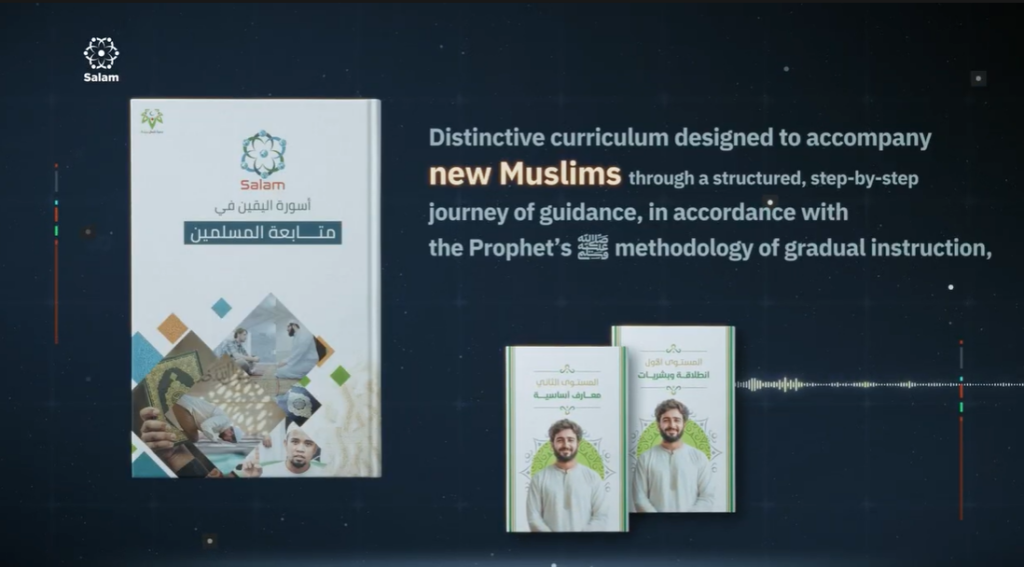
For new Muslims, the Asawirat Al-Yaqeen (Bracelets of Certainty) program offers a complete structured path toward firm faith, including:
- Stage One: The Declaration of Faith, prayer, and ritual essentials
- Stage Two: The pillars of Iman, fasting, zakat, and Hajj
- Stage Three: Repentance, character, and the Seerah of the Prophet (PBUH)
- Stage Four: Contemporary questions, Islamic identity, and life purpose
Over 114,000 new Muslims across 140 countries have walked this path. Join them.
Reach out directly to the Salam Center team to start the Asawirat Al-Yaqeen (Bracelets of Certainty) program for FREE.
Summary
Non-Muslims are permitted to hear, read, and study the Quran and its meanings — this openness is rooted in the Prophetic model and supported by scholarly consensus across all four Sunni schools of jurisprudence. Translations of the Quran are classified as tafsir, not the Quran itself, and carry no restriction on who may touch or read them.
The Arabic Mushaf carries a unique sanctity that Islamic scholars connect to ritual purity — a standard applied first to Muslims themselves. Sincere seekers engaging with the Quran through translations, bilingual tafsir books, or digital means encounter no scholarly restriction and are actively welcomed into the conversation.
Frequently Asked Questions
Can non-Muslims read the Quran in English?
Yes. Non-Muslims may read, listen to, and study the Quran in English or any other language without restriction. English translations are classified as interpretations of meaning (tafsir), not the Quran itself, so no ruling of ritual purity applies. Islam’s invitation through the Quran extends to all of humanity.
Can non-Muslims study the Quran to learn about Islam?
Yes — and Islamic scholarship actively encourages it. Imam al-Nawawi in Al-Majmu’ stated that if a non-Muslim shows genuine interest and conversion is hoped for, teaching them the Quran is permitted in the stronger scholarly opinion. The Prophet (PBUH) himself recited Quranic verses in letters sent to non-Muslim rulers and spoke the Quran openly to the Quraysh.
Is there a difference between the Arabic Quran and a translated copy for non-Muslims?
Yes — the distinction is fundamental in Islamic jurisprudence. The Quran is defined as the Arabic divine revelation revealed to the Prophet Muhammad (PBUH). Any translation renders meanings (ma’ani), not the sacred text itself, and is therefore classified as tafsir. Non-Muslims may handle translated or bilingual copies without the restriction that applies to the Arabic Mushaf.
Curious about Islam?
Journey towards clarity and purpose. Our team is here to support you in your search for truth and spiritual guidance.
Embrace the Truth