
Do You Have to Read the Quran to Be a Muslim?
| Key Takeaways |
| Reading the Quran is not a condition for becoming a Muslim — entering Islam requires only the sincere utterance of the Shahada with conviction. |
| The Quran is the literal word of Allah, preserved verbatim since its revelation to Prophet Muhammad (PBUH) over 1,400 years ago. |
| Reciting the Quran carries immense spiritual reward, with scholars of Ahlus Sunnah unanimously affirming its centrality to a Muslim’s daily worship. |
| Millions of Muslims worldwide worship through memorized recitations and engage with the Quran’s meaning through translations and scholarly commentary before mastering Arabic. |
The gateway into Islam is the Shahada — the sincere declaration that there is no deity worthy of worship except Allah, and that Muhammad (PBUH) is His final Messenger. That single act of faith, spoken with genuine belief in the heart, is sufficient to enter the fold of Islam. Nothing else is required at the moment of conversion.
What changes after that declaration is the beginning of a journey. And the Quran sits at the heart of that journey — not as a barrier to entry, but as a living companion for the road ahead.
Do You Have to Read the Quran to Be a Muslim?
No, you do not have to read the Quran to become a Muslim. Reading the Quran is not among the five pillars of Islam, and it is not a prerequisite for entering the religion.
The Prophet Muhammad (PBUH) welcomed people into Islam through the Shahada alone. Many of his Companions (Sahabah) embraced Islam before a single written Quranic scripture reached their hands, and their faith was complete and accepted.
That said, engaging with the Quran becomes an obligation that grows with one’s ability. Scholars affirm that learning what is necessary to perform the obligatory prayers — specifically Surah Al-Fatihah — is required of every Muslim who is capable of learning it. This is a graduated obligation, not an instant demand placed on a new believer the moment they say the Shahada.
To understand the relationship between the Quran and Muslim identity, it helps to understand what the Quran actually is from an Islamic doctrinal perspective. You can explore a full treatment of this on the what do Muslims believe about the Quran page of the Salam platform.
What New Muslims Are Actually Required to Learn From the Quran?
The first and most immediate Quranic obligation for a new Muslim is Surah Al-Fatihah. The Prophet (PBUH) said:
“لاَ صَلاَةَ لِمَنْ لَمْ يَقْرَأْ بِفَاتِحَةِ الْكِتَابِ”
“There is no prayer for the one who does not recite Al-Fatihah.” (Sahih al-Bukhari, Hadith 756)
Since the five daily prayers are obligatory, and every unit (rak’ah) of prayer requires Al-Fatihah, learning this opening chapter is the first concrete Quranic milestone for a new Muslim.
Al-Fatihah consists of just seven verses and can be learned through listening and repetition before any formal reading ability is developed.
Scholars permit the use of transliteration as a transitional aid, while emphasizing that learning the Arabic script remains the goal. The principle that religious obligations are scaled according to individual capacity — a principle rooted in the Quranic declaration:
لَا يُكَلِّفُ اللَّهُ نَفْسًا إِلَّا وُسْعَهَا
“Allah does not burden a soul beyond that it can bear.” (Quran 2:286)
This is one of the foundational islam principles that governs how Islamic law approaches gradual learning.
Have Questions About Islam?
Our team is ready to answer your questions clearly and respectfully. Ask freely and receive honest guidance.
Ask Us NowWhat Is the Quran?
The Quran is the literal word of Allah, revealed to Prophet Muhammad (PBUH) through the Angel Jibreel (Gabriel) over approximately 23 years. The Quran is Allah’s direct address to humanity.
Allah says in the Quran:
إِنَّا نَحْنُ نَزَّلْنَا الذِّكْرَ وَإِنَّا لَهُ لَحَافِظُونَ
“Indeed, it is We who sent down the Quran and indeed, We will be its guardian.” (Quran 15:9)
This divine guarantee of preservation is not merely theological — it has a documented historical reality.
The history of the Quran demonstrates how the text was memorized by thousands of Companions during the Prophet’s lifetime, compiled under Abu Bakr (RA), and standardized under Uthman ibn Affan (RA) into the Mushaf that exists today, unchanged, in over 2 billion homes worldwide.
Because of what the Quran is, connecting with it holds immense spiritual weight. The Prophet (PBUH) said:
“خَيْرُكُمْ مَنْ تَعَلَّمَ الْقُرْآنَ وَعَلَّمَهُ”
“The best among you are those who learn the Quran and teach it.” (Sahih al-Bukhari, Hadith 5027)
This hadith establishes learning the Quran as a mark of excellence — an aspiration, a spiritual summit — presented to motivate believers, not to gatekeep their faith.
The Reward for Reciting the Quran Even When It Is Difficult
One of the most compassionate and frequently cited hadiths on this subject addresses the new Muslim or any believer who struggles with recitation directly.
“الَّذِي يَقْرَأُ الْقُرْآنَ وَهُوَ مَاهِرٌ بِهِ مَعَ السَّفَرَةِ الْكِرَامِ الْبَرَرَةِ، وَالَّذِي يَقْرَأُ الْقُرْآنَ وَيَتَتَعْتَعُ فِيهِ وَهُوَ عَلَيْهِ شَاقٌّ لَهُ أَجْرَانِ”
“The one who is proficient in the Quran will be with the noble, righteous scribes (angels), and the one who recites the Quran and stutters and finds it difficult will have a double reward.” (Sahih Muslim, Hadith 798)
Two rewards — not a penalty, not a lesser standing. The struggle itself is the worship.
Reading, Listening, and Understanding — Multiple Valid Paths to the Quran
Many new Muslims engage with the Quran’s meanings long before they can read the Arabic script. This is a recognized and valued path within the tradition.
Listening to the Quran holds its own documented spiritual status. Allah says:
وَإِذَا قُرِئَ الْقُرْآنُ فَاسْتَمِعُوا لَهُ وَأَنصِتُوا لَعَلَّكُمْ تُرْحَمُونَ
“So when the Quran is recited, then listen to it and pay attention that you may receive mercy.” (Quran 7:204)
Reading a translation to understand the Quran’s guidance, exploring why Muslims believe in the Quran, and reflecting on its meanings are all acts of engagement that scholars have affirmed as spiritually meritorious.
Read Also: Can Non-Muslims Read the Quran?
What is the Quran’s Relationship to Islam’s Broader Belief System?
The Quran is inseparable from the broader framework of Islamic belief. It confirms the existence and absolute oneness of Allah — a doctrine explored fully in the article on how does Islam view the nature of God. It speaks about Islam’s view on other religions, clarifies what the Quran says about other religions, and provides the theological basis for Islam’s relationship with earlier scriptures, including what Muslims believe about the Bible.
Understanding the Quran is also tied to understanding the Messenger through whom it came. The Prophet’s biography — from his childhood to how he became the Prophet of Islam to the miraculous Night Journey — provides the living context in which the Quran was revealed and lived.
The Quran and the Prophet’s Sunnah are inseparable sources of guidance. One without the other is incomplete. Scholars of Ahlus Sunnah have always maintained that understanding the Quran requires understanding the Prophetic tradition that explained and embodied it.
Have Questions About Islam?
Our team is ready to answer your questions clearly and respectfully. Ask freely and receive honest guidance.
Ask Us NowA Structured Path for New Muslims
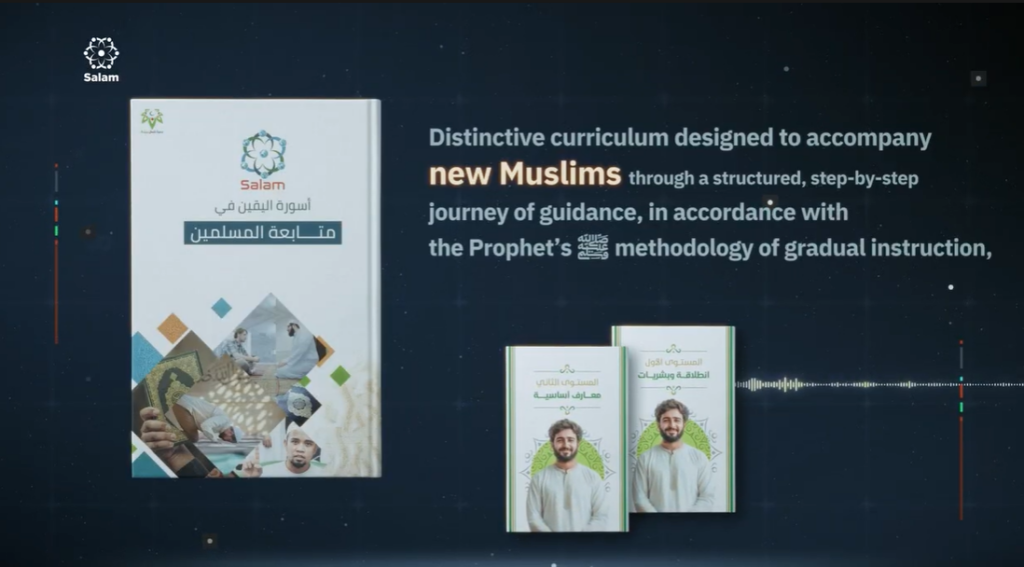
The Salam Center for Da’wah and Dialogue has addressed exactly this situation through its Asawirat Al-Yaqeen (Bracelets of Certainty) curriculum — a structured four-stage program supporting new Muslims from the Shahada onward. T
he curriculum’s first level, A New Beginning and Glad Tidings, introduces the pillars of Islam, the meaning of the Shahada, and the practical rulings for prayer — including the foundational Quranic recitations every Muslim needs.
It is designed on the principle of gradual instruction, mirroring the Prophetic approach of building faith and knowledge progressively.
Over 114,588 new Muslims across 140 countries have engaged with this curriculum — with more than 75% completing the first stage and building a confident, grounded relationship with the Quran from wherever they started.
Ready to begin a structured learning journey? The Asawirat Al-Yaqeen (Bracelets of Certainty) program offers:
- A progressive four-stage curriculum built for new Muslims
- Lessons on prayer, purification, belief, and Quranic engagement
- Compassionate instruction grounded in the methodology of Ahlus Sunnah wal Jama’ah
- Access for new Muslims across all language backgrounds and starting points
- A supportive community of learners from over 140 countries
Reach out directly to the Salam Center team to start the Asawirat Al-Yaqeen (Bracelets of Certainty) program for FREE.
Your Next Step — Wherever You Are
Whether you are still exploring, have recently said the Shahada, or simply want to understand Islam more clearly — the Salam platform is here for you.
Browse the Salam blog for in-depth articles on Islamic belief, practice, and spirituality.
Explore the full range of resources on the Salam Platform.
Have a specific question, want to enter Islam, or need guidance on the next step in your journey? Reach out directly — the Salam Center team is ready to help.
Summar
Becoming a Muslim requires only the sincere utterance of the Shahada — not prior Quranic literacy. What follows is a gradual journey toward engaging with the Quran through listening, memorization, and study, all scaled according to each person’s capacity by the mercy of Allah.
The Quran remains the central text of Muslim identity and daily worship. Every step taken toward it — however halting, however slow — is honored in the Prophetic tradition as an act of worship in itself, rewarded by Allah regardless of the level reached.
Frequently Asked Questions
Can you become Muslim without knowing how to read Arabic?
Yes, absolutely. You can become Muslim without knowing how to read Arabic. Entering Islam requires only the sincere declaration of the Shahada — there is no Arabic literacy requirement. The Prophet (PBUH) welcomed people into Islam through that declaration alone, and Islamic law scales all subsequent religious obligations according to each individual’s capacity, as established in Quran 2:286.
Is reading the Quran obligatory for Muslims?
Learning to recite Surah Al-Fatihah is obligatory for Muslims who are capable, because it is recited in every unit of the five daily prayers. Beyond that, engaging with the Quran’s meaning and broadening one’s recitation is a highly emphasized religious duty — but one that is pursued progressively, not demanded instantly. Scholars of Ahlus Sunnah affirm this graduated approach.
What reward do you get for struggling to read the Quran?
A double reward. The Prophet Muhammad (PBUH) stated in Sahih Muslim, Hadith 798 that the believer who recites the Quran with difficulty and finds it hard earns two rewards — one for the recitation, and one for the struggle itself. Difficulty is not a spiritual disqualification; it is a recognized act of worship.
Can a new Muslim listen to the Quran instead of reading it?
Yes, and it is spiritually meritorious. Allah commands in Quran 7:204 that when the Quran is recited, believers should listen attentively and they will receive mercy. Listening to the Quran is an endorsed form of engagement, especially for those still developing their reading skills, and it carries genuine spiritual reward.
How quickly does a new Muslim need to learn to read the Quran?
There is no fixed deadline. Islamic law operates on the principle that obligations are proportional to ability. New Muslims are encouraged to begin learning Surah Al-Fatihah as a first step and to build from there steadily. Programs like the Asawirat Al-Yaqeen (Bracelets of Certainty) curriculum by the Salam Center for Da’wah and Dialogue are designed precisely to support this gradual, compassionate journey.
Curious about Islam?
Journey towards clarity and purpose. Our team is here to support you in your search for truth and spiritual guidance.
Embrace the Truth