
Why Do Muslims Memorize the Quran?
| Key Takeaways |
| Muslims memorize the Quran primarily because it is recited verbatim five times daily in salah, making memorization a functional necessity rather than an optional devotion. |
| A person who memorizes the entire Quran is called a Hafiz, and this practice preserves an unbroken oral chain of transmission stretching back to Prophet Muhammad (PBUH). |
| The Quran’s own linguistic structure — its rhythm, repetition, and rhetorical patterns — was historically designed for oral preservation, not silent reading. |
| Hadith from Sahih al-Bukhari and Sahih Muslim describe specific spiritual rewards, including elevated status in Paradise, tied directly to Quran memorization. |
| Memorization protects the text from the kind of textual corruption Muslims believe affected earlier scriptures, fulfilling the Quranic promise of divine preservation in Surah Al-Hijr. |
Muslims memorize the Quran because Islamic law requires portions of it for valid prayer, and because the tradition holds enormous spiritual, historical, and communal weight beyond that basic requirement.
Five daily prayers cannot be performed without reciting Quranic verses from memory, which means every practicing Muslim memorizes at least some portion by necessity.
Beyond this baseline, millions pursue full memorization — becoming a Hafiz — for reasons rooted in worship, family legacy, textual preservation, and the promise of specific rewards described in authenticated Hadith.
1. Muslims Memorize the Quran Because Salah Cannot Be Performed Without Memorized Verses
Every unit of the five daily prayers requires reciting Quranic verses from memory, most centrally Surah Al-Fatihah, which Islamic scholarship holds as an essential pillar of valid prayer.
A worshiper cannot carry a written text into salah and read from it in the way one might read from a book during study; the recitation must come from what has been internalized.
This is the single most immediate and universal reason Muslims memorize Quranic material — it is not optional preparation but a functional requirement built into the five daily acts of worship every practicing Muslim performs.
2. The Quran Was Revealed in a Form Built for Oral Memory
The Quran’s internal structure — its rhyme patterns, repeated phrases, and rhythmic cadence — reflects a text designed for oral transmission rather than silent reading alone. Classical Arabic literary tradition already valued memorization and oral poetry before Islam, and the Quran’s revelation over 23 years to a largely oral society meant memorization was the primary method of preservation from the very first verses revealed to Prophet Muhammad (PBUH) in the cave of Hira.
Companions of the Prophet, known as the Sahaba, memorized chapters as they were revealed, often reciting them back to confirm accuracy.
This created layered redundancy: multiple individuals held identical memorized content simultaneously, which meant no single point of failure could corrupt the text.
Scholars studying the history of the Quran point to this oral-first transmission model as distinct from how many other ancient religious texts were preserved, which often relied more heavily on scribal copying with greater risk of transcription error.
The written compilation under Caliph Uthman came later, cross-checked against the living memories of numerous Huffaz (plural of Hafiz) precisely because oral memorization was already the trusted standard.
Learn More About Islam
Discover the beauty, teachings, and wisdom of Islam in a clear and welcoming way. Start exploring and deepen your understanding today.
Learn More3. Authentic Hadith Describe Specific Rewards for Memorizers of the Quran
Prophet Muhammad (PBUH) described distinct spiritual rewards for those who memorize and recite the Quran, recorded across multiple chains in Sahih Muslim and Sunan at-Tirmidhi. These narrations frame memorization not as an academic exercise but as an act carrying direct consequence in the Hereafter, which motivates believers well beyond the baseline needs of daily prayer.
One well-known Hadith found in Sunan at-Tirmidhi states that the one who recites the Quran fluently will be with the honorable, obedient scribes (angels), while the one who recites it with difficulty, struggling through it, receives a double reward.
This distinction matters — it tells believers that even imperfect memorization carries recognized value, not just fluent mastery.
Another narration in Sahih Muslim describes the Quran as an intercessor for its companion on the Day of Judgment, appearing on behalf of those who memorized and lived by it.
Believers who understand why Muslims believe in the Quran as the literal, uncreated word of Allah find these rewards logically connected — memorizing divine speech is treated with a gravity distinct from memorizing any human text.
4. Quran Memorization Preserves the Quranic Text Against Corruption
Muslims widely hold that Quran memorization functions as a living safeguard against textual alteration, fulfilling the Quranic verse that promises divine preservation of the revelation. Surah Al-Hijr states:
إِنَّا نَحْنُ نَزَّلْنَا الذِّكْرَ وَإِنَّا لَهُ لَحَافِظُونَ
“Indeed, it is We who sent down the Quran and indeed, We will be its guardian.” (Quran 15:9)
Muslims understand human memorization as one of the practical mechanisms through which this preservation occurs.
Because tens of thousands of Huffaz across different countries, languages of daily life, and generations hold the same text in memory simultaneously, any attempted alteration to a written copy would be immediately detectable against the living oral record.
This is frequently contrasted, within Islamic theological discourse, against the transmission history of earlier scriptures.
For readers curious about that comparative angle, the article on what the Quran says about other religions addresses this from the Quranic text’s own perspective, and do Muslims believe the Bible is preserved unpacks the theological distinction Muslims draw between the two transmission histories.
5. Memorizing the Quran Connects Modern Muslims to the Prophet’s Own Companions
Memorizing the Quran links a contemporary Muslim to an unbroken chain of transmission — called isnad — stretching back through named teachers to the companions who learned directly from Prophet Muhammad (PBUH). This is not a symbolic connection; it is a documented chain.
A student receiving an ijazah (certification of memorization) can typically trace their teacher, their teacher’s teacher, and so on, back through history to the Prophet himself.
This chain-based system means Quran memorization today is not an isolated personal project but participation in a continuous, verifiable tradition.
Companions like Zayd ibn Thabit, who led the compilation effort under Abu Bakr and later Uthman, were themselves Huffaz whose memorized recitation informed the written text.
Learn More About Islam
Discover the beauty, teachings, and wisdom of Islam in a clear and welcoming way. Start exploring and deepen your understanding today.
Learn More6. Memorizing the Quran Is an Act of Worship in Itself
Beyond its practical uses in prayer, the act of memorizing the Quran is considered a form of ibadah (worship) that draws a believer closer to Allah independent of any prayer requirement. Muslims often describe the process of memorization — the repetition, the quiet concentration, the gradual mastery of a passage — as spiritually transformative in its own right, distinct from simply reading translated meaning.
The Prophet Muhammad (PBUH) is reported in Sahih al-Bukhari to have said that the best among believers are those who learn the Quran and teach it to others, placing memorization within a broader framework of continuous transmission and communal benefit rather than solitary achievement.
This is why memorization circles, family Quran study, and formal Hifz programs are treated as communal religious activities rather than private study habits.
The process itself, believers hold, cultivates humility, patience, and sustained focus — qualities Islamic teaching considers valuable independent of the specific content memorized, though the Quran’s status as the literal speech of Allah intensifies the significance considerably.
This connects to the broader concept of faith in Islam as something cultivated through consistent, deliberate practice rather than passive belief alone.
Read Also: Why Do Muslims Read the Quran?
7. Full Memorization Carries Elevated Status Within the Muslim Community
A Hafiz — someone who has memorized the entire Quran, all 6,000-plus verses across 114 surahs — occupies a position of particular respect within Muslim communities globally, often leading prayer, teaching, and being consulted on textual questions.
This status is not primarily social prestige; it reflects the practical reality that a Hafiz carries complete, portable access to the text without dependency on written copies, useful historically in contexts where books were scarce, expensive, or physically impossible to carry.
Sahih al-Bukhari records that the Prophet Muhammad (PBUH) would appoint as prayer leader (Imam) whoever among a group had memorized the most Quran, a practical criterion still applied in mosques worldwide today.
This creates a direct, ongoing incentive: the more one memorizes, the more central a role one can play in communal worship.
Families across the Muslim world, from Indonesia to Morocco, prioritize sending children to Hifz programs specifically because this status is tied to concrete communal function, not abstract prestige.
Read Also: Can Non-Muslims Read the Quran?
8. Quran Memorization Anchors New Muslims During Their Early Learning Journey
For new Muslims, memorizing even short surahs provides an immediate, tangible sense of connection to the faith during a period that can otherwise feel overwhelming with new rulings, terminology, and practice.
Learning Al-Fatihah, Al-Ikhlas, and a handful of short chapters gives a convert something concrete to hold onto — verses they can recite in every prayer from day one, rather than waiting until they have mastered broader theological concepts.
This is part of why structured post-conversion education places early emphasis on memorization alongside foundational belief.
Read Also: Do Muslims Have to Memorize the Quran?
Learn More About Islam
Discover the beauty, teachings, and wisdom of Islam in a clear and welcoming way. Start exploring and deepen your understanding today.
Learn MoreDiscover More About Faith, Certainty, and the Journey to Islam
If these questions resonate with you, there is more to explore.
Read more reflections and answers on the Salam blog.
Curious about the broader picture of Islamic belief? Visit the Salam Platform to explore further.
Considering the next step yourself, or have specific questions about entering Islam? Reach out directly — a real person will respond, not an automated system.

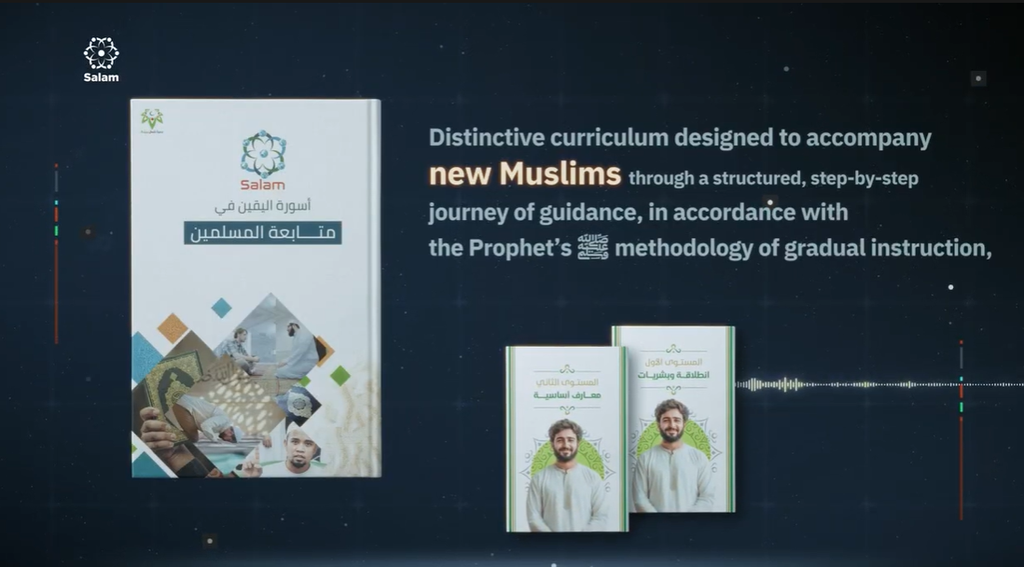
Interested in the Asawirat Al-Yaqeen (Bracelets of Certainty) program for new Muslims? It offers:
- A structured four-stage curriculum moving from foundational pillars through practical life rulings
- Guided lessons on Salah, purification, the Shahada, and the six pillars of Iman
- Seerah study covering the life of Prophet Muhammad (PBUH) and its lessons
- Support tailored specifically to converts navigating the early post-conversion period
The Salam Center team is available to answer general inquiries, walk through the conversion process, or simply talk through questions at your own pace.
Reach out directly to the Salam Center team to start the Asawirat Al-Yaqeen (Bracelets of Certainty) program for FREE.
Summary
Quran memorization serves both an immediate practical function and a deeper spiritual purpose within Islam. Salah cannot be performed without memorized verses, while full memorization connects believers to an unbroken chain of transmission reaching back to the Prophet’s own companions.
Beyond ritual necessity, memorization is treated as worship carrying specific rewards described in Sahih Hadith, alongside its role in textual preservation. New Muslims especially find early memorization anchors their growing faith during a formative period of learning.
Frequently Asked Questions
Do Muslims have to memorize the entire Quran?
No — only enough for valid prayer, typically Surah Al-Fatihah and a few short surahs, is required. Full memorization, earning the title Hafiz, is a voluntary pursuit carrying additional spiritual reward described in Sahih Muslim, not an obligation on every believer.
What is a Hafiz in Islam?
A Hafiz is someone who has memorized the entire Quran — all 114 surahs — accurately, often verified through an ijazah chain tracing back to earlier teachers. Sahih al-Bukhari notes that a Hafiz is often given priority to lead communal prayer.
How long does it take to memorize the Quran?
Timeframes vary widely, from under two years for young children in intensive Hifz programs to a decade or more for adults balancing memorization with work and family. Sahih al-Bukhari notes the Prophet Muhammad (PBUH) praised even gradual, effortful recitation, not only speed.
Can non-Arabic speakers memorize the Quran?
Yes — millions of Huffaz worldwide, from Indonesia to Nigeria to the United States, memorize the Quran in its original Arabic without being native Arabic speakers, often studying the meaning separately through translation. This reflects the tradition’s emphasis on preserving the exact revealed wording alongside its understood meaning.
Curious about Islam?
Journey towards clarity and purpose. Our team is here to support you in your search for truth and spiritual guidance.
Embrace the Truth