
Does the Quran Say Good Men Are for Good Women?
The Quran says good men are for good women — the statement comes from Surah An-Nur, verse 26, and it was revealed for a specific reason: to clear the name of Aisha (RA) after a group of hypocrites spread a slanderous accusation against her.
The verse does not float in isolation as a general dating principle. It closes a longer passage, spanning verses 11 through 26, that Allah revealed to settle one of the most painful episodes in early Islamic history.
What Does the Quran Say About Good Men Being for Good Women?
The verse in question is Surah An-Nur 24:26, and it pairs moral character with moral character rather than describing romantic attraction. The Arabic word used for “good” here is tayyib (طيّب), a term that carries the sense of purity, wholesomeness, and moral soundness — not merely likability or social status.
اَلْخَبِيثَاتُ لِلْخَبِيثِينَ وَالْخَبِيثُونَ لِلْخَبِيثَاتِ ۖ وَالطَّيِّبَاتُ لِلطَّيِّبِينَ وَالطَّيِّبُونَ لِلطَّيِّبَاتِ ۚ أُولَٰئِكَ مُبَرَّءُونَ مِمَّا يَقُولُونَ ۖ لَهُم مَّغْفِرَةٌ وَرِزْقٌ كَرِيمٌ
“Evil words are for evil men, and evil men are [subjected] to evil words. And good words are for good men, and good men are [an object] of good words. Those [good people] are declared innocent of what the slanderers say. For them is forgiveness and noble provision.” (Quran 24:26)
Some translators render this as “good women are for good men,” since the Arabic terms tayyibat and tayyibun apply grammatically to both feminine and masculine forms of goodness, and the verse sits directly after verses addressing Aisha’s innocence.
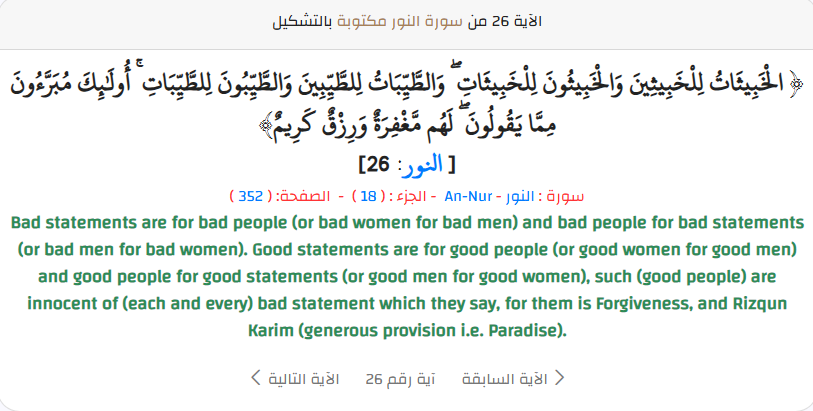
The structure mirrors itself: corruption pairs with corruption, purity pairs with purity, and each half of the verse reinforces the other.
Learn More About Islam
Discover the beauty, teachings, and wisdom of Islam in a clear and welcoming way. Start exploring and deepen your understanding today.
Learn MoreWhy Was Surah An-Nur Verse 26 Revealed?
Verse 26 closes the Quran’s response to the slander against Aisha (RA), known in Islamic history as Hadith al-Ifk, or the incident of the lie. During a military expedition, Aisha was inadvertently left behind by the caravan. A companion named Safwan ibn al-Mu’attal found her and escorted her safely back to the Muslim camp.
A faction of hypocrites, led by Abdullah ibn Ubayy, seized on this innocent event and fabricated an accusation of misconduct against her.
The Prophet Muhammad (PBUH) and Aisha both endured nearly a month of anguish before Allah revealed a passage of vindication, beginning at verse 11 of Surah An-Nur and concluding with verse 26. This history is why the verse cannot be read as a stand-alone dating aphorism.
According to the tafsir of Ibn Kathir, citing the companion Ibn ‘Abbas, the verse was revealed specifically regarding Aisha and those who slandered her — meaning slanderous speech was fitting only for people of corrupt character, while Aisha’s purity made her entirely unsuited to what was said about her.
The Ifk Incident In Brief
| Element | Detail |
| Who was accused | Aisha (RA), wife of the Prophet Muhammad (PBUH) |
| Who spread the slander | A faction led by the hypocrite Abdullah ibn Ubayy |
| Companion involved in the incident | Safwan ibn al-Mu’attal, who escorted Aisha back to the camp |
| Duration of distress | Approximately one month before revelation came |
| Resolution | Surah An-Nur, verses 11–26, publicly declaring Aisha’s innocence |
Read Also: The Quran Says Allah Has No Son
What Do Classical Scholars Say About This Verse?
Ibn Kathir’s tafsir explains that the verse establishes purity of speech and character as naturally suited to purity, and corruption as naturally suited to corruption. He records that Ibn ‘Abbas, along with Mujahid, Sa’id ibn Jubayr, and other early authorities, understood the verse as directly tied to Aisha’s case: what the hypocrites said about her belonged to people like themselves, while she belonged to innocence.
A number of commentators extend this into a broader observed principle — that a person’s habits and character rarely exist in isolation, and that outward conduct tends to reflect an underlying moral disposition. This reading treats the verse as descriptive of a spiritual pattern Allah has placed in creation, rather than a legal ruling or a guarantee about any individual case.
Scholars of Ahlus Sunnah wal Jama’ah caution against detaching the verse from its revealed context, since doing so risks turning a specific defense of Aisha’s honor into an unrelated general claim the verse itself does not make in isolation.
Read Also: Does the Quran Say Jesus Is the Word of God?
How Does This Verse Relate To Marriage And Compatibility?
The verse is often referenced in discussions of marriage because it reflects a Quranic emphasis on shared moral character between spouses, though its primary and historically established purpose was the vindication of Aisha.
Islamic teaching on marriage elsewhere in the Quran and Sunnah does emphasize compatibility of faith and character as a foundation for a stable household, which is why this verse is frequently cited alongside that broader teaching, even though 24:26 itself was revealed in a specific historical context rather than as marital legislation.
This distinction matters for anyone researching the verse online, since it is easy to encounter the phrase “good men are for good women” divorced entirely from the account of Aisha’s vindication.
Reading the verse within Surah An-Nur, alongside the surrounding what does the Quran say about other religions-type inquiries into how the Quran treats truth and slander generally, gives a fuller and more honest picture of its meaning.
Read Also: What Does the Quran Say About Gambling?
Learn More About Islam
Discover the beauty, teachings, and wisdom of Islam in a clear and welcoming way. Start exploring and deepen your understanding today.
Learn MoreGet Guidance And Support From Salam Platform
If this verse raised questions about how the Quran addresses justice, character, or the story of Aisha (RA), there is more to explore.
Curious about what else the Quran teaches? Visit the Salam blog for articles grounded in authentic sources.
Considering Islam for yourself? Reach out directly to the Salam Center team — real people are ready to answer sincere questions, at any hour, with no pressure.
Reach out directly — our team is ready to listen, guide, and welcome you.

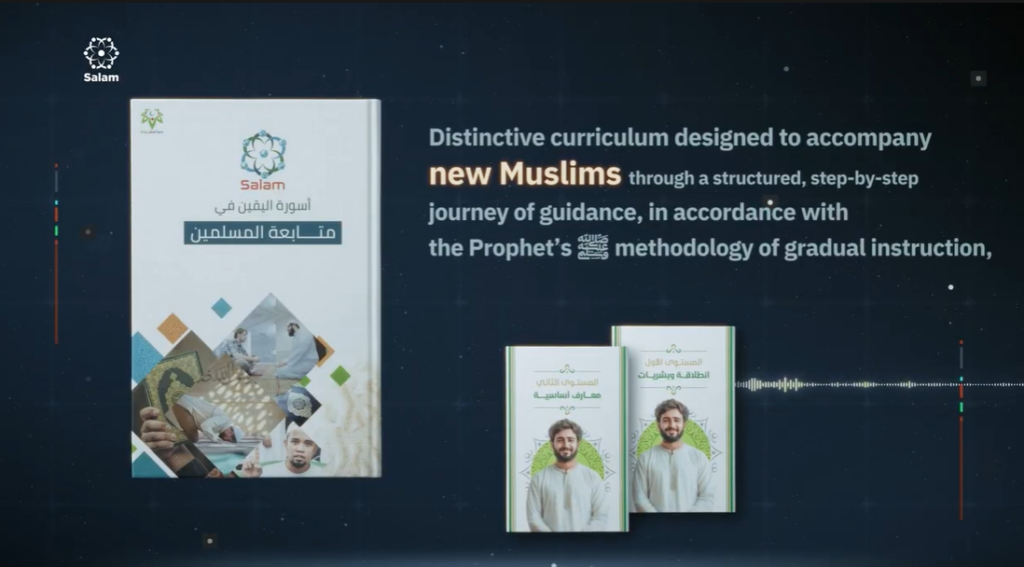
Already Muslim and looking for structured next steps? The Asawirat Al-Yaqeen (Bracelets of Certainty) program offers a guided path through the essentials of faith and practice, including:
- Foundational knowledge of the pillars of Islam and Iman
- Practical guidance on prayer, purification, and worship
- The Seerah of Prophet Muhammad (PBUH) and lessons from his life
- Etiquette, family rulings, and daily life guidance rooted in the Sunnah
- Contemporary issues addressed from the perspective of Ahlus Sunnah wal Jama’ah
Reach out directly to the Salam Center team to start the Asawirat Al-Yaqeen (Bracelets of Certainty) program for FREE.
Summary
Surah An-Nur 24:26 declares that good men are paired with good women in character, a statement Allah revealed to vindicate Aisha (RA) after false slander threatened her honor and standing.
The verse’s closing promise of forgiveness and honorable provision reflects a lasting Quranic principle: divine justice defends the innocent and matches purity of character with purity in return.
Frequently Asked Questions
Does the Quran literally say good men are for good women?
Yes. Surah An-Nur 24:26 states that good men and good women belong together, using the Arabic term tayyib for moral purity, within a passage revealed to vindicate Aisha (RA) after false accusations.
Is Surah An-Nur 24:26 a verse about marriage rules?
Not directly. Classical tafsir, including Ibn Kathir, ties it specifically to Aisha’s vindication, though its principle of matching character is often referenced in broader Islamic teaching on marital compatibility.
What does “tayyib” mean in this verse?
Tayyib means pure, wholesome, or morally sound. The Quran uses it here to describe good character, contrasting it with khabith, meaning corrupt or morally impure.
Curious about Islam?
Journey towards clarity and purpose. Our team is here to support you in your search for truth and spiritual guidance.
Embrace the Truth