The Quran Says Allah Has No Son
The Quran says clearly and repeatedly that Allah has no son. This sits at the center of Islamic theology, expressed with a force and clarity meant to leave no room for ambiguity.
Surah Al-Ikhlas, one of the most frequently recited chapters in Muslim daily life, exists almost entirely to establish this single truth: Allah does not beget, and He was not begotten.
Where does the Quran say God has no son?
The clearest statement in the Quran that Allah has no comes in Surah Al-Ikhlas, a short chapter revealed specifically to answer questions about who Allah is.
قُلْ هُوَ اللَّهُ أَحَدٌ
“Say, ‘He is Allah, [who is] One,'” (Quran 112:1)
اللَّهُ الصَّمَدُ
“Allah, the Eternal Refuge.” (Quran 112:2)
لَمْ يَلِدْ وَلَمْ يُولَدْ
“He neither begets nor is born,” (Quran 112:3)
وَلَمْ يَكُن لَّهُ كُفُوًا أَحَدٌ
“Nor is there to Him any equivalent.” (Quran 112:4)
This verse — “He neither begets nor is born” — closes the door on any notion of divine lineage. Allah does not produce offspring the way created beings do, and He was not produced by anything either.
The Prophet Muhammad ﷺ described this short surah as equal in meaning to one-third of the Quran, a statement recorded in Sahih Bukhari, underscoring how central this declaration is to Islamic theology as a whole.
The Quran describes claiming Allah has a son as a grave matter
Surah Maryam takes the discussion further, addressing the claim head-on with unusually intense language.
وَقَالُوا اتَّخَذَ الرَّحْمَٰنُ وَلَدًا
“And they say, ‘The Most Merciful has taken [for Himself] a son.'” (Quran 19:88)
لَّقَدْ جِئْتُمْ شَيْئًا إِدًّا
“You have done an atrocious thing.” (Quran 19:89)
تَكَادُ السَّمَاوَاتُ يَتَفَطَّرْنَ مِنْهُ وَتَنشَقُّ الْأَرْضُ وَتَخِرُّ الْجِبَالُ هَدًّا
“The heavens almost rupture therefrom and the earth splits open and the mountains collapse in devastation,” (Quran 19:90)
أَن دَعَوْا لِلرَّحْمَٰنِ وَلَدًا
“That they attribute to the Most Merciful a son.” (Quran 19:91)
وَمَا يَنبَغِي لِلرَّحْمَٰنِ أَن يَتَّخِذَ وَلَدًا
“And it is not appropriate for the Most Merciful that He should take a son.” (Quran 19:92)
This passage uses cosmic imagery — heavens rupturing, mountains collapsing — to convey the theological weight of the claim, not to threaten physical catastrophe.
The severity of the language reflects how directly the claim contradicts Allah’s nature as described throughout the Quran: self-sufficient, without need, and without any partner in His essence or actions.
Learn More About Islam
Discover the beauty, teachings, and wisdom of Islam in a clear and welcoming way. Start exploring and deepen your understanding today.
Learn MoreHow does the Quran address the specific claim about Jesus as the son of God?
This is where the Islamic position becomes most relevant to interfaith conversation, since the son claim in question is most commonly associated with Christian theology regarding Prophet Isa (Jesus).
يَا أَهْلَ الْكِتَابِ لَا تَغْلُوا فِي دِينِكُمْ وَلَا تَقُولُوا عَلَى اللَّهِ إِلَّا الْحَقَّ ۚ إِنَّمَا الْمَسِيحُ عِيسَى ابْنُ مَرْيَمَ رَسُولُ اللَّهِ وَكَلِمَتُهُ أَلْقَاهَا إِلَىٰ مَرْيَمَ وَرُوحٌ مِّنْهُ ۖ فَآمِنُوا بِاللَّهِ وَرُسُلِهِ ۖ وَلَا تَقُولُوا ثَلَاثَةٌ ۚ انتَهُوا خَيْرًا لَّكُمْ ۚ إِنَّمَا اللَّهُ إِلَٰهٌ وَاحِدٌ ۖ سُبْحَانَهُ أَن يَكُونَ لَهُ وَلَدٌ
“O People of the Scripture, do not commit excess in your religion or say about Allah except the truth. The Messiah, Jesus, the son of Mary, was but a messenger of Allah and His word which He directed to Mary and a soul [created at a command] from Him. So believe in Allah and His messengers. And do not say, ‘Three’; desist – it is better for you. Indeed, Allah is but one God. Exalted is He above having a son.” (Quran 4:171)
Prophet Isa holds an honored position in Islam as one of Allah’s greatest messengers, but the Quran is explicit that he was a created servant, not a divine son.
He spoke as an infant in his cradle to defend his mother’s honor, he performed miracles by Allah’s permission, and he called his people to worship Allah alone.
None of that, the Quran insists, makes him divine or makes Allah a father. This is a core distinction covered in more depth when comparing Islam vs. Christianity on the nature of Jesus and the concept of the Trinity.
Why does biological sonship not apply to Allah?
Arab commentators have long pointed out that fatherhood, in any literal sense, requires a kind of continuity — a father shares something of his nature with his child, and both exist within time and matter. Allah exists outside of these categories entirely; He is not bound by the processes of birth, growth, or reproduction that define created life.
Ascribing a son to Him would mean ascribing to Him a nature like that of His creation, which directly contradicts the meaning of As-Samad — the Self-Sufficient Master, needing nothing and dependent on nothing.
Read Also: Does the Quran Say Good Men Are for Good Women?
What does Islamic monotheism say about Allah’s uniqueness?
The rejection of a divine son is inseparable from the broader Islamic concept of Tawheed, or the oneness of Allah.
Tawheed holds that Allah is one in His essence, one in His attributes, and one in His right to be worshipped — no partner, no equal, no offspring shares in any of it.
| Concept | Islamic Position | Quranic Reference |
| Allah’s essence | Absolutely one, indivisible | Surah Al-Ikhlas 112:1 |
| Divine offspring | Categorically rejected | Surah Al-Ikhlas 112:3 |
| Jesus’s status | Prophet and messenger | Surah An-Nisa 4:171 |
| Trinity concept | Explicitly warned against | Surah An-Nisa 4:171 |
| Worship | Directed to Allah alone | Surah Maryam 19:93 |
This framework is often introduced to new seekers through the foundational 9 Islam principles, which lay out the basic architecture of Islamic belief before moving into more detailed theology.
For anyone exploring what belief in Allah actually requires on a daily, practical level, faith in Islam as a broader concept builds directly on this understanding of divine oneness.
Read Also: Does the Quran Say Jesus Is the Word of God?
How does this connect to the Quran’s view of other scriptures?
The Quran does not treat this correction as an attack on earlier revelation but as a restoration of a message it says had already been distorted over time.
Muslims are taught that the earlier scriptures given to Musa (Moses) and Isa (Jesus) originally taught the same monotheism, a claim explored further in what the Quran says about other religions.
Understanding why Muslims believe in the Quran as the final, unaltered word of Allah helps explain why this particular correction carries such theological weight for Muslims today.
Read Also: What Does the Quran Say About Gambling?
Learn More About Islam
Discover the beauty, teachings, and wisdom of Islam in a clear and welcoming way. Start exploring and deepen your understanding today.
Learn MoreGet Guidance And Support From Salam Platform
Questions about Allah’s nature often open the door to deeper questions about faith, purpose, and truth.
Browse more foundational topics on the Salam Platform
Read reflections and deeper explorations on the Salam blog
Have a specific question?
Reach out directly — our team is ready to listen, guide, and welcome you.
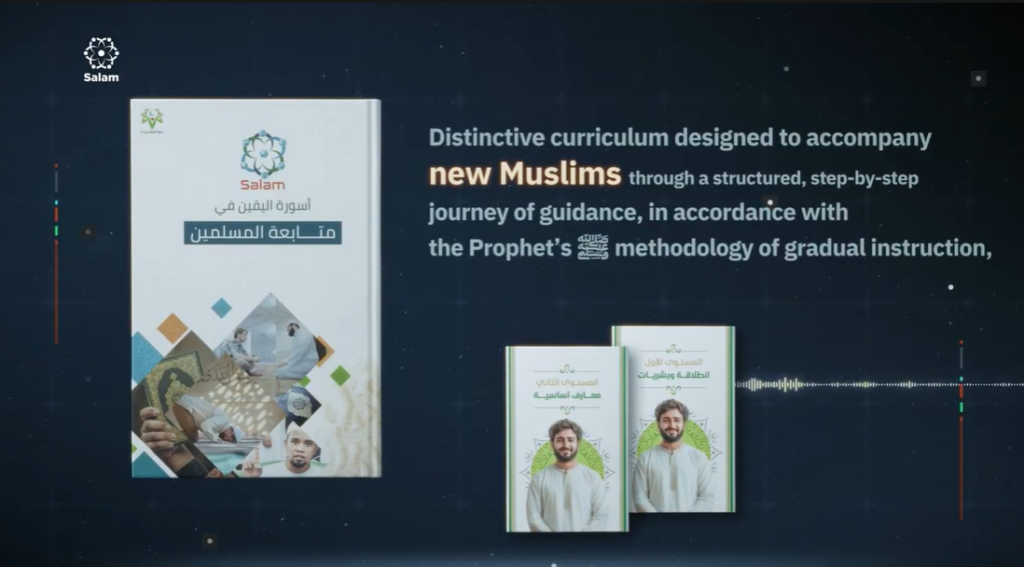
For those who have already taken their shahada or are considering it, the Salam Center offers structured post-conversion support through the Asawirat Al-Yaqeen (Bracelets of Certainty) program:
- A four-stage guided curriculum covering creed, worship, character, and daily life
- Personalized support from the earliest days after entering Islam
- Lessons on Tawheed, prayer, purification, and the life of Prophet Muhammad ﷺ
- A structured path from foundational knowledge toward lasting certainty (Yaqeen)
Whether you’re a sincere seeker with questions or a new Muslim looking for grounding, the Salam Center team welcomes you to reach out for guidance at any stage of the journey.
Reach out directly to the Salam Center team to start the Asawirat Al-Yaqeen (Bracelets of Certainty) program for FREE.
Summary
The Quran’s rejection of divine sonship for Allah rests on some of its most direct language, from Surah Al-Ikhlas’s declaration that He “neither begets nor is born” to Surah Maryam’s warning against the claim. Prophet Isa retains his honored status as a messenger throughout, while Tawheed remains the framework that ties every related verse together.
Understanding this belief opens a clearer view of how Islam approaches monotheism, prophethood, and the nature of the Divine. New Muslims and curious seekers alike find that this foundation, once grasped, brings a distinct sense of clarity and certainty to the rest of their faith journey.
Frequently Asked Questions
Does the Quran mention Jesus as the son of God?
No. The Quran explicitly denies that Jesus is the son of Allah, describing him instead as a prophet and messenger born miraculously to Maryam. Surah An-Nisa 4:171 states Allah is “exalted… above having a son,” affirming Jesus’s prophethood rather than divinity.
What surah says Allah has no son?
Surah Al-Ikhlas (112) is the clearest source, stating “He neither begets nor is born” (112:3). Surah Maryam (19:88-92) and Surah An-Nisa (4:171) reinforce this teaching from different angles, addressing both the general claim and its Christian formulation specifically.
Why is it considered serious in Islam to say Allah has a son?
Because it contradicts Tawheed, the belief in Allah’s absolute oneness, which Islam treats as the foundation of correct faith. Surah Maryam 19:89 calls the claim “an atrocious thing,” reflecting how directly it conflicts with Allah’s self-sufficient, uncreated nature.
Curious about Islam?
Journey towards clarity and purpose. Our team is here to support you in your search for truth and spiritual guidance.
Embrace the Truth