
Does the Quran Say Jesus Is the Word of God?
The Quran does call Jesus a “word” from Allah — this appears explicitly in Surah An-Nisa (4:171) and Surah Aal-e-Imran (3:45). But the title carries a meaning entirely different from what many assume. It does not signal divinity, nor does it echo the Christian doctrine of the Logos.
In the Quranic framework, Jesus is called a word from Allah because Allah created him through His command “Be” — without a father — the same creative word by which Allah brought Adam into existence.
Does the Quran say Jesus is the Word of God?
The Quran states directly that Jesus, son of Mary, is “a word from Him.” This phrase appears in two separate verses, addressed at two separate moments — once at the announcement of his conception, and once as a corrective statement to Christians centuries later.
In Surah Aal-e-Imran, the angels bring Mary the news of her son’s coming birth:
إِذْ قَالَتِ الْمَلَائِكَةُ يَا مَرْيَمُ إِنَّ اللَّهَ يُبَشِّرُكِ بِكَلِمَةٍ مِّنْهُ اسْمُهُ الْمَسِيحُ عِيسَى ابْنُ مَرْيَمَ وَجِيهًا فِي الدُّنْيَا وَالْآخِرَةِ وَمِنَ الْمُقَرَّبِينَ
“[And mention] when the angels said, “O Mary, indeed Allah gives you good tidings of a word from Him, whose name will be the Messiah, Jesus, the son of Mary – distinguished in this world and the Hereafter and among those brought near [to Allah].” (Quran 3:45)
Then, in Surah An-Nisa, Allah addresses the People of the Book directly, using the same term to correct a theological overreach:
إِنَّمَا الْمَسِيحُ عِيسَى ابْنُ مَرْيَمَ رَسُولُ اللَّهِ وَكَلِمَتُهُ
“The Messiah, Jesus, the son of Mary, was but a messenger of Allah and His word which He directed to Mary and a soul [created at a command] from Him…” (Quran 4:171)
Both verses use the Arabic term kalimah — word. Neither verse stops there. Both immediately qualify the title with something concrete: Jesus is a messenger, a soul created by command, and a son of Mary.
The title “word” sits inside a sentence built to close the door on any reading that elevates Jesus above his human, prophetic station.
What does “kalimah” mean in this context?
The Arabic word kalimah in these verses does not function as an abstract metaphysical title. Jesus is called “a word” because Allah brought him into being through the divine command “Kun” (Be) — without the ordinary means of a father. His entire existence originated from that single creative utterance, making the label descriptive of how he came to exist rather than what he is in essence.
This is confirmed just two verses later in the same surah, where Allah describes His own method of creation in general terms:
إِذَا قَضَىٰ أَمْرًا فَإِنَّمَا يَقُولُ لَهُ كُن فَيَكُونُ
“…When He decrees a matter, He only says to it, ‘Be,’ and it is.” (Quran 3:47)
The Quran draws a direct parallel between Jesus and Adam on this exact point, closing any theological gap a reader might assume exists between them:
إِنَّ مَثَلَ عِيسَىٰ عِندَ اللَّهِ كَمَثَلِ آدَمَ ۖ خَلَقَهُ مِن تُرَابٍ ثُمَّ قَالَ لَهُ كُن فَيَكُونُ
“Indeed, the example of Jesus to Allah is like that of Adam. He created him from dust; then He said to him, ‘Be,’ and he was.” (Quran 3:59)
Adam had no father or mother, yet no one calls him divine on that basis. Jesus had no father, and the Quran applies the identical logic — a miraculous creation by divine command, not a claim of shared essence with Allah.
Learn More About Islam
Discover the beauty, teachings, and wisdom of Islam in a clear and welcoming way. Start exploring and deepen your understanding today.
Learn MoreIs Jesus called the Word of God, or is He God?
The Quran answers this question within the very same verse that grants Jesus the title. Surah An-Nisa 4:171 pairs “His word” with an unmistakable rejection of Trinity and divine sonship, in a single continuous statement:
فَآمِنُوا بِاللَّهِ وَرُسُلِهِ ۖ وَلَا تَقُولُوا ثَلَاثَةٌ ۚ انتَهُوا خَيْرًا لَّكُمْ ۚ إِنَّمَا اللَّهُ إِلَٰهٌ وَاحِدٌ ۖ سُبْحَانَهُ أَن يَكُونَ لَهُ وَلَدٌ
“So believe in Allah and His messengers. And do not say, ‘Three’; desist – it is better for you. Indeed, Allah is but one God. Exalted is He above having a son.” (Quran 4:171)
This settles the matter as directly as language allows. Jesus is called a word from Allah, and in the same breath, the Quran forbids calling him divine. The title and the denial of divinity are not in tension — they are two parts of a single theological statement. A word is not the speaker. A creative command is not the one who issues it.
Elsewhere, the Quran records Jesus himself renouncing any claim to worship, describing his mission the same way every other prophet’s mission is described:
مَا قُلْتُ لَهُمْ إِلَّا مَا أَمَرْتَنِي بِهِ أَنِ اعْبُدُوا اللَّهَ رَبِّي وَرَبَّكُمْ
“I said not to them except what You commanded me — to worship Allah, my Lord and your Lord.” (Quran 5:117)
This is entirely consistent with the broader Quranic teaching on monotheism, which treats the oneness of Allah (Tawhid) as the unshakable center of the entire message, and treats any deviation from it — including polytheism in any form — as the gravest possible error a person can make.
How Does This Compare To The Christian Concept Of The Logos?
The Gospel of John opens with the declaration that “the Word was God” and that “the Word became flesh” — the theological foundation of the doctrine of the Incarnation.
On the surface, a reader might assume the Quran’s “word” language echoes this idea. It does not, and the difference is structural, not just semantic.
| Concept | Islamic View (Kalimah) | Christian View (Logos) |
| Meaning of “Word” | The divine command “Be” that brought Jesus into existence | An eternal, pre-existent divine person, co-equal with God |
| Relationship to God | A created effect of Allah’s speech — not part of His essence | Described as God Himself, “in the beginning” |
| Status of Jesus | A human prophet and messenger, honored but not divine | God incarnate, the second person of the Trinity |
| Scriptural pairing | Always paired with “messenger” and “servant of Allah” | Paired with claims of eternal divine nature |
Salam Center scholars and Islamic theologians consistently emphasize that this comparison is precisely why the Quran pairs “word” with “messenger” every single time the title appears — there is no instance in the Quran where Jesus is called God’s word without the qualifying language of servanthood and messengership sitting right beside it.
The parallel word “Logos” in Greek philosophy and Johannine theology carries a metaphysical weight the Arabic kalimah was never built to carry.
Readers exploring what do Muslims believe about the Quran will find this same principle running throughout: the Quran presents itself as internally consistent, using precise language that closes off misreadings rather than inviting them.
Read Also: The Quran Says Allah Has No Son
Why Is Jesus Given The Special Title of “the Word from Allah” In Islam?
Calling Jesus “a word from Allah” signals a genuinely unique status among the prophets — his miraculous conception by divine command alone marks him out from virtually every other messenger in Islamic history.
1. A Sign for Humanity
The Quran describes Jesus and his mother as “a sign for the worlds” (Quran 21:91), a virgin birth accomplished purely through Allah’s command, without the involvement of any human father.
This miracle sits within a broader pattern the Quran uses throughout: extraordinary events that testify to Allah’s total power over creation, alongside the parting of the sea for Moses or the she-camel given to Salih.
2. Part of the Testimony of Faith
Belief in Jesus as Allah’s word and spirit is not an optional detail in Islamic theology — it is woven directly into the testimony of faith itself. The Prophet Muhammad (PBUH) said, as recorded in Sahih al-Bukhari:
“Whoever testifies that there is no god but Allah alone without any partners, that Muhammad is His servant and His Messenger, that Jesus is the servant of Allah and His Messenger, His word which He bestowed upon Mary and a spirit from Him, and that Paradise is the truth and Hellfire is the truth, then Allah will admit him into Paradise by whatever good deeds he had done.”
This hadith is graded Muttafaqun Alayhi — agreed upon by both Imam al-Bukhari and Imam Muslim as authentic, the highest classification of hadith reliability in the Sunni tradition.
It demonstrates that a correct understanding of Jesus’s true status is not a peripheral theological footnote; it stands at the heart of a Muslim’s declaration of faith.
Read Also: Does the Quran Say Good Men Are for Good Women?
3. A Distinguished Prophet, Not a Peer to Allah
The Quran devotes considerable attention to Jesus’s honored rank: he speaks from the cradle, heals the sick by Allah’s permission, and will return before the Day of Judgment according to numerous authentic hadiths.
None of this elevates him beyond the category of prophet and messenger — a category he shares with Ibrahim, Musa, and Prophet Muhammad (PBUH), whose own family tree traces back to Ibrahim.
Read Also: What Does the Quran Say About Gambling?
Learn More About Islam
Discover the beauty, teachings, and wisdom of Islam in a clear and welcoming way. Start exploring and deepen your understanding today.
Learn MoreGet Guidance And Support From Salam Platform
Questions about Jesus, the Quran, or the foundations of Islamic belief deserve careful, honest answers — and this is only a starting point.
Continue learning on the Salam Platform, where structured articles walk through the pillars of faith, the lives of the prophets, and the evidences behind Islamic belief.
Read more reflections and deep dives on the Salam blog.
Reach out directly — our team is ready to listen, guide, and welcome you.

For those who have already taken their shahada or are considering it, the Salam Center for Da’wah and Dialogue offers guided support at every stage:
- Guidance on entering Islam — one-on-one conversations for sincere seekers, at whatever pace feels right
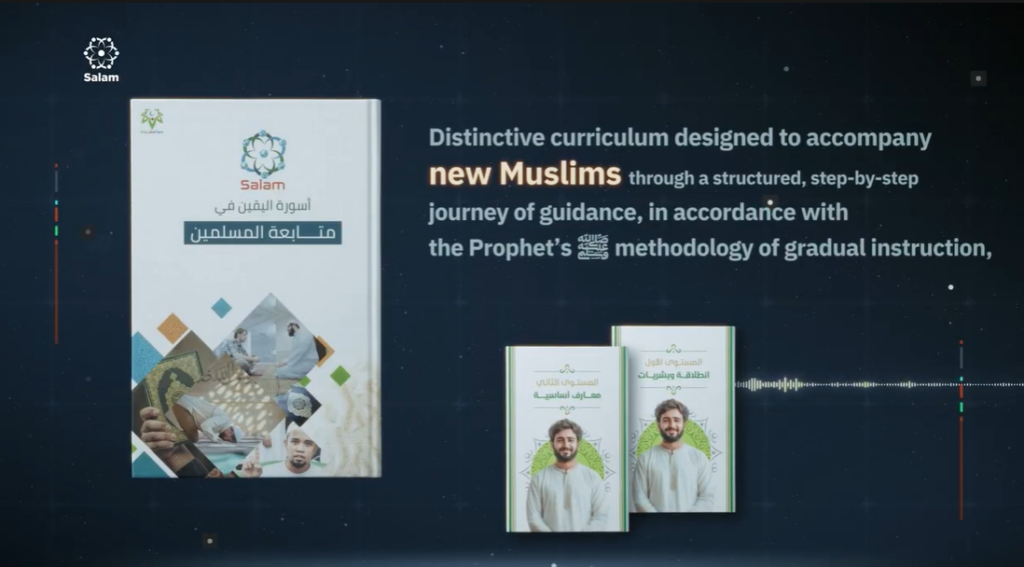
- Asawirat Al-Yaqeen (Bracelets of Certainty) — a structured four-stage program for new Muslims, covering everything from the basics of prayer to the life of the Prophet (PBUH) and practical daily-life rulings
- General inquiries — no question is too small, and no question is turned away
Reach out directly to the Salam Center team to start the Asawirat Al-Yaqeen (Bracelets of Certainty) program for FREE.
Summary
The Quran calls Jesus a word from Allah in two specific verses, referring to his miraculous, fatherless creation through the divine command “Be.” This title sits alongside a direct, unambiguous rejection of his divinity.
Understanding kalimah correctly protects against conflating Islamic theology with the Christian Logos doctrine. Jesus remains, in the Quran’s own words, a servant and honored messenger of Allah — never a partner to Him.
Frequently Asked Questions
Does the Quran call Jesus the Son of God?
No. The Quran explicitly states Allah is “exalted… above having a son” (Quran 4:171). Jesus is called a servant, prophet, and “word from Allah” — never His son. This rejection is direct and repeated across multiple verses.
What does “word from Allah” mean in the Quran?
It refers to Jesus’s creation through Allah’s command “Be” (Kun), without a father. Quran 3:59 compares this directly to Adam’s creation from dust — a miracle of divine speech, not a claim to shared divine essence.
Do Muslims believe Jesus was crucified?
Muslims do not believe Jesus died by crucifixion. The Quran states in Surah An-Nisa that those who claimed to kill him did not actually do so with certainty, though the exact details are addressed through classical tafsir rather than in this article’s scope.
Is Jesus considered a prophet in Islam?
Yes. Jesus (Isa) is one of the most honored messengers in Islam, mentioned by name 25 times in the Quran. He performed miracles by Allah’s permission and will return before the Day of Judgment, according to authentic hadith.
Why do Muslims still testify to Jesus’s status as part of their faith?
Sahih al-Bukhari 3435 records the Prophet Muhammad (PBUH) teaching that correctly affirming Jesus as Allah’s servant, messenger, word, and spirit — not as divine — is a required part of Islamic testimony (shahada), tied directly to entry into Paradise.
Curious about Islam?
Journey towards clarity and purpose. Our team is here to support you in your search for truth and spiritual guidance.
Embrace the Truth