
Islam’s Teachings on Peace and Violence
| Key Takeaways |
| The Arabic word “Islam” shares its root with “salaam,” meaning peace, and one of Allah’s own names is As-Salaam, the Source of Peace. |
| The Quran states that killing one innocent person is equivalent to killing all of humanity, establishing the sanctity of human life as a core principle. |
| The Prophet Muhammad (PBUH) forbade harming non-combatants, including women, children, the elderly, and religious clergy, even during active conflict. |
| Islam mandates just treatment of non-Muslims living under Muslim governance, a principle demonstrated in early treaties such as the Constitution of Medina. |
Islam’s teachings on peace and violence rest on a foundational distinction: peace is the default state Allah commands, and violence is a tightly regulated exception permitted only under conditions of self-defense or justice.
This distinction gets lost in headlines that isolate a single verse from its historical context, yet the Quran and the authenticated Sunnah together paint a consistent picture — one where the sanctity of human life sits near the very center of Islamic ethics, and where the rules of engagement in war are more restrictive than most modern military codes.
What does Islam teach about peace and violence?
Islam teaches that peace is the natural condition between people, and that violence is permitted only as a last resort — for self-defense, to end oppression, or to correct a specific act of aggression, not as a tool for spreading belief or punishing disagreement.
The Quran states plainly,
“There shall be no compulsion in [acceptance of] the religion.” (Quran 2:256),
closing the door on forced conversion entirely.
“لَا إِكْرَاهَ فِي الدِّينِ ۖ قَد تَّبَيَّنَ الرُّشْدُ مِنَ الْغَيِّ”
“There shall be no compulsion in [acceptance of] the religion. The right course has become clear from the wrong.” (Quran 2:256).
Where the Quran does address combat, it frames it defensively:
“Fight in the way of Allah those who fight you but do not transgress” (Quran 2:190).
“وَقَاتِلُوا فِي سَبِيلِ اللَّهِ الَّذِينَ يُقَاتِلُونَكُمْ وَلَا تَعْتَدُوا ۚ إِنَّ اللَّهَ لَا يُحِبُّ الْمُعْتَدِينَ”
“Fight in the way of Allah those who fight you but do not transgress. Indeed. Allah does not like transgressors.” (Quran 2:190)
The word transgress here carries real legal weight in the classical tradition — it means combat has boundaries that cannot be crossed even against an enemy.
This is the frame within which every other verse on conflict has to be read; isolating a single line from a chapter about a specific defensive battle and presenting it as a universal command is a well-documented distortion tactic, not sound scholarship.
The linguistic root of the word “Islam” itself, s-l-m, is shared with salaam (peace) and taslim (submission/surrender) — a Muslim is, by definition, one who has submitted to Allah and thereby entered a state of peace with Him.
This is reflected in the daily greeting exchanged between Muslims, As-Salaamu Alaykum — “peace be upon you” — and in one of the ninety-nine names of Allah, As-Salaam, “the Source of Peace.”
For a deeper look at how these foundational islam principles structure the faith’s ethical system, the Salam Center’s dedicated article walks through each one.
Learn More About Islam
Discover the beauty, teachings, and wisdom of Islam in a clear and welcoming way. Start exploring and deepen your understanding today.
Learn More1. The sanctity of human life is a foundational Quranic principle
Few verses in the Quran state a moral principle as starkly as this one:
“Whoever kills a soul… it is as if he had slain all mankind. And whoever saves one, it is as if he had saved all mankind” (Quran 5:32).
This verse was revealed in reference to the law given to the Children of Israel, and the Quran affirms it as a standing moral principle, not a historical footnote.
“مِنْ أَجْلِ ذَٰلِكَ كَتَبْنَا عَلَىٰ بَنِي إِسْرَائِيلَ أَنَّهُ مَن قَتَلَ نَفْسًا بِغَيْرِ نَفْسٍ أَوْ فَسَادٍ فِي الْأَرْضِ فَكَأَنَّمَا قَتَلَ النَّاسَ جَمِيعًا وَمَنْ أَحْيَاهَا فَكَأَنَّمَا أَحْيَا النَّاسَ جَمِيعًا”
“Because of that, We decreed upon the Children of Israel that whoever kills a soul unless for a soul or for corruption [done] in the land – it is as if he had slain mankind entirely. And whoever saves one – it is as if he had saved mankind entirely.” (Quran 5:32)
The weight of this statement is worth sitting with — it does not say murder is bad, it says murder of a single person carries the moral magnitude of destroying the entire human species. That is the register Islamic ethics operates in on this question.
This principle extends into Islamic jurisprudence through the concept of the five daruriyat — the essential objectives of Sharia that every ruling exists to protect: life, religion, intellect, lineage, and property. Life sits at the top of that list. Classical jurists across all four Sunni schools of law built entire branches of criminal and civil law around protecting it, with capital punishment reserved for the narrowest of categories and hedged with evidentiary standards deliberately designed to be difficult to meet.
2. Warfare in Islam is permitted under conditions
The Quran’s first explicit permission for Muslims to fight came only after years of persecution in Mecca, where early Muslims were tortured, boycotted, and killed without retaliating. The verse reads:
“Permission to fight is given to those who are being fought, because they were wronged” (Quran 22:39).
Note the grammar — permission is given because wrong was already done to them.
“أُذِنَ لِلَّذِينَ يُقَاتَلُونَ بِأَنَّهُمْ ظُلِمُوا ۚ وَإِنَّ اللَّهَ عَلَىٰ نَصْرِهِمْ لَقَدِيرٌ”
“Permission [to fight] has been given to those who are being fought, because they were wronged. And indeed, Allah is competent to give them victory.” (Quran 22:39)
Classical jurists identified a limited set of legitimate grounds for military conflict: repelling aggression, defending the oppressed regardless of their religion, and upholding treaties that had been violated by the other party. Forced conversion never appears on this list, in any of the recognized schools of Sunni jurisprudence.
The historical record of early Islamic expansion also shows this was largely political and territorial in nature — a common feature of the era across civilizations — rather than a program of religious coercion, which the Quran (2:256) explicitly forbids.
3. The Prophet Muhammad set clear limits on the conduct of war
Before any military expedition, the Prophet Muhammad (PBUH) issued instructions to his commanders that read, by the standards of seventh-century warfare, as remarkably restrictive. He instructed his armies:
“Do not kill any old person, any child, or any woman… Do not kill the monks in monasteries… Do not cut down trees… Do not slaughter a sheep or a camel except for food.”
Civilians, religious clergy, the environment, and livestock not needed for sustenance were placed off-limits — protections that predate the Geneva Conventions by roughly thirteen centuries.
The Prophet (PBUH) similarly rebuked a companion who had killed a person during battle after that person had declared the shahada (testimony of faith) moments before death, treating the declaration as sufficient to end the combatant’s status as a legitimate target.
Read Also: Islam’s Teachings on Forgiveness
4. Islam mandates just treatment of non-Muslims under Muslim governance
The Prophet’s arrival in Medina produced one of the earliest known written constitutions in human history — a document historians commonly call the Constitution of Medina — which bound Muslims, Jews, and other tribes into a single political community with mutual defense obligations and freedom to practice their own religious law.
This was not a hypothetical ideal; it was a functioning governing document in a city the Prophet (PBUH) himself administered.
The Quran reinforces this posture toward peaceful non-Muslims directly:
لَّا يَنْهَاكُمُ اللَّهُ عَنِ الَّذِينَ لَمْ يُقَاتِلُوكُمْ فِي الدِّينِ وَلَمْ يُخْرِجُوكُم مِّن دِيَارِكُمْ أَن تَبَرُّوهُمْ وَتُقْسِطُوا إِلَيْهِمْ ۚ إِنَّ اللَّهَ يُحِبُّ الْمُقْسِطِينَ
“Allah does not forbid you from being kind and equitable to those who have not fought you because of religion” (Quran 60:8).
The verse continues by naming exactly who falls outside this protection — only those who have actively fought Muslims because of their faith or driven them from their homes.
Everyone else is owed kindness and equity as a matter of Quranic command, not courtesy.
For readers exploring how this principle extends more broadly, the Salam Center’s article on how does islam view other religions covers the theological basis for interfaith coexistence in more depth.
5. Extremist violence contradicts mainstream Islamic scholarship and practice
Groups that invoke Islam to justify indiscriminate violence against civilians operate in direct contradiction to the juristic tradition outlined above — a contradiction that has been formally documented by major Islamic scholarly bodies.
Al-Azhar University, the oldest and most widely recognized seat of Sunni Islamic learning, has repeatedly and explicitly condemned terrorism as a violation of Islamic law, not a legitimate expression of it.
The overwhelming majority of victims of groups like ISIS and Al-Qaeda have themselves been Muslims, a fact frequently omitted from public discussion of religiously-motivated violence.
Read Also: Islam’s Teachings on Human Rights
6. The Quran’s emphasis on forgiveness and de-escalation over retaliation
Alongside its permission for defensive combat, the Quran repeatedly elevates forgiveness above retaliation as the preferred response to wrongdoing:
وَجَزَاءُ سَيِّئَةٍ سَيِّئَةٌ مِّثْلُهَا ۖ فَمَنْ عَفَا وَأَصْلَحَ فَأَجْرُهُ عَلَى اللَّهِ ۚ إِنَّهُ لَا يُحِبُّ الظَّالِمِينَ
“The repayment of a bad action is one equivalent to it, but whoever pardons and makes reconciliation, his reward is on Allah” (Quran 42:40).
Retaliation is capped at proportionality — it cannot exceed the original harm — while forgiveness is framed as the spiritually superior path, carrying a reward the verse leaves deliberately unspecified.
This theme recurs throughout the Prophet’s own biography. When he returned to Mecca in triumph after years of persecution and exile, he chose a general amnesty over retribution against the very people who had tortured and expelled his followers.
That single decision — made at the height of his political and military power, when retaliation would have been both possible and, by the standards of the era, expected — remains one of the most cited examples in Islamic scholarship of mercy overriding the impulse for revenge.
Read Also: Islam’s Teachings on Love and Hate
Learn More About Islam
Discover the beauty, teachings, and wisdom of Islam in a clear and welcoming way. Start exploring and deepen your understanding today.
Learn MoreYour Path to Deeper Authentic Knowledge Starts Here with Salam
Questions about how Islam addresses war, justice, or mercy often lead to deeper ones — about the nature of Allah, the reliability of the Quran, or what a life grounded in Yaqeen (certainty) actually looks like. The Salam Center team welcomes those questions, wherever they come from.
Continue reading on the Salam Platform for more evidence-based articles on Islamic belief and practice.
Visit the Salam blog for ongoing coverage of common questions and misconceptions.
Reach out directly — our team is ready to listen, guide, and welcome you.

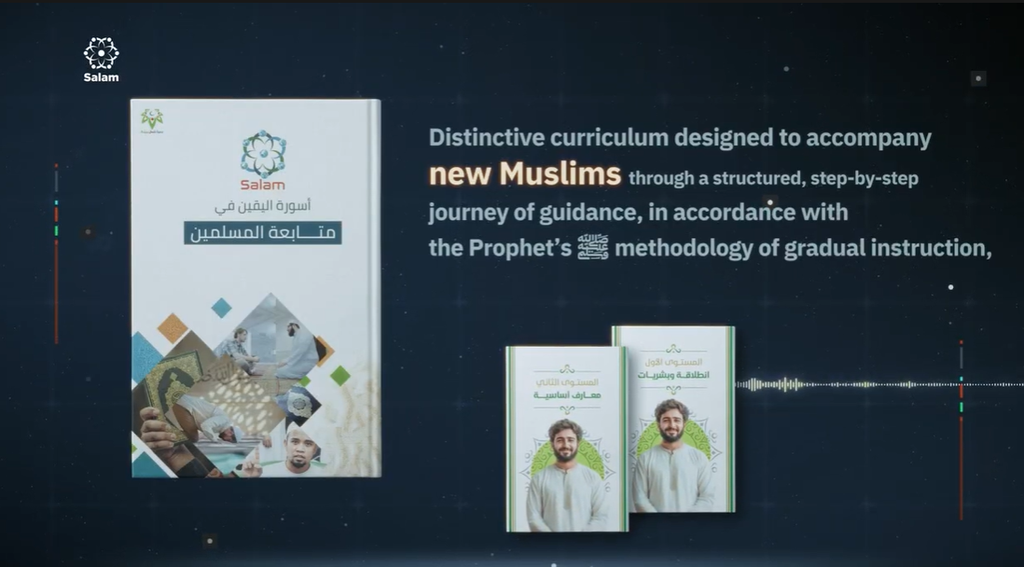
For new Muslims seeking structured post-conversion guidance, the Center’s Asawirat Al-Yaqeen (Bracelets of Certainty) program offers a four-stage learning path:
- Foundational knowledge of the pillars of faith and practical worship
- Guidance on repentance and the life of the Prophet (PBUH)
- Etiquette, family rulings, and daily practical guidance
- Advanced study of contemporary issues and Islamic distinctions
Reach out directly to the Salam Center team to start the Asawirat Al-Yaqeen (Bracelets of Certainty) program for FREE.
Summary
Islam’s core teaching frames peace as the default human condition and violence as a narrowly permitted exception, bound by defensive necessity and strict rules protecting civilians. The Quran’s sanctity-of-life principle and the Prophet’s own conduct in war reinforce restraint over aggression at every turn.
Extremist violence committed in Islam’s name stands in documented contradiction to mainstream Sunni scholarship, not as an alternative reading of it. Understanding this distinction matters for anyone evaluating Islam honestly, on its own textual and historical terms.
Frequently Asked Questions
Does Islam promote violence against non-Muslims?
No. The Quran states there is “no compulsion in religion” (2:256) and commands kindness toward non-Muslims who are not actively hostile (Quran 60:8). Combat is permitted only defensively, never to compel belief or punish disbelief itself.
Did the Prophet Muhammad (PBUH) fight wars?
Yes, but only after years of persecution and only under strict rules protecting civilians, clergy, and the environment, as documented in early hadith collections including those of Imam Malik and Abu Dawud.
Are Muslims required to forgive people who wrong them?
Forgiveness is strongly encouraged, not obligatory. The Quran (42:40) permits proportional response but calls pardon and reconciliation spiritually superior, a value the Prophet (PBUH) modeled at the conquest of Mecca.
How does Islam treat non-Muslims living in Muslim societies?
Historically through binding agreements guaranteeing protection and religious freedom, exemplified by the Constitution of Medina. The Quran commands equitable treatment toward any non-Muslim not engaged in hostility (60:8).
Curious about Islam?
Journey towards clarity and purpose. Our team is here to support you in your search for truth and spiritual guidance.
Embrace the Truth