
Islam’s Teachings on Human Rights
| Key Takeaways |
| Islam established a binding system of human rights in the 7th century, fourteen centuries before the 1948 Universal Declaration of Human Rights. |
| The Quran states that Allah has honored every child of Adam, making human dignity a divine grant rather than a state-issued privilege. |
| Classical Islamic law organizes rights around five protected necessities: religion, life, intellect, lineage, and wealth, known as Maqasid al-Shariah. |
| Sahih al-Bukhari records the Prophet Muhammad (PBUH) declaring a person’s blood, property, and honor permanently sacred and inviolable. |
| Islam’s human rights framework covers women’s inheritance, minority protection, judicial fairness, and the sanctity of innocent life, all grounded in revealed text rather than shifting consensus. |
Islam has a comprehensive and binding teaching on human rights, and it did not arrive as a reaction to modern political movements. It was revealed through the Quran and demonstrated through the practice of Prophet Muhammad (PBUH) starting in the early 7th century CE.
Long before the Universal Declaration of Human Rights was adopted in 1948, the Quran had already declared that Allah “has certainly honored the children of Adam” (Quran 17:70), establishing dignity as an unconditional divine grant to every human being, Muslim or not.
1. The sanctity of human life is protected by direct Quranic legislation
The starting point for any discussion of human rights in Islam is the sanctity of life itself. Islam does not treat this as a general moral sentiment. It is codified as law.
Allah states in the Quran:
مِنْ أَجْلِ ذَٰلِكَ كَتَبْنَا عَلَىٰ بَنِي إِسْرَائِيلَ أَنَّهُ مَن قَتَلَ نَفْسًا بِغَيْرِ نَفْسٍ أَوْ فَسَادٍ فِي الْأَرْضِ فَكَأَنَّمَا قَتَلَ النَّاسَ جَمِيعًا وَمَنْ أَحْيَاهَا فَكَأَنَّمَا أَحْيَا النَّاسَ جَمِيعًا ۚ وَلَقَدْ جَاءَتْهُمْ رُسُلُنَا بِالْبَيِّنَاتِ ثُمَّ إِنَّ كَثِيرًا مِّنْهُم بَعْدَ ذَٰلِكَ فِي الْأَرْضِ لَمُسْرِفُونَ
“Because of that, We decreed upon the Children of Israel that whoever kills a soul unless for a soul or for corruption [done] in the land — it is as if he had slain mankind entirely. And whoever saves one — it is as if he had saved mankind entirely.” (Quran 5:32)
This verse establishes that unjustified killing of a single innocent person carries the moral weight of a crime against all humanity.
Classical exegetes, including Ibn Kathir, explain that the verse ties the value of one life to the value of the human species as a whole, because there is no legitimate basis for ranking one soul above another absent guilt.
This principle is not confined to Muslims killing Muslims. The wording of the verse is universal, addressing “a soul,” not a specific nationality or faith.
The Prophet Muhammad (PBUH) reinforced this with severe warnings against harming even non-Muslims living under a pledge of protection. Sahih al-Bukhari records him saying:
“Whoever killed a person having a treaty with the Muslims, shall not smell the smell of Paradise though its smell is perceived from a distance of forty years.” (Sahih al-Bukhari 3166)
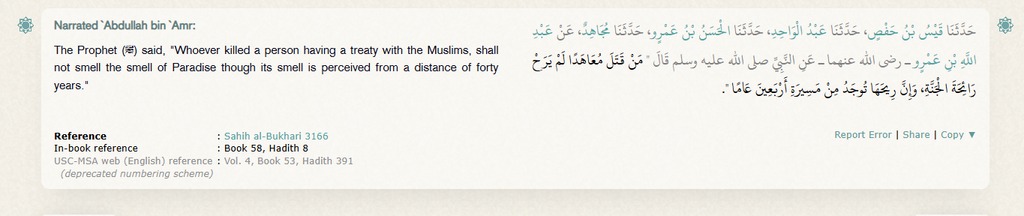
This hadith is directly relevant to religious minorities living within Muslim societies, historically known as dhimmis or mu’ahids.
Their protection was not a courtesy. It was a binding legal covenant, and its violation was treated by the Prophet (PBUH) as one of the gravest sins a Muslim could commit.
2. Human dignity is granted to every person
Every human being carries inherent dignity in Islam, independent of nationality, wealth, faith, or social status. This is not a modern gloss added to make Islamic teaching more palatable. It is stated plainly in the Quran.
Allah says:
وَلَقَدْ كَرَّمْنَا بَنِىٓ ءَادَمَ
“And We have certainly honored the children of Adam.” (Quran 17:70)
The phrase “children of Adam” (Bani Adam) encompasses every human being who has ever lived, without exception. This verse dismantles any claim that Islamic teaching restricts dignity to believers.
Dignity here is a birthright tied to being human, not a reward tied to correct belief.
The Quran elaborates on the meaning of human diversity in a separate verse that speaks directly to racial and ethnic equality:
يَا أَيُّهَا النَّاسُ إِنَّا خَلَقْنَاكُم مِّن ذَكَرٍ وَأُنثَىٰ وَجَعَلْنَاكُمْ شُعُوبًا وَقَبَائِلَ لِتَعَارَفُوا ۚ إِنَّ أَكْرَمَكُمْ عِندَ اللَّهِ أَتْقَاكُمْ
“O mankind, indeed We have created you from male and female and made you peoples and tribes that you may know one another. Indeed, the most noble of you in the sight of Allah is the most righteous of you.” (Quran 49:13)
The verse’s structure is deliberate. It first acknowledges that Allah created human diversity — different peoples and tribes — as a matter of divine design, meant for mutual recognition rather than rivalry.
It then removes any basis for one group claiming superiority over another by tying honor solely to piety (taqwa), something available equally to every human being regardless of ancestry.
This teaching found its clearest historical expression in the Prophet’s own farewell address, where he told the assembled pilgrims that lineage and skin color carry no weight before Allah, and that only righteousness distinguishes one person from another.
The Salam Center team consistently teaches this principle as foundational to understanding Islam’s view on other religions and interfaith coexistence, since a framework that denies innate superiority to any race or tribe extends naturally to how Muslims are commanded to treat people of other faiths.
Learn More About Islam
Discover the beauty, teachings, and wisdom of Islam in a clear and welcoming way. Start exploring and deepen your understanding today.
Learn More3. Blood, property, and honor are declared permanently sacred in the Prophet’s own words
Islam does not leave the protection of a person’s life, wealth, and reputation to vague sentiment. The Prophet Muhammad (PBUH) issued an explicit, repeated declaration on this matter during the largest gathering of his life.
Sahih al-Bukhari records:
“Verily! Your blood, property and honor are sacred to one another like the sanctity of this day of yours, in this month of yours and in this city of yours.” (Sahih al-Bukhari 67)
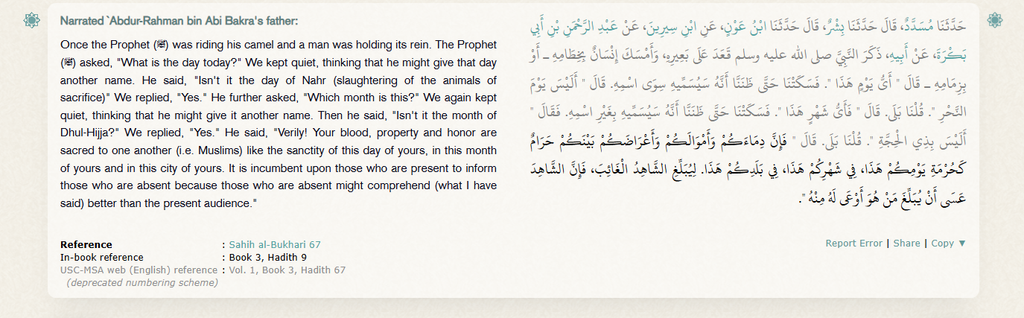
This declaration, repeated in a nearly identical form at Sahih al-Bukhari, uses the sanctity of the sacred month and the sacred city of Mecca — concepts every listener already understood as inviolable — as the standard against which a person’s blood, wealth, and reputation are measured.
Violating any of these three is treated with the same seriousness as violating a sacred time or sacred place.
This teaching underlies the entire structure of Islamic criminal and civil law. Theft, slander, and unlawful killing are not simply social inconveniences to be managed.
They are violations of a divine covenant announced publicly by the Prophet (PBUH) himself, witnessed by more than one hundred thousand people, and preserved through unbroken chains of authentic transmission.
4. Oppression in any form is condemned as a sin that darkens the Day of Judgment
Justice is one of the most frequently repeated commands in the entire Quran, and Islam treats oppression — zulm — as one of the gravest categories of sin a person can commit, whether against a Muslim or a non-Muslim, an individual or a nation.
The Prophet Muhammad (PBUH) said:
“Oppression will be a darkness on the Day of Resurrection.” (Sahih al-Bukhari 2447)
This hadith is agreed upon by both Sahih al-Bukhari and Sahih Muslim, meaning it carries the highest possible grade of authenticity in Islamic scholarship. The imagery of darkness on the Day of Judgment reflects a broader Quranic theme in which oppressors, having denied others their rights and clarity in this life, are denied light and clarity in the next.
The Quran commands believers to uphold justice even when it works against their own interests:
يَا أَيُّهَا الَّذِينَ آمَنُوا كُونُوا قَوَّامِينَ بِالْقِسْطِ شُهَدَاءَ لِلَّهِ وَلَوْ عَلَىٰ أَنفُسِكُمْ أَوِ الْوَالِدَيْنِ وَالْأَقْرَبِينَ ۚ إِن يَكُنْ غَنِيًّا أَوْ فَقِيرًا فَاللَّهُ أَوْلَىٰ بِهِمَا ۖ فَلَا تَتَّبِعُوا الْهَوَىٰ أَن تَعْدِلُوا ۚ وَإِن تَلْوُوا أَوْ تُعْرِضُوا فَإِنَّ اللَّهَ كَانَ بِمَا تَعْمَلُونَ خَبِيرًا
“O you who have believed, be persistently standing firm in justice, witnesses for Allah, even if it be against yourselves or parents and relatives. Whether one is rich or poor, Allah is more worthy of both. So follow not [personal] inclination, lest you not be just. And if you distort [your testimony] or refuse [to give it], then indeed Allah is ever, with what you do, Acquainted.” (Quran 4:135)
This standard is demanding by design. It does not permit a Muslim to bend the truth to protect family, tribe, nation, or personal advantage.
A judge, a witness, a parent, or an employer is bound by the same command: testify and act with fairness, even when fairness is costly.
Read Also: Islam’s Teachings on Forgiveness
5. Women’s rights are explicitly protected through inheritance, dignity, and legal personhood
Islam granted women legal and financial rights in the 7th century that were unavailable to women in most of the world for centuries afterward, including the right to own property independently, retain their own name after marriage, and inherit wealth by direct Quranic entitlement rather than social custom.
The Quran opens the chapter titled An-Nisa (The Women) with a verse that frames men and women as originating from a single soul, with neither possessing inherent superiority over the other:
يَٰٓأَيُّهَا ٱلنَّاسُ ٱتَّقُوا۟ رَبَّكُمُ ٱلَّذِى خَلَقَكُم مِّن نَّفْسٍ وَٰحِدَةٍ
“O mankind, fear your Lord, who created you from one soul and created from it its mate and dispersed from both of them many men and women.” (Quran 4:1)
The same chapter goes on to legislate specific inheritance shares for women, protect orphaned girls from exploitative marriages, and mandate that a woman’s bridal gift belongs to her alone, not to her father or husband’s family. These were not abstract statements of respect.
They were enforceable legal entitlements written directly into revealed scripture at a time when female infanticide was practiced in parts of pre-Islamic Arabia.
Read Also: Islam’s Teachings on an Eye for an Eye
6. Freedom of belief is protected by direct Quranic prohibition against coercion
Islam explicitly forbids forcing anyone into faith. This is a direct textual command, not an inference drawn from broader principles.
Allah says in the Quran:
“لَا إِكْرَاهَ فِي الدِّينِ ۖ قَد تَّبَيَّنَ الرُّشْدُ مِنَ الْغَيِّ”
“There shall be no compulsion in [acceptance of] the religion. The right course has become clear from the wrong.” (Quran 2:256).
This verse governs how Muslims are commanded to engage with people of other faiths. Invitation, evidence, and dialogue are the sanctioned methods of da’wah; coercion is not.
The Quran further instructs believers to call others to the way of their Lord with wisdom and good instruction, reflecting a consistent pattern across the text: conviction must be freely reached, or it carries no value in Islamic theology.
This principle extended historically into the legal protections granted to religious minorities under Muslim governance, protections that included freedom to practice their own faith, maintain their own courts for internal matters, and live under the same hadith-based guarantee of protected life discussed earlier at Sahih al-Bukhari 3166.
Read Also: Islam’s Teachings on Love and Hate
7. The five protected necessities of Maqasid al-Shariah form the legal architecture of Islamic human rights
Classical Islamic jurisprudence did not leave human rights as scattered verses and hadiths without an organizing framework. Scholars developed a comprehensive legal theory known as Maqasid al-Shariah, the Higher Objectives of Islamic Law, which identifies five essential rights that Islamic legislation exists to protect: religion (din), life (nafs), intellect (aql), lineage (nasl), and wealth (mal).
Every major category of Islamic law can be traced back to protecting one or more of these five necessities. The prohibition of murder protects life. The prohibition of intoxicants protects intellect.
Inheritance law protects lineage and wealth simultaneously. The legal protection of religious practice, including for non-Muslims living under Islamic governance, protects the necessity of religion itself.
This is what separates Islamic human rights teaching from a loose collection of moral exhortations. It is a structured legal system with an identifiable purpose behind every ruling, developed and refined by generations of scholars working within the framework of Ahlus Sunnah wal Jama’ah, and still taught today as the analytical lens through which contemporary Islamic legal questions are resolved.
Read Also: Islam’s Teachings on Peace and Violence
Learn More About Islam
Discover the beauty, teachings, and wisdom of Islam in a clear and welcoming way. Start exploring and deepen your understanding today.
Learn MoreLearn More About Faith, Certainty, and the Journey to Islam
If these teachings raised questions you’d like to explore further, there is more waiting for you.
Learn more about the foundational principles of Islam and how they connect to everyday life.
Read about faith in Islam and what belief actually requires.
Explore how Islam views other religions and the theological basis for interfaith respect.
Visit the Salam blog for more, or reach out directly with any question, however small or large it may seem.
If you are considering the next step, whether that means learning how to enter Islam or simply asking a question that has been sitting with you, the Salam Center welcomes you without judgment or pressure.
For new Muslims, the Asawirat Al-Yaqeen (Bracelets of Certainty) program offers structured, gradual guidance through:
- Foundational knowledge of the Shahada, prayer, and purification
- The six pillars of faith and the core obligations of zakat and fasting
- Guidance on repentance and understanding the Prophet’s biography
- Practical rulings on daily life, family, and community conduct
- Advanced study of contemporary issues from an Islamic perspective
Reach out directly to the Salam Center team to start the Asawirat Al-Yaqeen (Bracelets of Certainty) program for FREE.
Summary
Islam’s human rights framework rests on divine revelation rather than shifting political consensus, granting every person inherent dignity through the Quran’s declaration that Allah has honored all children of Adam. Life, property, honor, and religious freedom receive explicit legal protection through both scripture and the Prophet’s documented practice.
Classical scholarship organized these teachings into Maqasid al-Shariah, protecting religion, life, intellect, lineage, and wealth as absolute legal necessities. Women’s inheritance rights, minority protections, and judicial fairness all flow from this same coherent, text-based system of accountability before Allah.
Frequently Asked Questions
Does Islam recognize human rights for non-Muslims?
Yes, directly. Sahih al-Bukhari 3166 records the Prophet Muhammad (PBUH) warning that killing a non-Muslim under treaty protection bars a person from Paradise. Quran 17:70 grants dignity to all “children of Adam,” not exclusively believers.
What does the Quran say about racial equality?
Quran 49:13 states that Allah created humanity “into peoples and tribes that you may know one another,” declaring that nobility before Allah is determined by righteousness alone, not race, tribe, or lineage.
Does Islam allow forced conversion?
No. Quran 2:256 states plainly, “There shall be no compulsion in religion.” Islamic teaching requires belief to be freely reached through invitation and evidence, never coercion.
What rights did Islam give women in the 7th century?
The Quran granted women independent inheritance rights, ownership of their own wealth and bridal gifts, and legal personhood distinct from their husbands or fathers, codified directly in Surah An-Nisa at a time when such rights were rare globally.
What is Maqasid al-Shariah?
Maqasid al-Shariah is the classical Islamic legal framework identifying five necessities Islamic law exists to protect: religion, life, intellect, lineage, and wealth. Scholars including Imam al-Ghazali and Ibn Ashur developed this theory to explain the purpose behind Islamic legislation.
Curious about Islam?
Journey towards clarity and purpose. Our team is here to support you in your search for truth and spiritual guidance.
Embrace the Truth