The Creation Story in Islam and Christianity
| Key Takeaways |
| Both Islam and Christianity trace the origin of humanity to Adam and Hawwa (Eve), created by divine will and placed in a garden of paradise. |
| The Quran describes Adam as created from clay, honoured as Allah’s vicegerent (khalifah) on earth, and gifted with knowledge that surpassed the angels. |
| Islam rejects the doctrine of Original Sin entirely; Adam and Hawwa’s repentance was accepted by Allah, and no inherited guilt was passed to their descendants. |
| In Christianity, the Fall introduced a hereditary state of sin requiring redemption, a doctrine formalized by Saint Augustine of Hippo and the Council of Trent. |
| The Quran holds both Adam and Hawwa equally responsible for eating from the forbidden tree — Islam places no disproportionate blame on women. |
| The Islamic creation narrative presents humanity as inherently honoured and capable of returning to Allah, while the Christian framework centres on a fallen nature requiring external salvation. |
The creation story in Islam and Christianity shares a recognizable cast of characters — Adam, Eve, a forbidden tree, and an adversary — yet beneath this surface familiarity lie profoundly different theological frameworks.
For Muslims, the story of Adam, peace be upon him, is a story of honour, responsibility, and divine mercy.
For many Christians, it is the story of a catastrophic Fall that fractured human nature and necessitated a redemption plan spanning the entire biblical narrative.
1. The Creation of the Universe in Islam and Christianity
Both the Quran and the Bible speak of the universe being created in six days, yet the Islamic understanding of this timeframe differs substantially from the plain reading offered by many Christian traditions.
A. The Quranic Account of The Creation of the Universe
Allah states in the Quran:
إِنَّ رَبَّكُمُ اللَّهُ الَّذِي خَلَقَ السَّمَاوَاتِ وَالْأَرْضَ فِي سِتَّةِ أَيَّامٍ
“Indeed, your Lord is Allah, who created the heavens and earth in six days.” (Quran 7:54)
The Arabic word used for “day” in these verses is yawm, a term that appears elsewhere in the Quran with very different time scales — in one instance equated with 50,000 years (Quran 70:4), in another with 1,000 years of human reckoning (Quran 22:47).
Some classical scholars recognised that these six days could not refer to earth-measured days, since the sun — the basis for our counting — did not yet exist.
Some scholars interpreted the verse to mean that creation occurred in six stages rather than six solar days.
The Quran also presents what modern cosmology finds intriguing: the heavens and earth were once joined as a single unit before being separated (Quran 21:30), and the universe continues to expand (Quran 51:47) — a cosmological reality discovered by science only in the 20th century.
B. The Biblical Account The Creation of the Universe
According to the Bible’s Book of Genesis, the process of creation also unfolds across six days, with light and darkness created on the first day.
Some Christian denominations accept evolutionary science and read the Genesis story symbolically, while others insist on the literal historicity of a six-day creation, often connecting this position to the doctrine of original sin.
| Theme | Islamic View | Christian View |
| Duration of creation | Six ayyam (periods/stages) — precise duration known to Allah | Six days (interpreted literally or symbolically depending on denomination) |
| Nature of the account | Quranic revelation, confirmed by authentic Sunnah | Book of Genesis (two distinct creation narratives in chapters 1 and 2) |
| Relation to science | Classical scholars allowed flexible interpretation of yawm | Ranges from literal creationism to symbolic/allegorical readings |
| God’s method | Divine command — Kun fayakun (Be, and it is) | Spoken divine command across sequential days |
2. The Creation of Adam in Islam and Christianity
The narrative of Adam’s creation is a foundational element in both Islamic and Christian theology, illustrating the divine origin of humanity.
While both traditions share the core account of a creation from earthen elements, they diverge significantly in their theological implications regarding human nature, honour, and purpose.
A. Adam’s Physical Creation from Clay in the Quran and in the Bible
The Islamic account of Adam’s creation is both precise and profoundly dignified. Allah crafted Adam from clay — a material taken from across the earth, reflecting the diversity of humanity to come.
وَلَقَدْ خَلَقْنَا الْإِنسَانَ مِن صَلْصَالٍ مِّنْ حَمَإٍ مَّسْنُونٍ
“And We did certainly create man out of clay from an altered black mud.” (Quran 15:26)
Islam teaches that human beings are a unique life form created by Allah in a special way, with unique gifts and abilities unlike any other — a soul and conscience, knowledge, and free will.
The Quran emphasizes elsewhere: وَبَدَأَ خَلْقَ الْإِنسَانِ مِن طِينٍ — “He began the creation of man from clay.” (Quran 32:7)
Genesis 2:7 similarly records that God formed man from the dust of the ground and breathed life into him — a point of genuine commonality between both traditions.
B. The Unique Honour of Adam in the Quran
What distinguishes the Islamic account is what followed Adam’s physical creation. Allah taught Adam the names of all things — a direct bestowal of knowledge signifying Adam’s unique capacity among all created beings.
Then came the command that has no parallel in Genesis:
وَإِذْ قَالَ رَبُّكَ لِلْمَلَائِكَةِ إِنِّي جَاعِلٌ فِي الْأَرْضِ خَلِيفَةً
“And [mention, O Muhammad], when your Lord said to the angels, ‘Indeed, I will make upon the earth a successive authority (khalifah).'” (Quran 2:30)
A khalifah is one who exercises authority delegated by Allah, acting as His representative — not one who does what he pleases, but one obligated to carry out the will of his Lord.
Allah created Adam with His own hand, commanded the angels to prostrate before him, and taught him the names of everything — honours that testify to Adam’s singular rank among creation.
The angels then prostrated before Adam in obedience — not as an act of worship, which belongs to Allah alone, but as an act of recognition and honour, as classical scholars have clarified. The Genesis account contains no comparable event.
| Creation of Adam | Islamic Account (Quran & Sunnah) | Christian Account (Bible/Genesis) |
| Material | Clay/mud (صَلْصَالٍ) | Dust of the ground |
| Divine breath | Allah breathed His spirit into Adam | God breathed the breath of life |
| Unique honour | Named all things; angels prostrated before him | Given dominion over the earth and its creatures |
| Role on earth | Khalifah — Allah’s vicegerent | Steward/caretaker of the garden |
| Knowledge | Divinely gifted knowledge surpassing the angels | Acquired knowledge of good and evil only after the Fall |
3. The Creation of Hawwa (Eve) in Islam and Christianity
Islam and Christianity share the narrative of Hawwa’s origin from Adam; but they diverge significantly in their theological interpretations regarding her role and responsibility.
A. The Concept of Equality and Mutuality in the Islamic Narrative of Hawwa’s Creation
The Quran makes clear that a mate was created with Adam, from the same nature and soul:
“It is He who created you from one soul and created from it its mate that he might dwell in security with her.” (Quran 7:189)
While the Quran does not describe the physical mechanism of Hawwa’s creation in explicit detail, authenticated hadiths in Sahih Bukhari and Sahih Muslim indicate the creation of woman “from a rib.” The Prophet Muhammad (PBUH) is reported to have said:
“Treat women kindly, for woman was created from a rib…” (Sahih Bukhari, 3331)
Hawwa is never portrayed in the Quran as the primary agent of temptation or as uniquely responsible for the couple’s transgression. The Quran presents the temptation as directed at both of them equally.
B. The Biblical Account and the Blame on Eve
Genesis 2 describes Eve as formed from Adam’s rib — a detail echoed in the Islamic hadith tradition.
In traditional Christian belief, Eve is considered the primary perpetrator of the “original sin” of disobedience that caused God to expel them — and all their descendants — from the Garden of Eden into separation and suffering.
The Quran and the Sunnah clearly deny that Eve was the temptress and that women for all time must bear the consequence of her actions — as posited by some early Christian theologians.
| Creation of Hawwa / Eve | Islamic Account | Christian Account |
| Method | From the same soul/nature as Adam; hadith indicates from a rib | From Adam’s rib (Genesis 2:22) |
| Equality | Created of like nature (Quran 7:189); equally honoured | Considered secondary, created as a “helper” |
| Responsibility for transgression | Equally responsible with Adam (Quran 20:121) | Disproportionate blame on Eve; serpent approached her first (Genesis 3) |
| Theological consequence for women | No lasting consequence of blame in Islamic law or theology | Doctrine of pain in childbirth and subordination (Genesis 3:16) as divine punishment |
Learn More About Islam
Discover the beauty, teachings, and wisdom of Islam in a clear and welcoming way. Start exploring and deepen your understanding today.
Learn More4. Iblis in the Quran and the Serpent in the Bible
One of the most striking divergences between the two traditions concerns the identity and role of the adversary.
A. Iblis in the Quran
In the Islamic account, the adversary is Iblis — a jinn of extraordinary devotion who had risen to dwell among the angels. When Allah commanded all to prostrate before Adam, every being obeyed — except Iblis.
قَالَ مَا مَنَعَكَ أَلَّا تَسْجُدَ إِذْ أَمَرْتُكَ قَالَ أَنَا خَيْرٌ مِّنْهُ خَلَقْتَنِي مِن نَّارٍ وَخَلَقْتَهُ مِن طِينٍ
“[Allah] said, “What prevented you from prostrating when I commanded you?” [Satan] said, “I am better than him. You created me from fire and created him from clay.'” (Quran 7:12)
According to classical scholars Ibn Kathir and Al-Tabari, the root of Iblis’s disobedience was kibr — arrogance — as he argued his own superiority based on his creation from fire versus Adam’s creation from clay.
His expulsion was the direct consequence of pride, not of any theological rebellion against monotheism. He knew Allah existed; he simply refused to submit.
Iblis became Shaytan, the sworn enemy of mankind, vowing to mislead humanity through deception and false promises — with his goal being to lead people away from Allah through arrogance, temptation, procrastination, and despair.
B. The Serpent in Genesis
The biblical narrative in Genesis 3 introduces “the serpent” — described as crafty — without identifying its ultimate nature or origin.
The connection between the serpent and Satan/the Devil is developed in later Christian theology, where Iblis’s counterpart Satan is identified as the being who entered the Garden and tempted Eve to eat of the tree.
The Quran’s account is far more transparent: it names the adversary, explains his motivation, documents his arguments before Allah, and makes clear that he operates within the bounds of Allah’s will.
| The Adversary | Islamic Account | Christian Account |
| Identity | Iblis — a jinn, named and clearly identified | The serpent in Genesis; identified with Satan in later Christian theology |
| Origin of disobedience | Arrogance (kibr) — refusal to prostrate before Adam | Unexplained in Genesis; developed in later theological literature |
| Dialogue with Allah | Fully recorded in the Quran (multiple chapters) | No direct dialogue with God in the fall narrative |
| Who was tempted | Both Adam and Hawwa (Quran 20:120) | The serpent first approached Eve (Genesis 3:1) |
| His fate | Expelled from Allah’s mercy; granted respite until the Day of Judgement | Cast out of heaven; eventual defeat promised through redemption |
5. The Forbidden Tree in Islam and Christianity
Both traditions agree on the core event: Allah/God forbade the first couple from a specific tree, they consumed its fruit through the influence of the adversary, and they were subsequently removed from the garden of paradise.
The details, however, carry vastly different theological weight.
A. The Quranic Account of The Forbidden Tree and the Transgression
The divine command to avoid a particular tree became a test of obedience, and the allure of the forbidden fruit and the subtle whispers of Shaytan set the stage for the subsequent events.
Realising their mistake, Adam and Hawwa turned to Allah in sincere repentance.
The Quran records their shared supplication:
قَالَا رَبَّنَا ظَلَمْنَا أَنفُسَنَا وَإِن لَّمْ تَغْفِرْ لَنَا وَتَرْحَمْنَا لَنَكُونَنَّ مِنَ الْخَاسِرِينَ
“They said, ‘Our Lord, we have wronged ourselves, and if You do not forgive us and have mercy upon us, we will surely be among the losers.'” (Quran 7:23)
And Allah accepted their repentance:
فَتَلَقَّىٰ آدَمُ مِن رَّبِّهِ كَلِمَاتٍ فَتَابَ عَلَيْهِ ۚ إِنَّهُ هُوَ التَّوَّابُ الرَّحِيمُ
“Then Adam received from his Lord [some] words, and He accepted his repentance. Indeed, it is He who is the Accepting of repentance, the Merciful.” (Quran 2:37)
In this story, Islam does not teach original sin — it teaches original forgiveness. Allah forgave Adam, and this carries the lesson that when human beings commit sins, Allah is willing to forgive them if they repent before Him and seek His guidance.
B. The Biblical Account and the Doctrine of Original Sin
Original sin is a fundamental concept in Christianity asserting that all humans are born with a sinful nature due to the disobedience of Adam and Eve.
The Roman Catholic Church formalized this concept during the Council of Trent, affirming that original sin is transmitted through human reproduction and emphasising the necessity of divine grace for redemption.
This doctrine was advanced by Augustine of Hippo (354–430 CE), who believed that Adam’s sin was hereditary and passed from generation to generation.
The universality of sin as a result of Adam’s rebellion is a fundamental doctrine in Christian theology, with Romans 3:23 affirming that all have sinned and fall short of the glory of God — with the New Testament revealing God’s plan for humanity’s redemption through Jesus Christ.
| The Transgression | Islamic Account | Christian Account |
| Who was responsible | Adam and Hawwa, equally (Quran 20:121) | Eve first, then Adam (Genesis 3:6) |
| Consequence for descendants | None — no inherited sin in Islam | Original sin — all humans born with a sinful nature |
| Resolution for Adam and Hawwa | Direct repentance accepted immediately by Allah | Expelled from Eden; required promise of a future Redeemer |
| Theological implication | Human beings begin life in a state of purity (fitrah) | Human beings born with an inherited spiritual wound |
| Redemption mechanism | Direct tawbah (repentance) to Allah at any time | Sacramental channels (baptism, confession, etc.) in Catholic tradition; faith in Christ in Protestant tradition |
6. The Nature of Humanity After the Garden: Fitrah vs. the Fallen Nature
This is perhaps the deepest divergence between the two traditions of Islam and Christianity.
A. Islam Teaches the Pure Nature (Fitrah)
Islam teaches that every human being is born in a state of fitrah — pure, natural disposition inclined toward tawhid (the oneness of Allah). The Prophet Muhammad (PBUH) stated:
“Every child is born in a state of fitrah; his parents make him a Jew, a Christian, or a Magian.” (Sahih Bukhari, 1358)
There is no original sin in Islam. Tawbah — repentance — is a direct matter between a person and Allah, requiring no intermediary and no sacramental channel.
No one is to be excommunicated on the basis of disobedience or sin as long as one does not claim it lawful, and that believers live in hope of Allah’s forgiveness without despairing of it.
This is the platform’s foundation of faith in Islam — a faith built on confidence in Allah’s mercy, not guilt inherited from a distant ancestor.
B. Christianity Teaches the Fallen Nature
Christianity’s dominant tradition holds that Adam’s transgression altered human nature itself — not merely Adam’s personal standing.
The doctrines of the Fall of man and original sin are important beliefs in Christianity, though not held in Judaism or Islam.
The human being, in this framework, is constitutionally prone to sin and requires divine intervention — through Christ — to be restored to right relationship with God.
| Human Nature After the Garden | Islamic View | Dominant Christian View |
| Condition at birth | Pure (fitrah) — naturally inclined to worship Allah | Fallen — born with inherited sinful nature |
| Guilt from Adam’s act | None — Islam explicitly rejects inherited sin | Yes — original sin transmitted to all descendants |
| Path to restoration | Direct tawbah (repentance) to Allah | Faith in Christ (Protestant); faith and sacraments (Catholic) |
| View of human will | Free will intact; human beings are responsible moral agents | Debated — Augustinian tradition holds will is enslaved to sin without grace |
| God’s mercy | Directly and immediately accessible | Mediated through Christ’s atonement |
What is the Purpose Behind Creation in Islam and Christianity?
The Quran makes the purpose of human creation explicit, without ambiguity:
وَمَا خَلَقْتُ الْجِنَّ وَالْإِنسَ إِلَّا لِيَعْبُدُونِ
“And I did not create the jinn and mankind except to worship Me.” (Quran 51:56)
Human beings are not cosmic accidents, nor fallen creatures stranded in exile. They are honoured khalifah — Allah’s vicegerents on earth — entrusted with moral agency, knowledge, and the divine invitation to worship. The principles of Islam all flow from this foundational dignity.
The Biblical account presents humanity as caretakers of creation, made in God’s image. Yet the Fall narrative — interpreted through the lens of original sin — fundamentally alters this picture: the image of God in man becomes damaged or obscured, requiring redemption to restore it.
Key Similarities of the Creation Story in Islam and Christianity
Amid the differences, genuine convergences exist:
| Point of Agreement | Detail |
| Single origin | Both traditions affirm that humanity descends from one man and one woman |
| Creation by divine will | Neither tradition attributes the universe to chance or to natural processes alone |
| Material of Adam’s creation | Both mention clay/dust as the physical origin of Adam |
| A forbidden tree | Both traditions include the command not to approach a particular tree |
| Consequence of disobedience | Both acknowledge that Adam and Eve were removed from paradise |
| The adversary | Both traditions identify a rebellious being who tempted the first couple |
| Divine mercy | Both traditions affirm that God is merciful — though the mechanism differs |
Why Do the Islamic Account of the Creation Story Stand on Firmer Ground?
The Quran presents a complete, internally consistent account of creation preserved in its exact revealed form since the time of the Prophet Muhammad (PBUH). It does not contradict itself on the responsibility for the transgression, the nature of humanity, or the path of return to Allah.
As explored in depth at the Salam discussion on what Muslims believe about the Quran, the Quran’s preservation is itself a theological and historical argument for its divine origin.
The Biblical account, by contrast, contains two distinct creation narratives in Genesis chapters 1 and 2 — with different sequences and emphases — and the doctrine of original sin was developed centuries after the composition of the texts, primarily through the theology of Augustine of Hippo.
Modern scholarship has given rise to the Documentary Hypothesis, which suggests that the five books of Moses are a compilation of different sources woven together by later editors, rather than the work of a single author.
The Islamic position on how Islam views other religions is not one of dismissal — Islam affirms that prophets were sent to all nations — but of correction. Where earlier scriptures were altered or misunderstood, the Quran came to restore the original divine message.
To explore why Muslims believe the Quran carries this corrective authority, see the Salam article on why Muslims believe in the Quran.
You can also deepen your understanding of the Islamic comparison with Christianity and discover what the Quran says about other religions.
Learn More About Islam
Discover the beauty, teachings, and wisdom of Islam in a clear and welcoming way. Start exploring and deepen your understanding today.
Learn MoreExplore More Authentic Knowledge About Islam & Religions with Salam
If the creation story has opened a door of questions for you, the Salam Center is here to walk through them with you — calmly, honestly, and without pressure.
Whether you are a sincere seeker wanting to understand what Islam actually teaches, a new Muslim looking for structured knowledge, or someone correcting misconceptions formed through media, the Salam Platform and its Salam blog offer carefully written, evidence-grounded content on every essential topic.
If you have specific questions, want to learn more about Islam’s theological foundations, or are considering taking the Shahada, you are warmly invited to reach out directly.

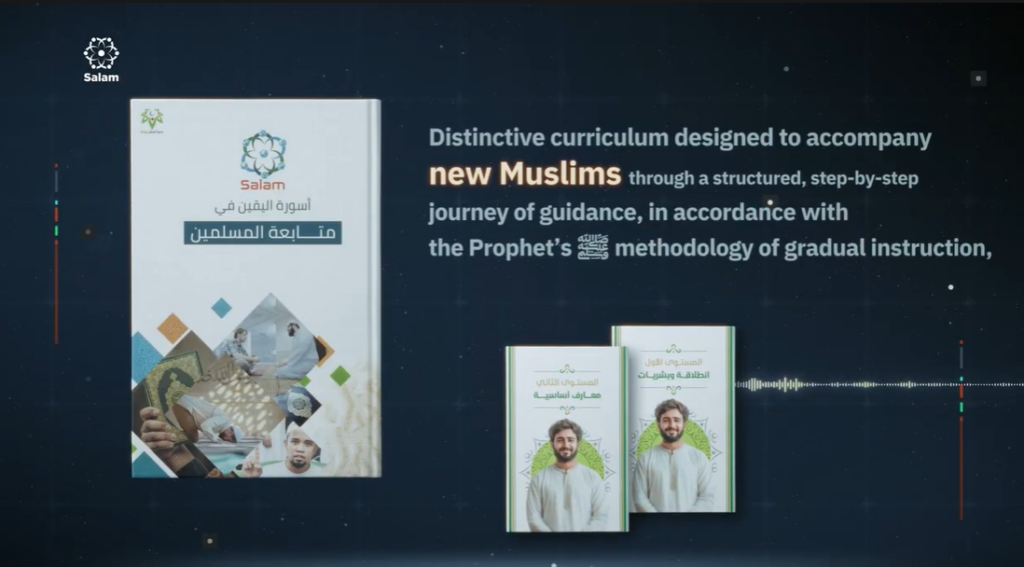
For new Muslims, the Salam Center has designed the Asawirat Al-Yaqeen (Bracelets of Certainty) program — a structured, four-stage educational curriculum that guides students through the knowledge they need to establish themselves firmly in their deen:
- Stage One covers the foundations: the meaning of the Shahada, the pillars of Islam, and the rulings of purification and prayer
- Stage Two deepens iman through the six pillars of faith, fasting, zakat, and Hajj
- Stage Three addresses repentance, major sins to avoid, and the biography of Prophet Muhammad (PBUH)
- Stage Four provides intellectual grounding in theology, contemporary issues, and a life roadmap from Surah Al-Asr
The program has already benefited 114,588 new Muslims across 140 countries. Enrol, learn, and grow — at your own pace, surrounded by a community that wants for you what it wants for itself.
Reach out directly to the Salam Center team to start the Asawirat Al-Yaqeen (Bracelets of Certainty) program for FREE.
Summary
Islam and Christianity both affirm that Adam and Eve were real, that they were created by divine will, and that a forbidden tree tested their obedience. The Quran, however, presents a narrative of dignity and mercy — Adam as Allah’s honoured vicegerent, the transgression as a shared human moment followed by immediate divine forgiveness, and humanity as born pure.
The Christian doctrine of original sin — developed centuries after the biblical texts by theologians like Augustine — introduces an inherited spiritual wound absent from the Quranic account.
Islam holds that every human being stands before Allah with an unblemished soul, capable of direct repentance, unencumbered by any guilt they did not personally incur.
Frequently Asked Questions
Does Islam believe in Adam and Eve the same way Christianity does?
Islam affirms that Adam and Hawwa (Eve) were the first humans, created by Allah from clay and from Adam’s nature respectively. Both were tested by Iblis, both ate from the forbidden tree, and both repented directly to Allah, whose forgiveness was immediately granted. The Quran treats them as co-equals in responsibility, not as a fallen couple whose sin was inherited by all descendants.
Does Islam teach original sin?
Islam rejects the doctrine of original sin. Every human being is born in a state of fitrah — a pure, natural disposition inclined toward tawhid. Imam Al-Tahawi’s Al-‘Aqidah, representing the scholarly consensus of Ahlus Sunnah wal Jama’ah, makes clear that no sin is inherited; each person is accountable only for their own deeds, and direct repentance (tawbah) to Allah is always open.
Who does Islam blame for the Fall — Adam or Eve?
The Quran assigns equal responsibility to both Adam and Hawwa. Quran 20:121 states clearly that they both ate from the tree, and Quran 7:23 records their joint supplication for forgiveness. Islam places no special blame on Hawwa and draws no lasting theological consequence for women from her role in the event.
How does the Islamic creation story relate to the Bible’s account?
The Quran confirms that prophets were sent to all nations with the message of tawhid, and that earlier scriptures contained divine revelation. Where the Bible’s account aligns with the Quran — one human pair, clay as Adam’s origin, a forbidden tree, an adversary — Islam affirms the shared root. Where they diverge — in the identity of the adversary, the nature of the transgression’s consequences, and the doctrine of inherited sin — the Quran presents a corrected and preserved account free from subsequent human alteration. For further reading, see the Salam article on whether Muslims believe the Bible.
Curious about Islam?
Journey towards clarity and purpose. Our team is here to support you in your search for truth and spiritual guidance.
Embrace the Truth