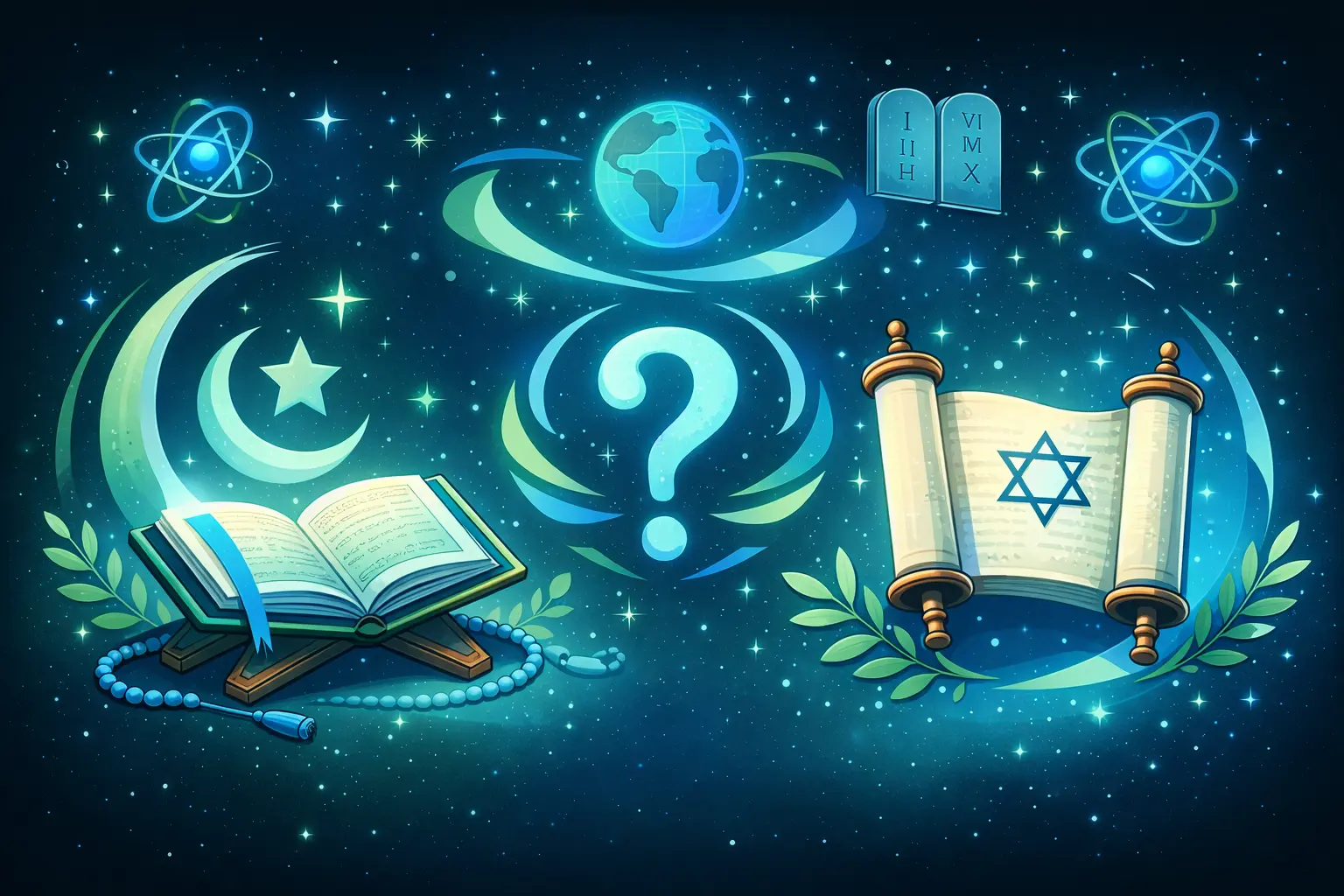
Does Islam Believe in the Torah?
| Key Takeaways |
| Islam affirms the original Torah (Tawrah) as a divine revelation sent by Allah to Prophet Musa (Moses), peace be upon him. |
| Muslims believe the original Torah contained guidance, light, and legal rulings for the Children of Israel. |
| Muslims believe that the Torah in circulation today has undergone significant alteration, distortion, and loss over centuries. |
| The Quran confirms both the divine origin of the original Torah and the historical tampering carried out by Jewish religious authorities. |
| Muslims are neither obligated to accept nor required to reject everything in the current Torah — they maintain a principled position of suspended judgment on its contents. |
| The Quran supersedes all previous scriptures and serves as the final, divinely preserved criterion for distinguishing truth from falsehood. |
Yes — Islam affirms belief in the Torah. Every Muslim, as a condition of their faith, believes that Allah revealed the Torah to Prophet Musa (Moses), peace be upon him, as a book of divine guidance, light, and mercy for the Children of Israel. This belief is not a theological courtesy or an interfaith gesture. It is a pillar of Islamic faith, grounded in the Quran and the authenticated Sunnah of the Prophet Muhammad (PBUH).
At the same time, Islamic scholarship — from the earliest generations to contemporary scholars — holds a clear and evidence-based position: the Torah that exists today is not identical to what Allah originally revealed to Musa (PBUH).
Over centuries marked by exile, conquest, destruction, and deliberate human manipulation, the original text was lost, rewritten, and distorted. What survives contains fragments of divine truth intermingled with human addition and alteration.
Does Islam Believe in the Torah?
Islam believes in the Torah as a divine scripture sent by Allah. Belief in the books revealed before the Quran — including the Torah — is one of the six pillars of faith in Islam. A Muslim who denies the divine origin of the Torah exits the fold of Islamic belief.
Allah states clearly in the Quran:
إِنَّا أَنزَلْنَا التَّوْرَاةَ فِيهَا هُدًى وَنُورٌ
“Indeed, We sent down the Torah, in which was guidance and light.” (Quran 5:44)
This verse leaves no ambiguity. The Torah was revealed by Allah. It carried divine guidance. It illuminated the path of the Children of Israel through the rulings delivered by their prophets. This is the Islamic baseline — and it is held with certainty, not hesitation.
The six pillars of faith in Islam, including belief in revealed scriptures, are foundational to every Muslim’s understanding of their religion. You can explore how this connects to the broader framework of faith in Islam and the core principles Islam is built upon.
1. The Original Torah Was a Direct Revelation from Allah to Prophet Musa (PBUH)
The Quran is explicit: the Torah was not composed by Musa (PBUH) himself, nor was it a product of Israelite scholarship. Allah revealed it, and He did so directly and with deliberate care.
وَكَتَبْنَا لَهُ فِي الْأَلْوَاحِ مِن كُلِّ شَيْءٍ مَّوْعِظَةً وَتَفْصِيلًا لِّكُلِّ شَيْءٍ
“And We wrote for him on the Tablets the instruction and explanation of all things.” (Quran 7:145)
The great exegete Ibn Kathir, in his monumental Tafsir al-Quran al-Azim, commented on this verse that the Tablets contained detailed rulings distinguishing the lawful from the forbidden, and that these Tablets were most likely the Torah itself.
The Tablets were physical, written, and divinely inscribed — a testament to the concrete, preserved nature of the original revelation.
This is further confirmed in an authenticated hadith narrated by Abu Hurayrah, where the Prophet (PBUH) described the debate between Adam and Musa (PBUH). In that narration, Adam (PBUH) said to Musa (PBUH):
“Allah chose you for His speech and wrote the Torah for you with His own Hand.” (Sahih Bukhari, 6614; Sahih Muslim, 2652)
The phrase “wrote with His own Hand” signals the supreme honor and divine intimacy through which the Torah was given — a status no human composition can claim.
2. The Original Torah Contained Binding Divine Law for the Children of Israel
The Torah was not merely a spiritual text of inspiration. It carried binding legal authority — the law of Allah governing every dimension of Israelite life.
The Quran references this directly when describing how the prophets of the Children of Israel judged by it, and how their rabbis and scholars were entrusted with its preservation.
يَحْكُمُ بِهَا النَّبِيُّونَ الَّذِينَ أَسْلَمُوا لِلَّذِينَ هَادُوا وَالرَّبَّانِيُّونَ وَالْأَحْبَارُ
“By which the prophets who submitted [to Allah] judged the Jews, as did the rabbis and scholars.” (Quran 5:44)
This is a significant detail. The Torah’s authority was not ceremonial — it was judicial and moral. Prophets ruled by it. Scholars were charged to uphold it.
The Quran even cites a specific example: the ruling of stoning (rajm) for adultery, which was present in the Torah before the Jewish scholars attempted to conceal it.
When a case involving two Jewish individuals was brought to the Prophet (PBUH), he called for the Torah to be produced and read — and the ruling was found within it, confirming that the divine law of the Torah had not been entirely erased at that point.
This understanding of divine law governing human life connects directly to how Islam views the relationship between monotheism, divine authority, and moral accountability. Readers can explore this further in the Salam platform’s discussion of how Islam views the nature of God and the foundations of monotheism in Islam.
Have Questions About Islam?
Our team is ready to answer your questions clearly and respectfully. Ask freely and receive honest guidance.
Ask Us Now3. The Torah Was Written and Physically Preserved in Tablets
A detail often overlooked in discussions about the Torah is that the Islamic tradition confirms the original Torah was a written scripture — not solely an oral tradition.
This matters because it establishes a fixed, stable text as the original form of divine revelation, and it makes subsequent human alterations to that text a measurable deviation from something concrete.
Allah says in the Quran:
وَكَتَبْنَا لَهُ فِي الْأَلْوَاحِ مِن كُلِّ شَيْءٍ
“And We wrote for him on the Tablets from all things.” (Quran 7:145)
The Prophetic hadith already cited reinforces this with the language of divine writing.
The scholars of Islam drew from these evidences the conclusion that the Tablets and the Torah were essentially one — the divinely inscribed text given to Musa (PBUH) as the foundation of Israelite law and faith.
4. The Torah Was Distorted by the Jewish Scholars and Clergy
This is perhaps the most consequential Islamic belief about the Torah — and the one that most directly addresses the gap between the original revelation and the text in circulation today. Islam holds, based on decisive Quranic evidence, that the Torah was deliberately and systematically altered by those entrusted with its preservation.
فَوَيْلٌ لِّلَّذِينَ يَكْتُبُونَ الْكِتَابَ بِأَيْدِيهِمْ ثُمَّ يَقُولُونَ هَٰذَا مِنْ عِندِ اللَّهِ لِيَشْتَرُوا بِهِ ثَمَنًا قَلِيلًا
“So woe to those who write the ‘scripture’ with their own hands, then say, ‘This is from Allah,’ in order to exchange it for a small price.” (Quran 2:79)
مِّنَ الَّذِينَ هَادُوا يُحَرِّفُونَ الْكَلِمَ عَن مَّوَاضِعِهِ
“Among the Jews are those who distort words from their [proper] usages.” (Quran 4:46)
The Quran uses the word tahrif — distortion — to describe what they did. This distortion occurred in two forms.
The first was alteration of wording itself — adding, removing, or substituting text.
The second was distortion of meaning while retaining words — interpreting divine statements in ways that reversed their intent.
Sheikh Muhammad al-Amin al-Shanqiti, in his celebrated Adwa’ al-Bayan, catalogued no fewer than five Quranic verses documenting different modes of this distortion: twisting words from their places, concealing much of what was revealed, reading the scripture with a twisted tongue to make fabricated content sound canonical, and writing the scripture with human hands while attributing it to Allah.
Each verse addressed a distinct method; together, they paint a comprehensive picture of sustained, deliberate corruption.
Read also: Shi’a Islam Beliefs
5. The Torah’s Corruption Began Early Through Historical Catastrophe and Deliberate Manipulation
The corruption of the Torah was not a single event. It unfolded over centuries through two converging forces: historical catastrophe and deliberate human tampering.
On the historical side, the Children of Israel suffered successive conquests. Their temples were destroyed, their books burned, their scholars killed or exiled.
The Assyrian invasion, the Babylonian conquest under Nebuchadnezzar, the Roman campaigns — each wave of destruction severed the chain of authentic textual transmission.
Ibn Hazm, in his encyclopedic Al-Fasl fi al-Milal wal-Ahwa’ wal-Nihal, documented these events in meticulous detail, concluding that by the time of the Babylonian exile, no verified, transmitted copy of the original Torah remained.
What followed was reconstruction — not restoration. When the Jews returned from Babylon, a figure known as Ezra reportedly reproduced the Torah from memory or from a single recovered copy.
Shaykhul-Islam Ibn Taymiyyah addressed this directly in Al-Jawab al-Sahih, noting that a text reproduced by one individual from memory — with no chain of authenticated transmission — does not meet any standard of textual certainty. It may contain truth, but it cannot be verified as the original divine text.
On the deliberate side, the Quran’s testimony is clear: certain rabbis and scholars knowingly concealed divine rulings, rewrote passages for financial or political gain, and prevented their communities from recognizing the truth — including the Quranic descriptions of the Prophet Muhammad (PBUH) which had been present in the original Torah.
6. Muslims Maintain a Position of Suspended Judgment on the Current Torah’s Contents
Because truth and falsehood are now thoroughly intermingled in the Torah, Islam prescribes a specific epistemic posture toward its contents: neither blanket acceptance nor blanket rejection, but suspended judgment.
The Prophet (PBUH) established this principle clearly, he said:
“When the People of the Book tell you something, do not believe them and do not disbelieve them. Say: We believe in Allah and what was revealed to us and what was revealed to you.”
Abdullah ibn Abbas (may Allah be pleased with him), the foremost Quranic commentator among the Companions, reinforced this in practical terms: “How do you ask the People of the Book about anything when your Book which was revealed to the Messenger of Allah (PBUH) is the most recent — you read it pure and unmixed? He has told you that the People of the Book altered the Book of Allah and changed it, and wrote the scripture with their own hands, saying: ‘This is from Allah.'” (Sahih Bukhari, 7363)
This suspended judgment is not agnosticism or theological uncertainty. It is intellectual precision. A Muslim affirms the divine origin of what Allah originally sent.
A Muslim also affirms that what humans altered cannot be accepted on mere human authority. The two affirmations stand together without contradiction.
Read also: Can You Believe In Science And Religion?
7. The Quran Supersedes the Torah as the Final, Preserved Divine Scripture
The relationship between the Quran and previous scriptures is one of succession and authority, not equality. Allah revealed the Quran as the final book — preserving what was true in the earlier revelations, correcting what had been corrupted, and superseding all prior legal frameworks with the universal and eternal Shariah of Prophet Muhammad (PBUH).
إِنَّا نَحْنُ نَزَّلْنَا الذِّكْرَ وَإِنَّا لَهُ لَحَافِظُونَ
“Indeed, it is We who sent down the Quran and indeed, it is We who are its guardians.” (Quran 15:9)
The divine preservation that was entrusted — and tragically lost — in the case of the Torah has been immutably secured in the Quran.
No army could burn it. No scholar could alter it. No political interest could rewrite it. Over fourteen centuries, the Quran has been memorized in its entirety by millions across every generation — a phenomenon with no parallel in human history.
The Prophet (PBUH) was unambiguous about the Torah’s subordination to his message. When Umar ibn al-Khattab (may Allah be pleased with him) once brought a portion of the Torah to show the Prophet (PBUH), the Prophet (PBUH) responded with displeasure and said:
“Are you in confusion about it, O son of al-Khattab? I have brought it to you white and pure. Were Musa alive, he would have no option but to follow me.” (Reported by Ahmad; Ibn Hajar assessed its chains collectively as providing a sound basis.)
You can explore how the Quran’s unique status as divine revelation is understood in Islam through the Salam platform’s detailed discussion of what Muslims believe about the Quran and why Muslims believe in the Quran.
The Quran Confirms What the Original Torah Proclaimed
One of the most compelling proofs of the Quran’s divine origin is that it confirms what the original Torah would have said — including the description of the Prophet Muhammad (PBUH) himself.
الَّذِينَ يَتَّبِعُونَ الرَّسُولَ النَّبِيَّ الْأُمِّيَّ الَّذِي يَجِدُونَهُ مَكْتُوبًا عِندَهُمْ فِي التَّوْرَاةِ وَالْإِنجِيلِ
“Those who follow the Messenger, the unlettered prophet, whom they find written in what they have of the Torah and the Gospel.” (Quran 7:157)
This is the Quran identifying itself as the criterion — the muhaymin — over what came before. Where the Torah is sound, the Quran confirms it. Where the Torah has been altered, the Quran corrects it.
Where the Torah is silent, the Quran completes it. This is the Islamic understanding of how Allah’s guidance flows through history — from one prophet to the next, culminating in the final, universal, and perfectly preserved message.
For a broader view of how Islam positions itself in relation to other faith traditions, the Salam platform’s article on how Islam views other religions offers a thoughtful, evidence-grounded treatment.
Have Questions About Islam?
Our team is ready to answer your questions clearly and respectfully. Ask freely and receive honest guidance.
Ask Us NowLearn More Authentic Knowledge About Islam with Salam
If this article opened a door for you — whether you are exploring Islam for the first time, seeking to understand what Muslims actually believe, or a new Muslim looking to deepen your knowledge — the Salam Center is here to walk with you.
Explore more on the Salam platform:
Browse our library of carefully researched articles at Salam blog — covering Islamic beliefs, Quranic guidance, common misconceptions, and much more.
Learn Islam at your own pace:
Visit the Salam Platform to access structured educational content designed for seekers and new Muslims alike.
Join the Asawirat Al-Yaqeen (Bracelets of Certainty) program:
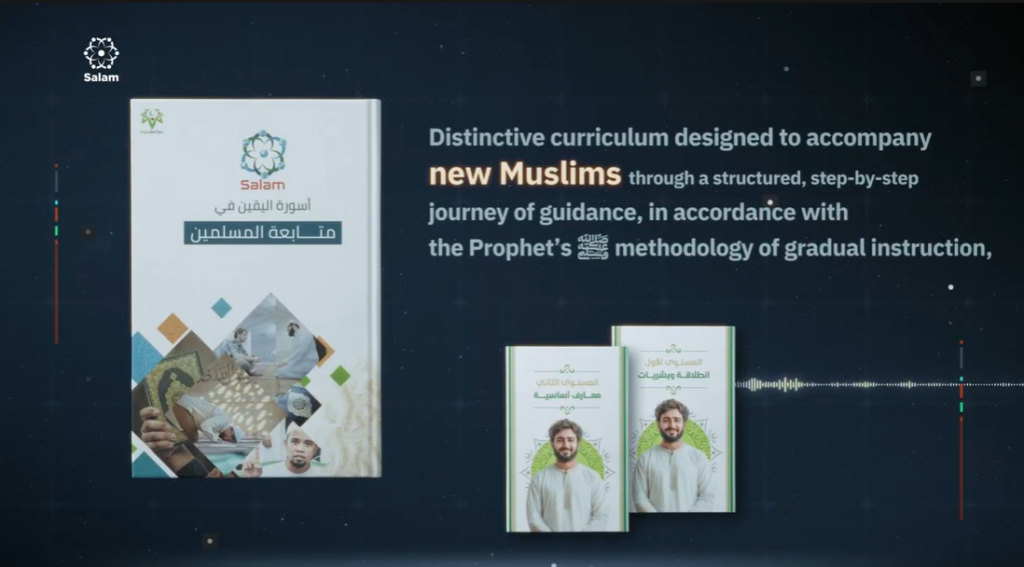
If you are a new Muslim, the Asawirat Al-Yaqeen (Bracelets of Certainty) program was built for you. It is a structured, four-stage curriculum designed by the Salam Center for Da’wah and Dialogue to guide you through the knowledge, practice, and spiritual grounding that every new Muslim needs:
- Stage One — The Foundation: The meaning of the Shahada, the pillars of Islam, practical rulings for prayer and purification
- Stage Two — The Construction Phase: The pillars of faith, fasting, Hajj, and the biography of the Prophet (PBUH)
- Stage Three — The Consolidation Phase: Spiritual character, repentance, Islamic etiquette, and family and life rulings
- Stage Four — The Empowerment Phase: Contemporary issues, theological foundations, and building your life roadmap on Islamic principles
The curriculum has guided over 114,000 new Muslims across 140 countries, and it is available to you wherever you are.
Have a question, or ready to take your Shahada?
Reach out directly — our team is ready to listen, guide, and welcome you.
Reach out directly to the Salam Center team to start the Asawirat Al-Yaqeen (Bracelets of Certainty) program for FREE.
Conalusion
Islam’s belief in the Torah is a matter of theological certainty — every Muslim affirms that Allah revealed the Torah to Prophet Musa (PBUH) as a book of divine guidance, light, and binding law for the Children of Israel, as the Quran states directly and unambiguously.
The Torah in existence today cannot be equated with that original revelation. Centuries of conquest, exile, deliberate alteration by religious authorities, and the loss of authentic transmission have produced a text in which divine truth and human distortion are inseparably intermingled, as documented by the Quran and the Islamic scholarly tradition.
The Quran stands as the final, preserved, and authoritative word of Allah — confirming what remained true in previous scriptures, correcting what was corrupted, and providing every seeker with a direct, unaltered path to the guidance of Allah.
Frequently Asked Questions
Does Islam recognize the Torah as a holy book?
Islam recognizes the original Torah — the revelation given by Allah to Prophet Musa (PBUH) — as a holy scripture. Belief in this revealed Torah is one of the six pillars of faith in Islam. The Quran states explicitly that the Torah contained guidance and light. Muslims therefore hold the divinely revealed Torah in the highest reverence. The Torah that exists today is a separate matter — it is regarded as a text that has undergone significant corruption over centuries, and it cannot be treated with the same certainty as the original divine revelation.
Do Muslims believe the Torah was changed or corrupted?
Yes. The Quran states that Jewish religious authorities distorted the Torah — altering words from their proper contexts, writing text with their own hands and attributing it to Allah, and concealing portions of what was revealed. Islamic scholars such as Ibn Hazm, Ibn Taymiyyah, and al-Shanqiti documented both the deliberate manipulation by religious elites and the historical catastrophes — conquest, exile, and destruction — that severed the chain of authentic textual transmission. The Islamic position is not speculation; it is derived directly from Quranic testimony and supported by historical evidence.
Can Muslims read or study the current Torah?
The classical Islamic ruling is that a layperson should not occupy themselves with reading the current Torah, given that truth and falsehood are intermingled within it and cannot be distinguished without the Quran as the criterion. The Prophet (PBUH) expressed clear displeasure when Umar ibn al-Khattab brought a portion of the Torah to him. Scholars of established knowledge — particularly those engaged in comparative religion or refutation of misconceptions — may study it for the purpose of calling people to Islam and clarifying Islamic truth, as the classical scholars themselves did when presenting evidence for the prophethood of Muhammad (PBUH) from Jewish scripture.
Did the original Torah mention Prophet Muhammad (PBUH)?
The Quran affirms that the original Torah contained a description of Prophet Muhammad (PBUH), stating that the People of the Book "find him written in what they have of the Torah and the Gospel" (Quran 7:157). Certain researchers and Islamic scholars have identified passages in existing manuscripts — including some that Jewish and Christian authorities historically kept from wide circulation — that they argue correspond to these descriptions. While the exact wording of such references cannot be confirmed with certainty given the Torah’s corrupted transmission history, the Quran’s testimony on this point is definitive.
What is the Islamic position when the Torah and the Quran say different things?
When the Torah’s content contradicts the Quran, the Quran takes precedence without qualification. The Quran is the final, divinely preserved revelation and the muhaymin — the guardian and criterion — over all previous scriptures. Allah guaranteed its preservation in a way He did not guarantee for earlier books. Where a statement in the current Torah aligns with the Quran or the authenticated Sunnah, Muslims may affirm it as a surviving fragment of the original revelation. Where it contradicts Quran or Sunnah, it is regarded as a product of corruption, and the Quran’s account is taken as truth.
Curious about Islam?
Journey towards clarity and purpose. Our team is here to support you in your search for truth and spiritual guidance.
Embrace the Truth