
What to Say in Sajdah in the Quran?
| Key Takeaways |
| The Quran commands prostration with the phrase “prostrate and draw near” in Surah Al-Alaq, establishing sajdah as a moment of closeness to Allah. |
| The Prophet Muhammad (PBUH) taught a specific tasbih for sujud: “Subhana Rabbiyal A’la,” meaning “Glory be to my Lord, the Most High.” |
| Sahih Muslim records that a servant is nearer to Allah in prostration than in any other position of prayer. |
| Beyond the obligatory tasbih, authentic hadiths permit additional supplication in any language during voluntary moments of sujud. |
| Repeating “Subhana Rabbiyal A’la” three times fulfills the minimum sunnah, though the Prophet (PBUH) sometimes prolonged his prostrations with more. |
Sajdah is the physical high point of Islamic prayer — forehead to the ground, the servant closest to Allah he will ever be in this life. New Muslims often ask exactly what words belong in that posture, and the Quran itself answers before the Sunnah elaborates.
In Surah Al-Alaq, Allah commands:
وَاسْجُدْ وَاقْتَرِبْ — “But prostrate and draw near [to Allah].” (Quran 96:19)
That single verse frames everything that follows: prostration is paired directly with nearness, and nearness calls for speech that honors it.
What to Say in Sajdah According to the Quran?
The primary phrase to say in sajdah is
“Subhana Rabbiyal A’la,” meaning “Glory be to my Lord, the Most High.”
This is confirmed in Sahih hadith as the specific tasbih the Prophet Muhammad (PBUH) instructed his companions to recite during prostration, distinct from the tasbih of ruku.
The Quran does not spell out the literal wording, but Surah Al-Alaq commands the act of drawing near through sajdah, and the Prophet (PBUH) then specified the exact phrase that fulfills that closeness in words.
Aisha (may Allah be pleased with her) narrated that the Prophet (PBUH) used to say frequently in his bowing and prostrations, “Subhanaka l-lahumma Rabbana wa bihamdika, Allahumma ghfir li” — “Exalted are You, O Allah, our Lord, and praise be to You; O Allah, forgive me” —
and the hadith adds that in doing so he was acting on what had been explained to him in the Quran (The Prophet (ﷺ) used to say frequently in his bowing and prostrations “Subhanaka l-lahumma Rabbana wa bihamdika, Allahumma ghfir li” … In this way he was acting on what was explained to him in the Holy Qur’an.).
Sahih al-Bukhari 817 preserves this narration, and it stands as one of the clearest bridges between revelation and practice in the entire body of prayer-related hadith.
What is the Sunnah Formula for What to Say in Sajdah?
Every scholar of the four schools of Ahlus Sunnah wal Jama’ah agrees on the core tasbih for sujud, drawn from an authentic instruction the Prophet (PBUH) gave upon the revelation of Surah Al-A’la. When the verse
سَبِّحِ اسْمَ رَبِّكَ الْأَعْلَى — “Exalt the name of your Lord, the Most High” (Quran 87:1) — was revealed, he told his companions to make it their sajdah remembrance.
The obligatory minimum is one utterance of “Subhana Rabbiyal A’la,” though the confirmed sunnah is to repeat it three times. Scholars of fiqh across the Hanafi, Maliki, Shafi’i, and Hanbali schools concur on this baseline, differing only on finer points such as whether a single utterance suffices for validity outside of the recommended repetition.
This consensus is not a modern invention — it traces continuously back through centuries of transmitted practice to the Prophet’s own prayer, which is precisely what gives the phrase its authority.
Learn More About Islam
Discover the beauty, teachings, and wisdom of Islam in a clear and welcoming way. Start exploring and deepen your understanding today.
Learn MoreExtended Supplications the Prophet Made in Prostration
Beyond the fixed tasbih, several Sahih narrations show the Prophet (PBUH) adding further words during sujud, particularly in voluntary prayer where he had more time.
Aisha reported that she once searched for him at night and found him in ruku or sujud saying,
“Subhanaka wa bihamdika, la ilaha illa Anta” — “Glory be to You and praise, there is no god but You.”
This shows that the fixed tasbih was a floor, not a ceiling, for what the Prophet (PBUH) said in that posture.
The single most important hadith establishing why sajdah invites extended dua comes from Sahih Muslim. Abu Hurairah reported that the Messenger of Allah (PBUH) said:
The nearest a servant comes to his Lord is when he is prostrating himself, so make supplication (in this state). (Sahih Muslim 482)
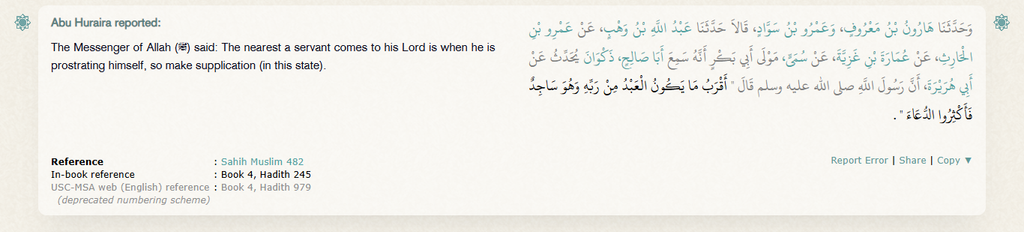
This hadith is the evidentiary foundation for every scholar who encourages personal supplication in sajdah, and it explains why the posture carries such spiritual weight in the broader structure of faith in Islam.
Read Also: How Do You Prepare to Read the Quran?
Why Does Sajdah Represent the Peak of Closeness to Allah?
Islamic theology does not describe nearness to Allah in sajdah as physical proximity, since Allah is not confined by space or direction — a point rooted in the broader Islamic understanding of the nature of Allah.
Rather, nearness here refers to spiritual rank and honor. The posture itself carries symbolic weight: it is the point at which a human being places the most honored part of the body, the face, upon the ground, in total submission — the very opposite of the arrogance that led Iblis to refuse prostration to Adam.
Read Also: How to Read the Quran?
How Many Times Should You Say the Tasbih in Sajdah?
The confirmed sunnah is to say “Subhana Rabbiyal A’la” three times in obligatory prayer, though a single utterance fulfills the minimum requirement for the prayer’s validity.
In voluntary night prayer, the Prophet (PBUH) is authentically reported to have prolonged his prostrations far beyond this minimum, sometimes remaining in sajdah for extended periods while repeating tasbih and dua.
This flexibility reflects the difference between the baseline required in every prayer and the additional devotion available to anyone who wishes to linger in that closest of positions.
Read Also: How to Learn the Quran for Beginners?
Learn More About Islam
Discover the beauty, teachings, and wisdom of Islam in a clear and welcoming way. Start exploring and deepen your understanding today.
Learn MoreDiscover More About Faith, Certainty, and the Journey to Islam
New to these questions, or just beginning to explore what prayer in Islam actually looks like? There’s more waiting for you.
Read more on the Salam blog
Explore the full Salam Platform
Reach out directly if you have questions about entering Islam, joining the program, or anything else on your mind.

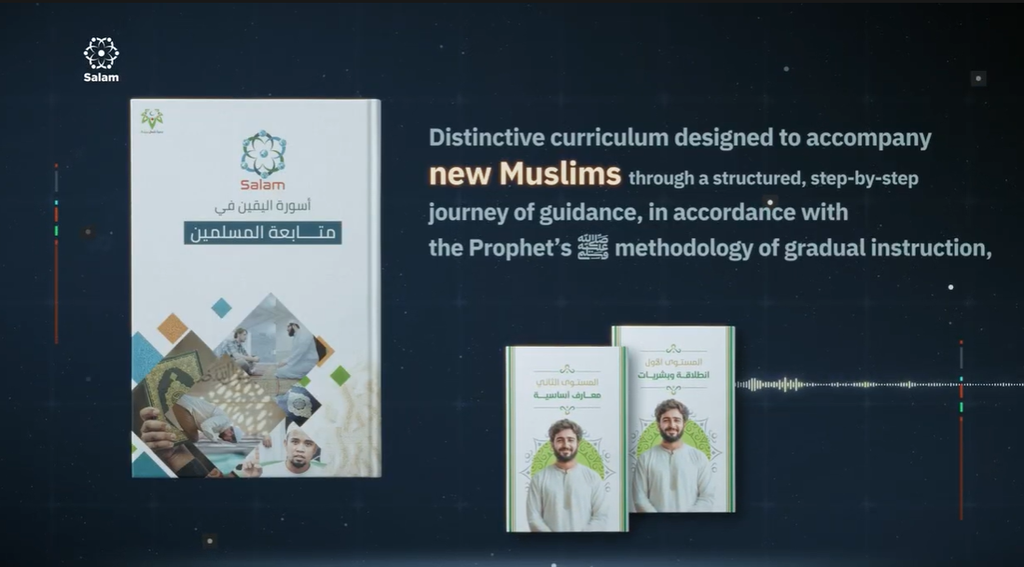
If you’re a new Muslim looking for structured guidance after taking shahada, the Salam Center team built exactly that:
- The Asawirat Al-Yaqeen (Bracelets of Certainty) program walks new Muslims through prayer, purification, and the pillars of faith step by step
- Level 1 alone covers wudu, salah basics, and the meaning of shahada in depth
- Thousands of students across more than a hundred countries have completed the journey
Reach out directly to the Salam Center team to start the Asawirat Al-Yaqeen (Bracelets of Certainty) program for FREE.
Summary
Sajdah carries a specific, transmitted vocabulary rooted in the Quran’s command to “prostrate and draw near,” fulfilled through the Prophet’s own tasbih of “Subhana Rabbiyal A’la.” Beyond this fixed remembrance, Sahih Muslim opens the door to extended personal supplication, since no posture in prayer places a servant nearer to Allah.
Learning these words is often a new Muslim’s first taste of how prayer connects ritual to intimacy with the Divine. Each prostration becomes less a motion to complete and more a moment genuinely worth lingering in.
Frequently Asked Questions
What is the exact phrase to say in sajdah?
The exact phrase is “Subhana Rabbiyal A’la,” meaning “Glory be to my Lord, the Most High.” This is the specific tasbih the Prophet Muhammad (PBUH) taught for prostration, distinct from “Subhana Rabbiyal Adheem” used in ruku, and it is repeated at least once and ideally three times in every sajdah.
Is it permissible to make personal dua in sajdah?
Yes, personal supplication in sajdah is strongly encouraged in Sahih Muslim, which states that a servant is nearest to Allah while prostrating. (Sahih Muslim 482) This applies after completing the required tasbih, particularly during voluntary prayers where more time in sajdah is customary.
Does the Quran mention what to say in sajdah?
The Quran does not give the literal wording but commands the act directly: “prostrate and draw near [to Allah].” (Quran 96:19) The Prophet (PBUH) then specified “Subhana Rabbiyal A’la” as the fulfillment of that command in speech.
Why is sajdah considered the closest moment to Allah?
Sajdah represents the deepest posture of humility in salah, and Sahih Muslim explicitly identifies it as the position of greatest nearness to Allah. Scholars explain this as nearness in rank and honor rather than physical distance, since Allah is beyond space and direction.
Curious about Islam?
Journey towards clarity and purpose. Our team is here to support you in your search for truth and spiritual guidance.
Embrace the Truth