
How to Learn the Quran for Beginners?
| Key Takeaways |
| Learning Quran for beginners starts with correct pronunciation of Arabic letters, not memorization, since accurate articulation shapes everything that follows. |
| A beginner does not need fluency in Arabic to begin; understanding meaning through translation can run alongside learning to read the Arabic script. |
| Consistency in short daily sessions produces far more retention than long, infrequent study sessions, a principle rooted in the Prophet’s own teaching method. |
| Learning Quran for beginners is considered an act of worship in itself, carrying ten rewards for every letter recited. |
Learning Quran for beginners does not require prior knowledge of Arabic, a scholarly background, or years of preparation. What it requires is a clear starting point and a willingness to move gradually — letter by letter, sound by sound, verse by verse.
Many people delay starting because they imagine the Quran as an intimidating, closed text reserved for the deeply learned. That impression could not be further from the truth.
Step 1: Learn the Arabic Alphabet and Its Correct Pronunciation
The starting point for learning Quran for beginners is mastering the twenty-eight letters of the Arabic alphabet, since Quranic Arabic uses sounds that do not exist in English or most other languages. Letters like ع (ayn), ح (ha), ق (qaf), and ص (sad) are produced from parts of the throat and mouth that a new learner has likely never engaged before.
Skipping this stage and jumping straight to reading verses is the single most common mistake beginners make.
A structured approach works best here. Many students begin with a foundational primer known as the Noorani Qaida, a small booklet designed specifically to isolate each letter, its shape in different positions (beginning, middle, end of a word), and its precise articulation point (makharij al-huruf). This is not busywork — it is the scaffolding everything else rests on.
Correct pronunciation matters because a single mispronounced letter can change the meaning of a word entirely. This is why traditional Quran teachers insist a beginner sit with a qualified instructor, even briefly, rather than relying solely on self-study.
Listening and repeating after a live teacher trains the ear in ways that written transliteration cannot replicate.
Step 2: Understand That Islam Values Effort as Much as Perfection
A beginner should know from the outset that the Quran does not demand instant mastery, and Islamic teaching explicitly honors the struggle of learning. This single piece of knowledge removes more psychological barriers than any technical instruction could.
The Prophet Muhammad (PBUH) addressed this directly. Aisha (RA) reported that the Prophet (PBUH) said:
“The one who is proficient in the Qur’an is associated with the noble, upright, recording angels; and he who falters in it, and finds it difficult for him, will have two rewards.” (Sahih al-Bukhari)
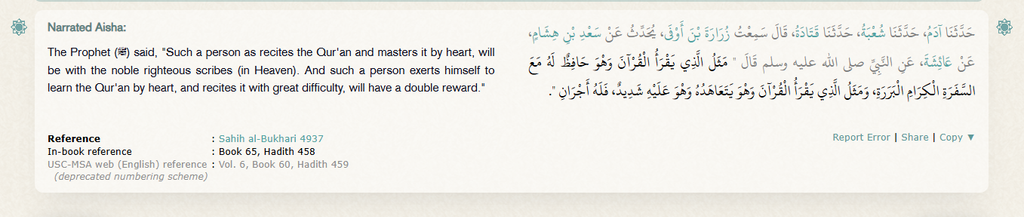
This hadith is one of the most consoling teachings a beginner can hold onto. Stumbling over a word, needing to repeat a line five times, or reading slowly does not diminish the value of the effort in the sight of Allah — it doubles it.
This is a central theme explored further in what Muslims believe about the Quran, where the relationship between sincerity and reward runs throughout Islamic teaching on scripture.
Learn More About Islam
Discover the beauty, teachings, and wisdom of Islam in a clear and welcoming way. Start exploring and deepen your understanding today.
Learn MoreStep 3: Begin With Short, Familiar Surahs
Beginners should start reciting with the shortest chapters of the Quran, typically found at the very end of the Mushaf, rather than attempting to open at Surah Al-Baqarah. Surahs like Al-Fatiha, Al-Ikhlas, Al-Falaq, and An-Nas are short, rhythmically simple, and repeated multiple times daily within the five prayers — which means a beginner gets built-in repetition without extra effort.
Surah Al-Fatiha holds particular importance because it is recited in every single unit of every prayer, making it the first surah most new reciters memorize. Its seven verses combine praise, supplication, and guidance in a compact structure that introduces a beginner to Quranic rhythm and vocabulary simultaneously.
Starting small also protects motivation. A beginner who tries to read a full page on day one often becomes discouraged. A beginner who masters four short verses feels genuine accomplishment, and that feeling sustains the habit.
Step 4: Learn the Meaning Alongside the Quranic Arabic Text
Reading the Arabic script is only one half of learning Quran for beginners; understanding what the words mean is equally essential and can begin on day one through a reliable translation. A beginner does not need to wait until they are fluent in Arabic to start engaging with meaning.
Reading a trustworthy English translation, such as the Sahih International rendering, alongside the Arabic text builds comprehension and emotional connection at the same time as pronunciation skills develop.
This dual-track approach reflects the Quran’s own description of itself. Allah says:
إِنَّا أَنزَلْنَاهُ قُرْآنًا عَرَبِيًّا لَّعَلَّكُمْ تَعْقِلُونَ — “Indeed, We have sent it down as an Arabic Qur’an that you might understand.” (Quran 12:2).
Comprehension is not a secondary goal in Islamic scholarship — it is stated as a purpose of the revelation itself.
For readers who want a deeper foundation on why the Quran holds this central place in Islamic belief, the article on why do Muslims believe in the Quran explores the theological basis in more depth.
Readers curious specifically about the Arabic-language question can also explore why the Quran is in Arabic for the scholarly reasoning behind this requirement.
Step 5: Practice Tajweed Rules Gradually
Tajweed — the set of rules governing correct Quranic recitation — should be introduced gradually to a beginner, not presented as a single overwhelming rulebook to memorize before reading a single verse. Tajweed covers things like elongation (madd), nasal sounds (ghunnah), and the specific way certain letter combinations are pronounced when they meet.
Allah instructed the Prophet (PBUH) directly regarding the manner of recitation:
أَوْ زِدْ عَلَيْهِ وَرَتِّلِ الْقُرْآنَ تَرْتِيلًا
“Or add to it, and recite the Qur’an with measured recitation.” (Quran 73:4).
The word used here, tartil, is the linguistic root of the entire discipline of Tajweed — deliberate, unhurried, clear recitation rather than rushed or slurred speech.
A practical approach for beginners is to learn one or two rules at a time, apply them to the short surahs already being practiced from Step 3, and only add new rules once the previous ones feel natural.
Attempting to absorb the full Tajweed curriculum before reading anything typically causes beginners to quit before they truly begin.
Step 6: Build a Consistent Daily Habit, Even If It Is Brief
Fifteen minutes of daily Quran practice produces far greater long-term retention for a beginner than two hours attempted once a week. Consistency, not duration, is what embeds recitation into memory and habit.
This principle mirrors the Prophet’s own guidance on worship generally, where he consistently favored sustainable, moderate practice over sporadic intensity.
The reward structure Islam attaches to Quran recitation reinforces why daily engagement matters so much. Abdullah ibn Mas’ud (RA) reported that the Messenger of Allah (PBUH) said:
“Whoever reads a letter from the Book of Allah, then he receives the reward from it, and the reward of ten the like of it. I do not say that Alif-Lam-Meem is a letter, but Alif is a letter, Lam is a letter, and Meem is a letter.” (Sunan al-Tirmidhi)
A brief calculation makes this concrete: Surah Al-Fatiha alone contains roughly 139 Arabic letters. Reciting it once, according to this hadith, generates the reward of nearly 1,400 good deeds.
A beginner reciting even a few short surahs daily is, by this teaching, accumulating reward at a scale that has nothing to do with recitation speed or fluency.
Read Also: How Do You Prepare to Read the Quran?
Step 7: Seek a Qualified Teacher or Structured Learning Program
No amount of self-study fully replaces sitting with a qualified teacher when learning Quran for beginners, because pronunciation errors are extremely difficult to self-correct through listening alone. A teacher catches subtle mistakes in real time — a slightly misplaced tongue position, an over-elongated vowel, a swallowed letter — that a beginner working alone would likely never notice.
This is precisely why the Prophet Muhammad (PBUH) placed such high value on the role of the teacher within the community. He said:
“The best among you are those who learn the Qur’an and teach it.” (Sahih al-Bukhari).
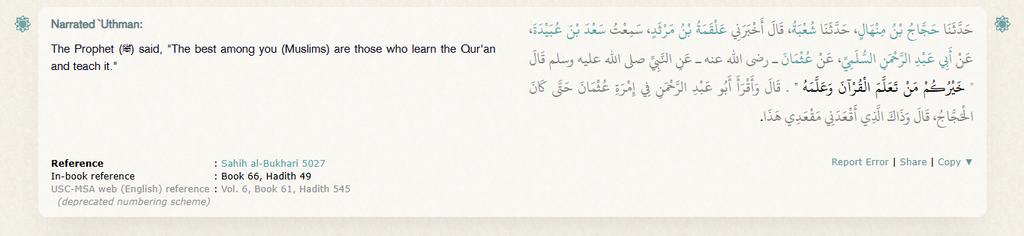
This hadith establishes teaching the Quran as one of the highest forms of service a Muslim can offer, and it is precisely this culture of mentorship that beginners should seek out, whether through a local mosque, an online ijazah-certified instructor, or a structured beginner curriculum.
For new Muslims specifically, this stage often overlaps with broader foundational learning.
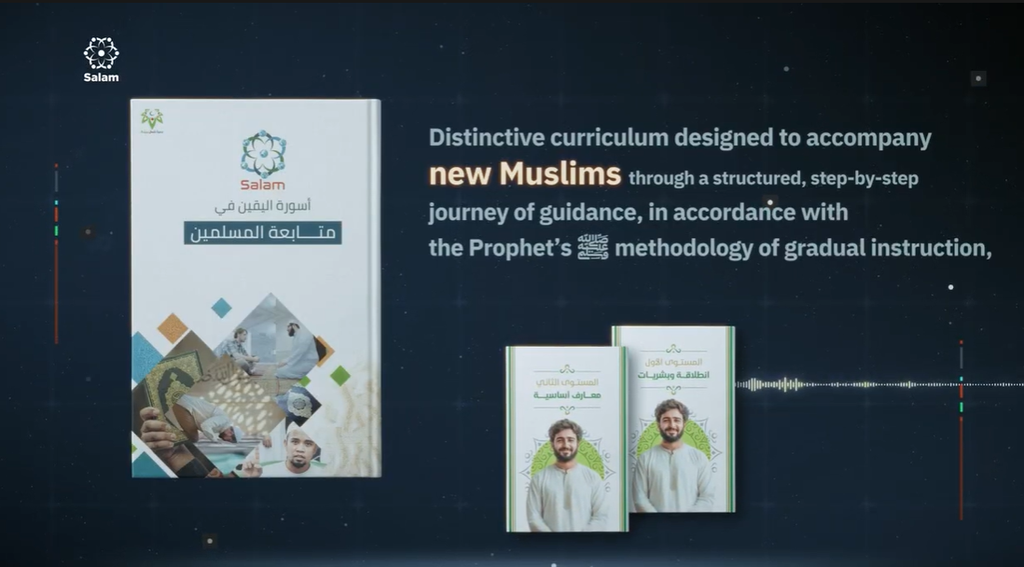
The Salam Center‘s Asawirat Al-Yaqeen (Bracelets of Certainty) program, for instance, pairs early Quran learning with instruction on wudu, salah, and the core pillars of the faith within its first educational level, recognizing that Quran learning rarely happens in isolation from the rest of a new Muslim’s foundational education.
Read Also: What to Say in Sajdah in the Quran?
Step 8: Reflect on Quranic Meaning as Understanding Deepens
Once a beginner can read with reasonable fluency, the next stage of growth is tadabbur — reflective engagement with the meaning of what is being recited, rather than recitation as a purely mechanical exercise. The Quran itself calls its reader toward this kind of engagement rather than passive repetition.
At this stage, beginners often find it valuable to explore surrounding topics that deepen appreciation for the text itself, such as the history of the Quran’s compilation or how the Quran addresses other religious traditions, which together build a fuller picture of the scripture’s place within Islamic life.
Read Also: How to Read the Quran?
Learn More About Islam
Discover the beauty, teachings, and wisdom of Islam in a clear and welcoming way. Start exploring and deepen your understanding today.
Learn MoreYour Path to Deeper Authentic Knowledge Starts Here with Salam
If this guide has sparked a genuine desire to go further, the door is open.
Explore more articles and reflections on the Salam Platform.
Read in-depth pieces on Quranic sciences, Islamic belief, and the Prophet’s biography on the Salam blog.
Have a personal question about learning Quran, taking your Shahada, or anything else? Reach out directly — there is no pressure and no agenda beyond genuine clarity.

For those who have recently embraced Islam, the Salam Center also offers the Asawirat Al-Yaqeen (Bracelets of Certainty) program, a structured post-conversion curriculum built around:
- Foundational worship — wudu, ghusl, and salah taught alongside early Quran engagement
- The six pillars of Iman — establishing the belief framework that gives Quran study its deeper meaning
- The Prophetic biography — practical lessons drawn from the life of Muhammad (PBUH)
- Daily life guidance — covering ethics, family, and interaction rooted in Quranic teaching
The program has guided over 114,000 new Muslims across 140 countries through exactly this kind of structured, compassionate learning journey.
Reach out directly to the Salam Center team to start the Asawirat Al-Yaqeen (Bracelets of Certainty) program for FREE.
Summary
Learning Quran for beginners follows a gradual path: mastering Arabic letters, starting with short surahs, learning meaning through translation, and applying tajweed step by step rather than all at once. Consistency matters more than intensity throughout this process.
Islamic teaching removes the fear that often stops beginners before they start, promising doubled reward for genuine struggle and tenfold reward for every letter recited sincerely and with effort.
Frequently Asked Questions
Do I need to know Arabic before I start learning Quran?
No, prior Arabic knowledge is not required. Learning Quran for beginners typically starts with the Arabic alphabet itself, using tools like the Noorani Qaida to build pronunciation from scratch, while a translation runs alongside to build understanding of meaning from day one.
How long does it take a beginner to learn to read the Quran?
Timelines vary widely by consistency and instruction quality, but many beginners achieve basic fluent reading within six months to a year of regular practice. Short daily sessions of fifteen to twenty minutes produce faster, more durable progress than infrequent long sessions.
Is it disrespectful to mispronounce Quran verses while learning?
No. The Prophet Muhammad (PBUH) explicitly taught that struggling reciters receive a doubled reward, according to Sahih al-Bukhari and Sahih Muslim. Effort and sincerity, not perfection, are what Islam honors in a beginner’s recitation.
Should I memorize the Quran or focus on reading first?
Reading correctly should come before memorization. A beginner who memorizes verses with incorrect pronunciation reinforces those errors permanently. Establishing accurate reading first, ideally with a teacher, creates a stable foundation for memorization later.
Curious about Islam?
Journey towards clarity and purpose. Our team is here to support you in your search for truth and spiritual guidance.
Embrace the Truth