Why Is the Quran in Arabic?
| Key Takeaways |
| The Quran was revealed in Arabic because Prophet Muhammad (PBUH) was an Arab, and Allah addresses every nation in the language of its messenger, as established in Surah Ibrahim (14:4). |
| Arabic was the most linguistically sophisticated language of its era — its precision made it uniquely capable of preserving divine meaning without distortion. |
| The Arabic of the Quran is itself a miraculous element of the revelation, with a literary structure no human has ever been able to replicate in over 1,400 years. |
The Quran is in Arabic because Allah chose Arabic as the vessel for His final, universal message — and that choice was neither arbitrary nor merely circumstantial. It was an act of divine wisdom rooted in the nature of the language itself, the identity of the messenger, and the requirement that this scripture endure uncorrupted until the Day of Judgment.
Some ask this question out of genuine curiosity. Others raise it as a challenge: why should a universal religion have a scripture in one specific language?
The answer, when examined with care, reveals that Arabic was not a limitation placed on the Quran — it was a prerequisite for it. The language, the message, and the miracle are inseparable.
1. Allah Explicitly States That Every Messenger Speaks the Language of His People
The foundation of this discussion is not speculation — it is a direct Quranic statement. Allah says:
وَمَا أَرْسَلْنَا مِن رَّسُولٍ إِلَّا بِلِسَانِ قَوْمِهِ لِيُبَيِّنَ لَهُمْ
“And We did not send any messenger except in the language of his people to state clearly for them.” (Quran 14:4)
The principle is universal: divine communication is calibrated to reach its first recipients with full clarity. Moses (PBUH) addressed the Israelites in their tongue. Jesus (PBUH) spoke Aramaic to his community.
And Muhammad (PBUH) — an Arab from Makkah, raised among the most eloquent speakers of classical Arabic — received a revelation in the language his people would understand most deeply and completely.
This was not exclusion. This was precision. The Arabs of the 7th century were the first addressees of a message intended to spread, through them, to all of humanity.
For that spread to happen truthfully, the original had to be flawless — and flawlessness required the messenger’s mother tongue.
Learn More About Islam
Discover the beauty, teachings, and wisdom of Islam in a clear and welcoming way. Start exploring and deepen your understanding today.
Learn More2. The Quran Identifies Itself as an Arabic Quran
Allah did not leave the linguistic identity of the Quran unstated. He affirmed it directly, in multiple verses, with evident intentionality.
إِنَّا أَنزَلْنَاهُ قُرْآنًا عَرَبِيًّا لَّعَلَّكُمْ تَعْقِلُونَ
“Indeed, We have sent it down as an Arabic Quran so that you might understand.” (Quran 12:2)
And in Surah Al-Zukhruf:
وَكَذَٰلِكَ أَنزَلْنَاهُ حُكْمًا عَرَبِيًّا
“And thus We have revealed it as an Arabic legislation.” (Quran 13:37)
The repeated self-identification of the Quran as “Arabic” is itself a theological statement — the language is part of the revealed identity of the scripture. This is why Muslim scholars across the centuries, from Imam al-Shafi’i to Ibn Taymiyyah, insisted on the centrality of Arabic in understanding divine intent. The language carries embedded meaning that no translation can fully reconstruct.
3. Arabic Was the Most Precise and Expressive Language Available for Divine Revelation
Classical Arabic possesses a structural precision and expressive depth that made it uniquely suited to carry a text that would serve as the final divine legislation for all of humanity.
Arabic has roots that branch into hundreds of derived forms. A single three-letter root can generate dozens of words, each capturing a distinct shade of meaning.
Arabic grammar encodes legal, ethical, and theological nuance at the level of morphology — the difference between a command and a recommendation, between an absolute prohibition and a contextual one, can rest on a single grammatical marker.
Imam Ibn al-Qayyim al-Jawziyyah documented in detail how Arabic’s structural richness makes it the most capable of all languages for conveying the subtle distinctions that divine law requires. No other language known to the 7th-century world — and few since — matched Arabic’s capacity to encode meaning with such layered density.
This is why Islamic jurisprudence (fiqh) and Islamic theology (aqidah) are inseparable from the Arabic text.
The rulings of scholars across centuries of Islamic scholarship derive directly from Arabic grammatical and lexical analysis — an enterprise that would be impossible in translation.
4. The Arabic Quran Is a Standing Miracle and Its Literary Inimitability Is a Divine Challenge
The Quran’s Arabic is not merely eloquent. It is, by the explicit challenge of Allah Himself, inimitable.
قُل لَّئِنِ اجْتَمَعَتِ الْإِنسُ وَالْجِنُّ عَلَىٰ أَن يَأْتُوا بِمِثْلِ هَٰذَا الْقُرْآنِ لَا يَأْتُونَ بِمِثْلِهِ وَلَوْ كَانَ بَعْضُهُمْ لِبَعْضٍ ظَهِيرًا
“Say, “If mankind and the jinn gathered in order to produce the like of this Qur’an, they could not produce the like of it, even if they were to each other assistants.” (Quran 17:88)
This challenge — known in Islamic scholarship as the i’jaz al-Quran (the inimitability of the Quran) — has stood unanswered for over 1,400 years. The Arabs of the Prophet’s era were masters of language and poetry. Their finest poets composed odes that were hung in gold on the walls of the Ka’bah.
When they heard the Quran, even those most hostile to Muhammad (PBUH) were struck silent by its literary force.
The miracle exists in the Arabic. A translated Quran can convey the meaning — but it cannot transmit the miracle.
Read Also: Has the Quran Been Changed?
5. Arabic Protects the Quran from the Distortions That Corrupted Previous Scriptures
One of the core reasons the Quran remains in its original Arabic is preservation — and history makes plain why this matters.
The Torah and the Gospel were revealed to their respective prophets in languages that are, today, largely inaccessible to their followers. The Hebrew of the Torah and the Aramaic of Jesus (PBUH) were progressively displaced by Greek, Latin, and vernacular translations.
Each step away from the original created new opportunities for theological interpretation, mistranslation, and — as Muslim belief affirms — deliberate alteration. This is a matter addressed directly in Quranic theology, and one explored in more depth in the discussion of what Muslims believe about the Quran.
The Quran’s preservation in a single, living, spoken Arabic — memorized by millions, recited in salah daily, and transmitted in an unbroken chain — is the primary mechanism by which Allah guaranteed its protection:
إِنَّا نَحْنُ نَزَّلْنَا الذِّكْرَ وَإِنَّا لَهُ لَحَافِظُونَ
“Indeed, it is We who sent down the Qur’an and indeed, We will be its guardian.” (Quran 15:9)
Classical Arabic — unlike many ancient languages — did not die. It was kept alive precisely because it is the language of the Quran. Every generation of Muslims, across every continent, preserves the language as an act of worship.
This is why, over 1,400 years after the revelation, a Muslim in Indonesia recites the exact same words as a Muslim in Morocco or Nigeria. The unity of the text is inseparable from the unity of the language.
Read Also: Does the Quran Say the Bible Is True?
6. Arabic Creates a Single Unifying Bond Across the Entire Global Muslim Community
Every Muslim on earth — from Kazakhstan to Brazil, from Indonesia to Senegal — recites the Quran in the same Arabic. This shared linguistic thread is one of Islam’s most profound markers of unity, and it is not accidental.
When Muslims stand in salah, they recite al-Fatihah in Arabic. When they make dhikr, they glorify Allah in Arabic. When they learn the Quran, they learn it in Arabic — whether or not it is their native tongue. The Arabic Quran functions as the liturgical and theological heartbeat of the ummah worldwide, transcending all ethnic, national, and cultural boundaries.
This unity is not merely symbolic. It has practical theological consequences. A Muslim scholar in Cairo and a Muslim convert in London can open the same mushaf and read the same text with identical pronunciation and meaning.
No doctrinal drift has entered through translation, because the primary reference point — the Arabic Quran — remains constant.
The history of the Quran’s compilation and preservation under the Companions, documented in detail in the history of the Quran, shows how seriously the early Muslim community took this linguistic unity.
Caliph Uthman ibn Affan (RA) standardized a single master manuscript — the Uthmanic codex — precisely to protect the ummah from future linguistic divergence.
Read Also: What Is the Quran in Islam?
Learn More About Islam
Discover the beauty, teachings, and wisdom of Islam in a clear and welcoming way. Start exploring and deepen your understanding today.
Learn MoreTake the Next Step in Your Journey
If this reflection on the Quran has stirred something in you — a question, a curiosity, or a desire to go deeper — the Salam Center is here for you.
Explore more articles, reflections, and evidences on the Salam Platform and the Salam blog.
If you have a personal question about Islam, want guidance on taking your Shahada, or simply want someone to talk to — reach out directly to the Salam Center team.

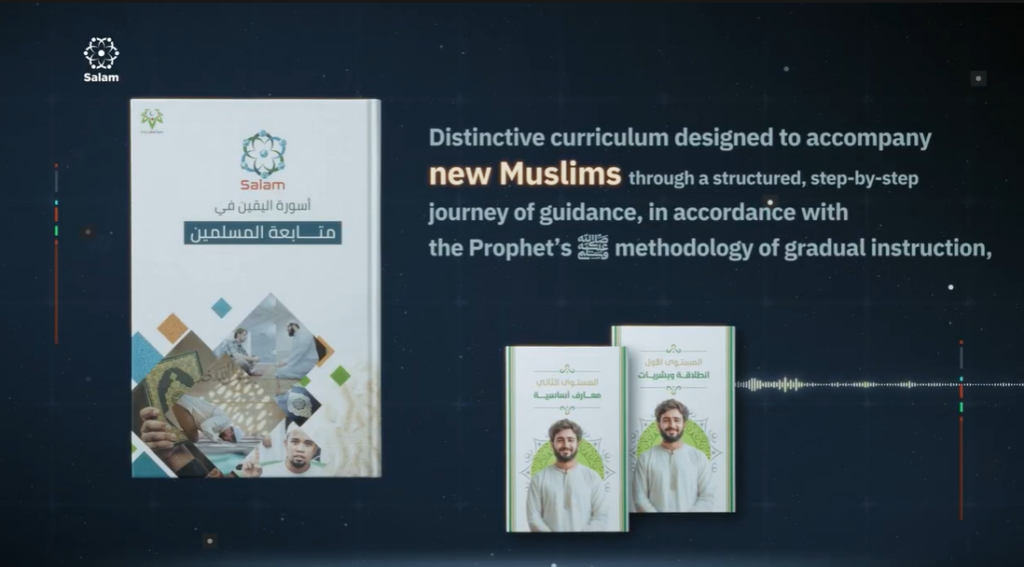
And if you have recently embraced Islam, consider joining the Asawirat Al-Yaqeen (Bracelets of Certainty) program — a structured, compassionate post-conversion curriculum that has guided over 114,000 new Muslims across 140 countries. The program covers:
- The foundations of faith — the pillars of Islam, the meaning of the Shahada, and essential acts of worship
- The six pillars of Iman — and how they shape a Muslim’s worldview and daily life
- The Prophetic biography — drawing practical lessons from the life of the Prophet (PBUH)
- Practical life rulings — from ethics of trade and family life to daily interaction and dress
- Contemporary issues and intellectual grounding — equipping new Muslims to engage confidently with modern questions
The door is open. The journey is structured. You are not alone.
Reach out directly to the Salam Center team to start the Asawirat Al-Yaqeen (Bracelets of Certainty) program for FREE.
Summary
The Quran arrived in Arabic because Arabic was the language best suited to carry an eternal, uncorrupted, and miraculously inimitable divine message — and that suitability was itself part of Allah’s design. The same linguistic precision that made the Quran a challenge to the masters of 7th-century Arabia is what makes it an anchoring, unifying force for over 1.8 billion Muslims today.
Translations of the Quran serve a vital role in conveying meaning to non-Arabic speakers, and every sincere seeker is encouraged to read them — understanding the message is the first gateway to the faith. The Arabic original, however, remains the living text, recited in every salah, memorized by millions, and preserved without a single letter of change since its revelation.
Frequently Asked Questions
Why did Allah choose Arabic specifically for the Quran?
Allah chose Arabic because it was the language of Prophet Muhammad (PBUH) and his people — and every messenger is sent in the tongue of his nation (Quran 14:4). Beyond that, classical Arabic’s structural precision and expressive capacity made it uniquely suited to carry a final, universal, and legislatively complete divine message without distortion.
Can non-Arabic speakers understand the Quran if it is only in Arabic?
Translations of the Quran convey its meanings in hundreds of languages, and every Muslim is encouraged to read them. However, translations are interpretations of meaning — the Quran itself, in its legal and theological weight, remains the Arabic text. Learning Arabic to engage with the Quran directly is considered a religious virtue in Islamic scholarship.
Is the Quran still in its original Arabic after 1,400 years?
Yes. The Quran is the only scripture in human history preserved in its original language, word for word, without alteration. It is memorized by millions of huffaz worldwide and has been transmitted through an unbroken chain since the time of the Prophet (PBUH) — a preservation guaranteed by Allah in Surah Al-Hijr (15:9).
Does the fact that the Quran is in Arabic make Islam an Arab religion?
Islam is a universal religion for all of humanity — the Quran itself addresses “all mankind” repeatedly. Arabic is the language of the scripture, not the defining identity of the faith. Muslims across every ethnicity, nationality, and culture embrace Islam and recite the Quran in Arabic as a unifying act of worship, not as an assertion of Arab identity.
Why can’t the Quran be officially translated and used in prayer?
The Quran’s inimitability (i’jaz) exists in its Arabic — the literary miracle, the legal precision, and the theological depth are embedded in the original language itself. Islamic scholars across all major jurisprudential schools hold that salah must be performed in Arabic, as no translation can carry the same divine weight. Translations serve learning; the Arabic Quran serves worship.
Curious about Islam?
Journey towards clarity and purpose. Our team is here to support you in your search for truth and spiritual guidance.
Embrace the Truth