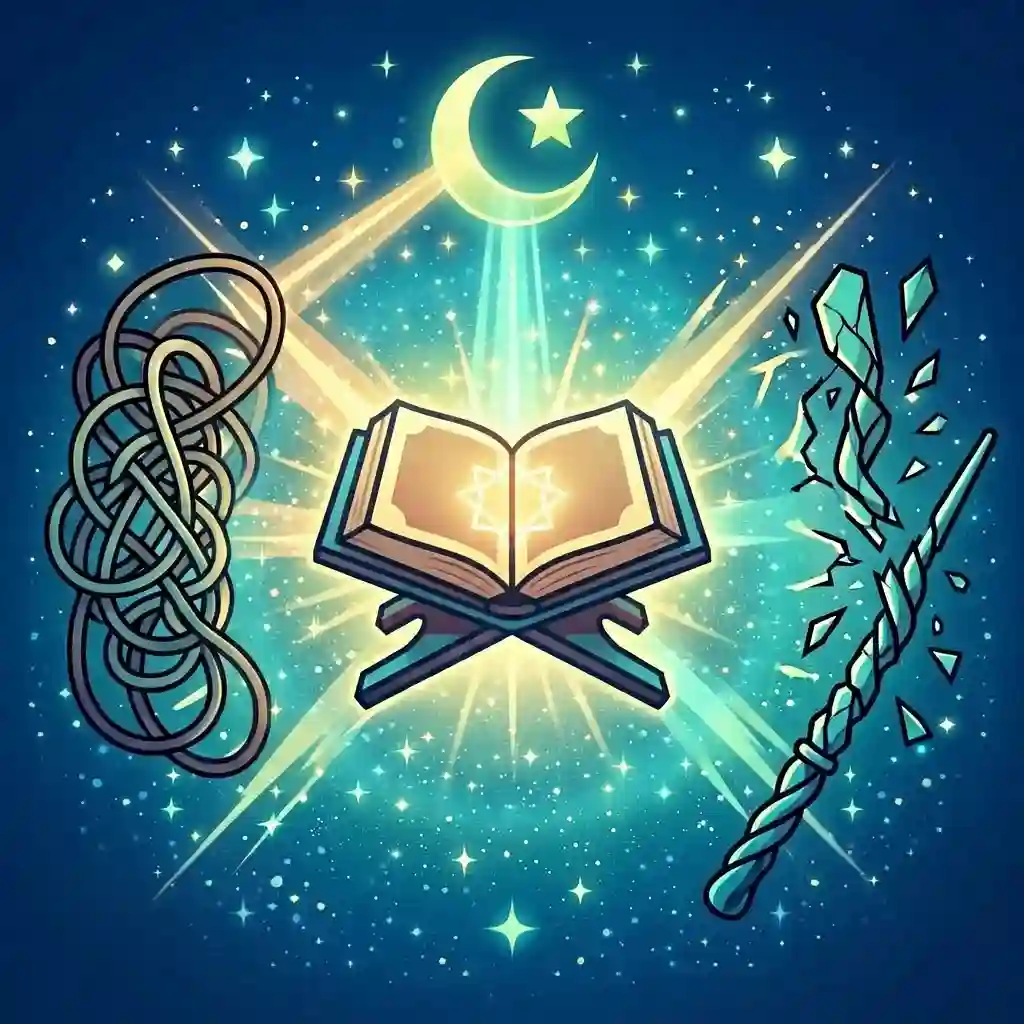
Does Islam Believe In Magic?
| Key Takeaways |
| Islam acknowledges magic (sihr) as real — it exists, it harms, and the Quran addresses it directly with clear rulings. |
| Practicing magic is one of the gravest sins in Islam, classified among the seven destructive major sins in an authenticated Hadith. |
| The Quran explicitly states that magicians harm people but cannot benefit them without Allah’s permission, establishing the limits of magic’s power. |
| Islam distinguishes between forbidden magic (sihr), the evil eye (ayn), protective ruqyah, and the natural world — each has its own ruling. |
| Seeking protection from magic through Quranic recitation and authentic supplication is not only permitted but strongly encouraged by the Prophet (PBUH). |
| Believing that magic can override Allah’s will or decree constitutes a form of shirk — associating partners with Allah — which is the gravest theological error in Islam. |
Magic has fascinated and frightened human civilizations for millennia. Every culture has its version of it — spells, curses, enchantments, the occult. So where does Islam stand? Does it dismiss magic as superstition, or does it take it seriously?
Islam takes it seriously. The Quran mentions magic in multiple places. The Prophet Muhammad (PBUH) was himself affected by a form of it. And Islamic law assigns one of the harshest verdicts to its practitioners.
This is a topic the tradition addresses head-on — with precision, without embarrassment, and with a complete theological framework that no other worldview quite parallels.
What follows is that framework, grounded in authentic sources, explained clearly.
Does Islam Believe in Magic?
Yes, magic occupies a clearly defined place in Islamic theology — real, dangerous, and strictly forbidden to practice. The Quran addresses it across multiple verses, and authentic Hadiths classify sorcery among Islam’s gravest sins, establishing both its reality and its spiritual consequences.
Protection from magic in Islam flows entirely through Quranic recitation, morning and evening remembrance, and closeness to Allah. These are real spiritual defenses that the Prophet (PBUH) taught and practiced throughout his life.
Magic Is Real in the Islamic Worldview, and the Quran Says So
Islam’s position is unambiguous: magic (Arabic: sihr) is real. It exists. It can affect people. And its origin is demonic.
The clearest Quranic proof comes from Surah Al-Baqarah, where Allah describes what was revealed to the two angels Harut and Marut in Babylon — and critically, what they warned every person who came to them:
وَمَا يُعَلِّمَانِ مِنْ أَحَدٍ حَتَّىٰ يَقُولَا إِنَّمَا نَحْنُ فِتْنَةٌ فَلَا تَكْفُرْ
“And they do not teach anyone unless they say, ‘We are a trial, so do not disbelieve.'” (Quran 2:102)
The verse then continues:
فَيَتَعَلَّمُونَ مِنْهُمَا مَا يُفَرِّقُونَ بِهِ بَيْنَ الْمَرْءِ وَزَوْجِهِ
“And they learn from them that by which they cause separation between a man and his wife.” (Quran 2:102)
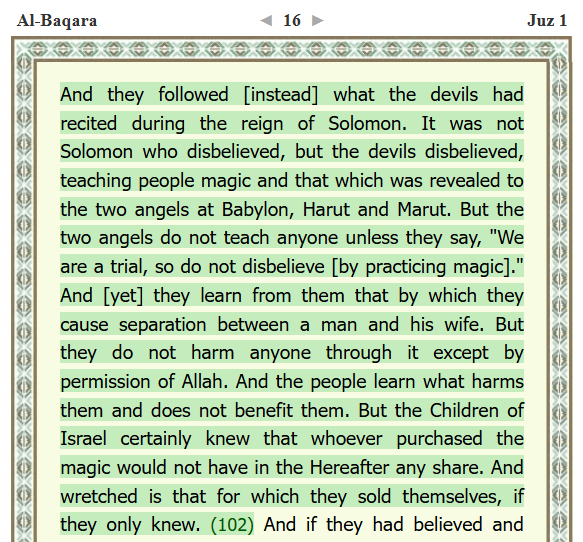
This verse alone settles the reality question. Allah is not describing a myth. He is describing an actual phenomenon with actual consequences — the breakdown of marriages.
The verse also names the source: the knowledge of sihr came through the satanic tradition, not through divine revelation.
Harut and Marut, whatever the scholarly debate around their precise nature, functioned as a test — and those who pursued their knowledge did so in defiance of Allah.
Practicing Magic Is Among the Seven Gravest Sins in Islam
Acknowledging that magic exists is one thing. Islam’s ruling on practicing it is another matter entirely — and it is severe.
The Prophet Muhammad (PBUH) explicitly listed magic among the seven major destructive sins:
The Prophet (ﷺ) said, “Avoid the seven great destructive sins.” They (the people!) asked, “O Allah’s Apostle! What are they?” He said, “To join partners in worship with Allah; to practice sorcery; to kill the life which Allah has forbidden except for a just cause (according to Islamic law); to eat up usury (Riba), to eat up the property of an orphan; to give one’s back to the enemy and fleeing from the battle-field at the time of fighting and to accuse chaste women who never even think of anything touching chastity and are good believers.” (Sahih al-Bukhari)
The list includes shirk (associating partners with Allah), unjust killing, consuming orphans’ wealth, and fleeing from battle. Magic sits in that company — which tells you everything about how Islam categorizes it.
Why so severe? Because practicing magic requires dealing with demons (shayateen), and that relationship almost always involves acts of disbelief — prostrating to idols, blaspheming Allah’s name, or using sacred texts in desecrating ways.
The magician, in order to secure the cooperation of evil spirits, typically surrenders something of his or her faith. This is why many classical scholars, including the renowned exegete Ibn Kathir, considered the practice of magic to be kufr (disbelief) in itself.
The ruling also reflects Islam’s understanding of faith in Islam as a wholeness — you cannot compartmentalize belief in Allah while simultaneously trafficking with His enemies.
Have Questions About Islam?
Our team is ready to answer your questions clearly and respectfully. Ask freely and receive honest guidance.
Ask Us NowThe Story of the Prophet’s Encounter with Magic
One of the most powerful proofs that Islam acknowledges magic’s real-world effect is the incident of the Prophet Muhammad (PBUH) himself being affected by it.
A Jewish man named Labid ibn al-A’sam performed a spell on the Prophet (PBUH) using a comb, some hair, and a date-palm spathe. The spell caused the Prophet (PBUH) to imagine he had done things he had not done.
Allah then revealed to him the location of the buried spell, and he was cured when it was removed. The two protective Surahs — Al-Falaq and An-Nas — were revealed in connection with this incident.
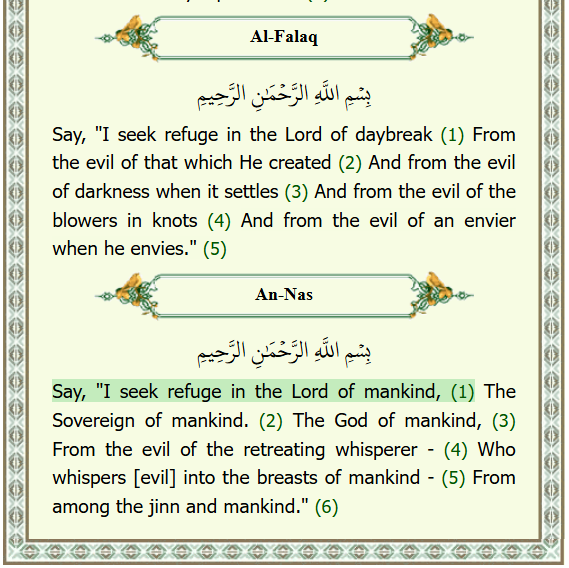
قُلْ أَعُوذُ بِرَبِّ ٱلْفَلَقِ ﴿١﴾ مِن شَرِّ مَا خَلَقَ ﴿٢﴾ وَمِن شَرِّ غَاسِقٍ إِذَا وَقَبَ ﴿٣﴾ وَمِن شَرِّ ٱلنَّفَّٰثَٰتِ فِى ٱلْعُقَدِ ﴿٤﴾ وَمِن شَرِّ حَاسِدٍ إِذَا حَسَدَ ﴿٥﴾
Say, “I seek refuge in the Lord of daybreak (1) From the evil of that which He created (2) And from the evil of darkness when it settles (3) And from the evil of the blowers in knots (4) And from the evil of an envier when he envies.” (5) (Quran 113:1-2)
The story, recorded in Sahih al-Bukhari, is instructive on multiple levels. The Prophet (PBUH) was not made to disbelieve. He was not made to sin. The spell affected his perception — his body, in a sense — but his prophethood and his connection to Allah remained intact. This is the Islamic nuance: magic has real effects, but those effects operate within the limits Allah permits. It cannot override divine decree.
This incident also shows that even the best of creation is not immune to the harm of evil, which is precisely why Islam emphasizes protection through Quranic recitation and constant remembrance of Allah.
What Are the Types of Magic and Related Phenomena in Islam?
In Islam, harmful magic (sihr) involves demonic assistance to create illusions or cause real harm, while the evil eye (al-‘ayn) is a separate but real phenomenon caused by envy or admiration. Protection comes through lawful means like ruqyah (Quranic healing), while jinn are a real creation often linked to sorcery through evil forces.
1. Sihr — Black Magic and Sorcery
Sihr is the Arabic word for magic in its forbidden sense. It involves using demonic assistance to affect people — causing illness, severing relationships, inducing obsession or madness, or creating illusions. The one who practices it is called a sahir (sorcerer).
The Quran returns to this theme repeatedly, most famously in the story of Musa (Moses) and Pharaoh’s magicians, where the magicians produced a spectacular illusion of serpents:
فَإِذَا حِبَالُهُمْ وَعِصِيُّهُمْ يُخَيَّلُ إِلَيْهِ مِن سِحْرِهِمْ أَنَّهَا تَسْعَىٰ
“And suddenly their ropes and staffs seemed to him from their magic that they were moving.” (Quran 20:66)
Yet when Musa cast his staff, the illusion was destroyed. Truth always overcomes falsehood — a theme woven into the deepest Islam principles.
2. Al-Ayn — The Evil Eye
The evil eye (al-ayn) is related to but distinct from magic. It refers to harm caused — sometimes unintentionally — through an admiring or envious gaze. The Prophet (PBUH) confirmed its reality:
“الْعَيْنُ حَقٌّ”
“The evil eye is real.” (Sahih al-Bukhari 5944)
Surah Al-Falaq seeks refuge from “the evil of the envier when he envies” — a direct reference to this phenomenon.
3. Ruqyah — Quranic Healing and Protection
Ruqyah is the recitation of specific Quranic verses and authenticated supplications for protection and healing. Seeking ruqyah against magic, the evil eye, or spiritual affliction is not only permitted — it is an established Sunnah.
The Prophet (PBUH) performed ruqyah and permitted others to do so with verified formulas.
The critical distinction: ruqyah that uses Quranic verses and authentic du’a is lawful. Ruqyah that uses unknown incantations, requests the assistance of jinn, or involves any act of disbelief is itself a form of magic — forbidden and harmful.
4. Al-Jinn — A Parallel Creation
Jinn are a real creation in Islamic theology — sentient beings made from smokeless fire, capable of both belief and disbelief. Surah Al-Jinn in the Quran describes a group of them who heard the Quran and accepted Islam. The connection to magic is that evil jinn (shayateen) are the agents through which sorcerers operate. This is why the prohibition on magic is so absolute — it is, at its core, a form of alliance with Allah’s enemies.
Read also: Do Muslims Believe in Polygamy?
Magic Cannot Override Allah’s Will
The most important theological principle in all of this: magic operates within limits set by Allah, and those limits are absolute.
The Quran states plainly about the magicians of Babylon:
وَمَا هُم بِضَارِّينَ بِهِ مِنْ أَحَدٍ إِلَّا بِإِذْنِ اللَّهِ
“But they do not harm anyone through it except by permission of Allah.” (Quran 2:102)
Every instance of harm through magic happens only because Allah permitted it — as a trial, a test, or a consequence.
The magician has no independent power. The jinn he employs have no independent power. They are all creatures operating within a created universe whose every movement is subject to Allah’s sovereign will.
This is why turning to magicians for help — asking them to cast spells on one’s behalf or break spells through forbidden means — constitutes an act that borders on shirk.
It attributes real independent power to something other than Allah, which directly contradicts the pure monotheism that is the foundation of Islam.
The nature of Allah in Islam is that of absolute sovereignty — Al-Qadir, the All-Powerful. To believe any created being, including a jinn or sorcerer, can act against His decree is a fundamental theological error.
Read also: Does Islam Believe In Reincarnation?
How Does a Muslim Protect Themselves from Magic?
Protection in Islam comes entirely through Allah — through remembrance, recitation, and righteous practice. The Prophet (PBUH) taught specific means:
Reciting Al-Mu’awwidhatain (Surah Al-Falaq and Surah An-Nas) morning and evening, and before sleep. These two Surahs were revealed specifically for protection from magic, the evil eye, and malevolent spirits.
Reciting “Bismillah al-ladhi la yadurru ma’a ismihi shay’un fi al-ardi wa la fi al-sama'” — “In the name of Allah, with whose name nothing on earth or in the heavens can cause harm” — three times in the morning and evening.
Consistent maintenance of salah and Quranic recitation, which forms a spiritual shield around the believer. The one who is near to Allah is protected by Allah — this is not metaphor but a genuine metaphysical reality in Islamic understanding.
Critically, a Muslim must never seek protection from magic by going to another magician.
The cure cannot come from the disease.
Read also: Does Islam Believe In Rebirth?
Seeking a Scholar or Practitioner of Legitimate Ruqyah
When a person genuinely believes they have been afflicted by magic or the evil eye, Islam does not leave them without recourse. Seeking a trustworthy practitioner of legitimate ruqyah shar’iyyah — Quranic ruqyah — is permitted and encouraged.
The International Islamic Fiqh Academy, one of the most authoritative global bodies in Islamic jurisprudence, has addressed the conditions for legitimate spiritual healing in multiple resolutions, emphasizing that all such healing must remain within Quranic and Sunnah-prescribed boundaries.
What to look for in a legitimate practitioner؟
Recitation of the Quran and authentic du’a only, no use of unknown symbols or incantations, no request to sacrifice animals in unusual ways, no claims of knowing the unseen.
Anyone who demands these things is not a healer — they are the very problem they claim to solve.
Have Questions About Islam?
Our team is ready to answer your questions clearly and respectfully. Ask freely and receive honest guidance.
Ask Us NowExplore More on the Salam Platform
If this topic raised further questions — about Islamic belief, the nature of the unseen world, or the foundations of faith — the Salam blog covers these and much more, written for readers at every stage of their inquiry.
Have a specific question not addressed here? Want to know more about Islam, or are you considering taking your shahada? The Salam Platform team is here —reach out directly for personal guidance, clarification on Islamic teachings, or simply to continue the conversation.

Frequently Asked Questions
Does Islam say magic is real or just superstition?
Islam explicitly affirms that magic is real. The Quran addresses it directly in Surah Al-Baqarah (2:102), describing magic taught in Babylon that could separate a husband from his wife. The Prophet Muhammad (PBUH) himself was affected by a spell cast by a man named Labid ibn al-A’sam, recorded in Sahih al-Bukhari. Islam treats magic as a genuine phenomenon with demonic origins — not folklore.
Is practicing magic a sin in Islam?
Practicing magic is one of the gravest sins in Islam. The Prophet (PBUH) classified sihr (sorcery) among the seven major destructive sins in an authenticated narration from Sahih al-Bukhari. Many classical scholars held that practicing magic constitutes disbelief (kufr) because it requires entering into an arrangement with evil jinn that typically involves acts of apostasy.
Can magic harm a Muslim who has strong faith?
Magic can physically affect a Muslim — the Prophet (PBUH) himself experienced this. However, magic cannot damage a believer’s faith, corrupt their relationship with Allah, or override divine decree. Allah states in Surah Al-Baqarah that magicians "do not harm anyone except by permission of Allah" (2:102). The protection for a Muslim is consistent remembrance of Allah, recitation of the Mu’awwidhatain (Surahs Al-Falaq and An-Nas), and Ayat al-Kursi — these form a real spiritual shield.
What is the difference between ruqyah and magic in Islam?
Ruqyah is the use of Quranic verses and authenticated Prophetic supplications for healing and protection — it is entirely lawful and is itself a Sunnah. Magic (sihr) involves invoking demonic entities through forbidden means. The distinction is in the source and method: ruqyah calls on Allah alone, while magic calls on His enemies. Anyone offering "spiritual healing" through unknown incantations, animal sacrifice, or claims of accessing the unseen is practicing magic, regardless of the label they use.
Does Islam consider the evil eye the same as magic?
The evil eye (al-ayn) and magic (sihr) are related but distinct phenomena. The Prophet (PBUH) confirmed both are real — "the evil eye is real" — but the evil eye can occur without any intentional act of sorcery. It may happen through admiration or envy, sometimes even unintentionally. Magic requires deliberate action and demonic assistance. Both can cause harm, both are addressed in Islamic protective recitations, and both are real within the Islamic worldview.
Is believing in magic’s power a form of shirk?
It depends on the belief. Acknowledging that magic exists and can cause harm — with Allah’s permission — is correct Islamic doctrine. Believing that magic or a sorcerer has independent power that can override Allah’s decree is a form of shirk (polytheism), because it attributes divine-level autonomy to created beings. This is a critical distinction rooted in the faith in Islam that everything happens only by Allah’s will and within His sovereign permission.
Curious about Islam?
Journey towards clarity and purpose. Our team is here to support you in your search for truth and spiritual guidance.
Embrace the Truth