
History of the Quran – Revelation, Preservation, & Transmission
| Key Takeaways |
| The Quran was revealed to Prophet Muhammad (PBUH) in Arabic over approximately 23 years, from 610 CE until his death in 632 CE. |
| The Quran was preserved through two simultaneous methods from the very beginning: oral memorization by companions and written inscription on available materials. |
| The first complete Mushaf (written compilation) was commissioned by Caliph Abu Bakr al-Siddiq (RA) after the Battle of Yamama in 633 CE, following the advice of Umar ibn al-Khattab (RA). |
| Caliph Uthman ibn Affan (RA) standardized the Quran into a single master copy around 650 CE, distributing it to major Islamic centers to unify the Muslim Ummah’s recitation. |
| The Quran remains the only religious scripture in human history to have been continuously memorized in its entirety by millions of people across every generation since its revelation. |
| The Quran is the literal word of Allah, preserved exactly as revealed — and this is supported by both the historical record and the Quran’s own textual consistency across 1,400 years. |
The Quran was preserved during the Prophet’s lifetime — simultaneously in writing and in the hearts of thousands. This is the historical reality that distinguishes the Quran from every other scripture in the ancient world.
Understanding the history of the Quran means understanding three intertwined processes: how it was revealed, how it was preserved during the Prophet’s lifetime, and how it was formally compiled and standardized after his death.
What is the Origin of the Quran?
The Quran originated as divine revelation from Allah, delivered to Prophet Muhammad (PBUH) through the Angel Jibreel in the Cave of Hira near Makkah in 610 CE. The Quran is the literal word of Allah — not authored by the Prophet (PBUH) — revealed in Arabic over 23 years and preserved without alteration to the present day, as affirmed in Quran 15:9.
إِنَّا نَحْنُ نَزَّلْنَا الذِّكْرَ وَإِنَّا لَهُ لَحَافِظُونَ
“Indeed, it is We who sent down the Quran and indeed, We will be its guardian.” (Quran 15:9)
1. The Revelation of the Quran Was a Process Spanning 23 Years
The first verse of the Quran descended upon Prophet Muhammad (PBUH) in the Cave of Hira, outside Makkah, during the month of Ramadan in 610 CE. The Angel Jibreel (Gabriel) came to him with the opening verses of Surah Al-Alaq:
اقْرَأْ بِاسْمِ رَبِّكَ الَّذِي خَلَقَ
“Read in the name of your Lord who created.” (Quran 96:1)
This was not a single, complete revelation. The Quran descended in stages — piece by piece, verse by verse, Surah by Surah — across approximately 23 years.
Scholars of the Islamic tradition divide the Quranic revelation into two broad phases: the Makkan period (approximately 610–622 CE), during which most verses addressed matters of creed, monotheism, resurrection, and the moral formation of the early Muslim community; and the Madinan period (622–632 CE), during which verses increasingly addressed social law, family rulings, governance, and interfaith relations.
This gradual method of revelation was purposeful. The Quran itself explains its own methodology:
وَقَالَ الَّذِينَ كَفَرُوا لَوْلَا نُزِّلَ عَلَيْهِ الْقُرْآنُ جُمْلَةً وَاحِدَةً ۚ كَذَٰلِكَ لِنُثَبِّتَ بِهِ فُؤَادَكَ ۖ وَرَتَّلْنَاهُ تَرْتِيلًا
“Those who disbelieve say, ‘Why was the Quran not revealed to him all at once?’ Thus [it is] that We may strengthen thereby your heart. And We have spaced it distinctly.” (Quran 25:32)
The gradual revelation allowed each verse to address real circumstances, to be memorized firmly, and to take root in the hearts of the believers before the next passage arrived.
How Did the Prophet (PBUH) Receive Revelation?
Sometimes Jibreel appeared to the prophet in human form and recited the verses directly. At other times, revelation came with an intensity the Prophet (PBUH) described as the ringing of a bell — an experience that would subside with the words of the Quran fully settled in his heart.
Aisha (RA) narrated in Sahih al-Bukhari that the Prophet (PBUH) would sometimes receive revelation even on cold days, and his forehead would perspire from the weight of what descended upon him.
Every time a new passage was revealed, the Prophet (PBUH) would instruct his scribes to record it and specify its exact position within the Surah in which it belonged.
The arrangement of verses and chapters was not left to human discretion — it was directed by Jibreel, and confirmed through the annual review of the entire Quran that the Prophet (PBUH) undertook with Jibreel every Ramadan.
2. Preservation of the Quran During the Prophet’s Lifetime Through Writing and Memory Together
Two pillars supported the preservation of the Quran during the prophetic era, and the strength of the Quran’s preservation rests on their combination.
A. The Scribes of Revelation
The Prophet (PBUH) maintained a dedicated group of scribes — known as Kuttab al-Wahy (scribes of the revelation) — who recorded each new passage immediately upon revelation.
Classical sources, including Al-Itqan fi Ulum al-Quran by the great Quranic scholar Imam Jalal al-Din al-Suyuti (849–911 AH), record that there were more than 40 such scribes.
Among the most prominent were Zayd ibn Thabit, Ubayy ibn Ka’b, Ali ibn Abi Talib, and Muawiyah ibn Abi Sufyan (RA).
The materials used for recording were those available at the time: flat stones (likhaf), palm stalks (jareed), leather (adim), bones (aktaf), and wooden tablets. These were stored in the home of the Prophet (PBUH).
The written record was not a backup for failing memories — it was a primary source, cross-referenced continuously with the oral tradition.
B. The Huffaz Are the Living Preservation of the Quran
Simultaneously, hundreds of companions committed the entire Quran to memory. The title of Hafiz — one who has memorized the complete Quran — was already an established distinction during the Prophet’s own lifetime.
Among the most celebrated Huffaz of that era were: Abdullah ibn Masud, Salim Mawla Abi Hudhayfa, Muadh ibn Jabal, Ubayy ibn Ka’b, and Zayd ibn Thabit (RA).
The Prophet (PBUH) himself confirmed which companions were the most proficient reciters, as recorded in Sahih al-Bukhari:
“Take the Quran from four: from Abdullah ibn Masud, Salim, Muadh, and Ubayy ibn Ka’b.”
This oral tradition carried the Quran with a precision that no handwritten manuscript alone could guarantee — because every reciter knew the sound, the rhythm, the pronunciation, and the pauses of every verse, and any deviation was immediately identifiable and correctable.
Learn More About Islam
Discover the beauty, teachings, and wisdom of Islam in a clear and welcoming way. Start exploring and deepen your understanding today.
Learn More3. The First Compilation of a Complete Mushaf After Yamama
After the Prophet’s death in 632 CE, the first great challenge to preservation emerged. The Battle of Yamama in 633 CE, fought against the false prophet Musaylima al-Kadhdhab, resulted in the martyrdom of approximately 70 Huffaz — companions who had carried the Quran in their hearts.
Umar ibn al-Khattab (RA), deeply alarmed, approached Caliph Abu Bakr al-Siddiq (RA) with a proposal: compile the Quran into a single written volume before more Huffaz were lost.
Abu Bakr (RA) was initially hesitant — this was something the Prophet (PBUH) had not explicitly commanded. But Umar persisted, and eventually Abu Bakr was satisfied that this was a righteous act of preservation, not an innovation in the religion. He appointed Zayd ibn Thabit (RA) to lead the compilation.
Zayd was ideally suited for this task: he had been one of the chief scribes of revelation during the Prophet’s lifetime, he had been present at the final review of the Quran with Jibreel, and he himself was a Hafiz. As Zayd described the weight of the task, recorded in Sahih al-Bukhari:
“By Allah, had they asked me to move a mountain, it would not have been heavier than what they asked of me — to compile the Quran.”
Zayd’s methodology was meticulous. He did not rely on his own memory alone. He gathered written fragments from wherever they had been preserved — from companions’ homes, from the Prophet’s records — and insisted on two conditions for accepting any written text: it must have been recorded in the presence of the Prophet (PBUH), and it must be corroborated by at least two reliable witnesses who had heard it directly from the Prophet (PBUH) himself.
The resulting Mushaf — a complete, ordered written compilation of the Quran — was entrusted to Abu Bakr (RA) until his death, then to Umar (RA) during his caliphate, and then to Umar’s daughter Hafsa (RA), the widow of the Prophet (PBUH).
4. The Uthmanic Standardization: One Quran, One Recitation
By the time of Caliph Uthman ibn Affan (RA) (around 650 CE), the Muslim Ummah had expanded dramatically — across Arabia, Persia, Egypt, and the Levant. Different regional communities were reciting the Quran in the various accepted dialects (ahruf) that the Prophet (PBUH) had been permitted to accommodate for ease of learning.
Hudhayfa ibn al-Yaman (RA) returned from campaigns in Armenia and Azerbaijan alarmed by the disagreements in recitation he had witnessed, and warned Uthman (RA):
“Catch this Ummah before they differ concerning the Book as the Jews and Christians differed.”
Uthman (RA) convened a committee of four senior companions — Zayd ibn Thabit, Abdullah ibn al-Zubayr, Said ibn al-As, and Abdurrahman ibn al-Harith ibn Hisham (RA) — and tasked them with producing a standardized master copy from Hafsa’s Mushaf, cross-referenced with the memories of the Huffaz.
Several copies were produced and sent to Madinah, Makkah, Kufa, Basra, Syria, and Yemen, with the instruction that all other written copies inconsistent with this standard be retired.
This was not censorship or alteration — it was a unification of the written form around the Quran as confirmed during the Prophet’s lifetime and the annual Ramadan review. The oral tradition of memorization continued unbroken alongside the standardized text.
5. The Quran Today: 1.9 Billion Memorizers, One Text
Today, an estimated 10 million Muslims have memorized the complete Quran from cover to cover — with millions more in the process. Every Hafiz alive today recites from the same text, with the same pronunciation, as confirmed through chains of transmission reaching back to the companions who learned directly from the Prophet (PBUH).
In countries as culturally distant from one another as Indonesia, Senegal, Turkey, and Brazil, a Hafiz in one community can correct a Hafiz from another — because there is only one Quran.
The Salam Center for Da’wah and Dialogue works directly with new Muslims and seekers to build this relationship with the Quran from the earliest stages of their journey, recognizing that knowing why the Quran can be trusted is as important as learning how to recite it.
Reach out directly — our team is ready to listen, guide, and welcome you.

The Quran’s Internal Structure and Its Arrangement
The Quran as Muslims hold it today contains 114 Surahs (chapters), arranged not in the chronological order of revelation but in an order established by the Prophet (PBUH) himself under divine guidance.
The longest Surahs appear near the beginning; the shortest near the end. Surah Al-Fatiha opens the Quran as a complete act of worship — a supplication that every Muslim recites at minimum 17 times daily in prayer.
The arrangement of verses within each Surah was also prophetically directed. This is why, for example, a verse revealed in Madinah may appear within a Surah that is otherwise Makkan in origin — the Prophet (PBUH) specified where each verse belonged.
Understanding this is essential for understanding what Muslims believe about the Quran — that its very ordering reflects divine intent, not human editorial choice.
Read Also: How Many Versions of the Quran Are There?
Why the Quran’s Preservation Is Unique in Religious History?
No other ancient scripture comes close to matching the Quran’s chain of preservation. The Torah and the Gospels were committed to writing generations after the figures they document, passed through translation, and exist today in manuscripts that diverge from one another in thousands of variants.
The Quran, by contrast, was written under the direct supervision of the Prophet (PBUH), memorized in its entirety by thousands of his companions, compiled within one year of his death, and standardized within 20 years — with the original voices of its first memorizers still alive and verifying every word.
The science of Quranic recitation — Tajweed — itself preserves the exact pronunciation, pause, elongation, and articulation of every letter as transmitted from the Prophet (PBUH) through an unbroken chain of masters. This is why Muslims believe in the Quran with a certainty that is both spiritual and intellectually defensible — the historical record supports the claim.
The scholar Imam al-Zarkashi (745–794 AH) addressed the sciences of Quranic preservation comprehensively in his monumental work Al-Burhan fi Ulum al-Quran, which remains one of the foundational references in Quranic sciences to this day.
Alongside it, Imam al-Suyuti’s Al-Itqan fi Ulum al-Quran provides the most thorough classical treatment of every aspect of Quranic history — from the modes of revelation to the arrangement of chapters.
Read Also: How Was the Quran Revealed and Compiled?
Learn More About Islam
Discover the beauty, teachings, and wisdom of Islam in a clear and welcoming way. Start exploring and deepen your understanding today.
Learn MoreRead Also: Who Wrote the Quran?
Learn More About Islam and Take the Next Step with Salam
If the history of the Quran has stirred something in you — curiosity, recognition, or a desire to know more — the Salam Platform is here to walk that journey with you.
Explore our articles on faith in Islam, what Muslims believe about the Quran, and why Muslims believe in the Quran to build a fuller picture.
If you have a personal question about Islam, want to take your Shahada, or simply want to speak with someone knowledgeable and caring —

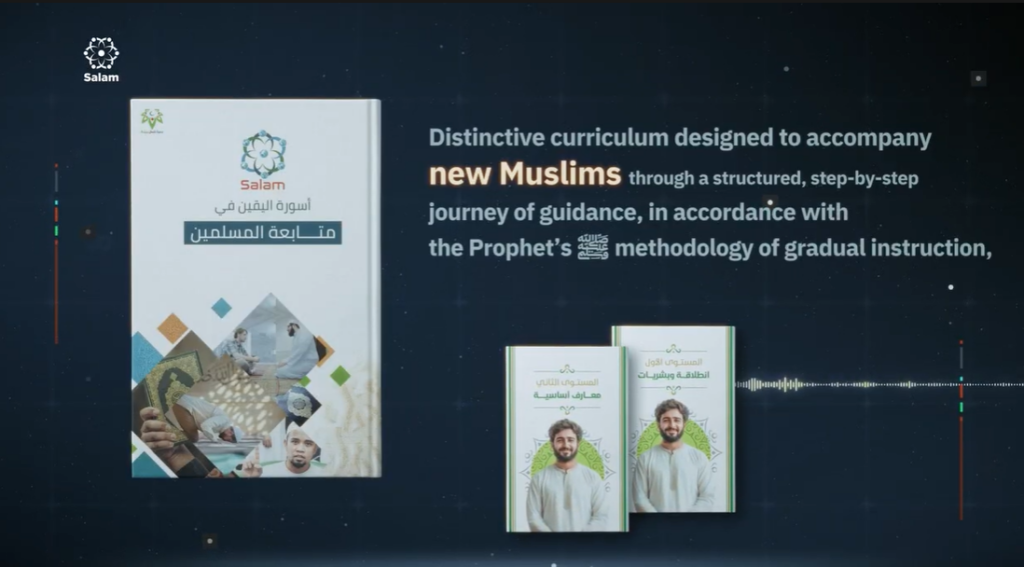
And if you’re a new Muslim ready to build your knowledge on firm ground, consider joining the Asawirat Al-Yaqeen (Bracelets of Certainty) program — a structured, four-stage curriculum designed specifically for you:
- Stage One: The foundations of faith, Shahada, prayer, and purification
- Stage Two: The pillars of Iman, fasting, Zakat, and the biography of the Prophet (PBUH)
- Stage Three: Purification of character, Tawbah, and practical ethics for daily life
- Stage Four: Contemporary questions, Islamic intellectual foundations, and your life roadmap
Already implemented with 114,588 new Muslims across 140 countries — this program meets you where you are and walks with you to where you want to be.
Explore the full Salam blog for articles on belief, practice, and the questions that matter most.
Reach out directly to the Salam Center team to start the Asawirat Al-Yaqeen (Bracelets of Certainty) program for FREE.
Summary
The Quran was preserved through two simultaneous methods from the moment of its first revelation: oral memorization by dedicated companions and written inscription supervised by the Prophet (PBUH) himself. Within one year of his death, Caliph Abu Bakr commissioned the first complete written Mushaf; within two decades, Caliph Uthman standardized it across the expanding Muslim world.
Fourteen centuries of unbroken transmission — through Huffaz in every generation and manuscripts confirmed by modern radiocarbon dating — establish the Quran as the most carefully preserved text in human history. For those seeking truth, its history is itself a form of evidence, inviting serious, honest engagement with the word of Allah.
Frequently Asked Questions
When was the Quran first written down?
The Quran was written down from the very beginning of its revelation in 610 CE. The Prophet (PBUH) appointed dedicated scribes — known as Kuttab al-Wahy — who recorded each newly revealed passage on available materials under his direct supervision. The first complete written compilation was produced under Caliph Abu Bakr (RA) in 633 CE, within one year of the Prophet’s death.
How was the Quran preserved before it was compiled into a single book?
The Quran was preserved through two complementary methods: written records maintained by the Prophet’s scribes, and oral memorization by hundreds of companions. Both methods operated simultaneously throughout the prophetic era. This dual system meant no single loss — whether of a written record or a memorizer — could compromise the integrity of the preserved text.
Did Caliph Uthman change the Quran when he standardized it?
Uthman ibn Affan (RA) did not alter the Quran’s content. He commissioned a standardized written copy from Hafsa’s Mushaf — itself compiled under Abu Bakr (RA) from materials verified during the Prophet’s lifetime — and unified the written orthography to eliminate regional scribal differences. The Quranic text was confirmed by living Huffaz who had learned directly from the Prophet (PBUH). No verse was added, removed, or changed.
What is the science of Tajweed and how does it relate to Quranic preservation?
Tajweed is the disciplined science of Quranic recitation governing the precise pronunciation, elongation, articulation, and pausing of every letter and word in the Quran. Transmitted through unbroken chains of masters from the Prophet (PBUH) to the present day, Tajweed preserves not only the text of the Quran but its exact sound — ensuring that a Hafiz today recites with the same phonetic precision as the companions who learned directly from the Prophet (PBUH).
Curious about Islam?
Journey towards clarity and purpose. Our team is here to support you in your search for truth and spiritual guidance.
Embrace the Truth