
How Was the Quran Revealed and Compiled?
| Key Takeaways |
| The Quran was revealed to Prophet Muhammad (PBUH) over approximately 23 years, beginning in 610 CE in the Cave of Hira near Mecca. |
| Allah promised to preserve the Quran Himself, making it the only divine scripture that has reached humanity in its original, unaltered form. |
| Revelation came through multiple authenticated modes, the most significant being the Angel Jibreel (Gabriel) delivering Allah’s words directly to the Prophet (PBUH). |
| During the Prophet’s lifetime, designated scribes recorded every verse on whatever material was available — palm leaves, flat bones, parchment, and stones. |
| The first Caliph Abu Bakr (RA) commissioned the initial compiled manuscript, and Caliph Uthman (RA) later standardized the definitive Mushaf that Muslims read today. |
| The Quran’s preservation rests on two simultaneous pillars: the written record of scribes and the living memory of thousands of Huffaz (those who memorized it). |
The Quran did not descend from the heavens as a bound book dropped into the hands of a waiting prophet. The Quran’s arrival was something far more profound — a living, breathing exchange between the Creator and His final messenger, unfolding across 23 years of prophethood, addressing the real struggles, questions, and spiritual needs of a community in transformation.
For seekers who want to understand what Muslims believe about the Quran, the story of its revelation and compilation is perhaps the most compelling starting point — because it reveals not just a scripture, but a divine covenant of preservation unlike anything the world has seen.
Allah declared in the Quran directly:
إِنَّا نَحْنُ نَزَّلْنَا الذِّكْرَ وَإِنَّا لَهُ لَحَافِظُونَ
“Indeed, it is We who sent down the Quran and indeed, We will be its Guardian.” (Quran 15:9)
That promise has been fulfilled — through the Prophet’s scribes, through the hearts of Huffaz, through the diligence of the Companions, and through an unbroken chain of transmission that reaches every Muslim alive today.
1. The Quran Was First Written in the Preserved Slate Before Any Human Received It
Before addressing the earthly revelation, Islamic creed establishes something essential: the Quran’s existence precedes its delivery to Prophet Muhammad (PBUH). Allah recorded it in Al-Lawh Al-Mahfuz — the Preserved Tablet — the cosmic register of all that exists and all that will ever occur.
بَلْ هُوَ قُرْآنٌ مَّجِيدٌ فِي لَوْحٍ مَّحْفُوظٍ
“But this is an honored Quran, [inscribed] in a Preserved Slate.” (Quran 85:21-22)
From the Preserved Tablet, the Quran descended to Bayt al-‘Izzah — the House of Honor in the lowest heaven — in its entirety, on Laylat al-Qadr (the Night of Decree). This is the descent described in Surah Al-Qadr.
From Bayt al-‘Izzah, the Quran was revealed to the Prophet (PBUH) gradually, over the full 23-year span of his prophethood. Ibn Abbas (RA), one of the foremost Quranic scholars among the Companions, explained this two-stage descent — a point elaborated in detail by Imam Ibn Hajar al-Asqalani (d. 852 AH), whose monumental work Fath al-Bari, his commentary on Sahih al-Bukhari, remains the gold standard of hadith scholarship.
This understanding explains why Allah says in the Quran:
وَقُرْآنًا فَرَقْنَاهُ لِتَقْرَأَهُ عَلَى النَّاسِ عَلَى مُكْثٍ وَنَزَّلْنَاهُ تَنزِيلًا
“And [it is] a Quran which We have separated [by intervals] that you might recite it to the people over a prolonged period. And We have sent it down progressively.” (Quran 17:106)
The gradual revelation was itself an act of divine wisdom — building a community, not just delivering a text.
2. The First Revelation of the Quran in the Cave of Hira
In 610 CE, Muhammad ibn Abdullah (PBUH) was forty years old. He had retreated, as was his custom, to the Cave of Hira on Jabal al-Nur — the Mountain of Light — near Mecca.
He was a man known for his truthfulness and contemplation, seeking solitude in worship before he had any name for what he sought.
Then the Angel Jibreel appeared.
Sayyida Aisha (RA) narrated the moment in detail, as recorded in Sahih al-Bukhari:
“The commencement of the Divine Inspiration to Allah’s Messenger (PBUH) was in the form of good dreams which came true like bright daylight, and then the love of seclusion was bestowed upon him. He used to go in seclusion in the Cave of Hira where he used to worship Allah alone continuously for many days before his desire to see his family. He used to take with him the journey food for the stay and then come back to [his wife] Khadijah to take his food likewise again, till suddenly the Truth descended upon him while he was in the Cave of Hira.”
The angel commanded: Iqra — “Recite!” The Prophet (PBUH) replied that he could not read. Jibreel embraced him powerfully — three times — until the first revelation poured forth:
اقْرَأْ بِاسْمِ رَبِّكَ الَّذِي خَلَقَ خَلَقَ الْإِنسَانَ مِنْ عَلَقٍ اقْرَأْ وَرَبُّكَ الْأَكْرَمُ الَّذِي عَلَّمَ بِالْقَلَمِ عَلَّمَ الْإِنسَانَ مَا لَمْ يَعْلَمْ
“Recite in the name of your Lord who created — Created man from a clinging substance. Recite, and your Lord is the Most Generous — Who taught by the pen — Taught man that which he knew not.” (Quran 96:1-5)
These five verses — the opening of Surah Al-Alaq — were the first words of Allah to reach the ears of humanity’s final prophet. The religion had begun.
3. How the Revelation Came to The Prophet Through Modes of Wahy
The Prophet (PBUH) himself described the physical experience of receiving revelation. In a famous hadith, he was asked by Al-Harith ibn Hisham (RA) how revelation came to him, and he replied as recorded in Sahih al-Bukhari:
“Sometimes it comes to me like the ringing of a bell — this is the hardest on me, then it passes off after I have grasped what is inspired. Sometimes the Angel comes to me in the form of a man and talks to me and I grasp whatever he says.”
Sayyida Aisha (RA) added that the Prophet (PBUH) would sweat profusely even on cold days, and those sitting near him could hear a sound near his blessed face — like the humming of bees — when revelation descended.
These are not details a later tradition invented; they are the firsthand accounts of those who witnessed it.
Islamic scholarship, drawing on the classical works of Uloom al-Quran — the sciences of the Quran — identifies the primary modes of revelation:
A. The Bell-like Sound (Sal-salat al-Jaras):
The most intense form, where the divine words would reach the Prophet’s heart with an overwhelming physical weight. He would sometimes lose consciousness of his surroundings momentarily.
B. Jibreel in the Form of a Man:
The most common and accessible mode, where the Archangel would appear as a man and speak the revelation directly.
C. Jibreel in His True Angelic Form:
The most majestic mode, which the Prophet witnessed twice in his lifetime — once at the beginning of his prophethood, and once during the Miraj.
Every mode shared one guarantee: the words arrived exactly as Allah intended, with no possibility of human addition, omission, or distortion.
Learn More About Islam
Discover the beauty, teachings, and wisdom of Islam in a clear and welcoming way. Start exploring and deepen your understanding today.
Learn More4. The Quran Was Revealed Gradually Over 23 Years
The disbelievers of Mecca once challenged the Prophet (PBUH), asking: why was the Quran not revealed all at once? Allah answered them directly in the Quran:
وَقَالَ الَّذِينَ كَفَرُوا لَوْلَا نُزِّلَ عَلَيْهِ الْقُرْآنُ جُمْلَةً وَاحِدَةً ۚ كَذَٰلِكَ لِنُثَبِّتَ بِهِ فُؤَادَكَ ۖ وَرَتَّلْنَاهُ تَرْتِيلًا
“And those who disbelieve say, ‘Why was the Quran not revealed to him all at once?’ Thus [it is] that We may strengthen thereby your heart. And We have spaced it distinctly.” (Quran 25:32)
The gradual revelation was itself a mercy and a methodology. It allowed the early Muslim community to absorb, memorize, and internalize each portion before the next arrived.
Verses addressing practical rulings were revealed in response to real situations — the prohibition of alcohol came in stages, over multiple revelations, allowing a society deeply attached to wine to be guided away from it incrementally.
Verses of consolation arrived in moments of grief; verses of legislation arrived as the community organized itself in Madinah.
The Quran itself is, in a sense, a record of a people’s journey — and the gradual revelation is the trail of that journey, marked by divine light at every turning point.
Understanding why Muslims believe in the Quran begins precisely here: a scripture that responded to living human reality, verse by verse, over two decades, cannot be the product of a human author.
5. The Scribes of the Revelation Wrote the Quran in the Prophet’s Lifetime
The Prophet (PBUH) appointed designated scribes of revelation (Kuttab al-Wahy) whose sole role was to record each verse the moment it was revealed.
Among the most prominent scribes were Zayd ibn Thabit (RA) — who would later lead both major compilation projects — as well as ‘Ali ibn Abi Talib (RA), Ubayy ibn Ka’b (RA), Mu’awiyah ibn Abi Sufyan (RA), and Zubair ibn al-‘Awwam (RA).
The scribes wrote on whatever materials were at hand: parchment (riq’), palm leaf stalks (aqtab), flat stones (lijhar), and the shoulder bones of animals (aktaf). These fragments were then kept securely.
The Prophet (PBUH) would also direct each scribe on precisely where to place a newly revealed verse within the Surah — meaning the arrangement of the Quran was itself divinely supervised, not a later editorial decision.
Additionally, every Ramadan, the Prophet (PBUH) would review the entire revealed Quran with Jibreel in what scholars call the ‘Aradah — the annual presentation.
In the final year of his life, this review happened twice, a sign, the Companions understood, that the revelation was complete. As confirmed in Sahih al-Bukhari, Ibn Abbas (RA) reported this double presentation and recognized it as an indication of the Prophet’s imminent passing.
6. The First Compilation in a Complete Mushaf
When the Prophet (PBUH) passed away in 632 CE, the Quran existed in two parallel forms: in the written fragments held by the scribes, and in the hearts of a large community of Huffaz. What had never been done was gathering all those written fragments into a single, ordered collection.
The impetus came tragically, through the Battle of Yamama (633 CE), where approximately seventy Huffaz — some of the Quran’s living repositories — were martyred.
Umar ibn al-Khattab (RA) approached Abu Bakr al-Siddiq (RA) with urgent counsel: compile the Quran before more of those who carried it were lost.
Abu Bakr (RA) was initially hesitant — how could he undertake something the Prophet (PBUH) himself had not formally done? Umar’s response was simple and decisive: “By Allah, it is a good thing.”
Abu Bakr (RA) entrusted this monumental task to Zayd ibn Thabit (RA), the most qualified of the scribes. Zayd (RA) himself narrated the process in the famous hadith recorded in Sahih al-Bukhari:
“So I started compiling the Quran by collecting it from the leafless stalks of the date-palm tree and from the pieces of leather and hides and from the stones, and from the chests of men who had memorized the Quran.”
Under Abu Bakr’s stewardship, an official unified compilation was made through a rigorous process of verifying each verse through the combined attestation of written materials, memorization, and direct testimony. No verse was accepted on the basis of memory alone; it had to be corroborated by written material recorded in the Prophet’s presence, and verified by at least two witnesses.
The resulting collection — the Suhuf, a set of ordered manuscripts — was preserved by Abu Bakr (RA), then passed upon his death to Umar ibn al-Khattab (RA), and after Umar’s assassination, to his daughter Hafsa bint Umar (RA), herself a Hafizah and widow of the Prophet (PBUH).
7. The Uthmanic Mushaf is The Standardized Quran That Reaches Us Today
By the caliphate of ‘Uthman ibn ‘Affan (RA), approximately 650 CE, Islam had spread across a vast geography — Persia, Sham, Egypt, Iraq. With this expansion came a natural variation: new Muslims were learning the Quran from Companions who came from different Arab dialects, and the differences in recitation were creating confusion.
The Companion Hudhayfah ibn al-Yaman (RA), who had witnessed Muslim armies of Sham and Iraq reciting the Quran differently during a shared campaign, rushed to ‘Uthman (RA) with a striking plea, recorded in Sahih al-Bukhari:
“Save this nation before they differ about the Book as Jews and the Christians did before.”
‘Uthman (RA) acted swiftly. He requested the Suhuf from Hafsa (RA) and formed a four-member committee, again led by Zayd ibn Thabit (RA), alongside ‘Abdullah ibn al-Zubayr (RA), Sa’id ibn al-‘As (RA), and ‘Abd al-Rahman ibn al-Harith (RA).
Their task was to produce a unified Mushaf in the dialect of Quraysh — the dialect of the Quran’s original revelation — from which all other copies would be made.
The committee’s methodology was equally meticulous. When any disagreement arose, ‘Uthman (RA) instructed them to default to the Qurayshi dialect.
Zayd ibn Thabit (RA) later confirmed that upon comparing the new Mushaf against all previous manuscripts, “they did not differ in anything” — a statement preserved in Hadith literature.
‘Uthman (RA) then dispatched official copies of this Mushaf to the major cities — Makkah, Madinah, Kufa, Basra, Sham — each accompanied by a qualified reciter, and ordered that any existing copies containing variations be destroyed.
This was an act of extraordinary foresight: he unified the Ummah around a single, authenticated text, eliminating the risk that personal copies — some containing marginal annotations or variant arrangements — would be confused with the revealed scripture itself.
That Uthman Mushaf, verified through memorization, written records, and living witnesses to the Prophet’s own recitation, is the Quran that every Muslim reads and recites today. Nothing has changed. Nothing could.
8. The Living Preservation Through Memorization and the Ijazah Chain
The Quran’s preservation was never solely a matter of ink on parchment. From the very first revelation, the Prophet (PBUH) would recite what he received, and his Companions would memorize and recite it back. The tradition of hifz — complete memorization of the Quran — has continued in every generation, from the Companions to the present day.
The Quran is the only book in human history memorized in its entirety by millions of people simultaneously, across every continent, in its original Arabic, to the precise letter.
A child in Indonesia, a student in Senegal, a scholar in Cairo — they all carry the same 6,236 verses in their hearts, word for word.
This living, human preservation runs in parallel to every written copy, meaning no single manuscript error could ever corrupt the text without the hafiz community immediately identifying and correcting it.
The institution of the Ijazah chain — where a student receives formal certification of Quranic recitation from a teacher, who received it from their teacher, in a documented chain reaching back to the Prophet (PBUH) himself — remains active today.
Millions of Muslims worldwide hold these chains, each one a living thread connecting this age directly to the night in the Cave of Hira.
Read Also: How Many Versions of the Quran Are There?
What Happened After the Final Verse Was Revealed?
The last revealed verse of the Quran is widely identified by scholars as:
الْيَوْمَ أَكْمَلْتُ لَكُمْ دِينَكُمْ وَأَتْمَمْتُ عَلَيْكُمْ نِعْمَتِي وَرَضِيتُ لَكُمُ الْإِسْلَامَ دِينًا
“This day I have perfected for you your religion and completed My favor upon you and have approved for you Islam as religion.” (Quran 5:3)
This verse was revealed on the Day of Arafah during the Prophet’s Farewell Pilgrimage, approximately 81 days before his death.
The understanding Muslims draw from this moment is profound: the Quran was complete, the religion was sealed, and the covenant of preservation was fully in effect.
Every verse that needed to be revealed had been revealed. Every word Allah intended for humanity had been delivered.
The story of how the Quran was compiled is ultimately the story of how a divine trust was honored — by angels, by prophets, by scribes, by scholars, and by ordinary believers who refused to let a single letter of their Lord’s speech be lost.
Read Also: Who Wrote the Quran?
Learn More About Islam
Discover the beauty, teachings, and wisdom of Islam in a clear and welcoming way. Start exploring and deepen your understanding today.
Learn MoreRead Also: History of the Quran – Revelation, Preservation, & Transmission
Explore More Authentic Knowledge About Islam on the Salam Platform
The story of the Quran’s revelation connects to the deepest questions every seeker asks: Who is Allah? What does He want from us? Is this scripture trustworthy?
The Salam Platform is here to walk alongside you in that journey:
- Read deeper articles and reflections on the Salam blog
- Explore foundational questions like how Islam views the nature of Allah and the principles of Islam
- Understand what Muslims believe about faith and why the Quran is their ultimate reference
- Have specific questions? Reach out directly — no question is too small

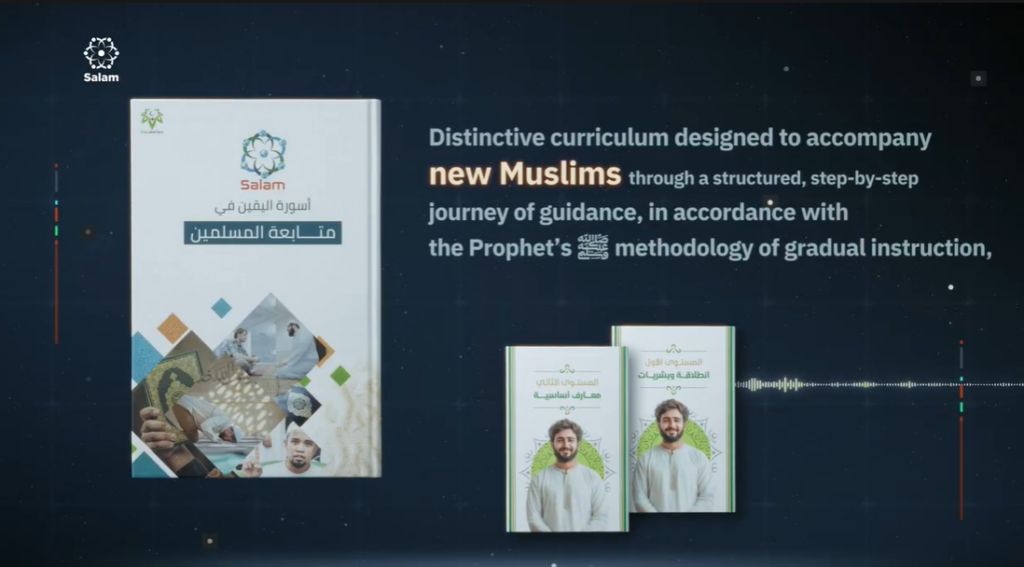
If you have taken your Shahada or are considering Islam, we warmly invite you to join the Asawirat Al-Yaqeen (Bracelets of Certainty) program — the Salam Center’s structured curriculum for new Muslims, implemented with over 114,000 graduates across 140 countries. The program guides you through four progressive stages:
- Stage One: The foundations — Shahada, prayer, and the pillars of Islam
- Stage Two: The essential beliefs — Iman, fasting, Zakat, and knowing your Prophet (PBUH)
- Stage Three: Spiritual refinement — repentance, character, and practical life rulings
- Stage Four: Empowerment — contemporary issues, Islamic identity, and a roadmap for life
Reach out directly to the Salam Center team to start the Asawirat Al-Yaqeen (Bracelets of Certainty) program for FREE.
Summary
The Quran’s revelation unfolded in stages, beginning in 610 CE with Angel Jibreel’s appearance in the Cave of Hira and continuing for 23 years through multiple authenticated modes of divine communication. Every verse was immediately recorded by appointed scribes and simultaneously memorized, creating a dual preservation system operative from the first day of prophethood.
After the Prophet’s passing, Abu Bakr (RA) commissioned the first formal collection under Zayd ibn Thabit (RA), requiring written and oral corroboration for every verse. Uthman (RA) later standardized this into the unified Mushaf distributed globally — a text unchanged to this day, preserved in millions of hearts and confirmed through unbroken chains of transmission reaching back to the Prophet (PBUH) himself.
Frequently Asked Questions
Was the Quran written down during the Prophet Muhammad’s lifetime?
The Quran was actively written during the Prophet’s lifetime by designated scribes called Kuttab al-Wahy, who recorded each verse on available materials immediately after revelation.
How long did the revelation of the Quran take?
The Quran was revealed over approximately 23 years, beginning in 610 CE when the Prophet (PBUH) was forty years old. The first verses were from Surah Al-Alaq, revealed in the Cave of Hira, and the final verses were revealed near the end of his life, completing the religion as declared in Quran 5:3.
Who compiled the Quran into a single book after the Prophet died?
Caliph Abu Bakr al-Siddiq (RA) commissioned the first formal compilation, led by the scribe Zayd ibn Thabit (RA), following the martyrdom of many Huffaz at the Battle of Yamama. Each verse was verified through written records and multiple witnesses. Caliph ‘Uthman (RA) later produced the standardized Mushaf, confirmed in Sahih al-Bukhari, from which all Qurans worldwide descend today.
Is the Quran today identical to what was revealed to the Prophet Muhammad (PBUH)?
The Quran today is identical to the Uthmanic Mushaf, which was compiled from the Abu Bakr Suhuf, which was itself compiled from materials written in the Prophet’s presence and verified by those who heard the recitation directly from him. Millions of Huffaz memorizing the same text across the globe — linked through documented Ijazah chains to the Prophet (PBUH) himself — make any undetected alteration a textual and historical impossibility.
Curious about Islam?
Journey towards clarity and purpose. Our team is here to support you in your search for truth and spiritual guidance.
Embrace the Truth