
Who Wrote the Quran?
| Key Takeaways |
| The Quran is the direct word of Allah, revealed to Prophet Muhammad (PBUH) through the Angel Jibreel (Gabriel) over approximately 23 years. |
| The Prophet Muhammad (PBUH) didn’t author the Quran; he was an unlettered man who could neither read nor write before revelation began. |
| The Quran was preserved through simultaneous oral memorization and written recording during the lifetime of the Prophet (PBUH). |
| No human being — not a single companion, scribe, or scholar — is credited with authoring even a single verse of the Quran in Islamic theology. |
| The Quran’s linguistic inimitability (I’jaz) has been documented by Arab linguists and scholars across fourteen centuries as a standing proof of its divine origin. |
The Quran is the unaltered word of Allah — revealed to His Messenger, Muhammad (PBUH), preserved by his companions, and compiled into a single Mushaf (written copy) by the early Muslim community.
Who Wrote the Quran?
The Prophet Muhammad (PBUH) did not compose the Quran. The Quran is the direct speech of Allah revealed to Prophet Muhammad (PBUH) through the Angel Jibreel over 23 years. Companions physically recorded the words as scribes, but no human being — including the Prophet himself — composed, authored, or contributed to the Quran’s content in any way.
The Islamic Position on the Authorship of the Quran Is Absolute and Unambiguous
The Quran has one author: Allah, the Lord of all creation. This is the foundational creed upon which all of Islam rests. Understanding faith in Islam requires understanding this point first, because belief in the divine origin of the Quran is itself one of the pillars of Iman.
Allah states directly in the Quran:
وَإِنَّهُ لَتَنزِيلُ رَبِّ الْعَالَمِينَ
“And indeed, it [the Quran] is the revelation of the Lord of the worlds.” (Quran 26:192)
Allah further states:
إِنَّا نَحْنُ نَزَّلْنَا الذِّكْرَ وَإِنَّا لَهُ لَحَافِظُونَ
“Indeed, it is We who sent down the Reminder, and indeed, it is We who are its Guardian.” (Quran 15:9)
The Quran describes its own origin with remarkable clarity, in multiple places, and attributes itself to none other than Allah.
The Prophet Muhammad (PBUH) Was the Recipient, Not the Author of the Quran
A critical clarification that Islamic scholarship has always emphasized: the Prophet Muhammad (PBUH) received the Quran — he did not produce it.
Before prophethood, he was known as Al-Amin (the Trustworthy) and Al-Ummi — the unlettered one. He could not read or write. Allah describes him in the Quran:
الَّذِينَ يَتَّبِعُونَ الرَّسُولَ النَّبِيَّ الْأُمِّيَّ
“Those who follow the Messenger, the unlettered Prophet.” (Quran 7:157)
This is historically and linguistically significant. A man who could not read or write produced — or received — a text that left the greatest Arab poets of his generation speechless.
وَكَذَٰلِكَ أَنزَلْنَآ إِلَيْكَ ٱلْكِتَٰبَ ۚ فَٱلَّذِينَ ءَاتَيْنَٰهُمُ ٱلْكِتَٰبَ يُؤْمِنُونَ بِهِۦ ۖ وَمِنْ هَٰٓؤُلَآءِ مَن يُؤْمِنُ بِهِۦ ۚ وَمَا يَجْحَدُ بِـَٔايَٰتِنَآ إِلَّا ٱلْكَٰفِرُونَ ﴿٤٧﴾ وَمَا كُنتَ تَتْلُوا۟ مِن قَبْلِهِۦ مِن كِتَٰبٍ وَلَا تَخُطُّهُۥ بِيَمِينِكَ ۖ إِذًا لَّٱرْتَابَ ٱلْمُبْطِلُونَ
“And thus We have sent down to you the Qur’an. And those to whom We [previously] gave the Scripture believe in it. And among these [people of Makkah] are those who believe in it. And none reject Our verses except the disbelievers. (47) And you did not recite before it any scripture, nor did you inscribe one with your right hand. Otherwise the falsifiers would have had [cause for] doubt.” (Quran 29:47-48)
The Quraysh of Makkah, fierce literary rivals who opposed him at every turn, were challenged directly by the Quran:
قُلْ لَّئِنِ اجْتَمَعَتِ الْإِنسُ وَالْجِنُّ عَلَىٰ أَن يَأْتُوا بِمِثْلِ هَٰذَا الْقُرْآنِ لَا يَأْتُونَ بِمِثْلِهِ وَلَوْ كَانَ بَعْضُهُمْ لِبَعْضٍ ظَهِيرًا
“Say, ‘If mankind and the jinn gathered in order to produce the like of this Quran, they could not produce the like of it, even if they were to each other assistants.'” (Quran 17:88)
This challenge — known in Islamic scholarship as the I’jaz al-Quran (the inimitability of the Quran) — has stood unanswered across fourteen centuries.
The Claim That the Quran Was Written by Muhammad (PBUH): A Response to a Historical Objection
Those who argue that the Prophet (PBUH) authored the Quran face several difficulties that classical Islamic scholars and contemporary researchers in Islamic studies have addressed comprehensively.
First, the Quran itself speaks to the Prophet (PBUH) directly, sometimes correcting him and sometimes directing him in ways that would be deeply unnatural if he were the author. Allah addressed the Prophet (PBUH) with the words:
عَفَا اللَّهُ عَنكَ لِمَ أَذِنتَ لَهُمْ
“May Allah pardon you, [O Muhammad]; why did you give them permission?” (Quran 9:43)
No human author writing a text to establish his own authority would include divine corrections of his own decisions. This is among the internal textual proofs that Islamic scholars have cited across generations.
Second, the Quran contains detailed knowledge — of previous nations, of natural phenomena, of human embryology — that was not available through the intellectual or scholarly resources of 7th-century Arabia. The principles of Islam connect directly to this point: the Quran’s knowledge is presented not as the Prophet’s insight but as divine disclosure.
Third, the Arabs at the time of the Prophet (PBUH) were the greatest masters of the Arabic language in human history. Their silence in the face of the Quranic challenge — their inability to produce a comparable text — was itself a sociological and literary event of enormous significance.
Learn More About Islam
Discover the beauty, teachings, and wisdom of Islam in a clear and welcoming way. Start exploring and deepen your understanding today.
Learn MoreHow Many Authors Wrote the Quran?
The Quran has exactly one author: Allah. There were many scribes, yes — but zero human authors. The number of people who physically recorded the Quran on behalf of the Prophet (PBUH) was estimated by tens, yet their function was purely transcriptional.
The companions who memorized the Quran — the Huffadh — are estimated to have numbered in the hundreds during the Prophet’s own lifetime.
The Quran was not primarily a written text in its first generation; its primary preservation was oral, embedded in the chests of those who had committed it to memory completely.
This oral-written dual preservation system was the genius of the early Quranic transmission: if writing was destroyed, the memorizers remained.
If memorizers died, the written records remained. Both streams ran simultaneously, from day one of revelation.
The Companions of the Prophet (PBUH) Were Scribes, Not Authors
When people ask “who wrote the Quran for Muhammad,” they are sometimes pointing to the historical fact that the Prophet (PBUH) employed scribes — companions who physically wrote down the verses as they were revealed. This fact is well-documented and openly acknowledged in Islamic scholarship.
Among the most prominent scribes of revelation were Zayd ibn Thabit, Ubay ibn Ka’b, Ali ibn Abi Talib, and Mu’awiyah ibn Abi Sufyan (may Allah be pleased with them all).
Their role was that of recorders, not composers. The distinction is precise and non-negotiable in Islamic theology: a court stenographer does not author the law. A scribe who writes down what is dictated to him does not become the author of what is dictated.
The Prophet (PBUH) also commanded the precise placement of each verse within its chapter. Whenever revelation came down, the Prophet (PBUH) would instruct his companions: “Place this verse in the chapter where such-and-such is mentioned.” The arrangement of the Quran was itself divinely guided.
The Compilation Under Abu Bakr and the Standardized Mushaf of Uthman
After the Prophet (PBUH) passed away, a pivotal moment in Islamic history tested the preservation of the Quran. In the Battle of Yamama (12 AH / 633 CE), a large number of Huffadh (those who had memorized the entire Quran) were martyred.
The companion Umar ibn al-Khattab (may Allah be pleased with him) urged the first Caliph, Abu Bakr al-Siddiq (may Allah be pleased with him), to compile the scattered written records into a single bound Mushaf.
Sahih al-Bukhari records this pivotal exchange in detail. Zayd ibn Thabit — one of the primary scribes of revelation — was tasked with the compilation. He described his own meticulous methodology: he gathered every piece of written revelation, cross-referenced it with the memorized recitation of the companions, and accepted no verse without two independent witnesses confirming its written form.
Under the third Caliph, Uthman ibn Affan (may Allah be pleased with him), this Mushaf was then standardized into multiple copies and distributed across the Muslim world, with the instruction that all other variant written collections be unified according to this authoritative text. This is the Mushaf — the physical Quran — that Muslims hold in their hands today.
The entire compilation process was an act of preservation, not composition. No new content was introduced. No human voice added to or subtracted from what had been received from the Prophet (PBUH).
Is the Quran Written by Allah?
The Quran is the Speech of Allah (Kalam Allah). The Quran is eternal in its origin, revealed in time, preserved in human memory and written record, recited with human voices, written in ink on pages — yet, in its essence and meaning, it is the speech of the Creator.
Read Also: How Many Versions of the Quran Are There?
Why Do Muslims Believe the Quran Is from Allah and Not from a Human Source?
Muslims hold this belief not as blind faith but as a rationally grounded conviction with multiple supporting pillars. The reasons why Muslims believe in the Quran span textual, historical, linguistic, and experiential dimensions.
Among the most powerful is the Quran’s own self-attestation, combined with the challenge it issued — the Tahaddi — to its contemporaries and all subsequent generations.
The Quraysh of Makkah had every political, social, and religious motivation to refute the Quran by producing something comparable. They had the finest poets of the Arabian Peninsula. They had unlimited resources. They had decades. They produced nothing.
The Islamic scholar and jurist Ibn Kathir (700–774 AH), in his monumental Tafsir Ibn Kathir, one of the most widely consulted classical works of Quranic exegesis in the Sunni tradition, documents this challenge and its historical response across his commentary on the relevant verses.
Read Also: How Was the Quran Revealed and Compiled?
Learn More About Islam
Discover the beauty, teachings, and wisdom of Islam in a clear and welcoming way. Start exploring and deepen your understanding today.
Learn MoreRead Also: History of the Quran – Revelation, Preservation, & Transmission
Continue Your Learning Journey About Islam with the Salam Platform
If this article has sparked sincere questions, or if you are at the beginning of a journey toward Islam, the Salam Center is here to walk with you — with knowledge, warmth, and no pressure.
Explore more on the Salam Platform — a comprehensive library of articles answering the most important questions about Islamic belief, the Quran, the nature of Allah, and the life of the Prophet (PBUH).
Read more on the Salam blog — where seekers and new Muslims find honest, carefully sourced answers rooted in authentic scholarship.
Ready to take the next step? Reach out directly — whether you have a personal question about Islam, wish to take your Shahada, or want to learn more.

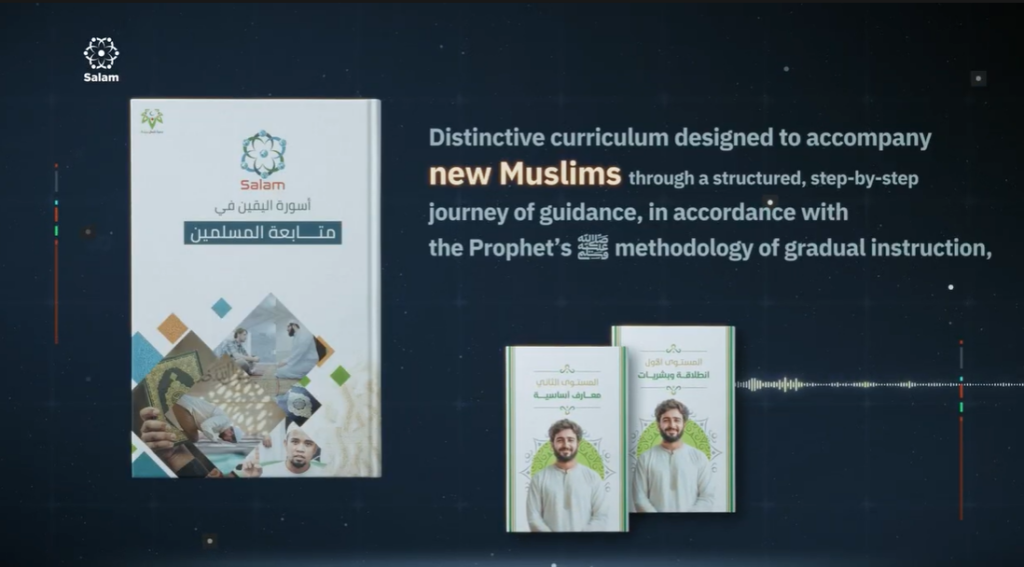
For new Muslims, the Salam Center offers the Asawirat Al-Yaqeen (Bracelets of Certainty) — a structured, four-stage educational journey designed to ground your faith on firm knowledge:
- Stage One: The foundations — Shahada, prayer, purification, and the pillars of Islam
- Stage Two: Faith, fasting, zakat, and the life of the Prophet (PBUH)
- Stage Three: Character development, spiritual purification, and practical life rulings
- Stage Four: Empowerment — contemporary issues, the creed of Ahlus Sunnah, and a life roadmap from the Quran
The Asawirat Al-Yaqeen (Bracelets of Certainty) program has already served over 114,000 new Muslims in 140 countries. It is waiting for you.
Reach out directly to the Salam Center team to start the Asawirat Al-Yaqeen (Bracelets of Certainty) program for FREE.
Summary
The Quran’s divine authorship rests on three converging pillars: the Quran’s own repeated self-attribution to Allah, the Prophet Muhammad’s documented status as an unlettered man who could not have produced such a text independently, and the unanswered linguistic challenge the Quran issued to the finest Arab poets of its era.
The historical compilation of the Quran — through dual oral and written preservation during the Prophet’s lifetime, formal collection under Abu Bakr, and standardization under Uthman — represents one of the most rigorously documented textual transmissions in human history, a process that added nothing and removed nothing from what was revealed.
Frequently Asked Questions
Who wrote the Quran for Muhammad (PBUH) and how was it recorded?
Several companions served as scribes who wrote down the revelation as it came, including Zayd ibn Thabit and Ubay ibn Ka’b. At the same time, hundreds of companions memorized the Quran in full. Both streams — written and memorized — were cross-verified during the official compilation under Abu Bakr al-Siddiq, then standardized under Uthman ibn Affan (may Allah be pleased with them).
How many authors wrote the Quran?
The Quran has exactly one author: Allah. There were multiple scribes who recorded the revelation under the direction of the Prophet (PBUH), and later companions who formally compiled it — but none of these individuals authored any verse. Their role was preservation, not composition, as confirmed in Sahih al-Bukhari.
Why couldn’t the Prophet Muhammad (PBUH) have written the Quran himself?
The Prophet (PBUH) was documented as unlettered — unable to read or write before and after prophethood. The Quran itself corrects the Prophet’s decisions on several occasions, which no self-serving author would include. And the Quran’s linguistic, historical, and scientific content consistently exceeded what was accessible through the scholarly or cultural resources available in 7th-century Arabia. The Quran’s open challenge to produce a comparable text has gone unanswered for over 1,400 years.
Curious about Islam?
Journey towards clarity and purpose. Our team is here to support you in your search for truth and spiritual guidance.
Embrace the Truth