
The Prophet Muhammad Hijrah Story
| Key Takeaways |
| The Hijrah refers to the Prophet Muhammad’s (PBUH) migration from Makkah to Madinah in 622 CE. |
| The Quraysh of Makkah convened at Dar al-Nadwah and plotted to assassinate the Prophet (PBUH), a conspiracy directly referenced in the Quran in Surah Al-Anfal (8:30). |
| Ali ibn Abi Talib (RA) volunteered to sleep in the Prophet’s bed on the night of departure, risking his life so that the assassins would not detect the Prophet’s absence. |
| The Prophet (PBUH) and Abu Bakr al-Siddiq (RA) sheltered in the Cave of Thawr for three nights, and Allah directly honored this moment in the Quran in Surah At-Tawbah (9:40). |
| Upon arriving at the outskirts of Madinah, the Prophet (PBUH) founded Masjid Quba — the first mosque built in Islam — before entering the city. |
The Prophet Muhammad hijrah story is the account of how a persecuted messenger and his small band of believers left their homes, their families, and everything they had known — and in doing so, laid the foundations of an entire civilization.
In 622 CE, after thirteen years of enduring oppression, torture, economic boycott, and assassination attempts in Makkah, Allah commanded His Prophet (PBUH) to migrate to Yathrib, the city that would soon be renamed Al-Madinah Al-Munawwarah — the Radiant City.
1. The Hijrah Became Necessary When The Pressure Reached Its Peak
For 13 years, the early Muslim community in Makkah lived under relentless persecution. The Quraysh — the dominant tribe that controlled Makkah and its sacred Kaaba — viewed the Prophet’s (PBUH) call to Tawhid (the oneness of Allah) as an existential threat to their social order, their religious authority, and their commercial interests.
Slaves were tortured in the desert sun. Families were torn apart. The Prophet (PBUH) himself was mocked, harassed, and physically attacked.
The situation intensified dramatically after the deaths of Khadijah (RA), his beloved wife and first supporter, and his uncle Abu Talib, who had provided him tribal protection.
The Quraysh saw their opportunity. And yet the message of Islam continued to travel beyond Makkah’s borders, reaching the tribes of Yathrib — the Aws and the Khazraj — who had been introduced to the Quran through delegations meeting the Prophet (PBUH) at the time of Hajj.
Two pledges at al-Aqabah, near Mina, sealed the bond. The people of Yathrib pledged to protect the Prophet (PBUH) as they would protect their own families. The call went out quietly to the Muslims of Makkah: it was time to make the journey north.
2. The Quraysh Plot at Dar al-Nadwah
The leaders of the Quraysh were not blind to what was happening. When news reached them that the Muslims had begun to leave for Yathrib, they convened an emergency council at their assembly house, Dar al-Nadwah.
As recorded by Imam Ibn Ishaq in his foundational Seerah and preserved in the tafsir of Ibn Kathir, the tribal chiefs debated three options: imprison the Prophet (PBUH), expel him, or kill him.
They realized that once the Prophet (PBUH) left Makkah, he would be beyond their reach, rendering them helpless in the face of a formidable threat.
Abu Jahl, the most hostile of the chiefs, proposed the most ruthless option: a band of young men drawn from all the different clans of the Quraysh should jointly pounce upon the Prophet (PBUH) and kill him. In such a case, the responsibility for his blood would rest upon all the clans of the Quraysh. This way, the Banu Hashim — the Prophet’s clan — would be unable to seek retaliation from any single tribe.
Allah recorded their conspiracy directly in the Quran:
وَإِذْ يَمْكُرُ بِكَ الَّذِينَ كَفَرُوا لِيُثْبِتُوكَ أَوْ يَقْتُلُوكَ أَوْ يُخْرِجُوكَ وَيَمْكُرُونَ وَيَمْكُرُ اللَّهُ وَاللَّهُ خَيْرُ الْمَاكِرِينَ
“And [remember, O Muhammad], when those who disbelieved plotted against you to restrain you or kill you or evict you [from Makkah]. But they plan, and Allah plans. And Allah is the best of planners.” (Quran 8:30)
The assassins gathered outside the Prophet’s house that same night, waiting for him to emerge at dawn.
3. Ali ibn Abi Talib Sleeps in the Prophet’s Bed During the Night of Hijrah
What the assassins did not know was that the Prophet (PBUH) had already received the divine command to depart. He called Ali ibn Abi Talib (RA) and asked him to do something that required extraordinary courage: to cover himself with the Prophet’s green mantle and to sleep in the Prophet’s bed. Ali (RA) accepted without hesitation — understanding that by lying in that bed, he was placing himself between the blades of the waiting assassins and the Prophet (PBUH) he loved more than his own life.
As Ali (RA) lay wrapped in the green Hadrami cloak, the Prophet (PBUH) walked out of his house, reciting the opening of Surah Ya-Sin. Not only that, the would-be assassins did indeed arrive at the appointed place at the appointed time. However, before they could harm him, the Prophet (PBUH) managed to escape safely.
The Quraysh plot was thus frustrated at the eleventh hour. When morning came and they rushed into the house, they found not the Prophet (PBUH) — but Ali (RA), lying calmly in his place.
Ali (RA) then fulfilled another trust the Prophet (PBUH) had placed with him: staying in Makkah to return deposits that the Quraysh — even in their enmity — had kept with the Prophet (PBUH), trusting him with their valuables because of his renowned honesty.
Once this obligation was discharged, Ali (RA) made his own journey to Madinah and joined the Prophet (PBUH).
Learn More About Islam
Discover the beauty, teachings, and wisdom of Islam in a clear and welcoming way. Start exploring and deepen your understanding today.
Learn More4. The Journey of Hijrah Begins with Prophet Muhammad and Abu Bakr
The Prophet (PBUH) made his way quietly through the darkness to the house of his closest companion, Abu Bakr al-Siddiq (RA).
The first most authentic account of the Hijrah comes from Aisha (RA), reported in Sahih al-Bukhari. She narrated that when the Prophet arrived at an unusual hour, Abu Bakr understood immediately what was happening.
When Abu Bakr learned he would accompany the Prophet (PBUH), he wept with joy.
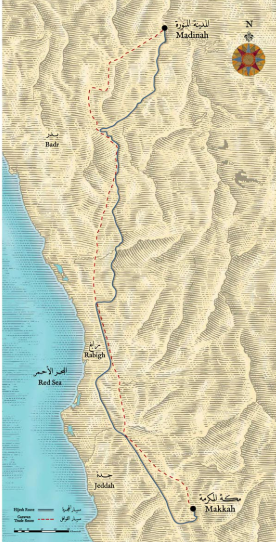
They departed together, heading south — away from Madinah, which lay to the north. This was deliberate. The Quraysh would expect a northern route.
Instead, the Prophet (PBUH) and Abu Bakr (RA) moved toward the mountain of Thawr, south of Makkah. Before leaving, the Prophet Muhammad (PBUH) started to leave his home at the end of Safar and headed in the direction of the house of Abu Bakr al-Siddiq.
Their guide for the journey was Abdullah ibn Uraiqit, a man known for his expertise in navigating the terrain — chosen for his skill, even though he was not yet Muslim at the time. The Prophet (PBUH) set out with his companion Abu Bakr al-Siddiq and their guide, Abdullah ibn Uraiqit, heading toward Madinah. They took the coastal route and walked all day.
This combination of tawakkul (complete reliance on Allah) and thorough practical planning is one of the most enduring lessons embedded in the Prophet Muhammad hijrah story — that trust in Allah does not replace careful preparation, but is perfected alongside it.
5. Three Nights in the Cave of Thawr
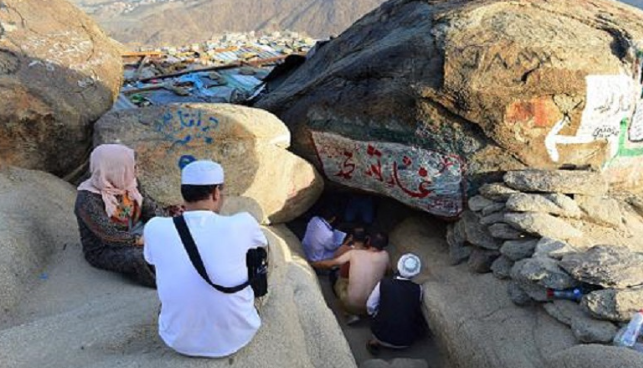
During the year of the Hijrah, the idolators tried to kill, imprison, or expel the Prophet (PBUH), who escaped with his friend and companion Abu Bakr ibn Abi Quhafah to the Cave of Thawr. They remained in the cave for three days so that the pagans who were sent in their pursuit returned to Makkah.
It was narrated that Aisha (RA) said:
“…the Messenger of Allah (PBUH) and Abu Bakr headed towards a cave on the mountain of Thawr, and they hid in it for three nights, during which Abdullah ibn Abi Bakr — who was a smart young lad — stayed with them at night, then left just before dawn so that he would be among the Quraysh in Makkah when morning came, as if he had spent the night among them. He used to listen out to see what they were planning, then he would bring news of that to the Prophet (PBUH) and Abu Bakr when darkness came.” This narration is recorded in Sahih al-Bukhari.
At one point, the Quraysh search party came so close to the cave entrance that Abu Bakr (RA), fearing for the safety of the Prophet (PBUH), said:
“If one of them were to look down at his feet, he would see us.”
The Prophet (PBUH) turned to him — calm, certain, and anchored in the knowledge that Allah’s plan could not be overturned — and said, as recorded in both Sahih al-Bukhari and Sahih Muslim:
“O Abu Bakr! What do you think about two, with Allah as their third?”
Allah preserved this moment for all time in the Quran:
إِذْ يَقُولُ لِصَاحِبِهِ لَا تَحْزَنْ إِنَّ اللَّهَ مَعَنَا
“…when he said to his companion, ‘Do not grieve; indeed Allah is with us.'” (Quran 9:40)
This verse, from Surah At-Tawbah, immortalizes Abu Bakr’s (RA) status as the companion of the Prophet (PBUH) in the cave — a recognition of rank that the scholars of Ahlus Sunnah wal Jama’ah have always held as one of the clear evidences of Abu Bakr’s honor in Islam.
One important note for those relaying this story: the widely circulated accounts of a spider weaving a web across the cave’s entrance, or of pigeons nesting there to conceal the two men from the Quraysh, are not established by authenticated hadith.
Shaykh Muhammad Nasir al-Din al-Albani noted their lack of authentic chain, and Shaykh Ibn al-Uthaymin echoed this assessment.
The story of the Hijrah carries enough divine miracle in its verified, authenticated events — and the Muslim is obligated to guard the Seerah from narrations that lack sound foundations.
6. Suraqah ibn Malik and a Prophecy Delivered on the Desert Road
After three nights, the Prophet (PBUH) and Abu Bakr (RA) left the cave and set out along the coastal route toward Madinah. The Quraysh had placed a bounty of one hundred camels on the Prophet (PBUH) — dead or alive. Many riders were scouring the terrain.
Among those who heard of the bounty was Suraqah ibn Malik ibn Ju’shum, who narrated what happened in a hadith recorded in Sahih al-Bukhari. He was sitting among his people, the Banu Mudlij, when a man came and said, “O Suraqah! I have just seen some people far away on the shore, and I think they are Muhammad and his companion.”
Suraqah recognized that it must have been them, but he told the man otherwise so that no one else would claim the reward before him.
Suraqah mounted his horse and galloped toward the Prophet (PBUH). When he got close, his horse’s legs sank into the sand. Suraqah then knew that the Prophet was under divine protection. He asked the Prophet for safety and promised to keep their secret. The Prophet granted him safety and promised him the bracelets of the Persian emperor, Kisra.
This prophecy — spoken in the open desert, at a moment of apparent vulnerability — came to pass decades later. During the caliphate of Umar ibn al-Khattab (RA), after the Muslim armies had conquered Persia, the bracelets of Kisra were brought to Madinah.
Umar called for Suraqah ibn Malik, then an elder man, and placed the bracelets of the Persian empire on his wrists — fulfilling the word of the Prophet (PBUH) exactly as it had been given on that desert road.
This incident is referenced in the classical Islamic sources and demonstrates that the Prophet (PBUH) spoke only from revelation in his prophecies.
7. The Arrival at Quba and the Welcome of Madinah
The Prophet Muhammad (PBUH) arrived in Quba on the eighth of Rabi’ al-Awwal and stayed there for four days before travelling to Madinah al-Munawwarah. While travelling, the Prophet (PBUH) and his group stopped to perform Friday prayers near Bani Salim ibn Awf.
At Quba, the Prophet (PBUH) founded the first mosque in Islamic history — Masjid Quba. The Quran honors this mosque with a direct reference in Surah Al-Tawbah (9:108), describing it as a mosque founded from the very first day on taqwa (Allah-consciousness).
Praying two units of prayer in Masjid Quba carries the reward of an Umrah, as established in an authenticated hadith recorded in Sunan Ibn Majah.
During the Prophet’s journey, news had reached his companions in Yathrib that he had emigrated from Makkah.
For many days before his arrival, they would go out to the outskirts of the city at dawn to spend the morning seeking signs of the Prophet’s arrival. Many of them had never seen the Prophet before, although they had heard a great deal about his message and resolution.
The Prophet’s arrival in Madinah marked the beginning of Islam as a living, organized community. The first structure he built was Masjid an-Nabawi, the Prophet’s Mosque — a center for prayer, learning, and governance. It was where decisions were made, disputes settled, and compassion taught.
The Prophet (PBUH) established the bond of brotherhood (al-mu’akhat) between the Muhajirun (those who had emigrated from Makkah) and the Ansar (the helpers of Madinah) — a bond so real that the Ansar shared their homes, their fields, and their livelihoods with strangers.
He also ratified the Constitution of Madinah, a document that defined the rights and responsibilities of all the city’s communities — a milestone in the history of organized societies.
Read Also: Prophet Muhammad Mercy Stories
Why Does the Hijri Calendar Begin with the Hijrah?
Scholars gathered around Caliph Umar ibn al-Khattab (RA) debated what event should mark “Year One” of the Islamic calendar. The consensus fell on the Hijrah — not because it was the Prophet’s birth or the first revelation, but because it symbolized the birth of the Muslim Ummah.
This choice speaks to how the Companions understood history. The Hijrah was the line between weakness and strength, between a persecuted message and an empowered community, between private faith and a lived public reality.
Time for the Muslim Ummah, they understood, truly began from that point.
For a deeper understanding of how Islam structures the world through divine principles, explore the Islam principles outlined on the Salam platform, or reflect on what faith in Islam genuinely means in its entirety.
read Also: The Story of Prophet Muhammad’s Mother
What Does the Hijrah Teach Us Today?
The Prophet Muhammad hijrah story carries living lessons that transcend its historical moment. Every element of the journey speaks directly to the human condition.
A. The first lesson is that divine command and human effort are inseparable.
The Prophet (PBUH) did not simply set out unguided. He chose a southerly route to deceive pursuers. He arranged a trusted guide. He entrusted Ali (RA) with returning deposits. He planned the logistics of the journey. And throughout it all, he placed complete trust in Allah. The Hijrah is the Sunnah of purposeful action grounded in certainty of divine support.
B. The second lesson is Yaqeen
When Abu Bakr (RA) expressed fear — a human, natural fear — the Prophet (PBUH) did not dismiss it. He responded with a truth that expanded the horizon: “Allah is with us.” This is the therapeutic language of Yaqeen (certainty): it does not deny reality; it places reality within a larger frame.
The Salam Center for Da’wah and Dialogue, in its Asawirat Al-Yaqeen (Bracelets of Certainty) curriculum, draws directly on this prophetic tradition — the tradition of building certainty progressively, one step of knowledge and one step of practice at a time.
Read Also: The Prophet Muhammad’s (PBUH) Story with the Jinn
C. The third lesson is in Suraqah’s story
The man who rode out as a bounty hunter returned as a companion. The Prophet (PBUH) responded to a drawn sword with an offer of safety and a prophecy of honor. This is the character that won Madinah before a single battle: not coercion, but the undeniable moral weight of a man sent as mercy to all the worlds.
For those curious about the Prophet’s (PBUH) earlier life, the Salam platform covers his childhood and how he became the Prophet of Islam, as well as his family tree from Ibrahim (Abraham).
The miraculous Night Journey — which preceded the Hijrah — is another essential milestone in understanding the Prophet’s (PBUH) life and mission.
Read Also: Prophet Muhammad’s Kindness Stories
Learn More About Islam
Discover the beauty, teachings, and wisdom of Islam in a clear and welcoming way. Start exploring and deepen your understanding today.
Learn MoreRead Also: The Prophet Muhammad’s Honesty Story
Learn More Authentic Knowledge About Islam with Salam
If the Prophet Muhammad hijrah story has stirred something in you — a question, a curiosity, a longing — you are not alone. Hundreds of thousands of people across the world have walked through exactly that door.
The Salam Center for Da’wah and Dialogue exists to walk alongside you, wherever you are in that journey.
Visit the Salam Platform to explore more articles, evidence-based resources, and compassionate answers to your sincere questions about Islam.
Browse the Salam blog for a wide range of topics — from Islamic beliefs and the life of the Prophet (PBUH), to practical guides for new Muslims.
Reach out directly — our team is ready to listen, guide, and welcome you.

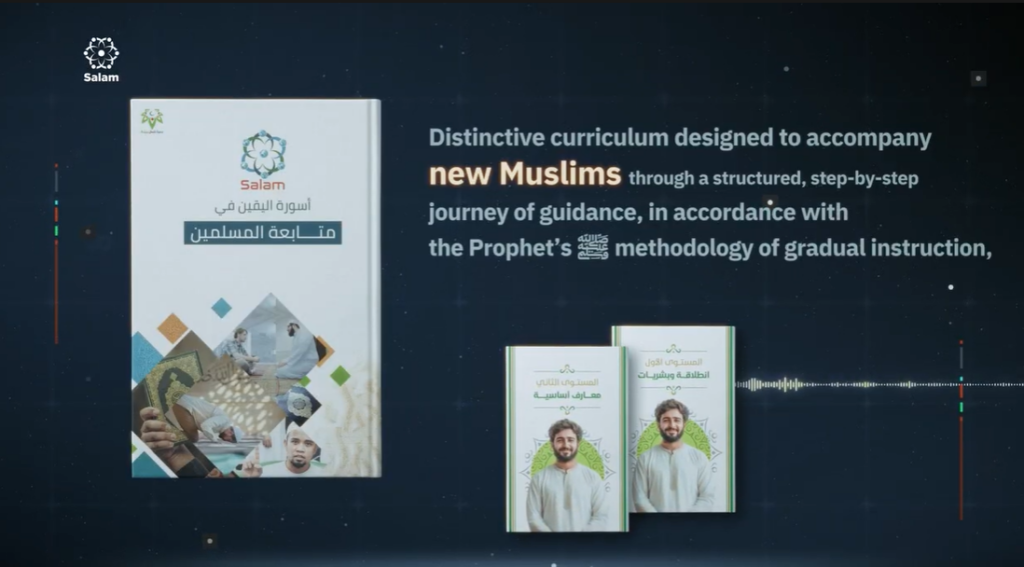
If you are considering entering Islam, have recently taken the Shahada, or want to build your faith on a solid, structured foundation, the Asawirat Al-Yaqeen (Bracelets of Certainty) program was built for you. This four-stage curriculum guides new Muslims through:
- Stage One: The Shahada, the pillars of Islam, and the foundational acts of worship — prayer, purification, and glad tidings
- Stage Two: The pillars of Iman, fasting, zakat, and the virtues of Hajj
- Stage Three: Repentance, spiritual development, and the life of the Prophet (PBUH)
- Stage Four: Contemporary issues, Islamic theology, and a life roadmap drawn from the Quran
The Asawirat Al-Yaqeen (Bracelets of Certainty) curriculum has served over 114,000 new Muslims in 140 countries, with more than 63% completing the full four-stage journey.
Reach out directly to the Salam Center team to start the Asawirat Al-Yaqeen (Bracelets of Certainty) program for FREE.
Summary
The Prophet Muhammad hijrah story describes the 622 CE migration from Makkah to Madinah, set in motion by the Quraysh assassination plot recorded in Quran 8:30. Marked by Ali’s (RA) selfless sacrifice, the three nights in the Cave of Thawr, divine reassurance in Quran 9:40, and the miraculous encounter with Suraqah ibn Malik, the journey combined tawakkul with meticulous planning.
Upon reaching Madinah, the Prophet (PBUH) founded Masjid Quba, established the brotherhood between the Muhajirun and Ansar, and built a community on divine principles — a moment so foundational that Caliph Umar ibn al-Khattab (RA) and the Companions unanimously chose it as the starting point of the Islamic Hijri calendar.
Frequently Asked Questions
Why did the Prophet Muhammad migrate from Makkah to Madinah?
The Prophet Muhammad (PBUH) migrated to Madinah because the Quraysh of Makkah had plotted to assassinate him, as recorded in Quran 8:30. After thirteen years of persecution in Makkah, Allah commanded the migration. The people of Madinah had pledged to protect him, making the city a place where the Muslim community could grow and practice Islam freely.
Who accompanied the Prophet Muhammad during the Hijrah?
The Prophet Muhammad (PBUH) was accompanied by his closest companion, Abu Bakr al-Siddiq (RA), and guided by Abdullah ibn Uraiqit, an expert navigator of the terrain. The Quran specifically honors Abu Bakr (RA) as “the companion of the cave” in Surah At-Tawbah (9:40), a distinction recognized by scholars of Ahlus Sunnah wal Jama’ah as one of the clearest marks of his rank.
What happened in the Cave of Thawr during the Hijrah?
The Prophet (PBUH) and Abu Bakr (RA) sheltered in the Cave of Thawr for three nights while the Quraysh search parties combed the region. When Abu Bakr (RA) feared discovery, the Prophet (PBUH) reassured him — as recorded in Sahih al-Bukhari (3653) and Sahih Muslim (2381) — with the words later immortalized in Quran 9:40: “Do not grieve; indeed Allah is with us.”
Who was Suraqah ibn Malik and what is his significance in the Hijrah story?
Suraqah ibn Malik (RA) was a leader of the Banu Mudlij tribe who initially set out to capture the Prophet (PBUH) for the Quraysh bounty of one hundred camels. His horse’s legs sank into the ground as he approached — a sign of divine protection. He then sought safety from the Prophet (PBUH), who granted it and prophesied that Suraqah would one day wear the bracelets of the Persian emperor, Kisra. This prophecy was fulfilled during the caliphate of Umar ibn al-Khattab (RA), and Suraqah later embraced Islam.
Why does the Islamic Hijri calendar start from the year of the Hijrah?
Caliph Umar ibn al-Khattab (RA) established the Hijri calendar during his caliphate, and the Companions unanimously chose the Hijrah as Year One. The Hijrah was selected not because it was the Prophet’s birth or the first revelation, but because it marked the beginning of the Muslim Ummah as an organized, self-governing community — the true birth of Islam as a living societal reality, not merely a private faith.
Curious about Islam?
Journey towards clarity and purpose. Our team is here to support you in your search for truth and spiritual guidance.
Embrace the Truth