
Does the Quran Say to Go to the People of the Book?
The Quran commands Muslims to invite the People of the Book to a shared word of pure monotheism, found in Surah Al-Imran 3:64. “People of the Book” (Ahl al-Kitab) refers primarily to Jews and Christians, communities that received earlier revelation from Allah.
Surah Al-Ankabut 29:46 instructs Muslims to debate the People of the Book only in the best possible manner, with grace and respect. Prophet Muhammad (PBUH) personally applied this command by sending a letter quoting Quran 3:64 to the Byzantine Emperor Heraclius.
Does the Quran Say to Go to the People of the Book?
Yes, the Quran instructs Muslims to go to the People of the Book — but not to argue, dominate, or convert by force. The invitation is to a shared truth: the oneness of Allah. This command appears in Surah Al-Imran, where Allah tells Prophet Muhammad (PBUH) to say directly to Jews and Christians: come to a word that is common between us and you.
This verse reshaped how Muslims have approached interfaith engagement for over fourteen centuries.
It is not a summons to conflict. It is an appeal grounded in what Jews, Christians, and Muslims already hold in common — belief in one God, without partners, without intermediaries treated as divine.
The Quran Commands Muslims to Invite the People of the Book to a Common Word
The clearest and most direct answer to this question sits in Surah Al-Imran, verse 64. Allah instructs the Prophet (PBUH) to speak directly to Jews and Christians and call them toward a word of agreement. The verse reads:
قُلْ يَا أَهْلَ الْكِتَابِ تَعَالَوْا إِلَىٰ كَلِمَةٍ سَوَاءٍ بَيْنَنَا وَبَيْنَكُمْ أَلَّا نَعْبُدَ إِلَّا اللَّهَ وَلَا نُشْرِكَ بِهِ شَيْئًا وَلَا يَتَّخِذَ بَعْضُنَا بَعْضًا أَرْبَابًا مِّن دُونِ اللَّهِ
“Say, ‘O People of the Scripture, come to a word that is equitable between us and you – that we will not worship except Allah and not associate anything with Him and not take one another as lords instead of Allah.'” (Quran 3:64)
The verse names a specific, workable common ground: pure monotheism. Muslims, Jews, and Christians all trace their scriptural roots to belief in one Creator.
The verse asks nothing sectarian — it asks only that worship stay directed at Allah alone, without partners and without human intermediaries elevated to divine status.
This single request forms the theological center of Islam’s approach to the People of the Book, and it directly shapes how Islam views other religions more broadly.
The historical weight of this verse becomes clear in how Prophet Muhammad (PBUH) himself used it. He did not merely preach it in Madinah. He wrote it into a formal letter and sent it to one of the most powerful rulers on earth.
Learn More About Islam
Discover the beauty, teachings, and wisdom of Islam in a clear and welcoming way. Start exploring and deepen your understanding today.
Learn MoreWho Are the People of the Book in Islamic Teaching?
The term Ahl al-Kitab, translated as “People of the Book,” carries a specific meaning across Quranic usage. Ahl al-Kitab refers primarily to Jews and Christians — communities that Allah describes as having received genuine revelation before the Quran. Classical scholars of tafsir (Quranic exegesis), including Ibn Kathir, understood this designation to reflect shared scriptural lineage: the Torah given to Musa (Moses), peace be upon him, and the Injil (Gospel) given to Isa (Jesus), peace be upon him.
This shared lineage explains why the Quran addresses the People of the Book differently than it addresses those who reject any concept of revealed scripture entirely.
There is common ground to build on — a starting point of recognized prophethood, recognized scripture, and recognized belief in a Creator.
This is part of why understanding what do Muslims believe about the Quran also requires understanding how the Quran positions itself relative to earlier revelation: as confirmation and correction, not as rejection of the entire prophetic chain.
The Distinction Between Debate and Compulsion
The Quran draws a line between inviting someone to truth and forcing them into it. These are treated as entirely separate categories in Islamic teaching. Surah Al-Baqarah makes this foundational principle explicit:
لَا إِكْرَاهَ فِي الدِّينِ ۖ قَد تَّبَيَّنَ الرُّشْدُ مِنَ الْغَيِّ
“There shall be no compulsion in [acceptance of] the religion. The right course has become distinct from the wrong.” (Quran 2:256)
Inviting someone to Islam is an act of sincere concern for their wellbeing, not an attempt to override their will. This is a subtle but essential point for anyone encountering Islamic da’wah (the call to Islam) for the first time. The invitation stands on its own clarity. Nobody is dragged toward it.
How Does the Quran Instruct Muslims to Engage the People of the Book?
Surah Al-Ankabut adds a second layer to this instruction — one focused specifically on manner and tone. Allah commands that any disagreement with the People of the Book must be conducted only in the best possible way. The verse states:
وَلَا تُجَادِلُوا أَهْلَ الْكِتَابِ إِلَّا بِالَّتِي هِيَ أَحْسَنُ إِلَّا الَّذِينَ ظَلَمُوا مِنْهُمْ ۖ وَقُولُوا آمَنَّا بِالَّذِي أُنزِلَ إِلَيْنَا وَأُنزِلَ إِلَيْكُمْ وَإِلَٰهُنَا وَإِلَٰهُكُمْ وَاحِدٌ وَنَحْنُ لَهُ مُسْلِمُونَ
“And do not argue with the People of the Scripture except in a way that is best… And our God and your God is one; and we are Muslims [in submission] to Him.” (Quran 29:46)
This verse is doing two things at once. First, it restricts the manner of engagement to what is gracious and reasoned — not hostile, not mocking, not condescending.
Second, it instructs Muslims to explicitly name the shared foundation: “our God and your God is one.” The verse anchors the entire relationship in recognized theological common ground before any point of difference is even raised.
Why Does Manner Matter as Much as Message in Islamic Da’wah?
A message delivered without grace loses its power, regardless of how true it is. This is why the Quran does not simply command Muslims to state the truth — it commands them to state it beautifully.
The therapeutic, reassuring tone that characterizes authentic Islamic outreach is not a modern communication strategy.
It traces directly back to this verse and to how the nature of God in Islam is presented: as Merciful, Patient, and inviting rather than coercive.
Read Also: What Does the Quran Say About Polygamy?
The Prophet Muhammad’s Letter to Heraclius Applied This Command Directly
The clearest historical example of Quran 3:64 in action comes from Prophet Muhammad’s (PBUH) own diplomatic correspondence. The Prophet (PBUH) sent a formal letter to Heraclius, the Byzantine Emperor and one of the most powerful Christian rulers of his era, quoting Quran 3:64 word for word. This account is preserved in one of the most authenticated hadiths in Islamic scholarship.
Narrated by Abdullah bin Abbas, the hadith records that Abu Sufyan bin Harb — at that time still a non-Muslim — was summoned by Heraclius to verify the Prophet’s (PBUH) claims after the emperor received the letter. The hadith states that the letter read:
“In the Name of Allah, the Most Beneficent, the Most Merciful. This letter is from Muhammad, Apostle of Allah, to Heraclius, the sovereign of Byzantine… I call you to embrace Islam. Embrace Islam and you will be saved.” The letter then closed with the verse itself: “Come to a word common to you and us that we worship none but Allah and that we associate nothing in worship with Him, and that none of us shall take others as Lords beside Allah.” (Sahih al-Bukhari 7)
This hadith is recorded in the very first book of Sahih al-Bukhari, the collection of Prophetic tradition recognized by Ahlus Sunnah wal Jama’ah as the most rigorously authenticated hadith source after the Quran itself.
It documents more than a single letter. It documents Heraclius conducting an extended cross-examination of Abu Sufyan about the Prophet’s character, honesty, and teachings, before Heraclius privately acknowledged that the description matched a true prophet — even though he never publicly embraced Islam himself.
Read Also: What Does the Quran Say About Marrying a Non-Muslim?
What the Heraclius Account Reveals About Genuine Da’wah?
The Prophet (PBUH) did not send an ultimatum. He sent an invitation, backed by reasoned questions Heraclius could verify independently — questions about honesty, lineage, and consistency of message. This models exactly the “best manner” instructed in Surah Al-Ankabut 29:46: reasoned, verifiable, respectful, and free of coercion.
Read Also: Does the Quran Say to Follow the Bible?
What Are Muslims Instructed to Say When Inviting the People of the Book?
The content of the invitation itself is deliberately narrow and precise. Muslims are instructed to call the People of the Book to three specific commitments, all rooted in Quran 3:64: worship Allah alone, associate no partners with Him, and avoid elevating any human — religious leader, scholar, or otherwise — to a position of lordship instead of Allah.
The invitation asks for consistency with that foundational claim, not abandonment of it. This overlap is part of why comparative study — such as examining Islam vs. Christianity or Islam vs. Judaism — consistently returns to the same starting point: shared monotheistic origin, followed by specific points of theological divergence.
The Quran’s broader teaching on other religions, detailed further in what the Quran says about other religions, reflects this same pattern throughout: recognition of shared origin, paired with clear articulation of where the final revelation completes and corrects what came before.
The history of the Quran itself is presented in Islamic scholarship as confirmation of earlier scripture, not as its erasure — which is precisely why the invitation in 3:64 begins from common ground rather than confrontation.
Read Also: Does the Quran Say Ezra Is the Son of God?
Learn More About Islam
Discover the beauty, teachings, and wisdom of Islam in a clear and welcoming way. Start exploring and deepen your understanding today.
Learn MoreLearn More Authentic Knowledge About Islam & Quran with Salam
If this question opened a door for you, there is more waiting on the other side of it.
Explore deeper answers on the Salam Platform, where sincere questions about Islam are met with honest, evidence-based responses.
Read more reflections and explorations on the Salam blog.
Reach out directly — our team is ready to listen, guide, and welcome you.
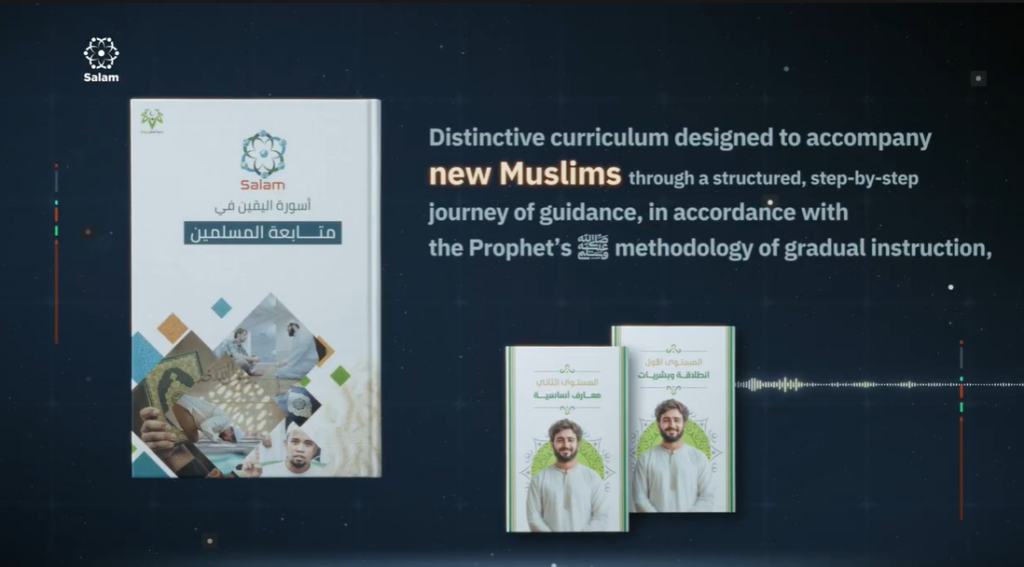
Considering Islam yourself, or newly arrived at it? The Salam Center built something specifically for this moment: Asawirat Al-Yaqeen (Bracelets of Certainty), a structured four-stage program for new Muslims.
- Stage One covers the foundations: the Shahada, prayer, purification, and the joy of a new beginning.
- Stage Two addresses repentance and deepens your knowledge of the Prophet’s (PBUH) life.
- Stage Three builds character, etiquette, and practical rulings for daily living.
- Stage Four equips you to engage confidently with contemporary questions and challenges.
The Salam Center team is ready to walk alongside you — with warmth, clarity, and zero pressure.
Reach out directly to the Salam Center team to start the Asawirat Al-Yaqeen (Bracelets of Certainty) program for FREE.
Summary
The Quran commands Muslims toward the People of the Book with a specific, gracious invitation — not confrontation. Quran 3:64 calls Jews and Christians to shared monotheism, while Quran 29:46 mandates only the best manner of discourse.
Prophet Muhammad (PBUH) modeled this personally through his letter to Heraclius, proving invitation and respect can coexist. No compulsion exists in this call; only clarity, patience, and an open door toward truth.
Frequently Asked Questions
Does the Quran say Muslims must debate the People of the Book?
The Quran instructs debate only when necessary, and only in the best possible manner. Surah Al-Ankabut 29:46 restricts disagreement to gracious, reasoned dialogue, explicitly excluding hostility or mockery, while affirming shared belief in one Allah as common ground.
Who exactly are the “People of the Book” in Islam?
“People of the Book” (Ahl al-Kitab) refers primarily to Jews and Christians. The Quran recognizes both communities as recipients of genuine earlier revelation — the Torah and the Injil — making them distinct from communities without any scriptural tradition.
Did Prophet Muhammad (PBUH) personally invite non-Muslim rulers to Islam?
Yes, the Prophet (PBUH) sent a formal letter to Heraclius, the Byzantine Emperor, quoting Quran 3:64 directly. This authenticated account appears in Sahih al-Bukhari, documenting an invitation delivered with reason, not force.
Does inviting someone to Islam violate their free will?
No — the Quran explicitly forbids compulsion in religion. Surah Al-Baqarah 2:256 establishes that truth stands distinct from falsehood on its own; invitation appeals to reason and sincerity, never coercion or pressure.
Curious about Islam?
Journey towards clarity and purpose. Our team is here to support you in your search for truth and spiritual guidance.
Embrace the Truth