
How Does the Quran Say Muhammad Died?
The Quran does not narrate the death of Prophet Muhammad (PBUH) the way a history book would. The Quran establishes Prophet Muhammad’s (PBUH) mortality as a theological principle rather than recording the scene of his passing.
Two verses carry the weight of this teaching: Surah Az-Zumar 39:30, revealed as a direct address to the Prophet affirming that he would die like everyone else, and Surah Al Imran 3:144, revealed after the Battle of Uhud to correct a crisis of faith among the early Muslims.
The actual circumstances, dates, and final words belong to the domain of Hadith — the authenticated sayings and reports about the Prophet’s life — not the Quran itself.
How does the Quran say Muhammad died?
The Quran does not describe the death scene of Prophet Muhammad (PBUH) at all. What the Quran provides instead is a direct declaration of his mortality, delivered while he was still alive, so that no future generation would mistake him for anything other than a human messenger. Allah states in Surah Az-Zumar:
إِنَّكَ مَيِّتٌ وَإِنَّهُم مَّيِّتُونَ
“Indeed, you are to die, and indeed, they are to die.” (Quran 39:30)
This ayah was revealed in Mecca, well before the Prophet’s actual death, and it addresses him personally with the second-person “you.” Classical commentators note that the verse responds to disbelievers who assumed the Prophet’s eventual death would somehow vindicate their rejection of him.
The Quran’s answer is that death comes to every soul, Prophet or otherwise, and that this fact has no bearing on the truth of the message he carried.
A second, equally important verse was revealed in Medina after the Battle of Uhud in the third year of the Hijrah, when a false rumor spread through the Muslim ranks that Muhammad (PBUH) had been killed in battle. Some companions faltered. Allah revealed:
وَمَا مُحَمَّدٌ إِلَّا رَسُولٌ قَدْ خَلَتْ مِن قَبْلِهِ الرُّسُلُ ۚ أَفَإِن مَّاتَ أَوْ قُتِلَ انقَلَبْتُمْ عَلَىٰ أَعْقَابِكُمْ
“Muhammad is not but a messenger. [Other] messengers have passed on before him. So if he was to die or be killed, would you turn back on your heels [to unbelief]?” (Quran 3:144)
Both verses share the same purpose: they anchor the Ummah’s faith in Allah rather than in the person of the Prophet, so that his eventual passing would never be mistaken for the end of the religion itself.
Learn More About Islam
Discover the beauty, teachings, and wisdom of Islam in a clear and welcoming way. Start exploring and deepen your understanding today.
Learn MoreWhy did Allah reveal these verses about the Prophet’s mortality?
Allah revealed 3:144 specifically to correct a moment of panic during the Battle of Uhud, when a false report claimed the Prophet had been killed. According to the tafsir tradition compiled by Ibn Kathir, this ayah reminded the believers that prophethood does not confer immortality; many messengers before Muhammad (PBUH) had already lived and died, and the truth of their message never depended on their physical survival.
The same principle resurfaced with even greater force on the actual day of his death. Aisha (RA), the Prophet’s wife, narrated that when Abu Bakr entered the room and saw the Prophet’s body, he uncovered his face, kissed him, and said the death written for him had come.
He then went out to address a grieving and disoriented community, some of whom, including Umar ibn al-Khattab, refused at first to believe the Prophet had actually died.
Abu Bakr’s address that day became one of the defining moments in Islamic history. He declared, “Whoever amongst you worshipped Muhammad, then Muhammad is dead, but whoever worshipped Allah, Allah is alive and will never die,” and then recited 3:144 aloud.
The narrator, Ibn Abbas, reported that people had almost forgotten this verse had been revealed years earlier until Abu Bakr recited it that day, after which everyone began repeating it (Sahih al-Bukhari 1241).
This account shows the Quran functioning exactly as intended: a verse revealed for one crisis became the theological anchor for an even greater one.
The theological function of prophetic mortality
Islam’s insistence on Muhammad’s (PBUH) full humanity is not incidental. It is a load-bearing feature of Islamic monotheism.
A prophet who dies like other human beings cannot be an object of worship, and this directly supports the doctrine of Tawhid, the oneness of Allah, which sits at the center of Islamic belief.
The Quran repeatedly draws this line: prophets deliver a message, they do not become divine through death, resurrection claims, or veneration.
This is one reason the Islamic account of prophethood differs so sharply from how Islam views the nature of God compared to traditions that ascribe divinity to a founding figure.
What do authentic hadiths say about the Prophet’s final illness and death?
The detailed narrative of the Prophet’s death comes entirely from hadith literature, not the Quran, and Sahih al-Bukhari preserves the most authoritative account. The Prophet (PBUH) fell ill in Medina during the final weeks of his life, suffering from fever and severe headaches.
He led prayers for as long as his strength allowed and eventually asked Abu Bakr to lead the congregation in his place, a detail scholars have long read as a quiet indication of who would carry leadership after him.
During this illness, reports describe him saying, according to one narration preserved in the hadith tradition, that a servant of Allah had been given a choice between this world and what is with Allah, and had chosen the latter.
Aisha (RA) later understood this as the Prophet speaking about his own approaching death.
He passed away in her room, his head resting in her lap, on the 12th of Rabi al-Awwal in the 11th year after the Hijrah, corresponding to June 8, 632 CE, at approximately sixty-three years of age.
His final audible words affirmed the oneness of Allah. His body was later washed by Ali ibn Abi Talib with the assistance of Al-Fadl and Qutham, sons of Al-Abbas, and he was buried where he died, in the room later incorporated into the Prophet’s Mosque in Medina.
| Aspect | Quranic Basis | Hadith Basis |
| Fact of mortality | Explicitly stated (39:30, 3:144) | Confirmed and applied historically |
| Timing and date of death | Not mentioned | Recorded (Rabi al-Awwal, 11 AH) |
| Illness and final words | Not mentioned | Recorded in Sahih al-Bukhari and Sahih Muslim |
| Burial location and process | Not mentioned | Recorded by companions present |
| Community’s reaction | Not mentioned | Recorded (Abu Bakr’s sermon, Umar’s response) |
Why the Quran omits historical detail
This division of labor between Quran and hadith is not a gap or an inconsistency. The Quran establishes doctrine, while the Sunnah preserves history and practice, and Islamic scholarship has always treated the two as complementary rather than competing sources.
The Quran’s silence on the specific date or circumstances of the Prophet’s death is consistent with its broader style: it addresses timeless principles of belief and law far more than it functions as a chronological record of events.
This pattern also shapes how Islam views other religions and their scriptures, since the Quran situates itself as a confirming and clarifying revelation rather than a historical archive.
Read Also: What Does the Quran Say About Killing in Self-Defense?
How does the Prophet’s death compare to claims about other prophets?
The Quran treats Muhammad’s mortality as consistent with the pattern of every prophet before him, explicitly rejecting the idea that any messenger achieves divinity through death or otherwise. This is a point of sharp theological contrast with some other religious traditions.
The Quran affirms that Prophet Isa (Jesus), peace be upon him, was a messenger of Allah and was not crucified but was raised up by Allah, directly opposing the crucifixion narrative central to mainstream Christian doctrine.
Readers exploring Islam vs. Christianity will find that this question of prophetic death and its theological weight is one of the clearest points of divergence between the two faiths, just as comparing Islam vs Judaism reveals shared ground on prophetic mortality even where other doctrines diverge.
The consistency of this principle across the Quran is part of what scholars point to when discussing why Muslims believe in the Quran as a coherent, internally consistent revelation rather than a patchwork of contradictory claims.
Read Also: What Does the Quran Say About Jihad?
Does the Prophet’s death affect the completeness of Islam?
No. Islamic teaching holds that the religion was already complete before the Prophet’s death, so his passing did not interrupt or diminish the message.
Shortly before his death, during the Farewell Pilgrimage, the verse was revealed:
“This day I have perfected for you your religion and completed My favor upon you and have approved for you Islam as religion.” (Quran 5:3)
This means the Quran and the core of Islamic law were fully established while the Prophet was alive to explain, demonstrate, and confirm them, which is a central reason Muslims trust the preservation of the text.
Readers curious about how the text reached its current form can review the history of the Quran for the full account of its compilation.
Read Also: Does the Quran Say How to Pray?
The night journey and prophetic evidence
The Prophet’s death also did not erase the miraculous signs associated with his prophethood, including the Isra and Mi’raj, his night journey from Mecca to Jerusalem and ascension, an event documented in both Quran and hadith and detailed further in the account of the story of Prophet Muhammad’s Night Journey.
These signs remained part of the historical record his companions preserved and transmitted after he passed away.
Read Also: What Does the Quran Say About Greed?
Learn More About Islam
Discover the beauty, teachings, and wisdom of Islam in a clear and welcoming way. Start exploring and deepen your understanding today.
Learn MoreDiscover More About Faith, Certainty, and the Journey to Islam
Questions about the Prophet’s life, the Quran, and the foundations of Islamic belief often lead to more questions, and that is exactly what the Salam Platform exists for.
- Browse the Salam blog for more on Islamic beliefs, the Prophet’s biography, and comparative religion
- Learn about the 9 Islamic principles that shape the faith
Reach out directly — our team is ready to listen, guide, and welcome you.

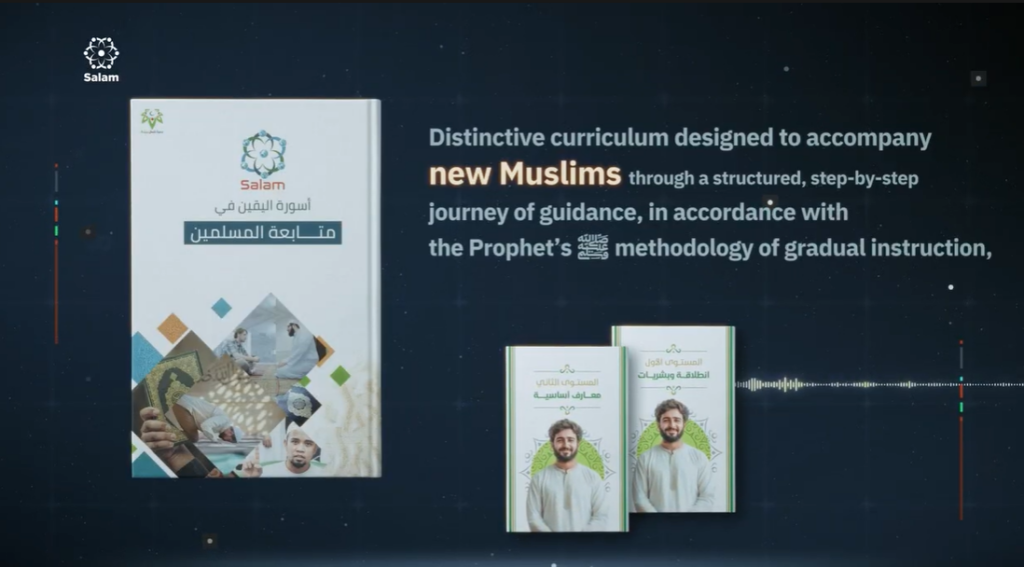
Ask about joining Asawirat Al-Yaqeen (Bracelets of Certainty), the Center’s structured program for new Muslims, which includes:
- A four-stage curriculum moving from foundational worship to advanced theological grounding
- One-on-one guidance through Shahada, prayer, and daily practice
- Ongoing support from the Salam Center team throughout the post-conversion journey
Reach out directly to the Salam Center team to start the Asawirat Al-Yaqeen (Bracelets of Certainty) program for FREE.
Summary
The Quran addresses Prophet Muhammad’s death only as a statement of principle, not as a narrated event, affirming through 39:30 and 3:144 that he was fully mortal like every prophet before him. The historical details of his illness, final words, and burial come entirely from authenticated hadith.
His passing in 632 CE confirmed rather than disrupted Islamic teaching, since the Quran had already been completed and preserved during his lifetime. This distinction between doctrine and history remains central to understanding Islam’s sources.
Frequently Asked Questions
Does the Quran mention the date Muhammad died?
No, the Quran does not mention a date. The date, 12th Rabi al-Awwal, 11 AH (June 8, 632 CE), comes exclusively from hadith and historical sources, not from the Quranic text itself, which addresses mortality only as a general principle.
What verse proves Muhammad was mortal?
Surah Az-Zumar 39:30 states directly, “Indeed, you are to die, and indeed, they are to die.” Surah Al Imran 3:144 reinforces this by warning believers against reverting to disbelief if the Prophet died or was killed, confirming his full humanity.
Who confirmed the Prophet’s death to the early Muslims?
Abu Bakr (RA) confirmed it publicly by reciting Quran 3:144 to a grieving crowd, some of whom, including Umar (RA), initially refused to accept the news, according to the authenticated account in Sahih al-Bukhari 1241.
Curious about Islam?
Journey towards clarity and purpose. Our team is here to support you in your search for truth and spiritual guidance.
Embrace the Truth