
What Do Unitarians Believe?
| Key Takeaways |
| Unitarians reject the Christian doctrine of the Trinity and affirm that God exists as a single, undivided person rather than three co-equal persons. |
| Historically, Unitarian Christians viewed Jesus as a prophet and moral teacher inspired by God, not as God incarnate or a divine being to be worshipped. |
| Modern Unitarian Universalism, formed in 1961, moved beyond Christian doctrine entirely and now welcomes theists, humanists, and people of many faiths under Seven Principles rather than a shared creed. |
| Islam affirms the same core objection Unitarians raised against the Trinity — that Allah’s oneness admits no division — while grounding that belief in continuous prophetic revelation rather than individual reason alone. |
| Unlike Unitarian Universalism, which treats religious truth as something each person constructs, Islam holds that Allah revealed a final, complete, and unaltered message through Prophet Muhammad (PBUH). |
Unitarians believe that God exists as one undivided being, not three persons in one essence. This single conviction is the reason Unitarianism exists as a distinct movement at all. Every other feature of Unitarian belief, from its view of Jesus to its approach to scripture, grows out of that founding rejection of the Trinity.
The movement began among Christians who read their own scriptures and could not find grounds for a triune God, and it eventually split into two very different things: a shrinking body of Christian Unitarians who still center Jesus as a prophet, and a much larger modern association, Unitarian Universalism, that abandoned Christian doctrine altogether in favor of open individual searching.
What Do Unitarians Believe?
Unitarians believe God is a single, indivisible person, not three co-equal persons united in one essence — this is the defining doctrine that separates them from Trinitarian Christianity. Historically, Unitarian Christians held that Jesus Christ was a real historical prophet and moral exemplar chosen and inspired by God, but not God himself, not co-eternal with the Father, and not a proper object of worship.
Unitarianism emerged during the Reformation in Poland, Transylvania, and England, later spreading to North America from the original New England Puritan churches, as leaders sought a reformation aligned with the Hebrew Scriptures and the New Testament, finding no scriptural basis for the doctrine of the Trinity.
Beyond the Trinity, Unitarians historically rejected the doctrine of original sin, believing instead in the inherent worth and dignity of every person, and emphasized reason as a primary tool for understanding religious truth rather than accepting doctrines simply because a church council had declared them binding.
Modern Unitarian Universalism, the majority expression of the movement today, has moved even further: it no longer requires belief in God, Jesus, or any specific creed at all, instead organizing around shared ethical principles that any person — Christian, Jewish, Buddhist, humanist, or otherwise — can affirm.
What Are the Core Doctrines Unitarians Actually Hold?
It helps to separate what is genuinely distinctive about Unitarian belief from what merely sounds unfamiliar to outsiders. Several convictions recur across nearly every Unitarian and Unitarian Universalist community.
1. Rejection of the Trinity and belief in God’s absolute oneness
This remains the historical hinge of the entire movement. Unitarian Christians affirm the unitary nature of God as the singular and unique creator of the universe. They hold that Jesus Christ was inspired by God in his moral teachings and served as the savior of humankind, but is not comparable or equal to God himself.
The stated purpose of the original movement was, in the words of one standard reference, to restore “primitive Christianity before later corruptions” had set in — a claim that echoes, in its own way, Islam’s central claim about restoring the pure monotheism taught by every prophet before corruption entered later religious traditions.
Readers exploring how Islam views the nature of God will notice this same insistence on radical, undivided oneness running through both traditions, even though they reach it by very different paths.
2. Jesus as a moral teacher and prophet, not as God incarnate
Unitarians place their emphasis on the full humanity of Jesus rather than on any claim to his divinity. Unitarian criticism of the Christian doctrine of the Trinity, which equated Jesus with the second person of a triune God, held that Jesus was not the proper object of worship, but God the Father was — leading Unitarians to affirm the simple humanity of Jesus.
Historically, three distinct strands of this belief developed. The Arian position held to a pre-existence of the Logos but maintained that Jesus was created and existed only as human, while the Socinian position rejected Jesus’s original divinity while still accepting that he should be honored in a special way.
Across all these variations, one thread holds constant: Unitarians do not pray to Jesus, and they do not consider him a partner alongside God in worship.
3. Rejection of original sin and confidence in human moral capacity
Where much of historic Christianity taught that every person inherits guilt from Adam’s disobedience, Unitarians took the opposite view.
They reject the doctrine of original sin, believing instead in the inherent worth and dignity of every person, and emphasize the potential for good in humanity rather than innate sinfulness.
This conviction shapes much of Unitarian ethical life; if people are not born condemned, then moral effort and reasoned reflection — not inherited guilt or vicarious atonement — become the primary paths toward a good life.
4. Reason, conscience, and continuous revelation over fixed creed
Modern Unitarian Universalism formalizes this emphasis on individual reasoning into an explicit structural principle.
Each individual has the right and responsibility to determine their own beliefs without imposed creeds or dogmas, and truth is understood as unfolding continuously through human experience, scientific discovery, and insight rather than being sealed within any ancient text.
Congregations are bound together not by shared doctrine but by seven shared principles, including the inherent worth and dignity of every person, a free and responsible search for truth and meaning, and respect for the interdependent web of all existence.
Congregational freedom and the individual’s right of conscience remain central to this heritage; congregations may establish statements of purpose so long as they do not require members to adhere to a particular creed.
5. Rejection of eternal damnation
Carrying forward the Universalist half of the 1961 merger, most Unitarian Universalists do not accept the concept of eternal damnation, believing instead that divine love ultimately embraces all people.
This differs sharply from both traditional Trinitarian Christian eschatology and from the Islamic understanding of accountability before Allah on the Day of Judgment, a difference the comparative section below addresses directly.
Learn More About Islam
Discover the beauty, teachings, and wisdom of Islam in a clear and welcoming way. Start exploring and deepen your understanding today.
Learn MoreWhat Are the Historical Roots of Unitarian Belief?
Unitarianism did not appear from nowhere. It grew out of a specific, traceable argument that Christian reformers had with the doctrine of the Trinity, and that argument has a documented history stretching back to the sixteenth century.
1. Michael Servetus and the first challenge to the Trinity
The Spanish physician and theologian Michael Servetus is widely regarded as the intellectual spark behind Unitarianism, even though he never used the label himself.
In his 1531 work De Trinitatis erroribus, or “On the Errors of the Trinity,” and his 1553 Christianismi restitutio, Servetus provided the important stimulus for the emergence of Unitarianism. He read the New Testament closely and concluded that the later formulation of a three-person Godhead simply was not there in the text.
The cost of that conclusion was severe. Servetus’s execution for heresy in 1553 led the liberal humanist Sebastian Castellio to advocate for religious toleration, and caused several Italian religious exiles then in Switzerland to relocate to Poland — a migration that would prove decisive for the movement’s future.
Scholars are careful to note that Servetus himself was not a full Unitarian in the later sense. He never held up the idea that Jesus was not in some very real sense divine; his objection concerned the Trinity’s internal logic, particularly around the Holy Spirit, more than a flat denial of Christ’s supernatural status.
Even so, his questioning opened a door that others walked through with far greater consistency.
2. Faustus Socinus and the Polish Brethren
The figure who gave classical Unitarianism its most systematic form was the Italian theologian Faustus Socinus. His acquisition in 1562 of the papers of his uncle Laelius Socinus — a theologian already suspected of heterodox views — led Faustus to adopt Laelius’s proposals for reforming Christian doctrine and to become a committed anti-Trinitarian theologian. Socinus eventually settled in Poland among a community of radical reformers.
In Poland-Lithuania, a group of radical reformers broke from the Calvinist Reformed Church in the 1560s, forming what became known as the Minor Reformed Church, or the Polish Brethren.
Influenced by Italian humanist refugees and by Servetus’s ideas, they rejected the doctrines of the Trinity and original sin, seeking to restore a simpler, “primitive” Christianity based solely on Scripture and reason.
Their teaching held that Scripture, read in the light of reason, did not support the Trinity, and that Christian doctrine must withstand rational scrutiny rather than being accepted on the authority of church councils alone.
Socinus’s followers eventually became known as Socinian Unitarians, and though their community was later suppressed and exiled, their writings spread across Europe and into Transylvania, where a parallel Unitarian church had already taken root under the theologian Francis Dávid.
3. From Christian Unitarianism to Unitarian Universalism
For roughly three centuries, Unitarianism remained a Christian movement, however unorthodox. That changed decisively in the twentieth century.
The modern Unitarian Universalist Association was formed in 1961 through the merger of the Universalist Church of America, founded in 1793, and the American Unitarian Association, founded in 1825.
The Universalist half of that merger contributed a different but related idea: that all people will ultimately be saved by God, not just those belonging to a specific faith or creed.
Combining a rejection of the Trinity with a rejection of exclusive salvation produced a religious body that, over the following decades, gradually stopped requiring belief in a personal God, Jesus, or Christianity at all.
The Islamic Position — Tawhid, the Absolute Oneness of Allah
The evidence-grounded position of Islam on the exact question Unitarians have spent five centuries wrestling with: who is God, and can He be divided?
1. Allah’s oneness is absolute, not a matter of theological negotiation
Islam did not arrive at monotheism through a process of reasoning away an existing Trinity, the way sixteenth-century Unitarian reformers did. Islam teaches that pure, undivided monotheism — Tawhid — was the original message given to every prophet Allah ever sent, and that later communities, not the prophets themselves, introduced division into that message.
This is stated with total clarity in Surah Al-Ikhlas, a chapter the Prophet Muhammad (PBUH) taught carries unique weight precisely because it defines Allah’s nature so completely:
قُلْ هُوَ اللَّهُ أَحَدٌ اللَّهُ الصَّمَدُ لَمْ يَلِدْ وَلَمْ يُولَدْ وَلَمْ يَكُن لَّهُ كُفُوًا أَحَدٌ
“Say, ‘He is Allah, [who is] One, Allah, the Eternal Refuge. He neither begets nor is born, nor is there to Him any equivalent.'” (Quran 112:1-4)
Nothing in this description leaves room for a second or third person sharing in Allah’s essence.
Readers wanting the fuller theological picture can explore God in Islam and the broader Islamic framework of monotheism, both of which unpack this doctrine at length.
Read Also: Scientific Miracles in the Quran
2. Jesus in Islam — honored as a prophet, never worshipped as divine
Islam agrees with the Unitarian rejection of Jesus’s divinity, and states that agreement even more emphatically. The Quran does not merely decline to call Jesus divine; it explicitly warns against the theological move that leads there:
يَا أَهْلَ الْكِتَابِ لَا تَغْلُوا فِي دِينِكُمْ وَلَا تَقُولُوا عَلَى اللَّهِ إِلَّا الْحَقَّ ۚ إِنَّمَا الْمَسِيحُ عِيسَى ابْنُ مَرْيَمَ رَسُولُ اللَّهِ وَكَلِمَتُهُ أَلْقَاهَا إِلَىٰ مَرْيَمَ وَرُوحٌ مِّنْهُ ۖ فَآمِنُوا بِاللَّهِ وَرُسُلِهِ ۖ وَلَا تَقُولُوا ثَلَاثَةٌ ۚ انتَهُوا خَيْرًا لَّكُمْ ۚ إِنَّمَا اللَّهُ إِلَٰهٌ وَاحِدٌ
“O People of the Scripture, do not commit excess in your religion or say about Allah except the truth. The Messiah, Jesus, the son of Mary, was but a messenger of Allah and His word which He directed to Mary and a soul [created at a command] from Him. So believe in Allah and His messengers. And do not say, ‘Three’; desist – it is better for you. Indeed, Allah is but one God.” (Quran 4:171)
Islam honors Isa (Jesus) as one of the greatest prophets ever sent, born miraculously of the Virgin Mary and given real miracles — but he remains, in every verse the Quran devotes to him, a created servant of Allah, never a partner in Allah’s divinity.
This is where Islam and classical Christian Unitarianism converge almost entirely on the conclusion, even while they arrive there through very different evidentiary paths — Unitarians largely through independent reasoning about New Testament texts, Islam through direct revelation confirming what earlier prophets, Jesus included, actually taught.
Readers can explore this shared ground further in what the Quran says about other religions and the dedicated comparison of Islam versus Christianity.
Read Also: What Did the Hellenists Believe?
3. Revelation, not individual reason alone, as the foundation of religious truth
Here the Islamic position diverges sharply from modern Unitarian Universalism, and this divergence matters more than the doctrinal agreement on God’s oneness.
Unitarian Universalism’s Fourth Principle affirms a free and responsible search for truth and meaning conducted by each individual, with no fixed doctrine binding the search’s outcome.
Islam takes a fundamentally different view: truth about Allah is not something each person constructs through private reasoning, but something Allah revealed, completed, and preserved.
The Quran was given as final revelation, confirming and correcting what came before it, and Muslims are taught to submit their reasoning to what Allah has revealed rather than treat continuous personal reinterpretation as a substitute for fixed truth.
This is a central theme explored in why Muslims believe in the Quran and in the broader account of what Muslims believe about the Quran.
This is not a small technical disagreement. A religion built on the premise that truth unfolds differently for each person, generation after generation, cannot in the end anchor moral or theological claims to anything beyond present consensus or individual preference.
Islam’s nine core principles rest instead on the conviction that Allah has spoken clearly, completely, and finally — and that faith in Islam means submitting to that revelation rather than replacing it with an evolving personal search.
Read Also: What Do Animists Believe?
4. Prophethood, accountability, and the meaning of submission
Islam also differs from Unitarian Universalism’s rejection of eternal consequence. Where Unitarian Universalists largely hold that divine love ultimately embraces all people regardless of belief or deed, Islam teaches genuine moral accountability before Allah, balanced always by His vast mercy toward those who sincerely turn to Him.
This is not a harsh doctrine bolted onto an otherwise gentle religion; it is what gives human choice its actual weight.
A well-known hadith recorded by both Bukhari and Muslim, describing what the Prophet Muhammad (PBUH) commanded his followers, captures the practical shape of this submission:
“He orders us to worship Allah Alone and not to associate a thing with Him in worship, to discard what our ancestors said, to perform the Salat (prayer), speak the truth, and maintain the ties of kinship.” (Sahih al-Bukhari 50)
This is the same structure Unitarian reformers were reaching for five centuries ago when they broke from inherited church doctrine to worship God alone — except Islam frames it as obedience to what Allah’s final Messenger (PBUH) actually taught, rather than a conclusion any individual reader must reconstruct from first principles.
Those exploring how this call to pure monotheism connects to the Prophet’s own life will find further context in how Muhammad became the Prophet of Islam.
Read Also: Islam Teachings on Respecting Other Religions
Learn More About Islam
Discover the beauty, teachings, and wisdom of Islam in a clear and welcoming way. Start exploring and deepen your understanding today.
Learn MoreYour Path to Deeper Authentic Knowledge Starts Here with Salam
If the question of God’s true nature has been on your mind, you are not alone, and you do not have to work through it by yourself.
Learn more on the Salam Platform
Read more reflections on the Salam blog
Have a specific question about Islam, entering the faith, or where to start?
Reach out directly — our team is ready to listen, guide, and welcome you.

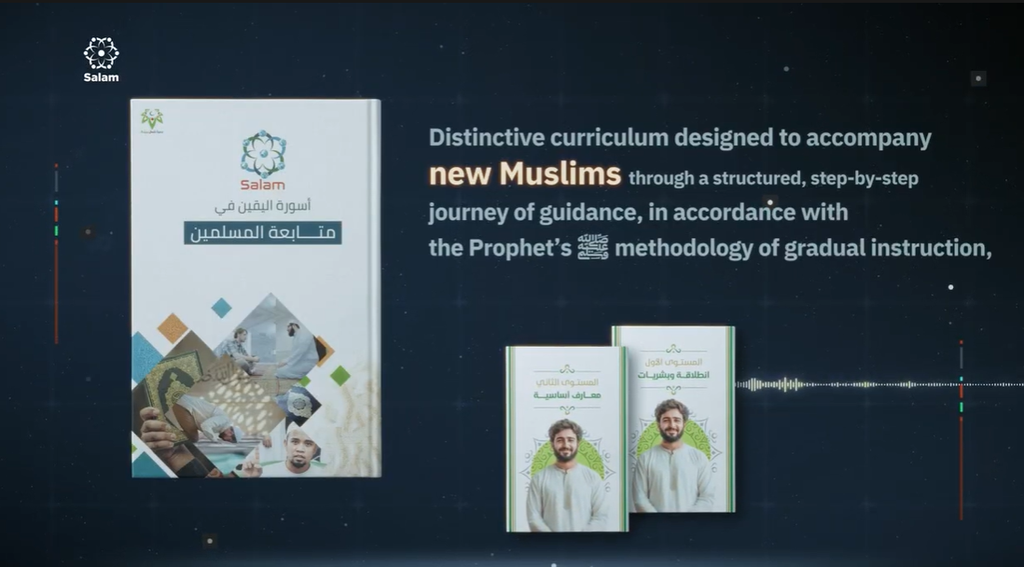
If you are newly Muslim or exploring conversion, the Salam Center offers structured support through Asawirat Al-Yaqeen (Bracelets of Certainty), a four-stage program built specifically for new Muslims:
- Foundational knowledge of the pillars of Islam, prayer, and purification
- Guidance on repentance, character, and the life of Prophet Muhammad (PBUH)
- Practical rulings for daily life, family, and personal conduct
- Advanced study of contemporary questions and interfaith evidence
The Salam Center team is here for general inquiries, guidance on entering Islam, or simply a conversation about what you have read.
Reach out directly to the Salam Center team to start the Asawirat Al-Yaqeen (Bracelets of Certainty) program for FREE.
Summary
Unitarians reject the Trinity and affirm God’s absolute oneness, a conviction that runs from sixteenth-century reformers like Servetus and Socinus through to today’s Unitarian Universalist congregations. Modern Unitarian Universalism, however, has moved past fixed doctrine entirely, replacing shared creed with individual searching.
Islam shares the Unitarian instinct that God cannot be divided into persons, but grounds that truth in completed revelation rather than personal reasoning alone. The Quran’s direct invitation to a “common word” in Surah 3:64 remains open to every sincere seeker today.
Frequently Asked Questions
What is the main belief of Unitarians?
Unitarians believe God exists as a single, undivided being rather than three co-equal persons, rejecting the doctrine of the Trinity. The movement emerged during the Reformation as leaders sought doctrine aligned with the Hebrew Scriptures and New Testament, finding no basis for the Trinity.
Do Unitarians believe Jesus was divine?
No. Historic Unitarian Christians held that Jesus was a prophet and moral teacher inspired by God, not God incarnate. Unitarians place their emphasis on the humanity of Jesus rather than treating him as the proper object of worship.
Are Unitarians and Unitarian Universalists the same?
Not exactly. Classical Unitarians were Christians who denied the Trinity. Unitarian Universalism formed in 1961 through a merger with the Universalist Church and has since moved beyond requiring belief in God or Jesus altogether, welcoming humanists and people of many faiths.
Curious about Islam?
Journey towards clarity and purpose. Our team is here to support you in your search for truth and spiritual guidance.
Embrace the Truth