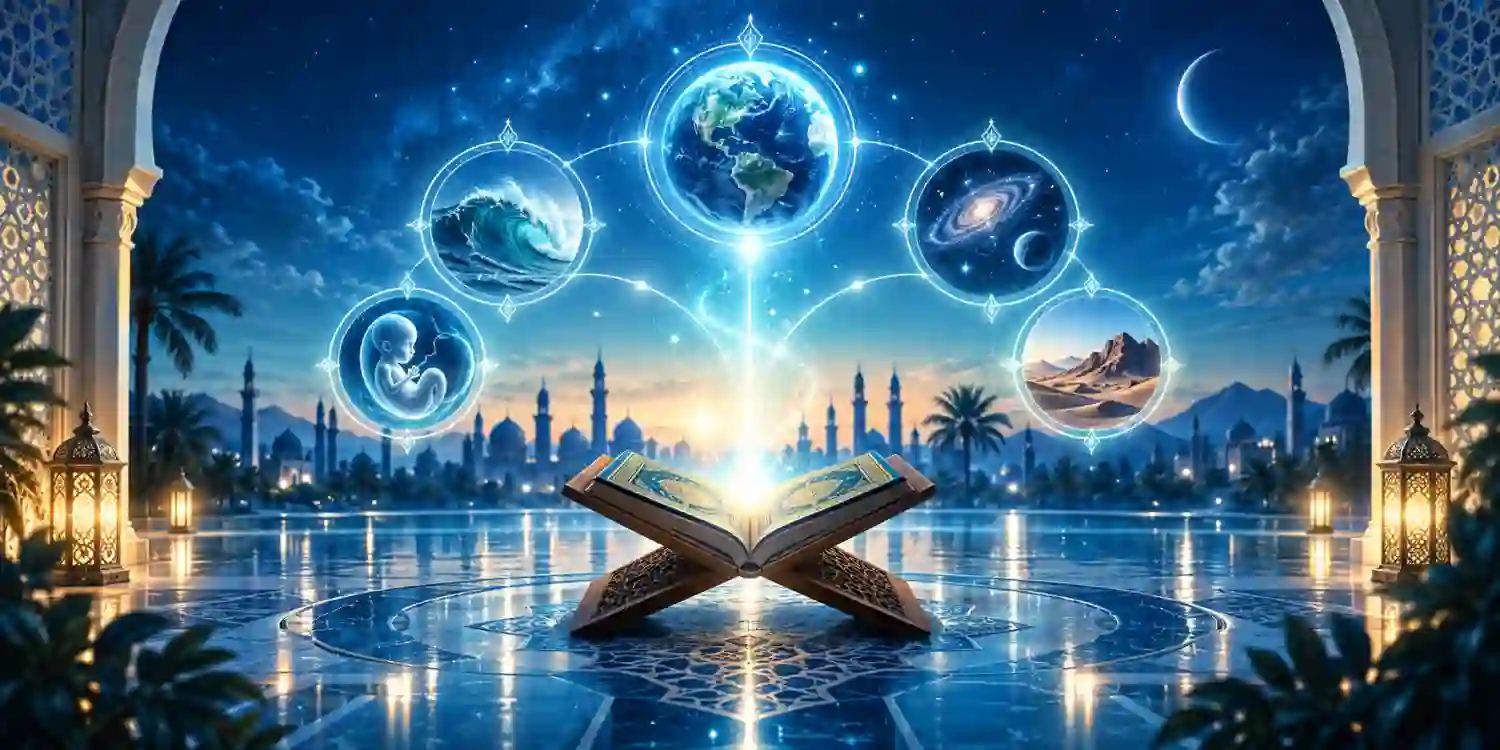
Scientific Miracles in the Quran
The Quran describes the universe’s origin as a unified mass later separated, a description that predates the expansion model of modern cosmology by over 1,400 years. Surah Al-Anbya 21:30 references the heavens and earth as a joined mass (ratq) later split apart (fatq), language scholars connect to the cosmos beginning as a single unified state.
Surah Al-Mu’minun 23:12-14 outlines a sequence of embryonic development — nutfah, alaqah, mudghah — that maps onto stages recognized in modern embryology.
Islamic scholars caution that these observations support the Quran’s divine origin without needing to force every scientific theory into scriptural language.
Do Scientific Miracles Exist in the Quran?
Yes, several verses in the Quran describe natural phenomena — the origin of the universe, stages of embryonic growth, the behavior of mountains and seas — using language that aligns closely with discoveries confirmed only through modern instruments and research centuries later.
Scholars of tafsir (Quranic exegesis) have documented this alignment as one strand of evidence for the Quran’s divine origin, alongside its linguistic inimitability and its account of unseen historical events.
This field is known as i’jaz ilmi, or scientific inimitability. It doesn’t claim the Quran is a science textbook. It claims that a text revealed to an unlettered man in 7th-century Arabia, in a society with no observatories, no microscopes, and no oceanographic instruments, contains descriptions that only later became verifiable — and that this consistency is itself a sign worth examining.
Muslim Scholars Urge Careful Limits on These Claims
Respected Muslim scholars including researchers caution that these observations should be presented as points of harmony and reflection, not as proofs requiring every verse to be retrofitted onto whichever scientific theory is currently popular. Scientific theories change; the Quran’s meaning, as understood through sound tafsir, does not.
The strength of i’jaz ilmi lies in cases like embryology and the sea barrier, where the match is precise and the underlying science is settled, not in stretching ambiguous verses to fit passing hypotheses.
This caution isn’t a weakness in the argument. The Prophet Muhammad (PBUH) made no claim to scientific training.
Understanding the Quran’s broader claims about revelation and its own nature helps frame why these specific verses carry the weight they do — see what Muslims believe about the Quran for that fuller picture, and why Muslims believe in the Quran for the wider evidentiary case beyond scientific alignment alone.
1. The Quran States That the Universe Began as a Single Joined Mass
Modern cosmology describes the universe expanding outward from an extremely dense, unified initial state — a model built on redshift observations and radiation data gathered only in the 20th century. Before that, the dominant scientific view, held by figures like Einstein himself, was of a static, unchanging universe. Surah Al-Anbya addresses this directly:
أَوَلَمْ يَرَ الَّذِينَ كَفَرُوا أَنَّ السَّمَاوَاتِ وَالْأَرْضَ كَانَتَا رَتْقًا فَفَتَقْنَاهُمَا
“Do those who disbelieve not consider that the heavens and the earth were a joined entity, and We separated them?” (Quran 21:30)
Classical commentators, writing centuries before any expansion theory existed, understood ratq as a state of tight cohesion and fatq as a subsequent splitting apart.
The verse doesn’t describe a mechanism or a timeline in scientific terms, but the basic sequence it describes, a unified beginning followed by separation, sits far closer to the current cosmological picture than to the static-universe assumptions of most of human history, including the era just before the Quran was revealed.
Learn More About Islam
Discover the beauty, teachings, and wisdom of Islam in a clear and welcoming way. Start exploring and deepen your understanding today.
Learn More2. Embryonic Development Follows a Precise Quranic Sequence
Surah Al-Mu’minun describes human development moving through distinct, named stages — a sequence that corresponds closely to how modern embryology classifies the early weeks of gestation. This is widely regarded, including by non-Muslim researchers who reviewed it decades ago, as one of the strongest and most specific instances in this field.
ثُمَّ خَلَقْنَا النُّطْفَةَ عَلَقَةً فَخَلَقْنَا الْعَلَقَةَ مُضْغَةً فَخَلَقْنَا الْمُضْغَةَ عِظَامًا فَكَسَوْنَا الْعِظَامَ لَحْمًا
“Then We made the sperm-drop into a clinging clot, and We made the clot into a lump [of flesh], and We made [from] the lump, bones, and We covered the bones with flesh.” (Quran 23:14)
The term alaqah carries three meanings in classical Arabic — something that clings, a leech-like form, and a clot of blood — and the early embryo attaches to the uterine wall and visually resembles a leech at that stage.
Mudghah means a chewed-looking lump, which matches the somite-segmented appearance of the embryo in the following weeks.
The sequence of cartilage-like bone formation preceding muscle tissue covering it also matches the order confirmed by modern developmental biology.
3. The Quran Says Mountains Move Though They Appear Still
Surah An-Naml describes mountains as being in motion, passing like clouds, even while appearing completely fixed to an observer — a description that aligns with plate tectonics and the Earth’s rotation, neither of which was understood as physical fact until the modern era.
وَتَرَى الْجِبَالَ تَحْسَبُهَا جَامِدَةً وَهِيَ تَمُرُّ مَرَّ السَّحَابِ
“And you see the mountains, thinking them rigid, while they will pass as the passing of clouds.” (Quran 27:88)
For most of human history, “solid ground” was the definitional example of something unmoving.
The theory that continents drift atop tectonic plates only gained scientific acceptance in the mid-20th century, following Alfred Wegener’s earlier, initially rejected hypothesis.
A companion verse, Surah An-Naba, describes mountains functioning as أَوْتَادًا — stakes or pegs — anchoring the land (Quran 78:6-7), which geologists connect to the way mountain ranges extend deep root structures into the crust, stabilizing the plates above them.
4. Two Seas Meet Without Their Waters Mixing
Surah Ar-Rahman describes two bodies of water meeting at a barrier they do not cross, a phenomenon oceanographers document today wherever seas of different salinity, density, or temperature converge.
مَرَجَ الْبَحْرَيْنِ يَلْتَقِيَانِ بَيْنَهُمَا بَرْزَخٌ لَا يَبْغِيَانِ
“He released the two seas, meeting [side by side]; between them is a barrier [so] neither of them transgresses.” (Quran 55:19-20)
This matches a real, observable oceanographic feature called a halocline — a sharp boundary layer where waters of differing salinity resist immediate mixing due to density differences, visible for example at the Strait of Gibraltar where Atlantic and Mediterranean waters meet.
Sailors and coastal communities may have noticed visual color differences at such points historically, but the underlying physical explanation, density-driven resistance to mixing, is a finding of modern fluid dynamics and oceanography, not something explainable through unaided 7th-century observation alone.
5. Iron Was Sent Down, Not Formed on Earth
Surah Al-Hadid describes iron as something Allah “sent down,” language that aligns with the astrophysical fact that iron cannot be formed by any process occurring within Earth or even within a normal star like the sun — it is only produced in the extreme conditions of a dying, exploding star.
وَأَنزَلْنَا الْحَدِيدَ فِيهِ بَأْسٌ شَدِيدٌ وَمَنَافِعُ لِلنَّاسِ
“And We sent down iron, wherein is great military might and benefits for the people.” (Quran 57:25)
Modern astrophysics established that elements up through iron form inside stars through nuclear fusion, but iron itself requires more energy to fuse than it releases — meaning stars cannot produce it through normal fusion.
Iron on Earth, and throughout the solar system, actually originated in supernova explosions of earlier, larger stars, then scattered through space before becoming part of the material that formed our planet.
The Arabic word used, anzalna (“We sent down”), is the same verb used elsewhere in the Quran for rain and revelation — something arriving from outside, not generated locally.
Classical commentators understood this as figurative for iron’s exceptional benefit to people; the added resonance with iron’s actual cosmic origin became apparent only once stellar nucleosynthesis was understood in the 20th century.
6. The Universe Is Continuously Expanding
Surah Adh-Dhariyat describes the sky as being built with power and continually expanded, a description matching the observation, confirmed only in the 1920s through Edwin Hubble’s redshift measurements, that the universe is not static but constantly growing outward.
وَالسَّمَاءَ بَنَيْنَاهَا بِأَيْدٍ وَإِنَّا لَمُوسِعُونَ
“And the heaven We constructed with strength, and indeed, We are [its] expander.” (Quran 51:47)
For most of recorded history, including the era of the Quran’s revelation, the prevailing assumption among astronomers was that the universe was fixed and unchanging, a view Einstein himself held until Hubble’s data forced a revision.
The Arabic term used here, from the root wasa’a, conveys ongoing expansion rather than a single completed act of construction, which is why many commentators connect this verse specifically to the expanding-universe model rather than treating it as a general statement about the sky’s vastness.
Read Also: What Is the First Surah in the Quran?
7. Honey Provides Genuine Healing Properties
Surah An-Nahl describes honey as containing healing for people, a claim now supported by substantial peer-reviewed medical research into honey’s antibacterial, antifungal, and wound-healing properties.
يَخْرُجُ مِن بُطُونِهَا شَرَابٌ مُّخْتَلِفٌ أَلْوَانُهُ فِيهِ شِفَاءٌ لِلنَّاسِ
“There emerges from their bellies a drink, varying in colors, in which there is healing for people.” (Quran 16:69)
This claim is also supported in the Hadith literature: the Prophet Muhammad (PBUH) is reported to have recommended honey for treating a man’s stomach ailment, a narration recorded in Sahih Bukhari.
Modern clinical research has documented honey’s low water content and high sugar concentration drawing moisture out of bacteria, its hydrogen peroxide production giving it antiseptic properties, and its acidity creating an environment hostile to many pathogens — findings that have led to medical-grade honey being used in wound dressings today.
Classical societies used honey medicinally based on observed effect, without the microbiological basis now available to explain why it works.
The Quran’s description doesn’t detail a mechanism; what stands out to scholars is the specific, confident claim of genuine healing, made at a time when many competing remedies in circulation had no real therapeutic value at all.
Read Also: What Did the Hellenists Believe?
These Verses of Scientific Miracles in the Quran Fit a Larger Pattern of Precision
None of these examples stand alone — each connects to the Quran’s broader claim about the nature of Allah as the Creator with complete knowledge of what He made, a claim examined in detail when exploring how Islam views the nature of God.
For someone weighing faith traditions, it’s also worth understanding how Islam views other religions and how Quranic claims compare across traditions, including what the Quran says about other religions.
These scientific observations sit within, not apart from, the foundational principles of Islam that shape how a believer reads every verse of the Quran.
Learn More About Islam
Discover the beauty, teachings, and wisdom of Islam in a clear and welcoming way. Start exploring and deepen your understanding today.
Learn MoreYour Path to Deeper Authentic Knowledge Starts Here with Salam
If these verses raised questions you’d like to sit with longer, you’re welcome here.
Read more reflections and evidence-based articles on the Salam blog.
Curious how Islam approaches faith more broadly? Start with faith in Islam.
Thinking about taking a next step, or simply want to ask a private question?
Reach out directly — our team is ready to listen, guide, and welcome you.

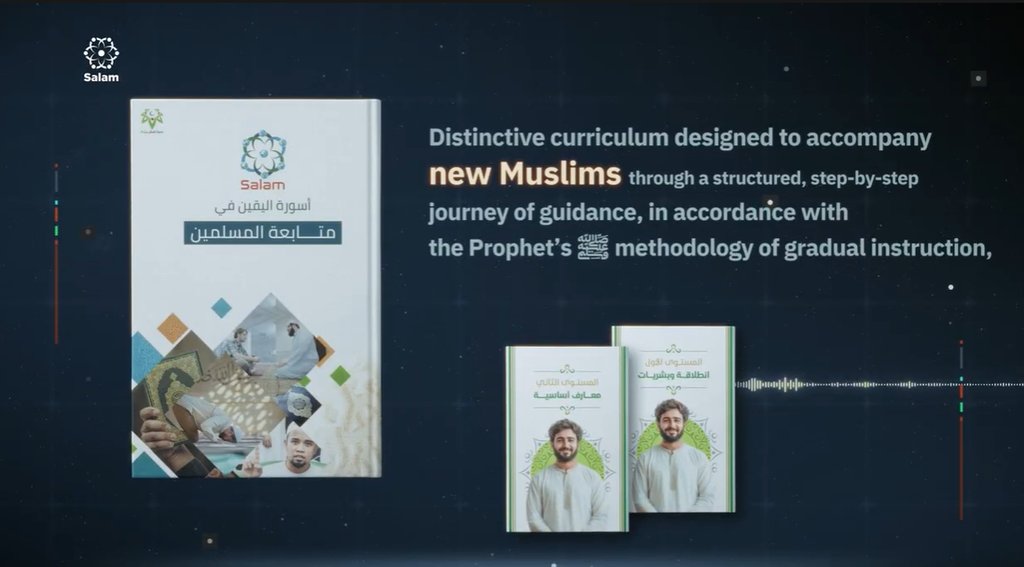
If you’re a new Muslim looking for structured, gentle guidance after your Shahada, the Salam Center built the Asawirat Al-Yaqeen (Bracelets of Certainty) program for exactly this stage:
- A four-stage journey moving from foundational pillars through Seerah, ethics, and practical life rulings
- Grounded in the creed of Ahlus Sunnah wal Jama’ah, with gradual, structured instruction
- Interactive lessons designed to keep you engaged rather than overwhelmed
- Support from real people at the Salam Center team, not just self-study materials
Reach out directly to the Salam Center team to start the Asawirat Al-Yaqeen (Bracelets of Certainty) program for FREE.
Summary
The Quran’s descriptions of cosmic origins, embryonic growth, mountain movement, and marine boundaries align with discoveries confirmed only through modern instruments. These scientific miracles in the Quran reflect precision unavailable to 7th-century observation alone.
Scholars frame this alignment as one thread among many pointing toward the Quran’s divine origin, held alongside its linguistic and historical evidence. Readers weighing these claims are invited to examine the verses, the science, and the surrounding tradition directly.
Frequently Asked Questions
What is i’jaz ilmi in Islam?
I’jaz ilmi, or “scientific inimitability,” refers to the field of study examining verses in the Quran that align with discoveries confirmed only through modern science. Scholars treat it as supporting evidence for the Quran’s divine origin, not as its sole or primary proof — that role belongs to the Quran’s linguistic and textual character.
Does the Quran mention the Big Bang?
The Quran does not use the term “Big Bang,” but Surah Al-Anbya 21:30 describes the heavens and earth as originally joined before being separated. Scholars note the conceptual overlap with modern cosmology’s expansion model, while stressing the verse isn’t a scientific paper and shouldn’t be read as one.
How accurate is the Quran’s description of embryonic development?
Surah Al-Mu’minun 23:14 describes a sequence — clinging form, chewed-lump form, bone formation, then muscle covering — that closely matches the staged terminology used in modern embryology. This passage is among the most frequently cited examples in i’jaz ilmi research due to its specificity.
Curious about Islam?
Journey towards clarity and purpose. Our team is here to support you in your search for truth and spiritual guidance.
Embrace the Truth