
Does Islam Believe in Original Sin?
| Key Takeaways |
| Islam does not believe in original sin; Islam teaches that every human being is born in a state of pure, untainted nature called the Fitra. |
| Adam and Eve sinned, repented sincerely, and Allah forgave them completely — their sin did not transfer to their descendants. |
| Islam holds each soul accountable only for its own deeds; no person carries the moral burden of another’s transgression. |
| The Islamic view of human nature is fundamentally optimistic — humanity is honored, capable of righteousness, and in direct relationship with Allah. |
| The concept of original sin is absent from the Quran and the authenticated Sunnah; it entered Christian theology centuries after Jesus through Augustine of Hippo. |
In Islam, the story of Adam is not a story of permanent corruption. It is a story of human frailty, sincere repentance, and divine mercy. Adam erred, turned to Allah in remorse, and was completely forgiven.
That forgiveness was real and total. His descendants inherited his humanity — his capacity for both error and virtue — but they did not inherit his sin. The Quran is explicit on this point, and the entire structure of Islamic moral theology rests upon it.
For anyone raised in or shaped by Christian culture, this distinction can be striking. The doctrine of original sin — the idea that Adam’s fall permanently corrupted human nature and that all of his descendants bear inherited guilt — is so embedded in Western religious thought that it can seem self-evident.
Do Muslims Believe in Original Sin?
No, Muslims do not believe in original sin. The concept of original sin has no foundation in Islamic theology. Muslims affirm that Adam and Eve disobeyed Allah, that they were expelled from the Garden as a consequence, and that this marked the beginning of human life on earth — but the theological conclusions drawn from those events differ entirely from the Christian framework.
In Islam, sin is personal. It cannot be inherited, transmitted, or carried by one generation on behalf of another. The Quran states this with direct clarity:
كُلُّ ٱمْرِئِۭ بِمَا كَسَبَ رَهِينٌ
“Every person, for what he earned, is retained” (Quran 52:21)
وَلَا تَزِرُ وَازِرَةٌ وِزْرَ أُخْرَىٰ
“And no bearer of burdens will bear the burden of another.” (Quran 35:18)
This verse — repeated in principle across multiple surahs — establishes the Islamic axiom of individual moral accountability as a foundation, not a footnote.
The burden of Adam’s disobedience was Adam’s to bear. He bore it, he repented, and Allah accepted his repentance. The matter was closed.
What humanity inherited from Adam is the Fitra: the innate, original disposition toward goodness, toward recognizing Allah, toward moral awareness.
The Prophet Muhammad (PBUH) confirmed this in an authentic narration recorded in Sahih Muslim:
“Every child is born upon the Fitra.”
The Fitra is not a state of corruption awaiting redemption — it is a state of purity awaiting cultivation.
1. Adam and Eve Sinned, Repented, and Were Completely Forgiven by Allah
The Quran narrates the story of Adam and Eve with a theological purpose that points decisively toward mercy, not condemnation. They ate from the forbidden tree. They erred. But the Quran does not linger on the sin — it moves swiftly to the repentance and the response of their Lord:
فَتَلَقَّىٰ آدَمُ مِن رَّبِّهِ كَلِمَاتٍ فَتَابَ عَلَيْهِ ۚ إِنَّهُ هُوَ التَّوَّابُ الرَّحِيمُ
“Then Adam received from his Lord [some] words, and He accepted his repentance. Indeed, it is He who is the Accepting of Repentance, the Merciful.” (Quran 2:37)
The forgiveness here is complete and unqualified. Allah accepted Adam’s repentance without reservation, without condition, and without attaching its consequences to Adam’s future children.
The Islamic narrative of the Garden ends with forgiveness — and that ending matters enormously for everything that follows in Islamic theology.
Adam and Eve were expelled from the Garden as a consequence of their disobedience, but expulsion and damnation are not the same thing.
Their life on earth was the divinely ordained next chapter — a chapter defined by the possibility of guidance, worship, and return to Allah — not by the weight of unresolved sin.
2. No Human Being Inherits the Sin or Guilt of Another
In Islamic theology, moral liability is strictly individual. The Quran returns to this point with a consistency that leaves no ambiguity:
وَأَن لَّيْسَ لِلْإِنسَانِ إِلَّا مَا سَعَىٰ
“And that there is not for man except that [good] for which he strives.” (Quran 53:39)
A person is accountable for what they do, not for what their ancestors did. This is the foundational principle of Islamic moral accountability, and it applies symmetrically in both directions: a person does not carry another’s sin, and a person cannot claim another’s righteous deeds as their own spiritual inheritance.
The implications of this principle extend across all of Islamic ethics. It is why Islam does not require a savior to bear human guilt. It is why repentance in Islam is a direct transaction between the individual and Allah, with no intermediary.
And it is why the Islamic understanding of divine justice is one where no soul will be wronged — because every soul is judged on precisely and only what it did.
The great 14th-century scholar Ibn Kathir, in his Tafsir of the Quran, addresses the story of Adam explicitly and confirms that the sin was personal to Adam and Eve, forgiven completely, and bore no transmitted moral consequence for their descendants. Their progeny inherited human nature — they did not inherit a debt.
Have Questions About Islam?
Our team is ready to answer your questions clearly and respectfully. Ask freely and receive honest guidance.
Ask Us Now3. Every Human Being Is Born in a State of Pure Fitra
The Fitra is Islam’s answer to the question of what human beings fundamentally are. The Prophet Muhammad (PBUH) taught:
“Every child is born upon the Fitra” (Sahih Muslim)
The Fitra is the primordial, God-given disposition: an innate recognition of the Creator, an embedded sense of right and wrong, and a natural orientation toward goodness and worship.
It is not the absence of sin merely — it is the presence of something positive, a God-aligned moral compass built into the human soul from birth.
This stands in direct theological contrast to the doctrine of original sin, which holds that human nature itself was corrupted by Adam’s fall and that human beings are born in a state of inherited depravity. Islam rejects this framing entirely. Human beings are born honored. The Quran declares:
وَلَقَدْ كَرَّمْنَا بَنِي آدَمَ
“And We have certainly honored the children of Adam.” (Quran 17:70)
Honor is the starting point. Corruption is not the default — it is a deviation from a state of original goodness that the soul can always return to through sincere repentance and righteous living.
Read also: Does Islam Believe In A Messiah?
4. Islamic Justice Forbids Collective Moral Punishment
The absence of original sin in Islam is not simply a doctrinal position — it follows necessarily from Islam’s understanding of divine justice.
A God of absolute justice cannot hold individuals accountable for acts they did not commit. The Quran addresses this directly and emphatically:
مَن عَمِلَ صَالِحًا فَلِنَفْسِهِ ۖ وَمَنْ أَسَاءَ فَعَلَيْهَا ۗ وَمَا رَبُّكَ بِظَلَّامٍ لِّلْعَبِيدِ
“Whoever does righteousness — it is for his [own] soul; and whoever does evil [does so] against it. And your Lord is not ever unjust to [His] servants.” (Quran 41:46)
Allah is not unjust. Punishing billions of people for a sin committed by two individuals would contradict the divine attribute of perfect justice.
Islam’s theology is coherent precisely because its understanding of accountability aligns with its understanding of who Allah is. Understanding how Islam views the nature of God — His absolute justice, mercy, and transcendence — is inseparable from understanding why original sin cannot exist within this framework.
This theological coherence is one of the reasons the Islamic position resonates with seekers who struggle with the logical difficulties of inherited guilt. Divine justice, in Islam, means each person stands before Allah with only their own record.
Read also: Does Islam Believe Jesus Is the Son of God?
5. The Doctrine of Original Sin Has No Basis in the Quran or the Authenticated Sunnah
A direct examination of Islamic scripture reveals a complete absence of the original sin doctrine. The Quran narrates the story of Adam across multiple passages — in Surah Al-Baqarah, Surah Al-A’raf, Surah Ta-Ha — and in none of them does Allah indicate that Adam’s descendants carry his sin.
The narrative arc is always: disobedience, remorse, forgiveness, and guidance going forward.
Surah Ta-Ha offers perhaps the most complete and theologically instructive version:
فَتَابَ عَلَيْهِ وَهَدَىٰ
“And He accepted his repentance and guided him.” (Quran 20:122)
Accepted and guided. The story of Adam in the Quran ends in divine mercy and renewed guidance — not in cosmic condemnation.
The authenticated Sunnah similarly contains no narration that attributes inherited sin to Adam’s descendants.
The Prophet (PBUH) spoke extensively about human nature, sin, repentance, and accountability — and in every instance, these are framed as personal and individual.
Read also: Do Muslims Believe The Bible?
6. Original Sin Is a Later Christian Theological Development, Not a Universal Abrahamic Teaching
The doctrine of original sin as it exists in Christian theology — particularly the idea of inherited guilt and the total corruption of human nature — was developed and systematized by Augustine of Hippo in the 4th and 5th centuries CE.
Original sin was not a universal teaching among early Christians and was not part of the original monotheistic message brought by the Prophets.
Islam affirms the original teachings of Jesus (Isa, peace be upon him) as those of a Prophet calling his people to the worship of Allah alone.
The faith in Islam includes belief in Jesus as a Prophet of Allah — but not the theological superstructure built around his name centuries after his time. The Quran confirms that earlier scriptures were altered over time:
فَوَيْلٌ لِّلَّذِينَ يَكْتُبُونَ الْكِتَابَ بِأَيْدِيهِمْ ثُمَّ يَقُولُونَ هَٰذَا مِنْ عِندِ اللَّهِ
“So woe to those who write the ‘scripture’ with their own hands, then say, ‘This is from Allah.'” (Quran 2:79)
The Eastern Christian traditions — including the Eastern Orthodox Church — also differ significantly from the Augustinian formulation of original sin, understanding Adam’s legacy as inherited mortality and weakness rather than inherited guilt.
This internal Christian disagreement further illustrates that the doctrine is a later theological construction, not a revealed truth that Islam is contradicting.
For a deeper understanding of how Islam views other religions and the relationship between their teachings and the original revelation, the Salam platform provides dedicated resources rooted in Quranic evidence and scholarly analysis.
Read also: Do Muslims Believe The Bible?
7. Islam’s Vision of Human Nature Is Fundamentally Optimistic
The Islamic worldview positions human beings as Allah’s vicegerents on earth — entrusted with moral agency, capable of great righteousness, and always able to return to Allah through sincere repentance. This is a vision of human nature defined by possibility, not by inherited failure.
إِنِّي جَاعِلٌ فِي الْأَرْضِ خَلِيفَةً
“Indeed, I will make upon the earth a successive authority.” (Quran 2:30)
The charge of vicegerency — Khalifah — is given to humanity as an honor. It presupposes capacity, moral fitness, and the ability to discharge a divine trust.
A being born in a state of total corruption and inherited guilt would be an odd choice for this role. Islam’s logic is internally consistent: human beings are honored because they are inherently capable; they are capable because they are born pure; and they are born pure because Allah’s justice does not condemn the innocent.
The core Islam principles that govern Islamic belief and practice all reflect this optimistic theological foundation — a vision of a merciful Creator in direct relationship with dignified, morally capable human beings.
What Does the Islamic View of Original Sin Mean?
If you are exploring Islam — or if you are a new Muslim still untangling the theological frameworks you grew up with — this distinction carries profound personal significance. You were not born broken.
You were not born carrying a debt you did not incur. You entered this world in a state of pure Fitra, with an innate capacity for recognizing truth and choosing good.
Every mistake you have made in your life is between you and Allah — personal, addressable, and forgivable through sincere repentance.
The Islamic understanding of monotheism places you in direct relationship with the One who created you, without intermediaries and without inherited condemnation. That relationship is defined by mercy.
قُلْ يَا عِبَادِيَ الَّذِينَ أَسْرَفُوا عَلَىٰ أَنفُسِهِمْ لَا تَقْنَطُوا مِن رَّحْمَةِ اللَّهِ ۚ إِنَّ اللَّهَ يَغْفِرُ الذُّنُوبَ جَمِيعًا
“Say, ‘O My servants who have transgressed against themselves [by sinning], do not despair of the mercy of Allah. Indeed, Allah forgives all sins.'” (Quran 39:53)
Have Questions About Islam?
Our team is ready to answer your questions clearly and respectfully. Ask freely and receive honest guidance.
Ask Us NowLearn More Authentic Knowledge About Islam with Salam
Whether you are a curious seeker, someone re-examining long-held beliefs, or a new Muslim building a foundation of knowledge — you are welcome here.
Visit the Salam Platform to explore a growing library of articles addressing Islam’s core beliefs, its answers to life’s deepest questions, and the misconceptions that too often cloud sincere inquiry.
Browse the Salam blog for accessible, evidenced-based content written with both the mind and the heart in mind.
Reach out directly if you have questions that go beyond what an article can address — whether about Islamic belief, your personal journey, or what it means to enter Islam. The Salam Center team is here to accompany you.

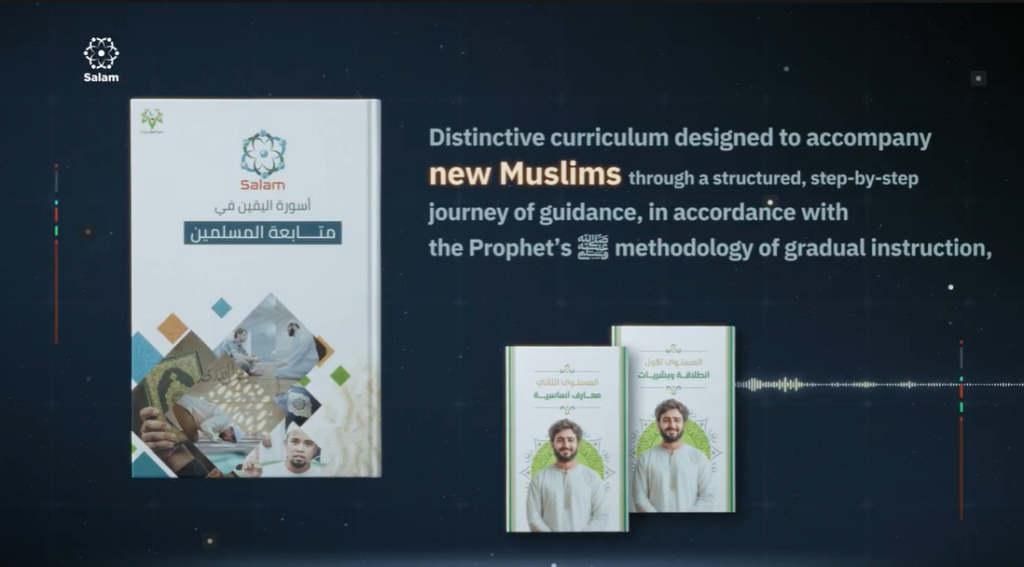
If you are a new Muslim seeking a structured path forward, the Asawirat Al-Yaqeen (Bracelets of Certainty) program is designed precisely for you. It is a four-stage curriculum that guides you from the foundational pillars of Islam toward confident, grounded faith:
- Stage One covers the Shahada, prayer, purification, and the pillars of faith
- Stage Two addresses repentance, the life of the Prophet (PBUH), and acts of worship
- Stage Three nurtures your character, spiritual life, and practical daily rulings
- Stage Four equips you with theological grounding and a life roadmap rooted in Quran
Over 114,000 new Muslims across 140 countries have walked this path. You do not have to walk it alone.
Reach out directly to the Salam Center team to start the Asawirat Al-Yaqeen (Bracelets of Certainty) program for FREE.
Conclusion
Islam’s position on original sin rests on Quranic revelation and prophetic teaching: Adam’s sin was personal, his repentance was accepted, and his descendants were born pure. Every human soul begins life in the Fitra — an untainted, God-oriented state of moral readiness.
Islamic moral theology builds accountability entirely on individual action. No person carries the sin of another, and no inherited guilt shapes a person’s standing before Allah.
Repentance remains directly accessible to every soul, requiring no mediator and carrying no residual burden from ancestral transgression.
Frequently Asked Questions
Do Muslims believe in original sin?
No. Islam explicitly rejects the doctrine of original sin. The Quran teaches that Adam and Eve sinned, repented, and were completely forgiven by Allah — and that no human being inherits the moral guilt of another’s transgression. Every person is born in a state of Fitra, a pure and untainted natural disposition. The governing Quranic principle is clear: no soul bears the burden of another (Quran 35:18).
What does Islam say happened after Adam and Eve sinned?
Islam teaches that Adam and Eve disobeyed Allah by eating from the forbidden tree, that they recognized their error and turned to Allah in sincere repentance, and that Allah accepted their repentance completely. The Quran records: "Then Adam received from his Lord [some] words, and He accepted his repentance. Indeed, it is He who is the Accepting of Repentance, the Merciful" (Quran 2:37). Their descendants were not parties to the sin and bear no consequence from it.
What is the Fitra in Islam and how does it relate to original sin?
The Fitra is the innate, God-given disposition that every human being is born with — an orientation toward recognizing the Creator and a natural moral awareness. The Prophet Muhammad (PBUH) confirmed: "Every child is born upon the Fitra" (Sahih Muslim). The Fitra represents the Islamic alternative to original sin: rather than an inherited corruption, human beings carry an inherited goodness — a baseline of spiritual purity that external influences can distort but never erase permanently.
How does Islam explain human sin if people are not born sinful?
Islam attributes human sin to individual choice, moral weakness, and the influence of Shaytan — not to an inherited corrupted nature. Every human being possesses free will and the capacity to choose obedience or disobedience. When a person sins, it is their personal act and their personal responsibility. Repentance is always available — direct, immediate, and without intermediary. Allah describes Himself repeatedly in the Quran as Al-Tawwab: the One who perpetually accepts repentance. Exploring the God in Islam framework illuminates how divine mercy and divine justice work together in this understanding.
Where did the doctrine of original sin come from if it is not in the Quran?
The doctrine of original sin as a systematic theology — particularly the concept of inherited guilt — was developed primarily by Augustine of Hippo in the 4th and 5th centuries CE, drawing on his reading of Paul’s letters and his own theological framework. It was not universally accepted among all early Christian traditions. The Eastern Orthodox Church, for instance, has historically understood Adam’s legacy as inherited mortality and weakness rather than inherited guilt. Islam, which affirms the original revealed message of all Prophets, finds no basis for this doctrine in the Quran or authenticated Sunnah.
Does rejecting original sin mean Islam views humanity as perfect?
No. Islam holds a balanced view: human beings are born pure but are also morally fallible by nature. The Prophet Muhammad (PBUH) acknowledged human imperfection plainly, while simultaneously emphasizing that sincere repentance is always accepted. Islam does not teach human perfection — it teaches human dignity, capacity, and the ever-open door of return to Allah. The rejection of original sin means rejecting inherited guilt, not acknowledging the reality of personal sin and the ongoing human need for divine guidance and forgiveness.
Curious about Islam?
Journey towards clarity and purpose. Our team is here to support you in your search for truth and spiritual guidance.
Embrace the Truth