
What Was the Significance of Gabriel’s Messages to Muhammad in Islam?
Angel Gabriel (Jibril) served as the sole intermediary through whom Allah revealed the entire Quran to Prophet Muhammad (PBUH) over twenty-three years. The first revelation occurred in the Cave of Hira when Gabriel commanded Muhammad (PBUH) to “Read,” delivering the opening verses of Surah Al-Alaq.
Gabriel is named directly in Quran 2:97 as the one who brought the Quran down upon the Prophet’s heart by Allah’s permission. Gabriel reviewed the entire Quran with the Prophet (PBUH) once every Ramadan, and twice in the final year before his death.
What was the significance of Gabriel’s messages to Muhammad according to Islamic teachings?
Gabriel’s significance lies in the fact that he was Allah’s chosen messenger to deliver the Quran, word by word, to Prophet Muhammad (PBUH) across a mission spanning twenty-three years. Every verse of the Quran that Muslims recite, memorize, and build their lives around passed through Gabriel before reaching the Prophet’s heart.
Allah confirms this directly in the Quran, closing off any ambiguity about who carried the message and why it matters.
قُلْ مَن كَانَ عَدُوًّا لِّجِبْرِيلَ فَإِنَّهُ نَزَّلَهُ عَلَىٰ قَلْبِكَ بِإِذْنِ اللَّهِ مُصَدِّقًا لِّمَا بَيْنَ يَدَيْهِ وَهُدًى وَبُشْرَىٰ لِلْمُؤْمِنِينَ ﴿٩٧﴾ مَن كَانَ عَدُوًّا لِّلَّهِ وَمَلَائِكَتِهِ وَرُسُلِهِ وَجِبْرِيلَ وَمِيكَالَ فَإِنَّ اللَّهَ عَدُوٌّ لِّلْكَافِرِينَ
“Say, “Whoever is an enemy to Gabriel – it is [none but] he who has brought the Qur’an down upon your heart, [O Muhammad], by permission of Allah, confirming that which was before it and as guidance and good tidings for the believers.” (97) Whoever is an enemy to Allah and His angels and His messengers and Gabriel and Michael – then indeed, Allah is an enemy to the disbelievers.'” (Quran 2:97-98)
This verse settles the matter with a directness rarely seen elsewhere in the Quran. Some of the Prophet’s Jewish contemporaries in Madinah reportedly claimed Gabriel was an enemy figure who brought only calamity, and Allah’s response was not a gentle correction but a flat rebuttal: Gabriel delivered this Quran, and he did so under Allah’s own authority.
That single sentence carries the weight of the entire discussion. It is the reason faith in Islam rests not on a vague spiritual feeling but on a chain of transmission that begins with Allah, passes through a named, identified angel, and lands in the heart of a specific man in a specific cave outside Mecca.
Readers exploring the broader architecture of belief this verse supports will find it laid out fully in the Salam Center’s guide to faith in Islam.
The first message of Gabriel in the Cave of Hira began the mission of prophethood
The first time Gabriel appeared to Muhammad (PBUH), the Prophet was forty years old and had retreated to the Cave of Hira on Jabal al-Nour, a small mountain outside Mecca, for solitary worship. He had been going there for years, drawn to quiet reflection away from the idolatry that surrounded him in the city.
Nothing about that particular night suggested it would become the hinge point of human history for over a billion people today.
Aisha (may Allah be pleased with her), the Prophet’s wife, narrated the full account, and it is preserved in Sahih al-Bukhari:
“The commencement of the Divine Inspiration to Allah’s Messenger (ﷺ) was in the form of true dreams in his sleep… Then he began to like seclusion, so he used to go in seclusion in the cave of Hira where he used to worship Allah continuously for many nights… till one day he received the Guidance while he was in the cave of Hira. An Angel came to him and asked him to read.” (Sahih al-Bukhari 4953)
The Prophet (PBUH) replied that he could not read. Gabriel pressed him firmly, released him, and repeated the command three times before delivering the actual words of revelation. What followed became the opening verses of the Quran itself:
اقْرَأْ بِاسْمِ رَبِّكَ الَّذِي خَلَقَ ﴿١﴾ خَلَقَ الْإِنسَانَ مِنْ عَلَقٍ ﴿٢﴾
“Recite in the name of your Lord who created— created man from a clinging substance.” (Quran 96:1-2)
This moment is the reason the Islamic calendar and the entire structure of prophethood shift at this exact point in Muhammad’s (PBUH) life.
Before Hira, he was known as a trustworthy, honest man in Mecca. After it, he carried the responsibility of relaying Allah’s final revelation to all of humanity.
Anyone wanting the deeper account of how this transition unfolded — his early years, his character before revelation, and the events leading up to that first night — can trace it through the Salam Center’s piece on the Prophet Muhammad’s childhood and the fuller narrative of how Muhammad became the Prophet of Islam.
Learn More About Islam
Discover the beauty, teachings, and wisdom of Islam in a clear and welcoming way. Start exploring and deepen your understanding today.
Learn MoreGabriel is described in the Quran as the Trustworthy Spirit entrusted with revelation
Allah does not leave Gabriel’s identity or reliability open to speculation; the Quran gives him a specific title that underscores exactly why his messages can be trusted without hesitation. In Surah Ash-Shu’ara, Allah describes the descent of the Quran in terms that leave no room for doubt about the purity of the transmission:
نَزَلَ بِهِ الرُّوحُ الْأَمِينُ ﴿١٩٣﴾ عَلَىٰ قَلْبِكَ لِتَكُونَ مِنَ الْمُنذِرِينَ ﴿١٩٤﴾
“The Trustworthy Spirit has brought it down. Upon your heart, [O Muhammad] – that you may be of the warners.” (Quran 26:193-194)
The phrase “al-Ruh al-Amin” (the Trustworthy Spirit) is not decorative language. It is a deliberate theological statement. Gabriel was not permitted to alter, edit, or add personal interpretation to what he delivered.
He was a conduit of absolute reliability, chosen precisely because trust was non-negotiable for a message meant to guide the Ummah until the end of time.
Gabriel’s role extended beyond revelation into direct religious instruction
One of Gabriel’s most remarkable appearances had nothing to do with delivering new verses of the Quran; instead, he came in human form to publicly teach the foundations of the religion to the Prophet’s companions. This event, recorded in Sahih Muslim, is often called the Hadith of Jibril, and scholars regard it as one of the most comprehensive single narrations in all of Islamic tradition.
Umar ibn al-Khattab (may Allah be pleased with him) described a man appearing among the companions, dressed in pure white with no signs of travel, who sat directly before the Prophet (PBUH) and began asking structured questions about Islam, Iman, and Ihsan.
“He said: ‘Inform me about al-Ihsan.’ He (the Prophet) replied: ‘It is to worship Allah as if you see Him, and if you cannot achieve this state of devotion, then you must consider that He is looking at you.'” (Sahih Muslim 8a)
After the man departed, the Prophet (PBUH) told Umar plainly that the visitor had been Gabriel, sent to teach the people their religion through dialogue rather than direct revelation.
This appearance matters because it shows Gabriel’s function was never limited to a one-way pipeline of verses.
He also modeled how belief should be structured, examined, and taught — submission in action, conviction in the heart, and awareness of Allah in every moment.
Gabriel guided the Prophet through the Night Journey and the Ascension into the heavens
Beyond the Quran and religious instruction, Gabriel personally escorted Muhammad (PBUH) on the single most extraordinary physical and spiritual journey recorded in Islamic history: the Isra and Mi’raj. In one night, the Prophet (PBUH) was taken from Masjid al-Haram in Mecca to Masjid al-Aqsa in Jerusalem, and then ascended through the heavens themselves, with Gabriel as his companion and guide at every stage.
Anas ibn Malik (may Allah be pleased with him) narrated the ascension in detail, describing how Gabriel requested entry at each heavenly gate on the Prophet’s behalf:
“Then Jibril (Gabriel) ascended along with me to the nearest heaven and requested for the gate to be opened. He was asked, ‘Who is there?’ He replied, ‘Jibril.’ He was asked, ‘Who is with you?’ He said, ‘Muhammad.'”
This pattern repeated through each of the seven heavens, with Gabriel formally announcing the Prophet’s arrival before he was welcomed by earlier prophets, including Adam, Ibrahim, Musa, and Isa (peace be upon them all).
Gabriel accompanied Muhammad (PBUH) until they reached Sidrat al-Muntaha, the furthest boundary a created being could cross, at which point Gabriel remained behind while the Prophet (PBUH) continued alone.
This detail matters theologically: it establishes that even Gabriel, despite his exalted status among the angels, operated within limits set by Allah.
The complete narrative of that night, including the events that preceded it and its lasting significance for the five daily prayers, is documented in the Salam Center’s account of the Night Journey.
Read Also: What Was The First Religion That Believed In One God?
Gabriel reviewed the Quran with the Prophet every year, protecting its precise wording
A less commonly discussed but deeply significant role Gabriel played was returning every year during Ramadan to review the entire revealed Quran with the Prophet (PBUH), verse by verse, ensuring nothing was misremembered or altered. Ibn Abbas (may Allah be pleased with him) described the pattern clearly:
“The Prophet (ﷺ) was the most generous of all the people, and he used to become more generous in Ramadan when Gabriel met him. Gabriel used to meet him every night during Ramadan to revise the Qur’an with him.” (Sahih al-Bukhari 3554)
In the final Ramadan before the Prophet’s death, this annual review happened twice instead of once — a detail the Prophet (PBUH) himself recognized as a sign that his life was drawing to a close. His daughter Fatimah (may Allah be pleased with her) later recounted what he confided to her:
“Every year Gabriel used to revise the Qur’an with me once only, but this year he has done so twice. I think this portends my death.” (Sahih al-Bukhari 3623)
This annual review is one of the strongest textual foundations for why Muslims trust the Quran’s preservation today. It was not left to memory alone across decades; it underwent structured, repeated verification directly between the Prophet and the angel who first delivered it.
This practice also became the origin of the Tarawih tradition observed across the Ummah during Ramadan nights. R
eaders curious about how this transmission history connects to the Quran’s broader preservation can explore the Salam Center’s article on the history of the Quran and the deeper reasoning behind why Muslims believe in the Quran.
Read Also: What Islam Teaches About Other Religions and Prophets
Gabriel’s role clarifies why the Quran is considered Allah’s literal, unaltered speech
Grasping why Gabriel’s messages matter so deeply requires understanding that Muslims do not view the Quran as Muhammad’s own words, composed with angelic inspiration in some loose sense; they view it as Allah’s direct speech, transmitted through a specific, named, trustworthy angel with zero editorial latitude. This distinction shapes nearly every downstream belief in Islamic theology, from how the Quran is recited to how it is memorized and taught.
This also explains why Islamic scholarship treats any denial of Gabriel’s role as more than a minor theological disagreement.
Since Gabriel acted entirely under Allah’s command, rejecting his role in revelation effectively means rejecting the authenticity of the message itself. This is precisely the concern Quran 2:97 addresses so directly.
It is also why the Islamic understanding of God in Islam as a singular, uncompromised source of truth stands apart from other frameworks — a topic covered more fully in the Salam Center’s discussion of how Islam views the nature of God.
Read Also: What Did Muslims Believe Before the Quran?
Learn More About Islam
Discover the beauty, teachings, and wisdom of Islam in a clear and welcoming way. Start exploring and deepen your understanding today.
Learn MoreDiscover More About Faith, Certainty, and the Journey to Islam
Questions about Gabriel, revelation, and the Quran often open the door to deeper questions about faith itself. Whether you are still searching or have already taken your shahada, there is a place for you here.
Browse more articles on the Salam Platform covering the foundations of belief, the life of the Prophet (PBUH), and answers to common questions about Islam.
Read further reflections and teachings on the Salam blog.
If you have specific questions, are considering entering Islam, or want structured guidance, reach out directly — the Salam Center team is here to walk with you.

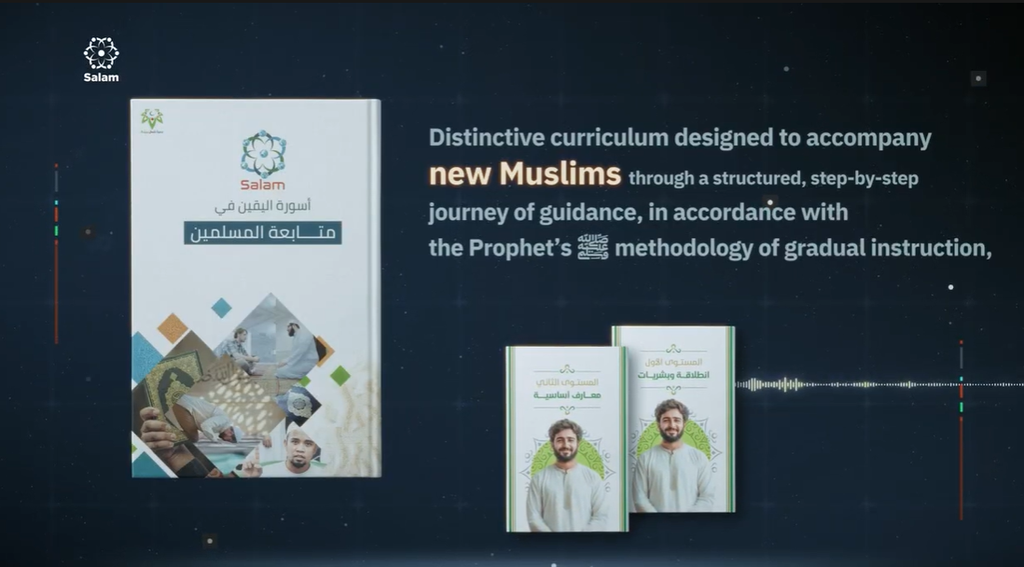
For new Muslims seeking a structured path forward, the Asawirat Al-Yaqeen (Bracelets of Certainty) program offers a guided four-stage journey:
- Foundational knowledge of the Shahada, prayer, and purification
- Understanding the pillars of faith, zakat, fasting, and Hajj
- Lessons on repentance and the life of the Prophet (PBUH)
- Etiquette, practical life rulings, and contemporary Islamic guidance
Reach out to learn how to join and begin building unshakeable certainty in your faith.
Reach out directly to the Salam Center team to start the Asawirat Al-Yaqeen (Bracelets of Certainty) program for FREE.
Summary
Gabriel’s messages to Prophet Muhammad (PBUH) delivered the entirety of the Quran across twenty-three years, beginning in the Cave of Hira and continuing through annual Ramadan reviews that safeguarded its exact wording. His role extended into direct teaching, most notably the Hadith of Jibril, and into guiding the Prophet through the Night Journey and Ascension.
Understanding this transmission clarifies why Muslims regard the Quran as Allah’s literal speech rather than human composition shaped by inspiration alone. Gabriel’s trustworthiness, affirmed explicitly in the Quran, remains central to why the message he carried continues to guide seekers and believers toward certainty today.
Frequently Asked Questions
Who was Angel Gabriel according to Islamic teachings?
Gabriel (Jibril) is the angel Allah selected to deliver the entire Quran to Prophet Muhammad (PBUH). The Quran calls him the Trustworthy Spirit in Quran 26:193, affirming his reliability as the sole conduit of divine revelation over twenty-three years.
Where did Gabriel first appear to Muhammad (PBUH)?
Gabriel first appeared in the Cave of Hira on Jabal al-Nour near Mecca, when the Prophet (PBUH) was forty years old. He commanded Muhammad (PBUH) to “Read,” delivering the opening verses of Surah Al-Alaq, marking the start of prophethood (Sahih al-Bukhari 4953).
Did Gabriel only deliver Quranic verses to the Prophet?
No, Gabriel also appeared in human form to teach the companions directly, and he guided the Prophet through the Night Journey and Ascension. The Hadith of Jibril (Sahih Muslim 8a) records him teaching Islam, Iman, and Ihsan through structured questioning.
Why did Gabriel review the Quran with the Prophet every Ramadan?
Gabriel reviewed the entire revealed Quran with the Prophet (PBUH) annually to verify its precise preservation, meeting him every night of Ramadan (Sahih al-Bukhari 3554). In his final year, this review happened twice, signaling his approaching death.
What does the Quran say about denying Gabriel’s role?
Quran 2:97 states that hostility toward Gabriel is effectively hostility toward Allah’s own decree, since Gabriel delivered the Quran strictly by Allah’s permission. This verse directly refuted claims from some of the Prophet’s contemporaries who viewed Gabriel with suspicion.
Curious about Islam?
Journey towards clarity and purpose. Our team is here to support you in your search for truth and spiritual guidance.
Embrace the Truth