Teaching Islam to Kids & in Schools
| Key Takeaways |
| Islam places teaching children about faith as a direct parental obligation, rooted in Quranic instruction and Prophetic command. |
| The Prophet Muhammad (PBUH) directed parents to introduce prayer to children at age seven and treat it as a firm habit by age ten. |
| Fun, age-appropriate methods — storytelling, routine-building, and interactive learning — tend to produce more lasting understanding in children than rote memorisation alone. |
Teaching Islam to kids works best when it combines clear religious duty with genuine warmth, not pressure or fear.
Parents raising Muslim children carry a direct responsibility rooted in the Quran and Sunnah, while schools — particularly in places like the UK — occupy a very different role, one bound by law, local policy, and educational neutrality rather than religious instruction.
1. Recognise That Teaching Children Faith Is a Parental Obligation, Not an Option
Islam does not treat a child’s religious education as optional or secondary to worldly schooling. Allah instructs believers directly to protect their families from spiritual harm, a command that begins with knowledge.
قُوا أَنفُسَكُمْ وَأَهْلِيكُمْ نَارًا
“O you who have believed, protect yourselves and your families from a Fire whose fuel is people and stones…” (Quran 66:6)
Classical commentators, including scholars within the tradition of tafsir, read this verse as establishing that a parent’s duty extends beyond providing food and shelter — it includes teaching children what Allah has commanded and forbidden.
2. Follow the Prophetic Timeline for Introducing Prayer to Children
The Prophet Muhammad (PBUH) gave parents a specific, practical age structure rather than vague encouragement. Salah instruction should begin at age seven, with firmer habit-building expected by age ten.
The Messenger of Allah (PBUH) said: “Command your children to pray when they become seven years old, and discipline them for it when they become ten years old; and arrange their beds (to sleep) separately.” (Sunan Abi Dawud 495)
This hadith gives structure to what could otherwise feel overwhelming. A parent does not need to explain the full theology of salah to a five-year-old — the Sunnah itself provides a gentle runway, starting instruction at seven and reserving firmer correction for ten.
This mirrors the broader principle of gradual instruction found throughout the nine core Islam principles, where faith is built in layers rather than delivered all at once.
3. Teach the Shahada as the Entry Point Before Anything Else
Before rulings, before rituals, a child benefits from grasping the single sentence that defines Muslim identity: there is no god worthy of worship except Allah, and Muhammad is His Messenger. The Shahada functions as both the first lesson and the lifelong anchor of Islamic identity.
Rather than presenting it as a phrase to memorise, effective teaching connects the Shahada to lived experience — Allah as the One who created the child, gave them their family, and deserves their gratitude.
This approach ties directly into a child’s early understanding of faith in Islam as something felt and lived, not only recited.
Learn More About Islam
Discover the beauty, teachings, and wisdom of Islam in a clear and welcoming way. Start exploring and deepen your understanding today.
Learn More4. Use Storytelling From the Seerah to Make Faith Memorable
Children retain narrative far better than abstract instruction. The Prophet’s biography offers dozens of episodes naturally suited to young minds — patience, honesty, kindness to animals, and mercy toward enemies.
Consider introducing episodes gradually: the honesty of Prophet Muhammad even before his prophethood, his tenderness shown in the mercy stories involving children and the vulnerable, or his relationship with his own mother detailed in the story of Prophet Muhammad’s mother.
A child who hears these stories repeatedly begins to internalise Prophetic character rather than simply memorising facts about him. Prophet Muhammad’s childhood in Makkah itself provides useful material, showing children a version of the Prophet (PBUH) closer to their own age and experience.
5. Introduce the Quran Through Listening Before Reading
Very young children absorb the Quran’s rhythm and sound long before they can read Arabic script. Regular listening builds familiarity, love, and eventual memorisation capacity.
Islamic educators across generations have relied on this principle — reciting short surahs aloud at bedtime, playing recitation during car rides, and encouraging repetition without pressure.
As comprehension develops, parents can explain what the Quran actually contains and gradually build toward why Muslims believe the Quran is the literal word of Allah, a foundational concept that shapes a child’s entire relationship with scripture.
6. Explain Wudu and Purification as Practical, Hands-On Lessons
Ritual purification (wudu) offers a rare teaching opportunity: it is physical, repeatable, and easy for children to practise alongside a parent. Demonstrating wudu step-by-step, rather than only describing it, builds muscle memory that lasts into adulthood.
Many parents find success turning wudu into a shared daily routine rather than an isolated lesson — washing together before Maghrib, narrating each step aloud, and gently correcting technique over weeks rather than expecting perfection immediately.
7. Frame the Six Pillars of Iman as a Story of Belief, Not a Checklist
Where the five pillars govern action, the six pillars of Iman govern belief — in Allah, His angels, His books, His messengers, the Last Day, and divine decree. Presenting these as an interconnected worldview helps children see Islam as coherent rather than a list of separate facts to memorise.
A helpful entry point is exploring how Islam views the nature of Allah — His oneness, His mercy, His names and attributes — since this single concept underpins the other five pillars of belief.
Children who understand Tawheed (monotheism) deeply tend to grasp the remaining pillars with far less difficulty.
8. Address Fun Ways to Teach Islam Through Games, Crafts, and Repetition
Structured worksheets alone rarely sustain a young child’s interest. Interactive methods — flashcards, recitation games, craft projects tied to Islamic months, and reward charts for prayer consistency — tend to produce stronger long-term retention than passive instruction.
Examples that consistently work across households: a “prayer tracker” chart with stickers for each salah performed, a memory-matching game using the names of the prophets, or simple crafts marking Ramadan and Eid.
The goal is consistent, low-pressure exposure — the Sunnah itself models patience over intensity, as reflected in the gradual seven-to-ten age structure for prayer instruction discussed earlier.
Do UK Schools Teach Islam?
Yes, commonly, though not by specific legal mandate. Religious education is compulsory in UK state schools since 1988, and locally agreed syllabuses typically include Islam as one of several principal religions studied alongside Christianity.
A. UK State Schools Have Taught Religious Education Since 1988
Religious education (RE) has been a compulsory subject in English and Welsh state schools since the Education Reform Act 1988, though it operates differently from most other subjects.
It is not part of the national curriculum — instead, each local authority’s Standing Advisory Council on Religious Education (SACRE) agrees a syllabus that individual schools follow.
This structure directly answers a common search query: schools teaching Islam in the UK do so under locally agreed frameworks, not a single nationwide Islam curriculum.
B. No UK Law Requires Schools to Teach Islam Specifically
A persistent misconception online claims UK schools are legally required to teach Islam as a “main study.” This is inaccurate. The law requires that locally agreed RE syllabuses reflect that Britain’s religious traditions are, in the main, Christian, while also taking account of other principal religions practised in Great Britain — Islam among them, but not exclusively or by mandate.
The Department for Education has confirmed there is no national requirement specifying Islam must be taught, though it commonly appears in RE lessons as a major world religion and is one of the options within the GCSE Religious Studies syllabus.
Parents retain a legal right to withdraw children from RE lessons entirely, a protection that has existed since the same 1988 legislation.
This distinction matters for anyone researching how Islam fits into UK education policy: coverage exists, but it is locally determined rather than nationally imposed — a helpful parallel to how Islam views engagement with other religions as a matter of respectful coexistence rather than uniformity of belief.
Read Also: What Are the Teachings of Islam?
C. The 2026 Push to Bring Religious Education Into the National Curriculum
Government policy on this subject is actively shifting. In 2025, the UK government agreed to bring religious education into the national curriculum for the first time in its history, with a formal consultation expected in September 2026.
Muslim education leaders, including representatives from the Islamic Society of Britain and the Muslim Council of Britain, have welcomed the proposed change, arguing it would raise the subject’s status, secure dedicated teaching time, and improve teacher training standards.
This represents the most significant potential shift in how Islam and other faiths are taught in English schools since 1988, though as of today it remains a proposal moving through consultation rather than settled law.
Read Also: What Are the Teachings of the Qur’an?
D. Build a Structured Post-School Learning Path for Deeper Understanding
School RE lessons — where they occur — offer general religious literacy, not the depth a Muslim child needs to build lasting Yaqeen. Supplementing school exposure with structured home or community-based Islamic education remains essential, particularly for children in mixed or secular school environments.
The Prophet (PBUH) established seeking knowledge as a lifelong obligation, not something bounded by a school timetable:
The Messenger of Allah (PBUH) said: “Seeking knowledge is an obligation upon every Muslim.” (Sunan Ibn Majah 224)
This principle extends to adults raising children just as much as to the children themselves. Structured programmes — study circles, weekend Islamic schools, or guided curricula — give children continuity that a once-weekly RE lesson cannot provide alone, reinforcing what parents build at home through the earlier steps in this list.
Read Also: What Are the Teachings of Prophet Muhammad?
Learn More About Islam
Discover the beauty, teachings, and wisdom of Islam in a clear and welcoming way. Start exploring and deepen your understanding today.
Learn MoreDiscover More About Faith, Certainty, and the Journey to Islam
If you are raising a Muslim child, navigating a UK school system, or simply exploring how Islamic education works, there is more to discover.
Visit the Salam Platform for deeper articles on faith, practice, and everyday questions.
Explore the Salam blog for ongoing guidance on raising children in faith, understanding school policy, and building a firm foundation of belief.
Have a specific question about your situation?
Reach out directly — our team is ready to listen, guide, and welcome you.
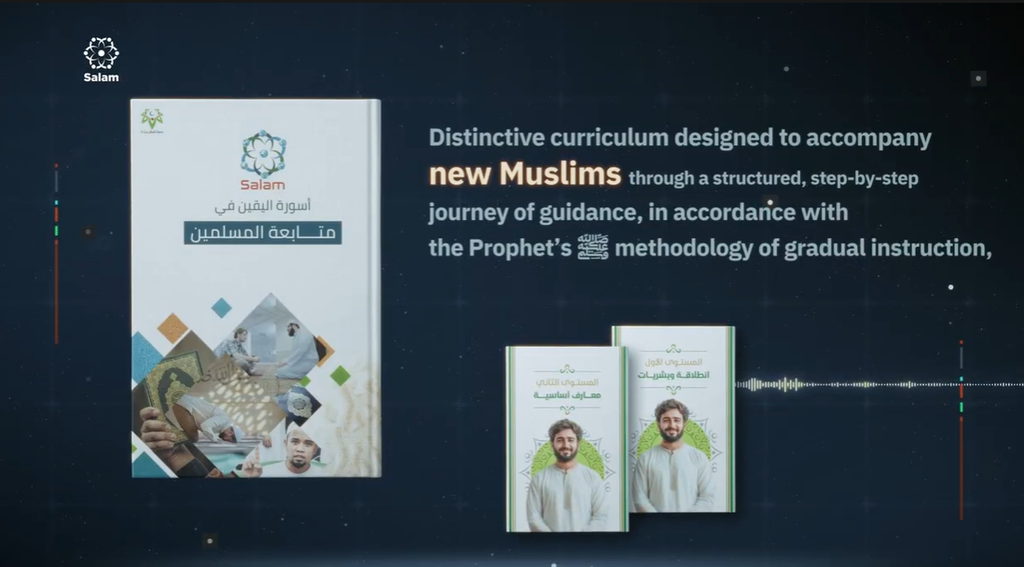
For new Muslim families specifically, the Asawirat Al-Yaqeen (Bracelets of Certainty) programme offers a structured path forward:
- A four-stage curriculum moving from foundational pillars through practical family and parenting rulings
- Dedicated content on raising children, covering etiquette, moral nurturing, and daily family life
- Delivered progressively, respecting where a new Muslim family is starting from
- Available to learners across many countries, with translation into multiple languages underway
Reach out directly to the Salam Center team to start the Asawirat Al-Yaqeen (Bracelets of Certainty) program for FREE.
Summary
Raising a Muslim child rests on Quranic command and Prophetic example, starting with the Shahada, moving through structured prayer instruction from age seven, and building outward through storytelling, hands-on ritual practice, and consistent routine.
UK schools have taught religious education since 1988 without a specific Islam mandate, though 2026 brings the most significant curriculum reform in decades, making structured home and community learning more valuable than ever for lasting faith.
Frequently Asked Questions
How do I teach Islam to my child at home?
Begin with the Shahada, introduce short Quran listening daily, and follow the Prophetic timeline: command prayer at age seven and reinforce it firmly by age ten (Sunan Abi Dawud 495). Build gradually rather than covering everything at once.
Are UK schools required to teach Islam specifically?
No. No UK law names Islam as a mandatory subject of study; local Standing Advisory Councils on Religious Education decide syllabus content, though national curriculum reform is under consultation as of 2026.
What age should a Muslim child start learning to pray?
The Prophet (PBUH) instructed parents to begin commanding prayer at age seven, with firmer expectation established by age ten (Sunan Abi Dawud 495). This gradual approach avoids overwhelming young children.
What are fun ways to teach Islam to kids?
Effective methods include prayer-tracking charts, prophet-story sessions, wudu practice together, and interactive Quran listening. Consistency and warmth matter more than intensity, especially for children under ten.
Curious about Islam?
Journey towards clarity and purpose. Our team is here to support you in your search for truth and spiritual guidance.
Embrace the Truth