
Beautiful Quran Quotes
Quran quotes in Arabic carry a weight that translation alone cannot fully capture. Muslims describe an experience that goes beyond reading — a physical and emotional response to specific verses that seems to happen almost against the reader’s will.
A person hears a particular ayah and their chest tightens, or loosens, or their eyes fill without warning. This is not superstition or exaggeration.
Surah Az-Zumar describes exactly this reaction as a marker of sincere faith, and centuries of Muslims across radically different cultures and languages have reported the same thing when specific passages reach them.
1. Remembrance Of Allah Is The Only True Source Of Heart’s Rest
Surah Ar-Ra’d contains one of the most psychologically resonant verses in the entire Quran, precisely because it names something almost every person has felt: restlessness that nothing external seems to fix.
الَّذِينَ آمَنُوا وَتَطْمَئِنُّ قُلُوبُهُمْ بِذِكْرِ اللَّهِ ۗ أَلَا بِذِكْرِ اللَّهِ تَطْمَئِنُّ الْقُلُوبُ
Alladhina amanu wa tatma’innu qulubuhum bidhikrillah, ala bidhikrillahi tatma’innul-qulub
“Those who have believed and whose hearts are assured by the remembrance of Allah. Unquestionably, by the remembrance of Allah hearts are assured.” (Quran 13:28)
The repetition here is deliberate and it is the entire point. The verse states the principle once — hearts find rest through dhikr — and then restates it immediately as an unqualified fact, opened with the emphatic Arabic particle “ala,” meaning “unquestionably” or “verily.”
Classical exegetes read this doubling as Allah closing off any room for alternative explanations of what actually settles the human heart. Wealth, status, and comfort are not named as false paths to peace; they are simply absent from the equation altogether.
For someone new to Islam, learning faith in Islam often begins exactly here, with this verse, because it reframes worship not as obligation but as the mechanism by which unrest gets resolved.
2. Hardship Is Always Accompanied By Ease In Surah Ash-Sharh
Surah Ash-Sharh is a short Makkan chapter revealed to comfort the Prophet Muhammad (PBUH) during a period of intense difficulty, and its central promise is repeated twice in successive verses — a stylistic choice that Quranic scholars have treated as significant rather than incidental.
فَإِنَّ مَعَ الْعُسْرِ يُسْرًا. إِنَّ مَعَ الْعُسْرِ يُسْرًا
Fa inna ma’al-‘usri yusra. Inna ma’al-‘usri yusra
“For indeed, with hardship [will be] ease. Indeed, with hardship [will be] ease.” (Quran 94:5-6)
A well-known point made by early commentators is that the Arabic word for hardship, “al-‘usr,” appears both times with the definite article, meaning it refers to the same specific hardship, while the word for ease, “yusr,” appears without it both times, meaning a fresh and different ease each time.
The classical reading drawn from this grammatical detail is that a single hardship can never outnumber the ease that accompanies it — there is always more than one door opening in response to one difficulty closing.
This is among the most frequently quoted Quran quotes in Arabic during periods of loss, illness, or financial strain, not because it minimizes pain, but because it locates that pain inside a larger and more hopeful structure.
3. Allah’s Mercy Remains Open To Every Sinner Who Turns Back To Him
Few verses in Islamic scripture carry the emotional force of Surah Az-Zumar 39:53, addressed directly to people who feel they have sinned too much or fallen too far to be forgiven. It is frequently cited in Islamic counseling and repentance literature because of how unconditionally it speaks.
قُلْ يَا عِبَادِيَ الَّذِينَ أَسْرَفُوا عَلَىٰ أَنفُسِهِمْ لَا تَقْنَطُوا مِن رَّحْمَةِ اللَّهِ ۚ إِنَّ اللَّهَ يَغْفِرُ الذُّنُوبَ جَمِيعًا ۚ إِنَّهُ هُوَ الْغَفُورُ الرَّحِيمُ
Qul ya ‘ibadiyal-ladhina asrafu ‘ala anfusihim la taqnatu mir-rahmatillah, innallaha yaghfirudh-dhunuba jami’a, innahu huwal-Ghafurur-Rahim
“Say, ‘O My servants who have transgressed against themselves [by sinning], do not despair of the mercy of Allah. Indeed, Allah forgives all sins. Indeed, it is He who is the Forgiving, the Merciful.'” (Quran 39:53)
The word “jami’a” — “all,” or “entirely” — is doing significant theological work in this verse. Allah does not say He forgives most sins, or minor sins, or the sins of the sincerely regretful only.
He says all sins, without a listed exception in this ayah. Islamic scholarship generally reads this alongside other texts that clarify shirk (associating partners with Allah) requires repentance specifically, but the emotional register of this verse is designed to reach someone at their lowest point and stop them from concluding that return is impossible.
4. Allah Never Burdens A Soul Beyond What It Can Bear
This principle closes Surah Al-Baqarah, the longest chapter in the Quran, and it functions as a kind of theological safety net running underneath the entirety of Islamic religious obligation.
لَا يُكَلِّفُ اللَّهُ نَفْسًا إِلَّا وُسْعَهَا
La yukallifullahu nafsan illa wus’aha
“Allah does not charge a soul except [with that within] its capacity.” (Quran 2:286)
This short clause carries enormous weight in Islamic jurisprudence and everyday practice.
It underlies the entire system of religious concessions (rukhas) — the traveler who shortens prayer, the ill person who is exempted from fasting, the person whose circumstances genuinely prevent a duty. Nothing in Islam, according to this verse, is designed to break a person.
Difficulty exists, but it is always calibrated to what a specific person can actually endure, not a fixed standard applied without regard for individual capacity.
Readers who want to understand how this principle connects to broader questions about how Islam views the nature of God will find that divine justice and divine mercy are treated as inseparable throughout the Quran, and this verse is often the clearest single illustration of that pairing.
5. The Quran Causes Skin To Shiver And Hearts To Soften At Its Recitation
Surah Az-Zumar 39:23 is unusual because it is a verse that describes the Quran describing itself — Allah speaking about the physical and emotional effect His own revelation has on sincere listeners.
اللَّهُ نَزَّلَ أَحْسَنَ الْحَدِيثِ كِتَابًا مُّتَشَابِهًا مَّثَانِيَ تَقْشَعِرُّ مِنْهُ جُلُودُ الَّذِينَ يَخْشَوْنَ رَبَّهُمْ ثُمَّ تَلِينُ جُلُودُهُمْ وَقُلُوبُهُمْ إِلَىٰ ذِكْرِ اللَّهِ
Allahu nazzala ahsanal-hadithi kitaban mutashabihan mathaniya taqsha’irru minhu juludul-ladhina yakhshawna rabbahum thumma talinu juluduhum wa qulubuhum ila dhikrillah
“Allah has sent down the best statement: a consistent Book wherein is reiteration. The skins shiver therefrom of those who fear their Lord; then their skins and their hearts relax at the remembrance of Allah.” (Quran 39:23)
Ibn al-Qayyim, a major scholar within the tradition of Ahlus Sunnah wal Jama’ah, wrote extensively on the stages described in this verse: first the shiver of awe, then the settling into calm remembrance.
Both reactions are treated as signs of a heart that is alive and responsive rather than hardened.
This verse is directly relevant to anyone asking what Muslims believe about the Quran because it makes an explicit claim about the nature of the text itself — that it is not simply information to be processed intellectually, but revelation designed to move the reader on a physical and emotional level when approached with sincerity.
Read Also: Quran Quotes About Patience
6. Believers Are Commanded Not To Weaken Or Grieve Regardless Of Circumstance
Revealed in the aftermath of the difficult Battle of Uhud, this verse from Surah Ali ‘Imran was addressed to a community that had just suffered real losses, making its instruction considerably more grounded than abstract encouragement.
وَلَا تَهِنُوا وَلَا تَحْزَنُوا وَأَنتُمُ الْأَعْلَوْنَ إِن كُنتُم مُّؤْمِنِينَ
Wa la tahinu wa la tahzanu wa antumul-a’lawna in kuntum mu’minin
“So do not weaken and do not grieve, and you will be superior if you are [true] believers.” (Quran 3:139)
According to Al-Tabari’s tafsir, the verse’s phrase “la tahinu” derives from the root “wahn,” describing both physical and spiritual weakness.
What distinguishes this verse from generic reassurance is its context — it was spoken directly to people mourning fallen companions and processing a military setback, not to an audience free of real grief.
The instruction is not to suppress sorrow entirely, since grief itself is acknowledged as natural elsewhere in Islamic teaching, but to prevent grief from curdling into weakness or despair that halts forward movement.
Read Also: Beautiful Quran Quotes About Life That Reveal Its True Purpose
7. Trusting Allah Completely Makes Him Sufficient For All Of A Believer’s Needs
The concept of tawakkul, or complete reliance on Allah, receives one of its clearest articulations in Surah At-Talaq, in a passage originally revealed regarding provision and sustenance but understood far more broadly across Islamic spiritual tradition.
وَمَن يَتَوَكَّلْ عَلَى اللَّهِ فَهُوَ حَسْبُهُ ۚ إِنَّ اللَّهَ بَالِغُ أَمْرِهِ
Wa many-yatawakkal ‘alallahi fahuwa hasbuh, innallaha balighu amrih
“And whoever relies upon Allah – then He is sufficient for him. Indeed, Allah will accomplish His purpose.” (Quran 65:3)
Ibn Kathir’s tafsir connects this verse to the broader promise that precedes it in the same surah — that Allah provides “from where he does not expect.”
The word “hasbuh,” translated as “sufficient for him,” implies not partial help but complete adequacy: nothing further is required once a person has genuinely placed their trust in Allah’s plan.
This does not remove the requirement to take practical means, a distinction Islamic scholars are careful to preserve, but it does reposition anxiety about outcomes as something a believer is invited to release rather than carry alone.
Read Also: Islamic Motivational Quotes from the Quran
Learn More About Islam
Discover the beauty, teachings, and wisdom of Islam in a clear and welcoming way. Start exploring and deepen your understanding today.
Learn MoreGet Guidance And Support From Salam Platform
These eight verses are a small window into a text that Muslims spend a lifetime returning to.
If these Quran quotes in Arabic moved something in you, there is more waiting to be discovered.
Explore the Salam Platform for deeper explorations of Islamic belief, the Quran, and the life of the Prophet Muhammad (PBUH).
Visit the Salam blog for ongoing articles answering real questions from seekers and new Muslims.
Reach out directly — our team is ready to listen, guide, and welcome you.

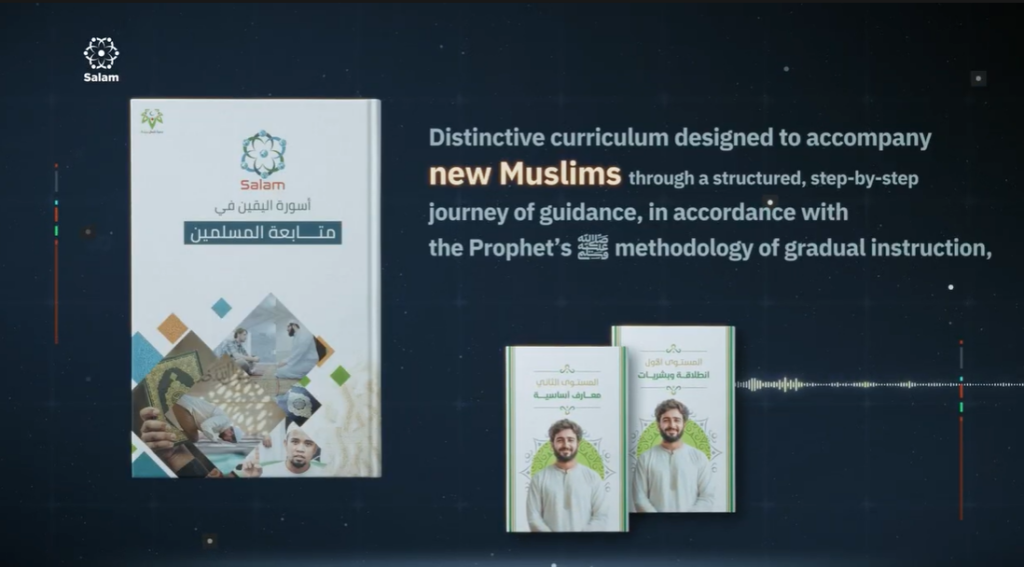
For those who feel ready to explore Islam further, or who have already taken their shahada and want structured support, the Salam Center‘s Asawirat Al-Yaqeen (Bracelets of Certainty) program offers a four-stage guided journey:
- Foundational knowledge of the pillars of Islam, prayer, and purification
- A dedicated stage on sincere repentance and the life of the Prophet Muhammad (PBUH)
- Practical guidance on daily conduct, family life, and personal etiquette
- An advanced stage addressing contemporary questions and interfaith understanding
Reach out directly to the Salam Center team to start the Asawirat Al-Yaqeen (Bracelets of Certainty) program for FREE.
Summary
Beautiful Quran quotes in Arabic offer more than poetic language; they carry theological weight on mercy, patience, and divine sovereignty. Verses like Ayat al-Kursi and Surah Ash-Sharh 94:5-6 remain central to daily Muslim practice and personal reflection worldwide.
Each verse examined here connects to a distinct emotional and spiritual need, from grief to guilt to uncertainty about the future. Exploring their Arabic text alongside authentic translation invites a deeper, more grounded encounter with the Quran itself.
Frequently Asked Questions
Why do Muslims recite Quran verses in Arabic rather than translation?
The Quran is the literal, unaltered word of Allah, and its linguistic structure, rhythm, and precise word choices carry meaning that translation cannot fully replicate. This belief is explored in detail in why Muslims believe in the Quran.
Which Quran verse talks about hardship and ease?
Surah Ash-Sharh 94:5-6 states twice, “For indeed, with hardship [will be] ease,” a repetition classical scholars read as a promise that one hardship is always met with more than one form of relief.
What does the Quran say about Allah’s mercy toward sinners?
Quran 39:53 declares that Allah forgives all sins for those who turn back to Him sincerely, addressing anyone who fears they have transgressed beyond forgiveness with the words, “do not despair of the mercy of Allah.”
How can I start learning to read Quran verses in Arabic?
Beginning with short, frequently recited verses like Ayat al-Kursi or Surah Ash-Sharh, paired with transliteration and audio recitation, is a common starting approach. Structured guidance through foundational Islamic knowledge is also available through the Salam Center‘s Asawirat Al-Yaqeen (Bracelets of Certainty) curriculum.
Curious about Islam?
Journey towards clarity and purpose. Our team is here to support you in your search for truth and spiritual guidance.
Embrace the Truth