
Beautiful Quran Quotes About Life That Reveal Its True Purpose
Life, in the Quranic view, is neither an accident nor an end in itself. Every soul that draws breath has been placed here for a reason Allah states plainly, not one left to guesswork or philosophical debate.
The quotes below trace that reason across different chapters of the Quran — from the declaration of purpose in Surah Adh-Dhariyat, through the test described in Surah Al-Mulk, to the promise of a good life in Surah An-Nahl.
1. Life exists so that human beings may know and worship their Creator
Before any discussion of hardship, purpose, or the afterlife can begin, the Quran settles the most basic question first: why does life exist at all? Surah Adh-Dhariyat answers this without ambiguity. The verse does not describe worship as one option among many for a meaningful life — it states worship as the very reason existence was granted in the first place. This is the foundation every other verse on this list builds upon.
وَمَا خَلَقْتُ الْجِنَّ وَالْإِنسَ إِلَّا لِيَعْبُدُونِ
Wa maa khalaqtul-jinna wal-insa illaa liya’budūn
“And I did not create the jinn and mankind except to worship Me.” (Quran 51:56)
Classical commentators, including those recorded in Tafsir Ibn Kathir, explain that “worship” here carries a broader meaning than ritual acts alone — it includes knowing Allah, submitting to His command, and directing every act of devotion to Him exclusively rather than to any created being.
This single verse reframes the entire question of purpose. A person is not searching for meaning in a universe indifferent to them; the Quran states the meaning outright, and everything else in a believer’s life is built on responding to it.
This is also why the nature of God in Islamic theology centers so heavily on Tawheed, the oneness of Allah — because if worship is the reason for existence, then who is worshipped, and how, becomes the most consequential question a person will ever answer.
2. Death and life together form a deliberate test of character
Once the reason for existence is clear, a second question follows naturally: what is this life actually testing? The Quran answers with a verse that is often recited yet rarely unpacked in full.
Surah Al-Mulk opens with a description of Allah’s dominion, and its second verse pairs two things — death and life — as a single, intentional trial rather than two separate events.
الَّذِي خَلَقَ الْمَوْتَ وَالْحَيَاةَ لِيَبْلُوَكُمْ أَيُّكُمْ أَحْسَنُ عَمَلًا ۚ وَهُوَ الْعَزِيزُ الْغَفُورُ
Allathee khalaqal-mawta wal-hayaata liyabluwakum ayyukum ahsanu ‘amalaa, wa Huwal-‘Azeezul-Ghafoor
“[He] who created death and life to test you [as to] which of you is best in deed – and He is the Exalted in Might, the Forgiving.” (Quran 67:2)
Notice the order: death is mentioned before life. Scholars have observed that this sequencing draws attention to death first precisely so that awareness of it shapes how a person lives, rather than treating death as a distant afterthought.
The test itself is not measured by how many deeds a person accumulates, but by their quality — sincerity toward Allah combined with adherence to the way of Prophet Muhammad (PBUH).
3. Righteous deeds done with faith produce a genuinely good life
If life is a test measured by deeds, a natural question follows: what happens to those who pass it, in this world, not only the next? Surah An-Nahl answers this directly, and its wording is deliberately inclusive — the promise applies without exception to gender, only to sincerity of faith and action.
مَنْ عَمِلَ صَالِحًا مِّن ذَكَرٍ أَوْ أُنثَىٰ وَهُوَ مُؤْمِنٌ فَلَنُحْيِيَنَّهُ حَيَاةً طَيِّبَةً
Man ‘amila saalihan min thakarin aw unthaa wa huwa mu’minun falanuhyiyannahu hayaatan tayyibah
“Whoever does righteousness, whether male or female, while being a believer – We will surely cause him to live a good life.” (Quran 16:97)
Tafsir scholars, drawing on the interpretations preserved in Tafsir Ibn Kathir, describe this “good life” as inward contentment — tranquility of heart, satisfaction with what Allah has provided, and freedom from the restlessness that consumes those chasing the world without faith.
It is not a guarantee of wealth or ease in the material sense; rather, it describes a quality of heart available to the believer regardless of circumstance.
This distinction matters when discussing the principles of Islam, because it corrects a common misconception — that righteousness is transactional, purchasing worldly comfort. The Quran instead describes something more durable: peace that does not depend on outward conditions.
4. The Life of This World Is Only Temporary Enjoyment
Surah Aal-Imran situates worldly life within a larger frame, without dismissing its value entirely.
وَمَا الْحَيَاةُ الدُّنْيَا إِلَّا مَتَاعُ الْغُرُورِ
Wa ma al-hayatu ad-dunya illa mata’u al-ghurur
“And what is the life of this world except the enjoyment of delusion.” (Quran 3:185)
This verse does not instruct believers to abandon worldly responsibilities. It recalibrates priorities, reminding the reader that comfort and status here are temporary compared to what follows — a theme explored further in discussions of what Muslims believe about the Quran.
Learn More About Islam
Discover the beauty, teachings, and wisdom of Islam in a clear and welcoming way. Start exploring and deepen your understanding today.
Learn More5. Worldly life is Play, Diversion, and Mutual Boasting that Eventually Withers
Having established that life is a test, the Quran turns to describing the true nature of the thing being tested through — the dunya itself. Surah Al-Hadid offers one of the most complete descriptions in the entire Quran, listing exactly what worldly life consists of before comparing it to a vivid image from nature.
اعْلَمُوا أَنَّمَا الْحَيَاةُ الدُّنْيَا لَعِبٌ وَلَهْوٌ وَزِينَةٌ وَتَفَاخُرٌ بَيْنَكُمْ وَتَكَاثُرٌ فِي الْأَمْوَالِ وَالْأَوْلَادِ ۖ كَمَثَلِ غَيْثٍ أَعْجَبَ الْكُفَّارَ نَبَاتُهُ ثُمَّ يَهِيجُ فَتَرَاهُ مُصْفَرًّا ثُمَّ يَكُونُ حُطَامًا ۖ وَفِي الْآخِرَةِ عَذَابٌ شَدِيدٌ وَمَغْفِرَةٌ مِّنَ اللَّهِ وَرِضْوَانٌ ۚ وَمَا الْحَيَاةُ الدُّنْيَا إِلَّا مَتَاعُ الْغُرُورِ
I’lamū annamal-hayaatud-dunyaa la’ibun wa lahwun wa zeenatun wa tafaakhurun baynakum wa takaathurun fil-amwaali wal-awlaad, kamathali ghaythin a’jabal-kuffaara nabaatuhu thumma yaheeju fataraahu musfarran thumma yakoonu hutaamaa, wa fil-aakhirati ‘athaabun shadeedun wa maghfiratun minallaahi wa ridwaan, wa mal-hayaatud-dunyaa illaa mataa’ul-ghuroor
“Know that the life of this world is but amusement and diversion and adornment and boasting to one another and competition in increase of wealth and children – like the example of a rain whose [resulting] plant growth pleases the tillers; then it dries and you see it turned yellow; then it becomes [scattered] debris. And in the Hereafter is severe punishment and forgiveness from Allah and approval. And what is the worldly life except the enjoyment of delusion.” (Quran 57:20)
The agricultural image here is deliberately precise. Rain produces vegetation that delights the farmer at its peak, yet within a single season it dries, yellows, and crumbles to dust.
Tafsir Ibn Kathir explains that Allah uses this parable because it mirrors exactly how worldly attractions operate — impressive at first sight, but never permanent.
The verse closes with a phrase repeated elsewhere in the Quran, “mata’ul-ghuroor,” the enjoyment of delusion, a description that recurs because the pattern itself recurs in every generation.
A shorter verse in Surah Al-An’am delivers the same message with different emphasis, ending in a direct question rather than a closing description.
وَمَا الْحَيَاةُ الدُّنْيَا إِلَّا لَعِبٌ وَلَهْوٌ ۖ وَلَلدَّارُ الْآخِرَةُ خَيْرٌ لِّلَّذِينَ يَتَّقُونَ ۗ أَفَلَا تَعْقِلُونَ
Wa mal-hayaatud-dunyaa illaa la’ibun wa lahwun wa lad-daarul-aakhiratu khayrul-lillatheena yattaqoon, afalaa ta’qiloon
“And the worldly life is not but amusement and diversion; but the home of the Hereafter is best for those who fear Allah, so will you not reason?” (Quran 6:32)
Scholars including Ibn Kathir note that this does not mean worldly life carries no seriousness or purpose whatsoever — obedience to Allah and the deeds that lead toward the Hereafter are excluded from this description.
What the verse addresses is preoccupation with the dunya as an end in itself, stripped of any connection to Allah.
The closing question, “will you not reason,” is not rhetorical decoration; it is an invitation to genuinely weigh what is temporary against what is permanent, a comparison at the heart of Islam’s core principles.
Read Also: Quran Quotes About Patience
6. The Hereafter is Better and More Lasting than Anything This Life Offers
If worldly life is temporary by nature, a comparison naturally follows: temporary compared to what? Surah Al-A’la answers this with a short, direct statement that contrasts human preference against divine reality, addressing a tendency the Quran treats as nearly universal.
بَلْ تُؤْثِرُونَ الْحَيَاةَ الدُّنْيَا وَالْآخِرَةُ خَيْرٌ وَأَبْقَىٰ
Bal tu’thiroonal-hayaatad-dunyaa. Wal-aakhiratu khayrun wa abqaa
“But you prefer the worldly life, while the Hereafter is better and more enduring.” (Quran 87:16-17)
The verse names a real tendency rather than condemning it in the abstract — human beings, by nature, gravitate toward what is immediate and visible over what is delayed and unseen, even when the delayed outcome is objectively superior.
Ibn Kathir’s tafsir links this directly to the preceding verses of the same surah, which describe the success of one who purifies himself and remembers his Lord.
The comparison is not between two equally weighted options; it is between something “abqaa” — more enduring, more lasting — and something that, by its very nature, cannot last. This same comparison appears with an added dimension in Surah Al-Ankabut, which goes further by naming the Hereafter as the only true life.
وَمَا هَٰذِهِ الْحَيَاةُ الدُّنْيَا إِلَّا لَهْوٌ وَلَعِبٌ ۚ وَإِنَّ الدَّارَ الْآخِرَةَ لَهِيَ الْحَيَوَانُ ۚ لَوْ كَانُوا يَعْلَمُونَ
Wa maa haathihil-hayaatud-dunyaa illaa lahwun wa la’ib, wa innad-daaral-aakhirata lahiyal-hayawaan, law kaanoo ya’lamoon
“And this worldly life is not but diversion and amusement. And indeed, the home of the Hereafter – that is the [eternal] life, if only they knew.” (Quran 29:64)
The Arabic word used here for “life” in reference to the Hereafter, “al-hayawan,” is an intensified form of the word for life itself — grammatically emphatic in a way ordinary usage is not.
Commentators explain this as the Quran signaling that the Hereafter is not simply another phase of existence following this one; it is life in its fullest, most real sense, while worldly existence by comparison is closer to a passing shadow.
Read Also: Islamic Motivational Quotes from the Quran
7. Wealth and Children Are Temporary Adornments, but Good Deeds Endure
Two things human beings tend to measure a successful life by are financial security and family. The Quran addresses both directly in Surah Al-Kahf, naming exactly what role they play without dismissing them, while placing something else above them in lasting value.
الْمَالُ وَالْبَنُونَ زِينَةُ الْحَيَاةِ الدُّنْيَا ۖ وَالْبَاقِيَاتُ الصَّالِحَاتُ خَيْرٌ عِندَ رَبِّكَ ثَوَابًا وَخَيْرٌ أَمَلًا
Al-maalu wal-banoona zeenatul-hayaatid-dunyaa, wal-baaqiyaatus-saalihaatu khayrun ‘inda Rabbika thawaaban wa khayrun amalaa
“Wealth and children are [but] adornment of the worldly life. But the enduring good deeds are better to your Lord for reward and better for [one’s] hope.” (Quran 18:46)
The word “zeenah,” translated as adornment, describes something decorative rather than something with lasting substance — wealth and children beautify a life, but Ibn Kathir’s tafsir notes they do not endure the way “al-baqiyatus-salihat,” the enduring righteous deeds, do.
This verse does not instruct believers to abandon providing for their families or building financial stability; it corrects where ultimate hope should be placed.
A person’s legacy, in the Quranic framework, is measured less by what they accumulate and more by what outlasts them — prayer, charity, knowledge passed on, and remembrance of Allah.
Read Also: Beautiful Quran Quotes
Learn More About Islam
Discover the beauty, teachings, and wisdom of Islam in a clear and welcoming way. Start exploring and deepen your understanding today.
Learn MoreGet Guidance And Support From Salam Platform
Reading these verses is often only the beginning. Many people who encounter the Quran’s description of life’s purpose find themselves with follow-up questions — about faith, about the Quran itself, or about what comes next if they are drawn toward Islam.
The Salam Center exists for exactly this stage of the journey. Whether you are comparing worldviews, correcting something you read online, or simply curious, there is space here to ask honestly and receive an answer grounded in the Quran and authentic Hadith.
Browse more reflections on the Salam blog, or reach out directly if you have a specific question — about these verses, about Islam generally, or about taking the next step.

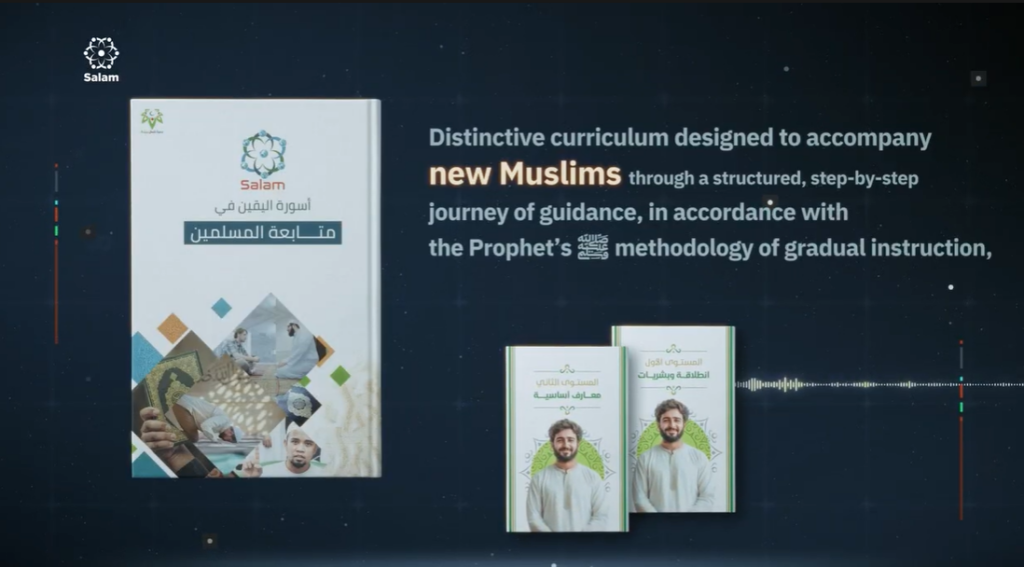
If you are further along and considering the Shahada, or have already taken it and want structure for what comes next, the Salam Center‘s Asawirat Al-Yaqeen (Bracelets of Certainty) program was built for you. It offers:
- A four-stage curriculum moving from foundational pillars (wudu, salah, the Shahada) through Seerah study, etiquette, and practical rulings on marriage, trade, and daily life
- One-on-one guidance paced to where you are, not a fixed timeline
- A community of others who began at the same starting point you are at now
- Content grounded consistently in the creed of Ahlus Sunnah wal Jama’ah
Reach out directly to the Salam Center team to start the Asawirat Al-Yaqeen (Bracelets of Certainty) program for FREE.
Summary
The Quran defines life’s purpose without ambiguity: worship, tested through hardship, and rewarded with a good life for the sincere believer. Seven verses spanning multiple surahs, alongside two authenticated hadiths, form a coherent framework for understanding suffering, patience, and daily conduct.
Every trial mentioned in these verses arrives paired with a promise — ease alongside hardship, mercy alongside loss, contentment alongside righteous effort. For anyone weighing these words seriously, the invitation the Quran extends remains open, patient, and unchanged across fourteen centuries.
Curious about Islam?
Journey towards clarity and purpose. Our team is here to support you in your search for truth and spiritual guidance.
Embrace the Truth