
Is Abraham in the Quran?
| Key Takeaways |
| Ibrahim (Abraham) is mentioned by name 69 times in the Quran, making him one of the most frequently referenced prophets in the entire scripture. |
| The Quran presents Ibrahim (AS) as a man who rejected polytheism through reasoned conviction and unwavering submission to Allah. |
| Ibrahim (AS) is described in the Quran as “Khalilullah” — the intimate friend of Allah — a title granted to no other prophet in the same explicit manner. |
| Muslims believe Ibrahim (AS) and his son Ismail (AS) physically built the Kaaba in Makkah, establishing the first house of worship dedicated to Allah on earth. |
| The legacy of Ibrahim (AS) runs through Islam’s five pillars, its annual rites of Hajj, the practice of Udhiyah (sacrifice), and the daily prayers of Muslims worldwide. |
Yes — Ibrahim (Abraham) is in the Quran, and his presence there is vast, deeply personal, and theologically central to the entire message of Islam. He appears across dozens of chapters, in stories of extraordinary courage, in supplications of heartbreaking beauty, and in theological arguments of precise intellectual force.
If you want to understand the Quran’s worldview, you cannot do so without understanding Ibrahim (AS).
The Quran does not treat Ibrahim (AS) as a distant ancestral figure. It presents him as a living model — a man whose life answers the most fundamental human questions: Who is my Creator? What does true submission look like? How does a person build a community upon truth? His story in the Quran is a complete spiritual biography, from his childhood rejection of idols to his final legacy as the builder of the Kaaba.
Is Abraham in the Quran?
Yes — Ibrahim (Abraham) is in the Quran, Ibrahim (AS) is mentioned by name in the Quran 69 times, across 25 separate chapters (Suwar). An entire chapter — Surah Ibrahim (Chapter 14) — bears his name. Beyond direct name mentions, his story unfolds in extended narrative passages in Surah Al-Baqarah (2), Surah Al-An’am (6), Surah Hud (11), Surah Yusuf (12), Surah Al-Hijr (15), Surah Maryam (19), Surah Al-Anbiya (21), Surah Al-Hajj (22), Surah Al-Shu’ara (26), Surah Al-‘Ankabut (29), Surah Al-Saffat (37), and Surah Al-Mumtahanah (60), among others.
No prophet in the Quran receives more sustained theological attention than Ibrahim (AS) — not even in terms of narrative length, but in terms of doctrinal centrality.
The Quran repeatedly invokes his example to establish core truths: the oneness of Allah, the rational basis for rejecting idolatry, the meaning of complete submission, and the continuity of the prophetic mission from Ibrahim (AS) to Muhammad (PBUH).
Allah says in the Quran:
إِنَّ أَوْلَى النَّاسِ بِإِبْرَاهِيمَ لَلَّذِينَ اتَّبَعُوهُ وَهَٰذَا النَّبِيُّ وَالَّذِينَ آمَنُوا
“Indeed, the most worthy of Abraham among the people are those who followed him [in submission to Allah] and this prophet [Muhammad], and those who believe.” (Quran 3:68)
This verse alone signals how Ibrahim (AS) functions in the Quran — not as a historical relic, but as the living spiritual ancestor of every believer.
1. The Quran Says Allah Chose Ibrahim (AS) as a Khalil
Among all the prophets mentioned in the Quran, Ibrahim (AS) holds a distinction that sets him apart: Allah chose him as a Khalil — an intimate, close friend. This is not a metaphor for general closeness.
Khullah (خُلَّة) represents the highest station of love — a complete permeation of love for Allah into every part of one’s being, with no room for any competing attachment.
وَاتَّخَذَ اللَّهُ إِبْرَاهِيمَ خَلِيلًا
“And Allah took Abraham as an intimate friend.” (Quran 4:125)
The Prophet Muhammad (PBUH) confirmed this station explicitly. Imam Muslim recorded in his Sahih that the Prophet (PBUH) said:
“Indeed Allah took me as a Khalil just as He took Ibrahim as a Khalil.” (Sahih Muslim, 532)
This parallel — the Prophet (PBUH) placing himself alongside Ibrahim (AS) in this singular divine distinction — reveals the extraordinary rank of Ibrahim (AS) in Islamic theology.
Learn More About Islam
Discover the beauty, teachings, and wisdom of Islam in a clear and welcoming way. Start exploring and deepen your understanding today.
Learn More2. The Quran Presents Ibrahim (AS) as a Seeker for Monotheism
The Quran presents Ibrahim (AS) as a man who rejected polytheism through reasoned conviction and unwavering submission to Allah.
A. The Young Ibrahim (AS) and the Rejection of Idols
The Quran narrates Ibrahim’s journey to monotheism with striking intellectual detail. As a young man, he observed his father and community worshipping idols — and his mind could not accept it. The Quran records his famous astronomical reflection:
فَلَمَّا جَنَّ عَلَيْهِ اللَّيْلُ رَأَىٰ كَوْكَبًا قَالَ هَٰذَا رَبِّي فَلَمَّا أَفَلَ قَالَ لَا أُحِبُّ الْآفِلِينَ
“And when the night covered him [with darkness], he saw a star. He said, ‘This is my lord.’ But when it set, he said, ‘I like not those that disappear.'” (Quran 6:76)
He observed the moon next, then the sun — and when each one set, he rejected it. Then came his declaration:
إِنِّي وَجَّهْتُ وَجْهِيَ لِلَّذِي فَطَرَ السَّمَاوَاتِ وَالْأَرْضَ حَنِيفًا وَمَا أَنَا مِنَ الْمُشْرِكِينَ
“Indeed, I have turned my face toward He who created the heavens and the earth, inclining toward truth, and I am not of those who associate others with Allah.” (Quran 6:79)
Ibrahim (AS) was not genuinely considering these celestial bodies as his lord — he was walking his community through a reasoned demonstration, step by step, of why created things cannot be the Creator. It was a method of argumentation, not a moment of doubt.
The Quran’s presentation of the nature of Allah finds one of its most compelling illustrations in exactly this passage.
B. Ibrahim (AS) Confronts the Idol Worshippers
The Quran describes Ibrahim (AS) taking dramatic action against the idols of his community — smashing them and leaving only the largest intact — then challenging his people to ask it what happened:
قَالَ بَلْ فَعَلَهُ كَبِيرُهُمْ هَٰذَا فَاسْأَلُوهُمْ إِن كَانُوا يَنطِقُونَ
“He said, ‘Rather, this — the largest of them — did it, so ask them, if they should [be able to] speak.'” (Quran 21:63)
The implicit argument is devastating: if your gods cannot even speak to explain what happened to them, how can they be worthy of worship? The Quran records the community’s response — they fell back on tradition and emotion rather than reason.
Ibrahim (AS) then declared plainly that what they worshipped were fabrications with no power. This is precisely the Islamic stance on polytheism — an intellectual and spiritual rejection grounded in the evidence of reason and revelation together.
C. The Fire That Did Not Burn Ibrahim (AS)
The community condemned Ibrahim (AS) to be burned alive for his challenge to their gods. The Quran records one of the most powerful divine interventions in all of prophetic history:
قُلْنَا يَا نَارُ كُونِي بَرْدًا وَسَلَامًا عَلَىٰ إِبْرَاهِيمَ
“We said, ‘O fire, be coolness and safety upon Abraham.'” (Quran 21:69)
Imam Ibn Kathir records that the fire burned the ropes that bound Ibrahim (AS) but did not harm his body — a miracle that demonstrated the absolute power of Allah over every created thing.
The very elements of creation obeyed their Lord’s command, while the human enemies of Ibrahim (AS) could do nothing.
3. The Quran Reveals About Divine Testing of Ibrahim (AS)
The Quran states explicitly that Allah tested Ibrahim (AS) with a series of commands, and Ibrahim (AS) fulfilled every one of them:
وَإِذِ ابْتَلَىٰ إِبْرَاهِيمَ رَبُّهُ بِكَلِمَاتٍ فَأَتَمَّهُنَّ
“And [mention] when Abraham was tried by his Lord with commands and he fulfilled them.” (Quran 2:124)
A. Leaving His Family in the Valley of Makkah
Among the trials recorded across Islamic sources is Ibrahim (AS) being commanded to leave his wife Hajar and their infant son Ismail (AS) in an uninhabited valley with no water and no food.
The story — preserved in detail in Sahih Bukhari — describes Hajar searching desperately for water between the hills of Safa and Marwa, and the miraculous emergence of the well of Zamzam.
This trial gave birth to one of Islam’s most enduring ritual acts: the Sa’i (walking between Safa and Marwa) performed by every Muslim during Hajj and Umrah to this day.
B. The Greatest Trial: The Command to Sacrifice His Son
The most famous of Ibrahim’s trials is the command to sacrifice his son. The Quran narrates this with extraordinary emotional depth:
فَلَمَّا بَلَغَ مَعَهُ السَّعْيَ قَالَ يَا بُنَيَّ إِنِّي أَرَىٰ فِي الْمَنَامِ أَنِّي أَذْبَحُكَ فَانظُرْ مَاذَا تَرَىٰ قَالَ يَا أَبَتِ افْعَلْ مَا تُؤْمَرُ سَتَجِدُنِي إِن شَاءَ اللَّهُ مِنَ الصَّابِرِينَ
“And when he reached with him [the age of] exertion, he said, ‘O my son, indeed I have seen in a dream that I [must] sacrifice you, so see what you think.’ He said, ‘O my father, do as you are commanded. You will find me, if Allah wills, of the steadfast.'” (Quran 37:102)
When both father and son submitted, Allah intervened — substituting a great ram for the sacrifice. This moment is commemorated annually by Muslims worldwide through Eid al-Adha and the rite of Udhiyah (animal sacrifice).
The Salam Platform offers structured guidance on these Islamic practices for those seeking to understand them deeply.
4. Ibrahim (AS) and Ismail (AS) Build the Kaaba
One of the most theologically significant passages about Ibrahim (AS) in the Quran describes him and his son Ismail (AS) raising the foundations of the Kaaba — the cubic structure in Makkah that serves as the qibla (direction of prayer) for 1.9 billion Muslims:
وَإِذْ يَرْفَعُ إِبْرَاهِيمُ الْقَوَاعِدَ مِنَ الْبَيْتِ وَإِسْمَاعِيلُ رَبَّنَا تَقَبَّلْ مِنَّا إِنَّكَ أَنتَ السَّمِيعُ الْعَلِيمُ
“And [mention] when Abraham was raising the foundations of the House and [with him] Ishmael, [saying], ‘Our Lord, accept [this] from us. Indeed You are the Hearing, the Knowing.'” (Quran 2:127)
As they built, Ibrahim (AS) made a supplication that the Quran preserves in full — asking Allah to make Makkah a city of peace, to provide its people with fruits, to raise from his descendants a prophet who would recite Allah’s verses to them and purify them.
Muslim scholars across generations have noted that this supplication was answered through the Prophet Muhammad (PBUH), who descended from Ismail (AS).
The connection between monotheism as a theological principle and Ibrahim (AS) as its living embodiment is inseparable in the Quran’s presentation.
5. The Quran Commands Muslims to Follow The Millah of Ibrahim
The Quran does not merely narrate Ibrahim’s story as history — it commands the believing community to follow his path. The Arabic term used is Millah Ibrahim — the way, creed, and practice of Ibrahim (AS):
ثُمَّ أَوْحَيْنَا إِلَيْكَ أَنِ اتَّبِعْ مِلَّةَ إِبْرَاهِيمَ حَنِيفًا وَمَا كَانَ مِنَ الْمُشْرِكِينَ
“Then We revealed to you, [O Muhammad], to follow the religion of Abraham, inclining toward truth; and he was not of those who associate others with Allah.” (Quran 16:123)
This command establishes a direct theological continuity between the message of Ibrahim (AS) and the final revelation brought by the Prophet Muhammad (PBUH).
The principles of Islam — submission, monotheism, sincerity of worship — are precisely the principles Ibrahim (AS) embodied and for which he sacrificed everything. This is why the Quran asks:
أَمْ كُنتُمْ شُهَدَاءَ إِذْ حَضَرَ يَعْقُوبَ الْمَوْتُ إِذْ قَالَ لِبَنِيهِ مَا تَعْبُدُونَ مِن بَعْدِي قَالُوا نَعْبُدُ إِلَٰهَكَ وَإِلَٰهَ آبَائِكَ إِبْرَاهِيمَ وَإِسْمَاعِيلَ وَإِسْحَاقَ إِلَٰهًا وَاحِدًا وَنَحْنُ لَهُ مُسْلِمُونَ
“Or were you witnesses when death approached Jacob, when he said to his sons, ‘What will you worship after me?’ They said, ‘We will worship your God and the God of your fathers, Abraham, Ishmael and Isaac — one God. And we are Muslims [in submission] to Him.'” (Quran 2:133)
6. The Quran Distinguishes the Islamic Ibrahim from Other Traditions
The Quran acknowledges that both Jewish and Christian traditions claim Ibrahim (AS) — and addresses this claim directly:
مَا كَانَ إِبْرَاهِيمُ يَهُودِيًّا وَلَا نَصْرَانِيًّا وَلَٰكِن كَانَ حَنِيفًا مُّسْلِمًا وَمَا كَانَ مِنَ الْمُشْرِكِينَ
“Abraham was neither a Jew nor a Christian, but he was one inclining toward truth, a Muslim [submitting to Allah]. And he was not of the polytheists.” (Quran 3:67)
The Quran’s position is precise: the Torah was revealed long after Ibrahim (AS), and the Gospel long after that.
How could Ibrahim (AS) have been defined by scriptures that came centuries after him? He was Hanif — one who inclined purely toward the worship of one Allah, prior to and independent of any later religious label.
This is why, when Muslims discuss how Islam views other religions, the figure of Ibrahim (AS) is central — he represents the pure, primordial religion of tawhid (monotheism) that all prophets carried.
The Islamic narrative of Ibrahim (AS) is the preserved, uncorrupted account of his life, while the Biblical narratives contain alterations introduced over centuries. The Islamic perspective on the Bible addresses this matter in careful detail.
7. The Supplications of Ibrahim (AS) in the Quran
The Quran preserves the personal prayers of Ibrahim (AS) in a way that gives readers intimate access to his inner life. Among them, the du’a (supplication) he made for his parents:
رَبَّنَا اغْفِرْ لِي وَلِوَالِدَيَّ وَلِلْمُؤْمِنِينَ يَوْمَ يَقُومُ الْحِسَابُ
“Our Lord, forgive me and my parents and the believers the Day the account is established.” (Quran 14:41)
And his prayer for Makkah:
رَبِّ اجْعَلْ هَٰذَا الْبَلَدَ آمِنًا وَاجْنُبْنِي وَبَنِيَّ أَن نَّعْبُدَ الْأَصْنَامَ
“My Lord, make this city [Makkah] secure and keep me and my sons away from worshipping idols.” (Quran 14:35)
These are not ceremonial words. They reveal the deepest concerns of a man who understood what was at stake — who feared for his children’s faith, who prayed for his community, and who placed every hope in Allah alone.
8. The Quran Calls Ibrahim (AS) an Ummah — A Nation Unto Himself
In a remarkable verse, the Quran describes Ibrahim (AS) with a word that is never used for an individual human being anywhere else in the scripture:
إِنَّ إِبْرَاهِيمَ كَانَ أُمَّةً قَانِتًا لِلَّهِ حَنِيفًا وَلَمْ يَكُ مِنَ الْمُشْرِكِينَ
“Indeed, Abraham was a [comprehensive] leader [Ummah], devoutly obedient to Allah, inclining toward truth, and he was not of those who associate others with Allah.” (Quran 16:120)
The word Ummah typically means a community or nation of people. Applying it to a single man is deliberate. Ibrahim (AS) was called an Ummah because he stood alone upon truth when every person around him worshipped idols.
He carried within himself the faith, the worship, the knowledge, and the moral completeness that ordinarily requires an entire community to embody. One man — equal in spiritual weight to a nation.
Read Also: Is Moses in the Quran?
Ibrahim (AS) is Mentioned in the Daily Prayers of Every Muslim
The presence of Ibrahim (AS) in Islamic worship extends beyond annual rituals. Every Muslim, in every prayer — five times daily — recites the Salat al-Ibrahimiyyah (Abrahamic salutation) in the final sitting of each prayer:
“O Allah, send prayers upon Muhammad and upon the family of Muhammad, as You sent prayers upon Ibrahim and upon the family of Ibrahim. Indeed, You are Praiseworthy and Glorious.” (Sahih al-Bukhari, 3370)
This means Ibrahim (AS) is remembered by Muslims in formal worship approximately 17 times per day — in every single obligatory prayer.
No other prophet, aside from Muhammad (PBUH) himself, is woven into Muslim devotional life with this consistency.
Understanding what Muslims believe about the Quran makes this connection clear: the Quran is not a collection of stories — it is a living guide, and Ibrahim (AS) walks through every page of Muslim life.
Read Also: What Does the Quran Teach?
Learn More About Islam
Discover the beauty, teachings, and wisdom of Islam in a clear and welcoming way. Start exploring and deepen your understanding today.
Learn MoreRead Also: Are Adam and Eve in the Quran?
Explore More Authentic Knowledge About Islam & Quran with Salam
If the story of Ibrahim (AS) has stirred something within you — a question, a recognition, a desire to know more — you are exactly the person this platform was built for.
At the Salam Center, we believe that genuine curiosity deserves genuine answers. Whether you are exploring Islam for the first time or deepening a faith you have already embraced, we walk this path with you.
Browse the Salam Platform for articles on Islamic beliefs, the Quran, prophethood, and more — written with the same care and authenticity you found here.
Visit the Salam blog to explore the full library of topics covering everything from the pillars of faith to practical Islamic living.
Reach out directly with your questions — no question is too small, no journey too complicated.

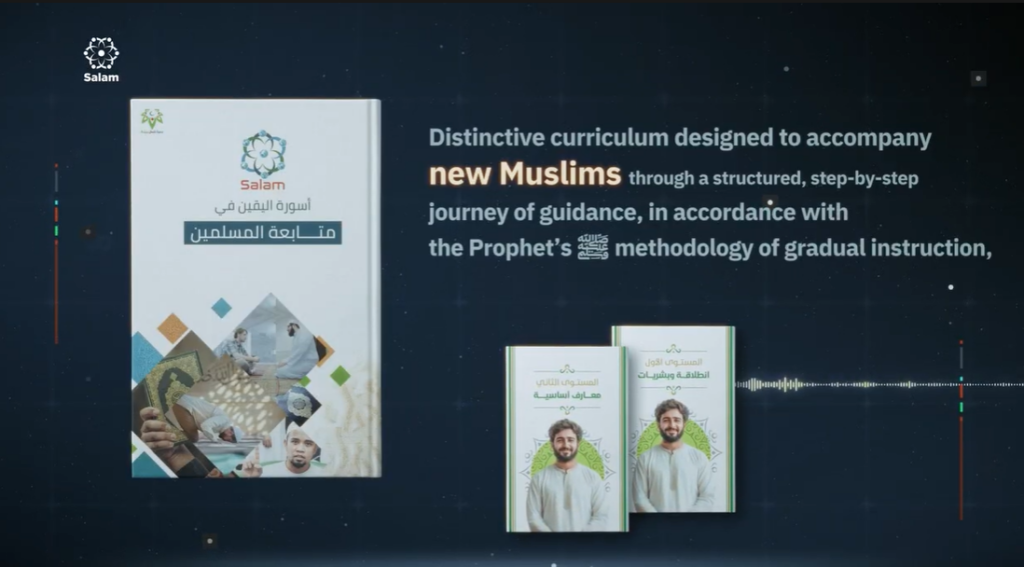
If you have taken your Shahada — or are standing at that threshold — consider joining the Asawirat Al-Yaqeen (Bracelets of Certainty) program, the Salam Center‘s structured post-conversion curriculum, implemented with over 114,000 new Muslims across 140 countries. The program guides you through four progressive stages:
- Stage One: The foundations of faith, prayer, and purification
- Stage Two: The pillars of Iman, fasting, Zakat, and Hajj
- Stage Three: Repentance, the Prophet’s biography, and moral nurturing
- Stage Four: Contemporary issues, theological foundations, and a life roadmap from Surah Al-Asr
This is knowledge built for your journey — step by step, at your pace, with clarity and compassion.
Reach out directly to the Salam Center team to start the Asawirat Al-Yaqeen (Bracelets of Certainty) program for FREE.
Summary
Ibrahim (AS) appears 69 times by name across 25 Quranic chapters, functioning as the Quran’s central model of pure monotheism and complete submission to Allah. His life — from his rational rejection of idol worship to his willingness to sacrifice his son — embodies the foundational principles that Islam carries forward to every generation.
His legacy lives in the rituals of Hajj, in the Udhiyah performed at Eid al-Adha, and in the Salat al-Ibrahimiyyah recited in every Muslim’s daily prayer. The Quran’s designation of Ibrahim (AS) as both Khalilullah and a nation (Ummah) unto himself affirms that his spiritual standing remains unparalleled among all who sought the truth.
Frequently Asked Questions
How many times is Abraham mentioned in the Quran?
Ibrahim (Abraham) is mentioned by name 69 times across 25 chapters of the Quran. An entire chapter — Surah Ibrahim (Chapter 14) — is named after him, and his story appears in extended narrative passages throughout many other Surahs, making him among the most referenced prophets in the entire scripture.
Why is Ibrahim (AS) called Khalilullah in the Quran?
The Quran states in verse 4:125 that Allah took Ibrahim as a Khalil — an intimate friend — a title denoting the highest station of love in Islamic theology. Khullah means love for Allah permeates one’s entire being, leaving no room for competing attachments.
Did Ibrahim (AS) build the Kaaba according to the Quran?
Yes. The Quran states in verse 2:127 that Ibrahim (AS) and his son Ismail (AS) raised the foundations of the Kaaba — the sacred house in Makkah — while supplicating to Allah to accept their effort. This act established the first house of worship dedicated to the pure monotheism that Islam upholds.
Was Abraham a Muslim according to the Quran?
The Quran states explicitly in verse 3:67 that Ibrahim was neither a Jew nor a Christian, but a Hanif — one purely inclined toward truth — and a Muslim (one who submits to Allah). He predated both the Torah and the Gospel by centuries, so his faith was the primordial religion of tawhid carried by all prophets.
Curious about Islam?
Journey towards clarity and purpose. Our team is here to support you in your search for truth and spiritual guidance.
Embrace the Truth