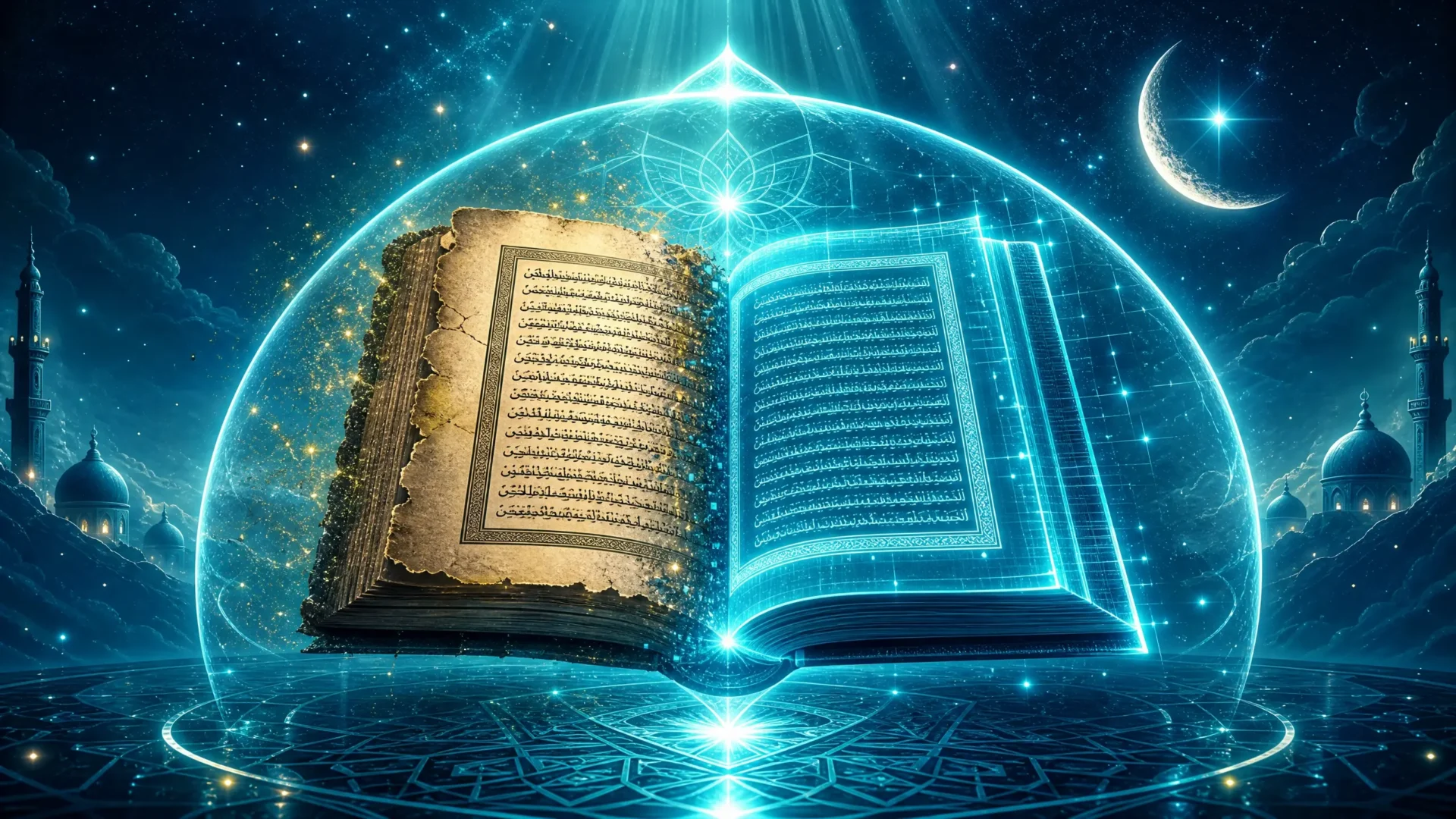
Has the Quran Been Changed?
| Key Takeaways |
| The Quran has never been changed, altered, or corrupted since its revelation to Prophet Muhammad (PBUH) over 1,400 years ago. |
| Allah Himself guaranteed the Quran’s preservation in the Quran: “Indeed, it is We who sent down the Quran, and indeed, We will be its guardian.” (Quran 15:9) |
| The Quran was memorized verbatim by thousands of companions (Sahabah) simultaneously — an unbreakable oral chain that has never been interrupted to this day. |
| Every copy of the Quran on Earth — in any country, any language of transliteration — contains identical Arabic text, word for word. |
| Historical manuscript evidence, including the Samarkand and Birmingham Qurans, confirms the text has remained unchanged from the earliest recorded copies. |
| Unlike the Bible, which scholars openly acknowledge underwent textual evolution, the Quran has no variant editions, no deleted books, and no doctrinal rewrites. |
The Quran has never been changed, and this fact rests on an interlocking system of preservation — oral transmission, written compilation, systematic standardization, and physical manuscript evidence — that has no parallel in the history of any religious text.
When someone asks how many times the Quran has been changed, the honest, evidence-based answer is: zero.
Understanding why requires a clear look at how the Quran was preserved, what the manuscripts reveal, and why every comparison with altered scriptures misses a fundamental distinction.
Has the Quran Been Changed?
No, the Quran has never been changed, altered, or corrupted since its revelation to Prophet Muhammad (PBUH) over 1,400 years ago — and the evidence for this is both historical and ongoing.
The Quran you hold in your hands today in Cairo, Karachi, London, New York, or Cape Town is word-for-word identical to the revelation that descended upon Prophet Muhammad (PBUH) in the 7th century.
How Many Times Has the Quran Been Changed?
The Quran has been changed zero times. Not a letter of the Quran has been added. Not a word has been removed. Every version of this claim has been examined by scholars and refuted by the evidence. No variant edition of the Quran exists.
Every copy of the Quran on Earth — in every country and every script — contains the same Arabic text, word for word.
Is There Proof That the Quran Has Been Changed?
No such proof exists — because no change has occurred in the Quran. Researchers have examined thousands of Quranic manuscripts across dozens of countries and archives. None contains a meaningfully different text. The Sana’a Manuscripts, the Birmingham Quran, and the Samarkand Kufic Quran all align with the Quran read today.
In contrast to Biblical textual criticism, which openly documents variants and interpolations, Quranic scholarship has never produced an equivalent finding.
The Divine Guarantee of Preserving the Quran
Before examining the historical evidence, the foundation must be stated clearly.
Allah did not leave the Quran’s preservation to chance, to human effort alone, or to institutional goodwill. He gave an explicit, unconditional guarantee in the Quran itself:
إِنَّا نَحْنُ نَزَّلْنَا الذِّكْرَ وَإِنَّا لَهُ لَحَافِظُونَ
“Indeed, it is We who sent down the Qur’an and indeed, We will be its guardian.” (Quran 15:9)
This verse is a statement of divine certainty, not a prediction. For a Muslim, this alone resolves the question.
For the seeker looking for verification beyond faith, the historical record confirms that this guarantee has — by every measurable standard — been fulfilled.
How Was the Quran Preserved During the Prophet’s Lifetime?
The Quran’s preservation during the Prophet’s lifetime was secured through a dual methodology of immediate oral memorization by thousands of companions and meticulous written documentation by appointed scribes.
1. The Oral Transmission System of the Quran Was Unmatched in Human History
The Quran’s preservation began the moment each verse was revealed. When Jibreel (Gabriel) brought a verse to the Prophet (PBUH), the Prophet immediately recited it aloud to his companions, who memorized it on the spot. This was not incidental — it was the central religious practice of early Muslim life.
Memorization in 7th-century Arabia was a culturally refined skill. Entire lineages of poets memorized thousands of verses without a single written aid. The companions applied this same capacity, multiplied by spiritual devotion, to the Quran.
By the time of the Prophet’s death (632 CE), there were thousands of men and women — known collectively as the Huffaz (حُفَّاظ) — who had memorized the entire Quran.
Every single verse existed simultaneously in hundreds of living memories, cross-checked daily in prayer, recitation circles, and Quranic review sessions.
2. The Written Record of the Quran Began Immediately
The Prophet (PBUH) appointed designated scribes — called Kuttab al-Wahy (كُتَّاب الوحي), the scribes of revelation — specifically to write down every verse as it was revealed. Among the most prominent was Zayd ibn Thabit, whose precision and trustworthiness made him the primary scribe and later the chief compiler.
Verses were written on what was available: flat stones, palm leaves, camel shoulder bones, and treated leather.
These were not random records — the Prophet (PBUH) himself dictated the exact placement of each verse within its chapter, and he reviewed the entire Quran with Jibreel twice in the final year of his life. The Quran you read today follows that exact arrangement.
Have Questions About Islam?
Our team is ready to answer your questions clearly and respectfully. Ask freely and receive honest guidance.
Ask Us NowThe First Official Compilation of the Entire Mushaf Under Abu Bakr (RA)
This section details the critical transition from oral preservation to a centralized written record, initiated by the first Caliph, Abu Bakr (RA), following the Battle of Yamama.
Why Did the First Official Compilation of the Entire Quran Under Abu Bakr Happen?
After the Prophet’s death, the Battle of Yamama (633 CE) resulted in the martyrdom of approximately 70 memorizers of the Quran in a single day.
The companion Umar ibn al-Khattab (RA) recognized the risk: if Huffaz continued to be killed in battle without a centralized written Mushaf (manuscript copy), the oral chain could theoretically be weakened over generations.
He brought this concern to the first Caliph, Abu Bakr al-Siddiq (RA). Abu Bakr initially hesitated — the Prophet had not instructed this explicitly. After consultation and reflection, he authorized the project.
Zayd ibn Thabit was assigned to lead it. His methodology was extraordinarily rigorous. According to the hadith recorded in Sahih al-Bukhari, Zayd accepted no verse for inclusion unless it was confirmed by at least two witnesses who had heard it directly from the Prophet (PBUH) — even though Zayd himself had memorized the entire Quran.
This compilation became the foundational Mushaf kept by Abu Bakr, then passed to Umar (RA), then to his daughter and the Prophet’s wife, Hafsa (RA).
The Third Caliph’s Decisive Action Preserved Uniformity
By the Caliphate of Uthman ibn Affan (RA), Islam had spread across Persia, the Levant, and North Africa. Different regions had developed slightly different recitation styles (based on the seven ahruf — modes of recitation permitted by the Prophet), and minor disputes about recitation were beginning to surface.
Uthman (RA) convened a committee of senior companions — led again by Zayd ibn Thabit and including Abdullah ibn al-Zubayr, Sa’id ibn al-‘As, and Abd al-Rahman ibn al-Harith — to produce a standardized master copy.
They worked directly from Hafsa’s manuscript and the memories of leading companions.
Multiple identical copies of this Uthman Mushaf were produced and distributed to major Islamic centers: Makkah, Madinah, Kufa, Basra, Syria, and Egypt.
A copy was retained in Madinah. Regional governors were instructed that all other written records inconsistent with these copies should be destroyed to prevent confusion.
This was not a rewriting or an alteration. It was a unification — from multiple accurate records into one authoritative standard. The content was never in dispute. The companions present, including Ali ibn Abi Talib (RA), fully endorsed the Uthman Mushaf.
The Manuscript Evidence That the Quran Has Never Been Changed
No manuscript has ever surfaced containing a “different version” of the Quran. In over 14 centuries, with thousands of manuscripts examined across dozens of countries, there is no textual variant of meaningful significance. This is historically unique.
Ancient Copies Confirm What Living Memory Already Knew
If the Quran had been changed at any point, physical manuscripts would reveal it. They do the opposite.
The Birmingham Quran Manuscript, held at the University of Birmingham and radiocarbon-dated to 568–645 CE by the Oxford Radiocarbon Accelerator Unit in 2015, corresponds to the lifetime of the Prophet (PBUH) himself. The text is identical to the Quran read by 1.8 billion Muslims today.
The Samarkand Kufic Quran, held at the Hast Imam Library in Tashkand, Uzbekistan, is one of the oldest complete or near-complete Quran manuscripts in existence, dated to the 8th century CE. It matches the contemporary Quran without variance.
The Sana’a Manuscripts, discovered in Yemen in 1972 and studied by scholars including Behnam Sadeghi and Mohsen Goudarzi, represent some of the earliest Quranic parchments known. Their analysis confirmed that the text of these manuscripts, even accounting for their early orthographic conventions, conveys the same Quranic content found in every mosque in the world today.
Every Generation Has Carried the Quran in Memory
The most powerful and ongoing proof that the Quran has never been changed is not found in a museum — it walks among us.
Today, there are an estimated 10 million people worldwide who have memorized the entire Quran word for word, including every vowel marking, every pause rule, and every elongation. This includes children as young as seven years old.
The chain of oral transmission stretches unbroken from those children back through their teachers, and their teachers’ teachers, all the way to the Prophet (PBUH) himself.
This is called the Isnad system — the verified chain of narrators. Every reciter of the Quran can trace their oral lineage through named individuals across the centuries.
The science that governs this transmission is called Tajweed and Qira’at, taught at institutions including Al-Azhar University in Cairo — the oldest continuously operating Islamic university in the world — and thousands of institutes globally.
If a single letter were ever altered in any printed Quran, millions of memorizers would immediately detect and correct it. This is not theoretical. It has happened. Publishers who have printed even accidental typographic errors have been corrected by readers within days of distribution.
Read Also: Does the Quran Say the Bible Is True?
The Quran’s Own Challenge is a Proof of Its Divine Origin
The Quran does not merely claim preservation — it dares its opponents to challenge it:
أَفَلَا يَتَدَبَّرُونَ الْقُرْآنَ ۚ وَلَوْ كَانَ مِنْ عِندِ غَيْرِ اللَّهِ لَوَجَدُوا فِيهِ اخْتِلَافًا كَثِيرًا
“Then do they not reflect upon the Quran? If it had been from any other than Allah, they would have found within it much contradiction.” (Quran 4:82)
Fourteen centuries of scrutiny — by believers, critics, linguists, historians, and scientists — have failed to produce a single credible internal contradiction.
The Quran’s internal consistency across 114 chapters, revealed over 23 years in varying circumstances, is itself a standing argument for its divine authorship and divinely guaranteed preservation.
This is also connected to what the Quran says about other religions — it consistently positions itself as a confirmation and correction of what came before, speaking from a position of preserved clarity that earlier scriptures no longer possess in their original forms.
Read Also: Why Is the Quran in Arabic?
Have Questions About Islam?
Our team is ready to answer your questions clearly and respectfully. Ask freely and receive honest guidance.
Ask Us NowBegin Your Journey With Salam
If reading this has opened a question in your heart — about the Quran, about Islam, about what it means to seek truth — then you are exactly the person the Salam Platform was built for.
The Salam Center exists to walk with seekers and new Muslims through every stage of this journey. Here is how:
Explore further on the Salam Platform — in-depth, evidence-grounded articles on Islamic beliefs, the Quran, prophethood, and more.
Read more from the Salam blog at the Salam blog — new articles covering questions exactly like this one, written for curious minds.
Reach out directly at Reach out directly — for specific questions, guidance about entering Islam, or simply to speak with someone who cares.
Read Also: What Is the Quran in Islam?

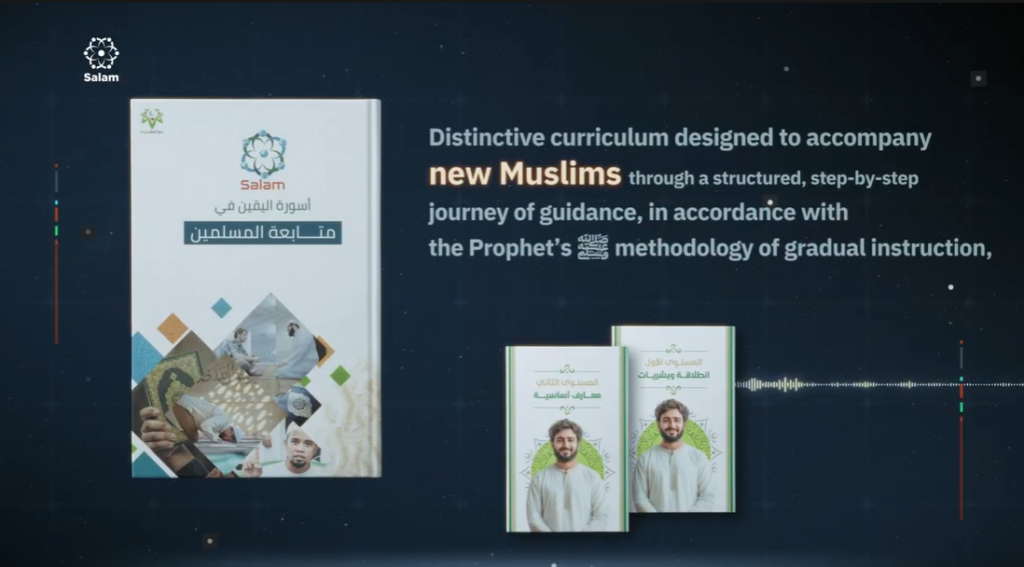
Join Asawirat Al-Yaqeen (Bracelets of Certainty) — the Salam Center‘s structured post-conversion curriculum, designed for new Muslims seeking firm, grounded faith:
- A four-stage methodology rooted in Prophetic tradition and the creed of Ahlus Sunnah wal Jama’ah
- Progressive levels covering creed, worship, character, family life, and contemporary challenges
- Implemented with over 114,000 new Muslims across 140 countries
- Currently being developed into a smart application and interactive website
- Accessible, compassionate, and designed to meet every new Muslim where they are
You do not have to navigate this alone.
Summary
The Quran’s preservation rests on an interlocking system that has no historical parallel: a divine guarantee, a vast network of memorizers, immediate written documentation, rigorous compilation under Abu Bakr (RA), and global standardization under Uthman (RA). Physical manuscripts dating to the Prophet’s era confirm the text has remained word-for-word identical across fourteen centuries.
Every honest enquiry into how many times the Quran has been changed arrives at the same answer the evidence demands — none. With millions of living memorizers, ancient manuscript corroboration, and 1,400 years of unbroken scholarly transmission, the Quran stands as the most verifiably preserved text in human history.
Frequently Asked Questions
Has the Quran been changed or corrupted over time?
No — the Quran has never been changed or corrupted, and no credible manuscript evidence of any alteration exists. The Quran was preserved through simultaneous oral memorization by thousands of companions and immediate written documentation under the Prophet’s direct supervision. Allah guaranteed its preservation in Quran 15:9, and 14 centuries of uninterrupted transmission — confirmed by ancient manuscripts including the Birmingham Quran (dated 568–645 CE) — bear this out completely.
Did Uthman (RA) change the Quran when he compiled it?
No — Uthman (RA) standardized the script, not the content. The Uthman Mushaf was produced by a committee of senior companions working directly from Hafsa’s copy of the original Abu Bakr compilation, with oral verification from leading Huffaz. It unified regional copies into one authoritative standard to prevent confusion. The companions present — including Ali ibn Abi Talib (RA) — unanimously approved it. No verse was added, removed, or altered.
How does the Quran’s preservation compare to the Bible’s?
The Quran’s textual preservation is historically unmatched, while the Bible’s has been openly documented to involve alteration. Biblical scholars — including those at institutions like the Society of Biblical Literature — acknowledge known textual variants, added passages, and disputed books across denominations. The Quran has no equivalent scholarly debate. As Islam views other religions, previous scriptures were genuine revelations but were not preserved under the same divine guarantee. The Quran was sent as the final, incorruptible word of Allah — and has remained exactly that.
Curious about Islam?
Journey towards clarity and purpose. Our team is here to support you in your search for truth and spiritual guidance.
Embrace the Truth