30 Facts About the Quran
| Key Takeaways |
| The Quran was revealed in Arabic over approximately 23 years through the Angel Jibreel (Gabriel) to Prophet Muhammad (PBUH). |
| The Quran is the only religious scripture in history to have been continuously memorized in its entirety by millions of people across generations. |
| Every chapter (Surah) of the Quran, except one, opens with Bismillah ir-Rahman ir-Raheem — “In the name of Allah, the Most Gracious, the Most Merciful.” |
| The Quran was compiled into a single bound manuscript during the caliphate of Abu Bakr (RA) and standardized during the caliphate of Uthman ibn Affan (RA). |
| The Quran in circulation today is identical to what was revealed to the Prophet (PBUH), letter for letter. |
| The Quran addresses not only spiritual belief but also law, history, ethics, family, commerce, and the natural world. |
The Quran is the literal, preserved word of Allah — revealed to Prophet Muhammad (PBUH) over 23 years, memorized by his Companions, compiled into a single volume, and transmitted to every generation since with an unbroken chain.
For Muslims, The Quran is not merely a book of religious guidance; it is the primary constitution of their entire way of life.
For the seeker asking sincere questions about Islam, understanding the Quran — its origin, its structure, its preservation, its content — is the most direct path into the heart of the faith.
Fact 1: The Quran Is the Direct Word of Allah, Not a Human Composition
The Quran is the speech of Allah (Kalam Allah), transmitted word-for-word to Prophet Muhammad (PBUH) through the Angel Jibreel (Gabriel). This is the foundational claim of Islam — and it is what distinguishes the Quran from every other religious text.
The Prophet (PBUH) did not compose it, paraphrase it, or interpret it. He received and conveyed it exactly as revealed.
Allah says in the Quran:
وَإِنَّهُ لَتَنزِيلُ رَبِّ الْعَالَمِينَ نَزَلَ بِهِ الرُّوحُ الْأَمِينُ عَلَىٰ قَلْبِكَ لِتَكُونَ مِنَ الْمُنذِرِينَ
“And indeed, the Quran is the revelation of the Lord of the worlds. The Trustworthy Spirit has brought it down upon your heart, so that you may be of the warners.” (Quran 26:192–194)
Fact 2: The Quran Was Revealed Gradually Over 23 Years
The revelation of the Quran was not delivered all at once. It descended in stages over approximately 23 years — 13 years in Makkah and 10 years in Madinah — responding to events, answering questions, and guiding the emerging Muslim community in real time.
This gradual revelation was itself part of the divine wisdom: it allowed the Companions to absorb, memorize, and live by each portion before the next arrived.
Allah explains this directly:
وَقُرْآنًا فَرَقْنَاهُ لِتَقْرَأَهُ عَلَى النَّاسِ عَلَىٰ مُكْثٍ وَنَزَّلْنَاهُ تَنزِيلًا
“And it is a Quran which We have separated for you to recite it over a prolonged period. And We have sent it down progressively.” (Quran 17:106)
Fact 3: The Quran Contains 114 Chapters (Surahs) and 6,236 Verses (Ayahs)
The Quran is organized into 114 Surahs (chapters), which together contain 6,236 Ayahs (verses). The chapters vary dramatically in length — from the two-verse Surah Al-Kawthar (Chapter 108) to the 286-verse Surah Al-Baqarah (Chapter 2).
They are arranged not chronologically by order of revelation, but by a divinely guided sequence, established by the Prophet (PBUH) himself under instruction from Jibreel during annual reviews of the complete text.
Fact 4: The First Word Revealed Was “Iqra” — “Read – Recite”
The very first word of Quranic revelation was the command to read. The Angel Jibreel appeared to the Prophet (PBUH) in the Cave of Hira and said:
اقْرَأْ بِاسْمِ رَبِّكَ الَّذِي خَلَقَ
“Recite in the name of your Lord who created.” (Quran 96:1)
This moment, reported in Sahih Al-Bukhari, marked the beginning of prophethood. The command to read — issued to a man in a society where literacy was not universal — signals the Quran’s foundational emphasis on knowledge, reflection, and learning.
Learn More About Islam
Discover the beauty, teachings, and wisdom of Islam in a clear and welcoming way. Start exploring and deepen your understanding today.
Learn MoreFact 5: The Quran Was Memorized Orally Before It Was Written in Codex Form
From the moment of its revelation, the Quran was preserved first and foremost through living memory. The Prophet (PBUH) received each portion, recited it to his Companions, and they memorized it immediately. Those who mastered the entire text were called Huffadh (singular: Hafidh).
At the Battle of Yamama (12 AH), approximately 70 such memorizers were martyred — prompting the first compilation of the written text.
The Companion Zayd ibn Thabit (RA), the Prophet’s chief scribe, was commissioned by Caliph Abu Bakr (RA) to collect the complete written Quran. This is recorded in Sahih Al-Bukhari.
Fact 6: The Quran Has Been Preserved Letter-Perfect for Over 1,400 Years
No other ancient text in human history has been preserved with the same level of documentary and oral accuracy as the Quran. The standardized Uthmani Mushaf — the written Quran compiled under Caliph Uthman ibn Affan (RA) — matches precisely the Quran memorized and recited by millions of Muslims today. Not a single letter has changed.
Allah Himself guaranteed this preservation:
إِنَّا نَحْنُ نَزَّلْنَا الذِّكْرَ وَإِنَّا لَهُ لَحَافِظُونَ
“Indeed, it is We who sent down the message, and indeed, We will be its guardian.” (Quran 15:9)
The full history of the Quran’s compilation and preservation demonstrates a level of textual integrity unmatched in world scripture.
Fact 7: The Quran Challenges All of Humanity to Produce Its Like
The Quran issues an open, standing challenge — known as the Tahaddi — to the entirety of humanity and the jinn: produce even a single chapter comparable to it. This challenge has stood for over 14 centuries. It has never been met.
وَإِن كُنتُمْ فِي رَيْبٍ مِّمَّا نَزَّلْنَا عَلَىٰ عَبْدِنَا فَأْتُوا بِسُورَةٍ مِّن مِّثْلِهِ
“And if you are in doubt about what We have sent down upon Our Servant [Muhammad], then produce a surah the like thereof.” (Quran 2:23)
Arab poets and orators of the Prophet’s (PBUH) era — masters of the Arabic language — recognized the Quran’s inimitability. Scholars of rhetoric across centuries have documented this literary miracle systematically.
Fact 8: The Quran Was Revealed in Arabic and Arabic Is Inseparable From It
The Quran’s revelation in Arabic is not incidental — it is essential. Classical Arabic is the Quran’s native tongue, and no translation, however precise, carries the full authority or meaning of the original. T
ranslations are understood in Islamic scholarship as interpretations of meaning — valuable tools for the non-Arabic speaker, but not the Quran itself.
إِنَّا أَنزَلْنَاهُ قُرْآنًا عَرَبِيًّا لَّعَلَّكُمْ تَعْقِلُونَ
“Indeed, We have sent it down as an Arabic Quran so that you might understand.” (Quran 12:2)
Fact 9: The Quran Addresses Both Humans and Jinn
The Quran was not revealed for humans alone — it is explicitly addressed to both mankind (ins) and the jinn. Surah Al-Jinn (Chapter 72) records that a group of jinn heard the Quran recited and immediately believed. Surah Al-Rahman (Chapter 55) addresses both creation types directly throughout its verses.
قُل لَّئِنِ اجْتَمَعَتِ الْإِنسُ وَالْجِنُّ عَلَىٰ أَن يَأْتُوا بِمِثْلِ هَٰذَا الْقُرْآنِ لَا يَأْتُونَ بِمِثْلِهِ
“Say: If mankind and the jinn gathered in order to produce the like of this Quran, they could not produce the like of it.” (Quran 17:88)
Fact 10: The Quran Is Divided Into 30 Equal Parts Called “Juz'”
For ease of recitation and memorization, the Quran is divided into 30 equal portions, each called a Juz’ (plural: Ajza’).** This division allows a Muslim completing one Juz’ per day to finish the entire Quran in a single month — a common practice during Ramadan.
The divisions are not chapters; they cut across Surah boundaries and are a traditional scholarly arrangement.
Fact 11: Every Surah Except One Opens With “Bismillah”
113 of the 114 Surahs open with the phrase Bismillah ir-Rahman ir-Raheem (“In the name of Allah, the Most Gracious, the Most Merciful”). The sole exception is Surah At-Tawbah (Chapter 9), which scholars of Ahl al-Sunnah wal-Jama’ah explain began without the Basmala due to its nature as either a continuation of Surah Al-Anfal or a declaration of disavowal.
Surah An-Naml (Chapter 27) contains a Basmala within its verses — bringing the total occurrences of the phrase in the Quran to 114.
Fact 12: The Quran Confirms, Corrects, and Supersedes Previous Scriptures
The Quran affirms the original revelation given to the prophets before Muhammad (PBUH) — including the Torah (Tawrah) given to Musa (Moses) and the Gospel (Injeel) given to Isa (Jesus). At the same time, it establishes that those scriptures were altered by human hands over time. The Quran came as the final, incorruptible revelation — a guardian over all that preceded it.
وَأَنزَلْنَا إِلَيْكَ الْكِتَابَ بِالْحَقِّ مُصَدِّقًا لِّمَا بَيْنَ يَدَيْهِ مِنَ الْكِتَابِ وَمُهَيْمِنًا عَلَيْهِ
“And We have revealed to you the Book in truth, confirming that which preceded it of the Scripture and as a guardian over it.” (Quran 5:48)
For a deeper look at how the Quran relates to biblical texts, do Muslims believe the Bible examines this question directly through the Islamic framework.
Fact 13: The Quran Affirms the Prophethood of 25 Named Prophets
The Quran names 25 prophets explicitly, from Adam (AS) to Muhammad (PBUH), including Ibrahim (Abraham), Musa (Moses), Dawud (David), Sulayman (Solomon), and Isa (Jesus). Muslims are required to believe in all of them without distinction.
The Quran presents their stories not merely as history, but as lived lessons in faith, patience, and submission to Allah.
لَا نُفَرِّقُ بَيْنَ أَحَدٍ مِّن رُّسُلِهِ
“We make no distinction between any of His messengers.” (Quran 2:285)
Fact 14: The Quran Directly Affirms the Virgin Birth of Isa (Jesus)
The Quran confirms that Isa ibn Maryam (Jesus, son of Mary) was born without a father — a miraculous creation by Allah’s command. Maryam (Mary) is the only woman named directly in the Quran, and an entire Surah bears her name (Chapter 19).
The Quran honors Isa (AS) as a prophet and messenger of Allah, born of a virgin, speaking from the cradle, and returning before the Day of Judgment.
قَالَتْ رَبِّ أَنَّىٰ يَكُونُ لِي وَلَدٌ وَلَمْ يَمْسَسْنِي بَشَرٌ ۖ قَالَ كَذَٰلِكِ اللَّهُ يَخْلُقُ مَا يَشَاءُ
“She said, ‘My Lord, how will I have a child when no man has touched me?’ He said, ‘Such is Allah; He creates what He wills.'” (Quran 3:47)
Fact 15: The Quran Is the Primary Source of Islamic Law (Fiqh)
Islamic jurisprudence (Fiqh) draws its rulings first and foremost from the Quran. The Quran establishes the foundations of worship, financial dealings, family law, criminal law, and social ethics.
The Sunnah of the Prophet (PBUH) serves as the practical elaboration and commentary on Quranic principles. Together, these two sources govern the entirety of Islamic legal scholarship.
Understanding this is essential to grasping the principles of Islam — the Quran is not a devotional text separate from daily life; it is the founding constitution of an entire civilization.
Fact 16: The Quran Addresses Scientific Realities That Were Unknown at the Time of Revelation
Among the Quran’s remarkable features is its reference to natural phenomena that were not scientifically established until centuries after its revelation. Scholars and da’wah practitioners cite the Quran’s descriptions of embryological development, the expansion of the universe, the barrier between bodies of water, and the composition of deep-sea darkness as examples.
سَنُرِيهِمْ آيَاتِنَا فِي الْآفَاقِ وَفِي أَنفُسِهِمْ حَتَّىٰ يَتَبَيَّنَ لَهُمْ أَنَّهُ الْحَقُّ
“We will show them Our signs in the horizons and within themselves until it becomes clear to them that it is the truth.” (Quran 41:53)
Learn More About Islam
Discover the beauty, teachings, and wisdom of Islam in a clear and welcoming way. Start exploring and deepen your understanding today.
Learn MoreFact 17: The Quran Establishes the Absolute Oneness of Allah (Tawheed)
The most foundational message of the Quran — woven through every chapter — is Tawheed: the absolute, undivided oneness of Allah. The Quran rejects every form of shirk (associating partners with Allah) with uncompromising clarity. The shortest and most concentrated expression of Tawheed in the entire Quran is Surah Al-Ikhlas:
قُلْ هُوَ اللَّهُ أَحَدٌ اللَّهُ الصَّمَدُ لَمْ يَلِدْ وَلَمْ يُولَدْ وَلَمْ يَكُن لَّهُ كُفُوًا أَحَدٌ
“Say, ‘He is Allah, [who is] One. Allah, the Eternal Refuge. He neither begets nor is born, nor is there to Him any equivalent.'” (Quran 112:1–4)
This Surah is reported in Sahih Al-Bukhari and Sahih Muslim to be equivalent in reward to reciting one-third of the Quran.
For a fuller treatment of this concept, how does Islam view the nature of God explores Tawheed through the Quranic lens.
Fact 18: The Quran Has a Unique System of Recitation Rules Called “Tajweed”
Tajweed is the formal science of reciting the Quran according to precise rules of pronunciation, rhythm, and melody — transmitted directly from the Prophet (PBUH). Every letter has specific characteristics (Makhraj — place of articulation), and rules govern elongation, nasalization, merging, and pausing. Mastery of Tajweed is considered obligatory for proper Quranic recitation.
The science of Tajweed was systematically documented by classical scholars and has been transmitted through unbroken chains to certified teachers today. Institutions like Dar al-Ulum Deoband in India and Al-Azhar University in Egypt have maintained formal Tajweed instruction for generations.
Fact 19: The Quran Recognizes and Engages Other Faith Traditions by Name
The Quran directly addresses followers of earlier scriptures — specifically Jews and Christians — whom it refers to as Ahl al-Kitab (People of the Book). It acknowledges their prophets, validates the original truth of their scriptures, and invites them toward the complete and final message of Islam with wisdom and good counsel.
قُلْ يَا أَهْلَ الْكِتَابِ تَعَالَوْا إِلَىٰ كَلِمَةٍ سَوَاءٍ بَيْنَنَا وَبَيْنَكُمْ
“Say, ‘O People of the Scripture, come to a word that is equitable between us and you.'” (Quran 3:64)
The Quran’s perspective on other faiths is both principled and direct — something explored further in what does the Quran say about other religions and the broader framework of how Islam views other religions.
Fact 20: The Quran Was Revealed Through Multiple Authenticated Modes of Recitation
Classical Islamic scholarship established that the Quran was transmitted through ten recognized modes of recitation — called Qira’at. These are not different versions of the Quran. They are variations in vowelization, pronunciation, and occasional wording that were all directly authorized by the Prophet (PBUH) from divine instruction.
Ibn Mujahid (d. 936 CE), the pioneering scholar of Qira’at, documented seven canonical reading traditions in his foundational work Kitab al-Sab’ah. All recognized Qira’at are considered equally authentic and are consistent in meaning.
Fact 21: The Quran Contains Detailed Accounts of the Prophets as Moral and Spiritual Examples
The stories of the prophets in the Quran are not mere historical records — they are deliberate moral frameworks. The Quran narrates the trials of Ibrahim (Abraham) as a model of total submission; the patience of Ayyub (Job) as a model of steadfastness; the integrity of Yusuf (Joseph) — whose story spans all 111 verses of Surah Yusuf — as the Quran itself describes “the best of stories.”
نَحْنُ نَقُصُّ عَلَيْكَ أَحْسَنَ الْقَصَصِ بِمَا أَوْحَيْنَا إِلَيْكَ هَٰذَا الْقُرْآنَ
“We relate to you the best of stories in what We have revealed to you of this Quran.” (Quran 12:3)
Fact 22: The Quran Forbids Compulsion in Religion
One of the Quran’s clearest and most direct statements on religious freedom is its prohibition of compulsion in matters of faith. Islam, in the Quranic framework, is a truth that a person accepts with full conviction — never under coercion.
لَا إِكْرَاهَ فِي الدِّينِ ۖ قَد تَّبَيَّنَ الرُّشْدُ مِنَ الْغَيِّ
“There shall be no compulsion in religion. The right course has become clear from the wrong.” (Quran 2:256)
This verse is among the most quoted in da’wah dialogues — particularly in discussions comparing Islam with other frameworks.
For a structured examination of these comparisons, Islam vs. Christianity provides a Quran-grounded perspective.
Fact 23: The Quran Contains the Greatest Verse in All of Scripture — Ayat al-Kursi
Prophet Muhammad (PBUH) himself identified Ayat al-Kursi (Quran 2:255) as the greatest verse in the Quran. Reported in Sahih Muslim, this verse describes Allah’s absolute sovereignty over the heavens and earth — His all-encompassing knowledge, His eternal existence, and His complete dominion without fatigue or limitation.
Reciting it after every obligatory prayer is among the Sunnah-recommended acts reported in authenticated narrations.
اللَّهُ لَا إِلَٰهَ إِلَّا هُوَ الْحَيُّ الْقَيُّومُ ۚ لَا تَأْخُذُهُ سِنَةٌ وَلَا نَوْمٌ
“Allah — there is no deity except Him, the Ever-Living, the Sustainer of existence. Neither drowsiness overtakes Him nor sleep.” (Quran 2:255)
Fact 24: The Quran Was Reviewed Annually by Jibreel and Recited Twice in the Year of the Prophet’s Death
Every Ramadan, the Angel Jibreel would descend and review the entire Quran with the Prophet (PBUH). In the final year of the Prophet’s life (10 AH), this review occurred twice — a sign, scholars note, that his earthly mission was nearing completion.
This is documented in Sahih Al-Bukhari and forms part of the chain of verification that guarantees the Quran’s accuracy.
Fact 25: The Quran’s Shortest Surah Has Only 10 Words
Surah Al-Kawthar (Chapter 108) is the shortest Surah in the Quran — consisting of only three verses and ten Arabic words. Yet within those words, it contains a promise of divine abundance to the Prophet (PBUH), a command to pray and sacrifice, and a statement of the Prophet’s enemies’ ultimate failure.
The density of meaning in the shortest Surah is itself a testament to the Quran’s linguistic miracle.
Fact 26: The Quran Describes Itself With Multiple Names and Titles
The Quran uses several self-referential names, each illuminating a different dimension of its nature. Among the most significant: Al-Quran (the recitation), Al-Furqan (the criterion between truth and falsehood), Al-Kitab (the book), Al-Dhikr (the reminder), Al-Huda (the guidance), and Al-Nur (the light).
Each name appears in authenticated Quranic verses and reflects a specific function or quality of the scripture itself.
Read Also: What Does the Quran Say About Jesus?
Fact 27: The Quran Lays the Foundation for Faith in the Unseen
A defining feature of Quranic guidance is its call to believe in what cannot be empirically perceived — Al-Ghayb (the unseen). This includes belief in Allah, the angels, the divine decree (Qadr), the resurrection, and the Day of Judgment. Quranic faith is not blind — it is reasoned submission, based on evidence, reflection, and the testimony of prophets.
ذَٰلِكَ الْكِتَابُ لَا رَيْبَ ۛ فِيهِ ۛ هُدًى لِّلْمُتَّقِينَ الَّذِينَ يُؤْمِنُونَ بِالْغَيْبِ
“This is the Book about which there is no doubt, a guidance for those conscious of Allah — who believe in the unseen.” (Quran 2:2–3)
Understanding this dimension of faith in Islam begins with the Quran’s own definition of the believer.
Read Also: Does the Quran Mention the Bible?
Fact 28: The Quran Was the Primary Catalyst for the Arabic Language’s Standardization
The Quran’s revelation triggered the formal grammatical and philological study of the Arabic language. Early Muslim scholars recognized that preserving the Quran’s meaning required preserving its linguistic precision. This gave rise to the fields of Arabic grammar (Nahw), morphology (Sarf), rhetoric (Balagha), and lexicology (Mu’jam).
The foundational grammarian Sibawayhi (d. ~796 CE), whose monumental work Al-Kitab remains a reference, grounded his entire framework in Quranic usage.
Read Also: When Was the Quran Written?
Fact 29: Millions of People Have Memorized the Entire Quran — in Multiple Languages’ Worth of Text
The Quran contains approximately 77,000 words — equivalent to a substantial book — and millions of people worldwide have memorized every single one. This phenomenon — a global, multigenerational community of oral custodians — has no equivalent in any other tradition.
A child memorizing the Quran in Nigeria recites the identical text as a Hafidh in Indonesia, Turkey, Egypt, or the United States. The oral chain connects directly to the Prophet’s (PBUH) own recitation.
Read Also: When Was the Quran Revealed?
Fact 30: The Quran’s Final Verse Completed the Religion of Islam
The last verse revealed to the Prophet (PBUH) completed the foundation of Islam as a perfected, self-sufficient way of life. Shortly before his death, during the farewell pilgrimage (10 AH), the following was revealed:
الْيَوْمَ أَكْمَلْتُ لَكُمْ دِينَكُمْ وَأَتْمَمْتُ عَلَيْكُمْ نِعْمَتِي وَرَضِيتُ لَكُمُ الْإِسْلَامَ دِينًا
“This day I have perfected for you your religion and completed My favor upon you and have approved for you Islam as religion.” (Quran 5:3)
With this verse, the Quran — and the mission of all the prophets — reached its completion. Islam was sealed as the final, preserved, universal message of Allah to humanity.
Read Also: How Old Is Islam According to the Quran?
Learn More About Islam
Discover the beauty, teachings, and wisdom of Islam in a clear and welcoming way. Start exploring and deepen your understanding today.
Learn MoreRead Also: Why Is the Quran the Holy Book of Islam?
Learn More Authentic Knowledge About Islam & Quran with Salam
The Quran invites everyone — seekers, questioners, and those at the threshold of a life-changing decision — to read, reflect, and return to the truth their souls already recognize.
If you are exploring Islam for the first time, the Salam Platform offers a structured, compassionate journey through the foundations of Islamic belief and practice.
Browse the full Salam blog for articles covering the Quran, the prophets, Islamic theology, and answers to the most sincere questions asked by seekers worldwide.
If you have a specific question, want guidance on how to enter Islam, or simply need someone to speak with — reach out to the Salam Center team directly.
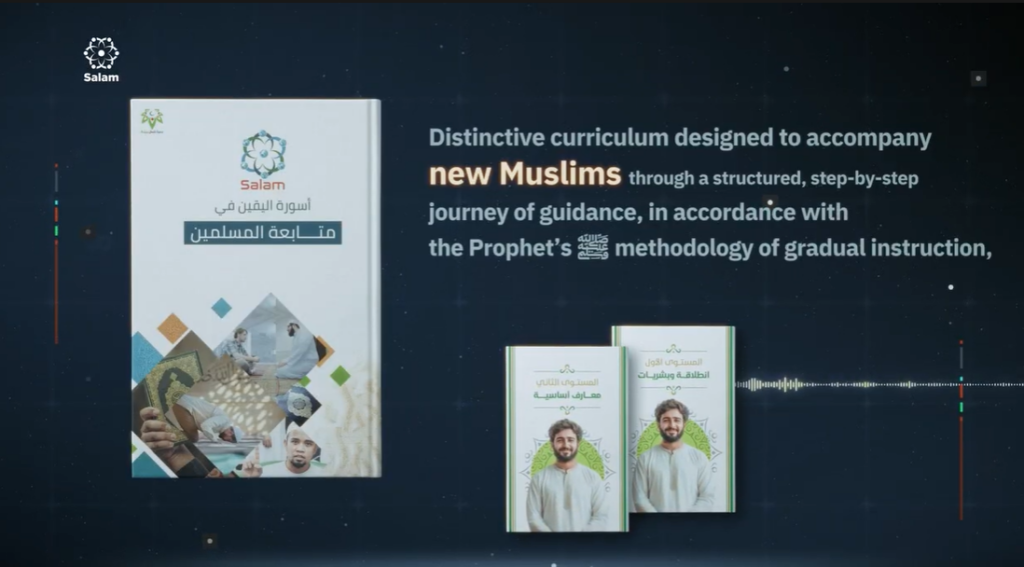
For those who have already taken their Shahada — or are ready to — the Salam Center offers the Asawirat Al-Yaqeen (Bracelets of Certainty) program: a proven, four-stage post-conversion curriculum that has guided over 114,000 new Muslims across 140 countries. Through it, you will:
- Learn the pillars and fundamentals of Islamic belief and worship from their Quranic and prophetic foundations
- Build your understanding progressively, from the Shahada through family law, ethics, trade, and empowerment
- Engage with carefully structured lessons designed by trained scholars and da’wah specialists
- Graduate with verified knowledge — 41.3% of students complete with an “excellent” grade
- Join a global community of new Muslims walking the same path of Yaqeen (certainty)
Reach out directly to the Salam Center team to start the Asawirat Al-Yaqeen (Bracelets of Certainty) program for FREE.
The Quran Stands as the Preserved, Living Word of Allah
Across 30 authenticated facts, one reality emerges without contradiction: the Quran is the most carefully preserved, widely memorized, and thoroughly documented scripture in human history. Its textual integrity, its legislative depth, and its literary inimitability point — consistently and directly — to a single source beyond human authorship.
For the seeker at the door of Islam, the Quran is the first conversation. It speaks to every question the sincere mind carries: about the nature of Allah, the purpose of existence, and the path that leads to peace and certainty.
Frequently Asked Questions
How many verses are in the Quran and how is it organized?
The Quran contains 6,236 verses (Ayahs) arranged across 114 chapters (Surahs). The chapters are not organized by chronological order of revelation — they follow a divinely guided sequence, established through the Prophet’s (PBUH) annual review with Jibreel. The Quran is further divided into 30 equal portions (Ajza’) for ease of daily recitation.
Was the Quran changed or altered over time?
The Quran has remained unchanged, letter for letter, since its revelation over 1,400 years ago. Allah guaranteed its preservation explicitly in Quran 15:9. The Uthmani Mushaf, standardized under Caliph Uthman ibn Affan (RA) and verified against the memorized text of the Companions, is identical to what millions of Huffadh recite today from memory worldwide.
Is the Quran the same as the Bible or Torah?
The Quran is a distinct and separate revelation — the final, preserved word of Allah. It confirms the original truth of the Torah (given to Musa) and the Gospel (given to Isa), but establishes that those scriptures were altered over time. The Quran was sent as the final revelation and guardian over all that preceded it, as stated in Quran 5:48. For a direct comparison, do Muslims believe the Bible examines this precisely.
Why is the Quran only considered authentic in Arabic?
The Quran is the direct speech of Allah revealed in Arabic, and no translation carries the same textual authority. Arabic translations of meaning (Tafsir) are scholarly tools — valuable for understanding — but the Quran’s linguistic miracle, its memorization tradition, and its legal weight all rest in the original Arabic. Allah Himself states in Quran 12:2 that it was revealed as an Arabic Quran for the purpose of comprehension.
What is the most important verse in the Quran?
Prophet Muhammad (PBUH) identified Ayat al-Kursi (Quran 2:255) as the greatest verse in the Quran, as recorded in Sahih Muslim. It describes Allah’s absolute sovereignty, eternal existence, and complete dominion over the heavens and earth — making it the most concentrated expression of divine majesty in a single verse. Reciting it after each obligatory prayer is among the authenticated Sunnah-recommended practices.
Curious about Islam?
Journey towards clarity and purpose. Our team is here to support you in your search for truth and spiritual guidance.
Embrace the Truth