
Sin in Islam vs Christianity
| Key Takeaways |
| Islam teaches that every person is born in a state of fitrah, pure and free of inherited guilt, while mainstream Christian doctrine holds that humanity inherits Adam’s guilt through original sin. |
| The Quran states directly that no soul bears the burden of another soul’s wrongdoing, rejecting the transfer of Adam’s sin to his descendants. |
| Islam and Christianity agree that Adam and Eve disobeyed Allah in the Garden, but Islam teaches Allah forgave them completely after their sincere repentance. |
| Islam holds that forgiveness comes directly through sincere repentance (tawbah) to Allah, with no need for an intermediary or blood sacrifice. |
| Mainstream Christian theology, particularly in Pauline writings, links forgiveness of inherited sin to the atoning death of Jesus Christ. |
| Islam categorizes sin by severity — major sins (kaba’ir) and minor sins (sagha’ir) — with a built-in path of return through repentance available at every stage of life. |
Islam and Christianity share the same starting point — Adam’s disobedience in the Garden — but they part ways completely on what that moment means for every human being born after him. In Christian theology, that first sin left a permanent stain passed down through every generation, a debt only Jesus Christ’s sacrifice can settle. In Islam, Adam repented, Allah forgave him outright, and no child is ever born carrying someone else’s fault.
This single difference in how Islam views the nature of God and His justice shapes almost everything else the two faiths teach about guilt, forgiveness, and what a person actually needs to do to stand right before their Creator.
1. Islam Teaches Every Person Is Born Pure Not Guilty of Adam’s Sin
The Islamic starting point is a hadith so well known among scholars that it anchors the entire discussion. The Prophet Muhammad (PBUH) said, as recorded in Sahih al-Bukhari and Sahih Muslim, that every child is born upon the fitrah — a natural, unblemished disposition toward recognizing Allah — and it is the surrounding environment, not any inherited fault, that later shapes belief.
This state of fitrah is not a vague sentiment; it is described in the Quran itself as woven into human creation:
فَأَقِمْ وَجْهَكَ لِلدِّينِ حَنِيفًا ۚ فِطْرَتَ ٱللَّهِ ٱلَّتِى فَطَرَ ٱلنَّاسَ عَلَيْهَا ۚ
“So be steadfast in faith in all uprightness ˹O Prophet˺—the natural Way of Allah which He has instilled in ˹all˺ people.” (Quran 30:30)
A child, in this view, arrives with no ledger of debt already open against them. Guilt is something a person earns through their own conscious choices once they reach the age of accountability, never something transferred to them at birth.
This is a foundational piece of faith in Islam — that the relationship between a person and Allah begins clean, and stays that way until the individual’s own actions change it.
2. The Quran States No Soul Carries the Burden of Another Soul’s Sin
Beyond the hadith on fitrah, the Quran makes the point explicitly, more than once, as a settled principle of divine justice rather than a passing remark.
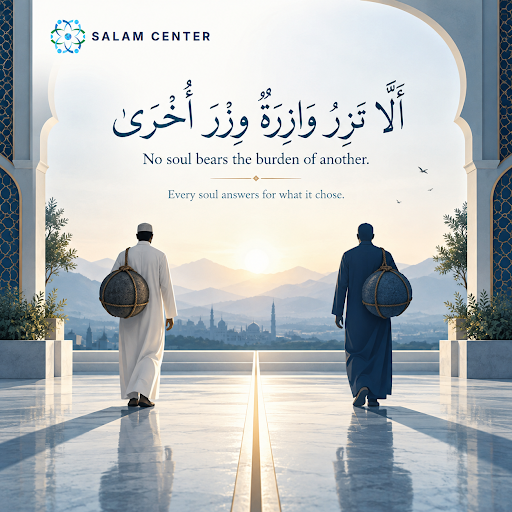
أَلَّا تَزِرُ وَازِرَةٌ وِزْرَ أُخْرَىٰ
“That no soul burdened with sin will bear the burden of another.” (Quran 53:38)
This same principle repeats in Surah Al-An’am and elsewhere in the Quran, forming a consistent theological pillar rather than an isolated verse. Every person answers only for what they themselves chose. No descendant of Adam inherits a share of his mistake, and no parent’s sin transfers onto a child’s soul.
This directly rules out any doctrine resembling inherited guilt in Islamic theology, and it is one of the clearest points of divergence when comparing what the Quran says about other religions and their differing accounts of sin.
3. Christianity Teaches Adam’s Sin Corrupted Human Nature for All Descendants
Mainstream Christian theology, shaped heavily by the writings of Paul and later systematized by figures like Augustine of Hippo, teaches that Adam’s disobedience did more than end his own state of innocence — it altered human nature itself for every person born afterward.
The doctrinal anchor is found in the Book of Romans: sin, according to this passage, entered the world through one man, and death followed as its consequence, spreading to every person because all share in that fall (Romans 5:12). From this verse, the doctrine known as original sin developed: the belief that every human being inherits a corrupted nature and a state of guilt before God, independent of any sin they have personally committed.
This teaching became formal Catholic doctrine through centuries of theological development and remains central to Catholic and most Protestant catechesis today, though the precise mechanics of inheritance and the exact nature of the “stain” have been debated among Christian denominations for centuries. Original sin in this framework is not a metaphor — it is treated as a real inherited condition requiring a real remedy.
4. Islam Rejects Original Sin While Affirming Adam and Eve’s Genuine Disobedience
It would be a mistake to think Islam denies that Adam disobeyed Allah — the Quran describes the episode plainly, including Satan’s deception and the eating from the forbidden tree. Where Islam diverges sharply is in what happened next.
فَتَلَقَّىٰ آدَمُ مِن رَّبِّهِ كَلِمَاتٍ فَتَابَ عَلَيْهِ ۚ إِنَّهُ هُوَ التَّوَّابُ الرَّحِيمُ
“Then Adam received words ˹of guidance˺ from his Lord, so He forgave him. Indeed, He is the Accepting of Repentance, Most Merciful.” (Quran 2:37)
Notice the sequence: Adam sinned, Adam sincerely turned back to Allah, and Allah forgave him — fully, immediately, with nothing left outstanding to be passed on to his children.
The Quran even records the exact words of Adam’s repentance in Surah Al-A’raf, showing a complete, closed transaction between a servant and his Lord. The Fall, in Islamic theology, is a lesson in the mechanics of repentance — not the opening chapter of a debt every human being since has been born owing.
Learn More About Islam
Discover the beauty, teachings, and wisdom of Islam in a clear and welcoming way. Start exploring and deepen your understanding today.
Learn More5. Forgiveness in Islam Comes Through Direct Repentance Not Sacrificial Atonement
Because Islam has no doctrine of inherited guilt, it has no theological need for a sacrificial mechanism to settle that guilt.
Forgiveness operates on a much more direct model: a servant sins, recognizes the wrong, turns back to Allah in sincere tawbah (repentance), and Allah — described throughout the Quran as constantly forgiving — accepts it.
قُلْ يَا عِبَادِيَ الَّذِينَ أَسْرَفُوا عَلَىٰ أَنفُسِهِمْ لَا تَقْنَطُوا مِن رَّحْمَةِ اللَّهِ ۚ إِنَّ اللَّهَ يَغْفِرُ الذُّنُوبَ جَمِيعًا ۚ إِنَّهُ هُوَ الْغَفُورُ الرَّحِيمُ
“Say, ‘O My servants who have exceeded the limits against themselves ˹by sinning˺, do not lose hope in Allah’s mercy, for Allah certainly forgives all sins. He is indeed the All-Forgiving, Most Merciful.'” (Quran 39:53)
There is no intermediary standing between the sinner and Allah in this process, and no requirement of blood sacrifice.
This stands in clear contrast with Christian atonement theology, where forgiveness of the inherited stain of sin is tied specifically to Christ’s crucifixion, as expressed in the Book of Hebrews’ teaching that without bloodshed there is no forgiveness (Hebrews 9:22). In Islam, the door to forgiveness is always open, and the key is repentance itself — nothing more, nothing less.
6. Islam Distinguishes Between Major and Minor Sins While Christianity Debates Sin’s Categories Differently
Islamic scholarship developed a structured framework for understanding sin’s severity. Kaba’ir (major sins) — such as shirk (associating partners with Allah), murder, and abandoning prayer — carry serious warnings in the Quran and Sunnah and require sincere repentance.
Sagha’ir (minor sins) are the smaller everyday shortcomings that authentic hadith describe as being wiped away through ordinary acts of worship, good deeds, and the passage of time between one Friday prayer and the next, so long as major sins are avoided.
Christian theology has its own internal categorization — Catholic tradition, for instance, distinguishes between mortal and venial sins in a way that echoes this major/minor structure. The shared instinct that not all wrongdoing carries equal weight appears in both traditions, even while their explanations for why sin exists in the first place remain fundamentally different.
Read Also: What Is the Difference Between Catholic and Christian?
7. Islam and Christianity Affirm Human Free Will Though They Frame Its Origins Differently
Islam teaches that human beings possess genuine free will and are held accountable precisely because they can choose. The fitrah inclines a person toward recognizing Allah, but nothing forces belief or disbelief — a principle closely tied to the broader framework of Islamic principles governing human responsibility before Allah.
Christianity likewise affirms free will, but the doctrine of original sin introduces a complication: many Christian traditions teach that human will itself has been weakened or bent toward sin as a consequence of the Fall, meaning grace becomes necessary not just for forgiveness but for the capacity to choose rightly at all. Islam does not require this extra layer — the human being remains fully capable, from birth, of choosing the good that their own fitrah already recognizes.
Read Also: Catholic vs Protestant
8. Islamic Theology Rejects the Concept of Vicarious Punishment on Principle
The rejection of original sin in Islam is not an isolated teaching — it flows from a broader Quranic principle about divine justice itself.
Allah’s justice, as described throughout the Quran, does not transfer the penalty of one soul’s wrongdoing onto another soul, whether that other soul is a child, a parent, or an unrelated bystander.
وَلَا تَكْسِبُ كُلُّ نَفْسٍ إِلَّا عَلَيْهَا ۚ وَلَا تَزِرُ وَازِرَةٌ وِزْرَ أُخْرَىٰ
“No one will reap except what they sow. No soul burdened with sin will bear the burden of another.” (Quran 6:164)
This principle is why the Islamic model of justice reads as intensely personal — a direct, individual accounting before Allah on the Day of Judgment, free from any inherited or transferred liability.
It is also a principle Muslims see reflected, though imperfectly and inconsistently, even within parts of the Hebrew Bible’s own wisdom literature, which raises interesting questions when Muslims consider do Muslims believe the Bible as a text with a mixed transmission history.
Read Also: How Old Is Islam and Christianity?
The Practical Effect Shapes How Each Faith Frames a Person’s Relationship With God
These theological differences are not abstract — they shape the emotional and spiritual posture each tradition asks of its followers.
A Christian shaped by original sin doctrine typically approaches God aware of an inherited debt requiring a specific, singular remedy already accomplished on their behalf.
A Muslim approaches Allah as a servant starting from a position of innate purity, whose only task is to preserve that fitrah through worship and to return quickly through tawbah whenever they personally fall short.
Neither framework treats sin lightly, but they locate the problem in different places — one in an inherited condition passed down through humanity’s shared ancestry, the other in the accumulated choices of each individual soul across a single lifetime.
Considering how Islam frames monotheism and divine unity, explored further in the discussion of Monotheism in Islamic theology, helps clarify why Islam insists so firmly that no partner, intermediary, or inherited burden can stand between a servant and direct accountability to Allah alone.
Learn More About Islam
Discover the beauty, teachings, and wisdom of Islam in a clear and welcoming way. Start exploring and deepen your understanding today.
Learn MoreContinue Exploring With Salam
Questions about sin, justice, and forgiveness often open the door to bigger questions about who Allah is and what He asks of us. You don’t have to sit with these questions alone.
- Explore more on the Salam Platform and the Salam blog
- Curious about how Islam addresses other core beliefs? Start with Islam vs. Christianity or how Islam views other religions
- Have a personal question about faith, repentance, or entering Islam? Reach out directly — the Salam Center team is ready to talk, no pressure, no obligation
- If you’re a new Muslim looking for a clear next step, ask about the Asawirat Al-Yaqeen (Bracelets of Certainty) program — a guided, four-stage path covering the testimony of faith, prayer, and the foundations of belief, with real people walking alongside you

Summary
Islam teaches humans are born pure through fitrah, carrying no inherited guilt from Adam, while Christianity’s original sin doctrine holds that Adam’s disobedience corrupted all descendants, requiring atonement.
Forgiveness in Islam flows directly from sincere repentance to Allah alone, without intermediary or sacrifice — a distinction that reshapes how each faith defines justice, mercy, and a person’s standing before God.
Frequently Asked Questions
Does Islam believe in original sin?
No. Islam rejects original sin entirely. The Quran states that no soul bears the burden of another (Quran 53:38), and every child is born in a pure state of fitrah, free from any inherited guilt tied to Adam’s disobedience.
What happened to Adam and Eve after they sinned in Islam?
Adam sincerely repented, and Allah forgave him completely and immediately (Quran 2:37). Islam teaches this was a closed matter between Adam and his Lord, never something passed down to his descendants.
How does forgiveness of sin differ between Islam and Christianity?
Islam teaches forgiveness comes directly through sincere repentance (tawbah) to Allah, with no intermediary required. Mainstream Christian theology ties forgiveness of inherited sin to the atoning sacrifice of Jesus Christ.
What is fitrah in Islam?
Fitrah is the innate, pure disposition every human is born with, inclining them naturally toward recognizing Allah. The Prophet Muhammad (PBUH) described it in an authentic hadith recorded in Sahih al-Bukhari and Sahih Muslim.
Are all sins equal in Islam?
No. Islamic scholarship distinguishes between kaba’ir (major sins), which require sincere repentance, and sagha’ir (minor sins), which authentic hadith describe as forgiven through ordinary righteous deeds when major sins are avoided.
Curious about Islam?
Journey towards clarity and purpose. Our team is here to support you in your search for truth and spiritual guidance.
Embrace the Truth