
How Do the Quran and Sharia Guide Muslims?
| Key Takeaways |
| The Quran is the verbatim word of Allah, revealed to Prophet Muhammad (PBUH) as the primary and supreme source of guidance for all Muslims. |
| Sharia is the comprehensive Islamic legal and moral framework derived from the Quran, the Sunnah, scholarly consensus (Ijma’), and analogical reasoning (Qiyas). |
| The Quran and Sharia guide Muslims in worship, ethics, family life, commerce, and social relations — forming an integrated system, not a collection of isolated rules. |
| Islamic law is grounded in five universal objectives (Maqasid al-Sharia): the preservation of religion, life, intellect, lineage, and property. |
The Quran and Sharia guide Muslims by providing a complete, divinely sourced framework that governs every dimension of human life — spiritual, moral, social, and legal. This is not a peripheral feature of Islam; it is its defining characteristic. Allah says in the Quran:
الْيَوْمَ أَكْمَلْتُ لَكُمْ دِينَكُمْ وَأَتْمَمْتُ عَلَيْكُمْ نِعْمَتِي وَرَضِيتُ لَكُمُ الْإِسْلَامَ دِينًا
“This day I have perfected for you your religion and completed My favor upon you and have approved for you Islam as religion.” (Quran 5:3)
That verse was revealed on the day of Arafah — a moment of finality and completeness. From it, Muslim scholars have always understood that Islam arrived as a total system. To ask how the Quran and Sharia guide Muslims is, in essence, to ask how a Muslim lives — because the two are inseparable from the lived reality of a believer.
1. The Quran Establishes the Foundational Relationship Between the Creator and the Created
Before any ruling or law, the Quran does something more fundamental: it defines the human being’s relationship with Allah. Muslims understand the nature of God in Islam through direct Quranic revelation — not through philosophical speculation alone.
Allah is One, without partner or equal.
قُلْ هُوَ اللَّهُ أَحَدٌ
“Say, ‘He is Allah, [who is] One.'” (Quran 112:1)
This declaration of monotheism is the axis on which all Islamic guidance rotates. Every ruling in Sharia flows from this single conviction: that ultimate authority belongs to Allah alone, and that human beings are accountable to Him.
The Quran addresses human beings as ‘ibad — servants — and as khulafa’ — stewards on earth. These two roles together define the Muslim’s purpose. Worship and responsibility are not in tension; they are unified.
The Quran’s guidance, therefore, begins not with a list of prohibitions but with a worldview that gives every prohibition and permission its meaning.
2. The Quran Functions as the Supreme and Unchallengeable Primary Source of Islamic Law
Muslim scholars are unanimous that the Quran holds the highest rank among all sources of Islamic law. No ruling from any other source — however authoritative — may contradict an explicit Quranic text.
To understand what Muslims believe about the Quran is to understand why it occupies this position. The Quran is not a human document later attributed to Allah. It is the direct, verbatim speech of Allah, preserved without alteration. Allah Himself guaranteed its preservation:
إِنَّا نَحْنُ نَزَّلْنَا الذِّكْرَ وَإِنَّا لَهُ لَحَافِظُونَ
“Indeed, it is We who sent down the Quran and indeed, We will be its guardian.” (Quran 15:9)
This guarantee, unique among scriptures, is part of why Muslims believe in the Quran with absolute certainty. The text memorized by hundreds of millions of Muslims today is identical to what was recited in the 7th century — a fact acknowledged even by non-Muslim scholars of textual history.
Imam al-Shafi’i (d. 204 AH), the founder of the Shafi’i school of jurisprudence, articulated in his foundational legal treatise Al-Risala that the Quran’s authority precedes every other source and that its explicit rulings admit no override.
Learn More About Islam
Discover the beauty, teachings, and wisdom of Islam in a clear and welcoming way. Start exploring and deepen your understanding today.
Learn More3. The Sunnah of the Prophet (PBUH) Explains, Specifies, and Extends Quranic Guidance
The Quran commands obedience to the Prophet (PBUH) in terms that make the Sunnah inseparable from Quranic guidance itself:
وَمَا آتَاكُمُ الرَّسُولُ فَخُذُوهُ وَمَا نَهَاكُمْ عَنْهُ فَانتَهُوا
“And whatever the Messenger has given you — take; and what he has forbidden you — refrain from.” (Quran 59:7)
The Quran commands prayer but does not describe its full method. The Quran mandates Zakat but does not always specify its exact thresholds. The Sunnah fills these spaces with authoritative precision.
The Prophet (PBUH) said:
“I have left among you two things; you will never go astray as long as you hold fast to them: the Book of Allah and my Sunnah.” (Mustadrak al-Hakim)
4. Sharia Covers Every Domain of Human Life Through a Coherent Classification System
Sharia assigns one of five rulings (al-ahkam al-khamsah) to every human act: obligatory (wajib), recommended (mustahabb), permitted (mubah), disliked (makruh), or forbidden (haram).
This classification covers the full range of human behavior — from acts of worship to financial transactions, from speech to silence.
This is precisely what makes Sharia a complete system. The principles of Islam are not a partial moral code demanding supplement from secular philosophy. They address human life comprehensively, on their own terms.
5. The Five Objectives of Sharia (Maqasid al-Sharia) Reveal the Wisdom Behind Every Ruling
Islamic scholars identified five overarching objectives that every Sharia ruling serves: the preservation of religion (din), life (nafs), intellect (‘aql), lineage (nasl), and property (mal). These are known as the Maqasid al-Sharia — the higher objectives of Islamic law.
Every prohibition in Sharia protects one or more of these five necessities. The prohibition of intoxicants protects the intellect and lineage. The prohibition of theft protects property and social trust. The obligation of Hajj nurtures the unity of religion.
Understanding the Maqasid transforms the way a Muslim experiences Sharia — not as an arbitrary external constraint, but as a purposeful mercy designed to protect what human beings naturally hold most precious.
6. The Quran and Sharia Guide the Inner Life: Creed, Intention, and Spiritual Purification
Islamic guidance is never reducible to external legal compliance alone. The Quran repeatedly addresses the heart (qalb) as the seat of belief, sincerity, and moral accountability. Faith in Islam is defined as conviction in the heart, declaration on the tongue, and action in the limbs — all three dimensions are inseparable.
أَلَا بِذِكْرِ اللَّهِ تَطْمَئِنُّ الْقُلُوبُ
“Verily, in the remembrance of Allah do hearts find rest.” (Quran 13:28)
Sharia, accordingly, governs intention as much as action. The Prophet (PBUH) said:
“Actions are judged by intentions, and every person will have what they intended.” (Sahih al-Bukhari, no. 1)
This hadith — the very first in Sahih al-Bukhari — signals that Islamic guidance is fundamentally about the inner orientation of the person, with outward action as its natural expression.
7. Sharia Governs Worship in Precise, Structured, and Spiritually Meaningful Ways
The Five Pillars of Islam — Shahada, Salah, Zakat, Sawm, and Hajj — are the most visible expressions of Sharia’s guidance in the domain of worship (‘ibadat). Each pillar is Quranically mandated and Prophetically detailed.
Salah, for example, is commanded directly in the Quran:
أَقِمِ الصَّلَاةَ لِدُلُوكِ الشَّمْسِ إِلَىٰ غَسَقِ اللَّيْلِ وَقُرْآنَ الْفَجْرِ
“Establish prayer at the decline of the sun [from its meridian] until the darkness of the night and [also] the Quran of dawn.” (Quran 17:78)
The precise method — the standing, bowing, prostration, and recitation — was demonstrated by the Prophet (PBUH), who said:
“Pray as you have seen me pray.” (Sahih al-Bukhari, no. 631)
Sharia thus takes a divine command and renders it practically executable, leaving nothing to arbitrary personal interpretation.
Read Also: The 5 Pillars of Islam in the Quran
8. Sharia Establishes Justice and Ethics in Social, Commercial, and Family Relations
The Quran’s guidance extends into every sphere of human interaction. In commercial dealings, it prohibits riba (usury) with remarkable directness:
وَأَحَلَّ اللَّهُ الْبَيْعَ وَحَرَّمَ الرِّبَا
“Allah has permitted trade and has forbidden interest.” (Quran 2:275)
In family relations, the Quran details marriage, divorce, inheritance, and parental rights with a level of legal specificity that reflects Islam’s view of the family as the foundational social unit. In interpersonal ethics, the Prophet (PBUH) summarized the moral standard:
“The most complete of the believers in faith are those with the best character.” (Sunan Abu Dawud, no. 4682)
Islamic jurisprudence developed these Quranic principles into applied law across the four major Sunni schools: Hanafi, Maliki, Shafi’i, and Hanbali — each representing centuries of rigorous scholarly effort to apply divine guidance to lived human circumstances.
Read Also: What Is the Definition of Muslim in the Quran?
9. Scholarly Consensus and Analogical Reasoning Extend Sharia’s Guidance to Every Age
When the Quran and Sunnah do not address a new situation explicitly, two additional sources complete the framework: Ijma’ (scholarly consensus) and Qiyas (analogical reasoning). These were systematically defined by Imam al-Shafi’i in Al-Risala as the third and fourth pillars of Islamic legal methodology.
The Islamic Fiqh Academy — affiliated with the Organisation of Islamic Cooperation (OIC) and based in Jeddah — has functioned since 1981 as one of the most authoritative contemporary bodies applying these principles to modern jurisprudential questions, issuing binding resolutions on topics from bioethics to digital finance, based directly on Quranic and Sunnah foundations.
This demonstrates the living quality of Sharia: its sources are fixed and divine, but its application is dynamic and responsive — guided by scholars who carry the trust of the tradition.
Read Also: Why Do Muslims Read the Quran?
10. The Quran and Sharia Together Form a Mercy, Not a Burden, for the Muslim
Allah did not reveal guidance to oppress but to liberate — from ignorance, from moral chaos, from the tyranny of unchecked desire.
وَمَا أَرْسَلْنَاكَ إِلَّا رَحْمَةً لِّلْعَالَمِينَ
“And We have not sent you, [O Muhammad], except as a mercy to the worlds.” (Quran 21:107)
The Prophet (PBUH) was sent with the Quran and the Sharia as one unified gift of mercy. A Muslim who understands this does not experience Islamic law as external pressure — it becomes the natural shape of a life oriented toward Allah.
Read Also: Why Is the Quran Important to Muslims?
Learn More About Islam
Discover the beauty, teachings, and wisdom of Islam in a clear and welcoming way. Start exploring and deepen your understanding today.
Learn MoreLearn More Authentic Knowledge About Islam and Quran with Salam
If these points have stirred something in you — curiosity, recognition, or a desire to know more — the Salam Platform is here for exactly that.
Whether you are exploring Islam for the first time or deepening a faith you have already embraced, we invite you to continue your journey through the Salam blog, where knowledge is shared with care and without judgment.
Have a specific question? Want guidance on taking your Shahada? Looking for someone to walk you through the foundations of this faith?
Reach out directly — our team is ready.
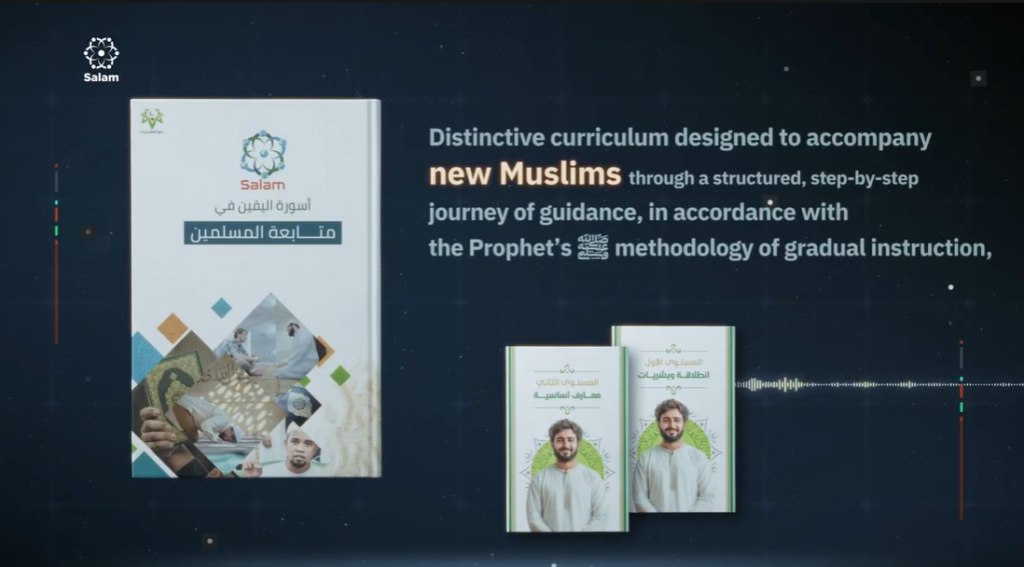
For those who have already entered Islam, the Salam Center offers the Asawirat Al-Yaqeen (Bracelets of Certainty) program — a structured, four-stage curriculum designed to ground new Muslims in firm knowledge and lived faith:
- Stage One — The Foundation: Pillars of Islam, Shahada, Wudu, Salah, and pillars of Iman
- Stage Two — The Construction Phase: Tawbah, the Seerah of the Prophet (PBUH)
- Stage Three — The Consolidation Phase: Ethics, family rulings, and practical life guidance
- Stage Four — The Empowerment Phase: Contemporary issues, theological foundations, and your life roadmap
Join 114,588 new Muslims from 140 countries who have walked this path — and begin building your certainty today.
Reach out directly to the Salam Center team to start the Asawirat Al-Yaqeen (Bracelets of Certainty) program for FREE.
Summary
The Quran, as the verbatim word of Allah, and the Sunnah of the Prophet (PBUH) form the twin foundations of Islamic guidance, with Sharia extending their principles into a comprehensive legal and moral system serving every domain of human life. Scholars of Ahlus Sunnah wal Jama’ah — from Imam al-Shafi’i to Imam al-Ghazali — built fourteen centuries of jurisprudence on these sources.
Sharia’s five objectives — protecting religion, life, intellect, lineage, and property — reveal its purpose as mercy and wisdom rather than restriction.
Every Muslim who internalizes the Quran’s worldview finds in Sharia not a cage but a coherent path toward dignity, justice, and closeness to Allah in this life and the next.
Frequently Asked Questions
What is the relationship between the Quran and Sharia?
The Quran is the primary divine source; Sharia is the legal and ethical framework derived from it, alongside the Sunnah, scholarly consensus (Ijma’), and analogical reasoning (Qiyas). Sharia does not exist independently — every ruling traces back to Quranic authority or Prophetic example authenticated by scholars of Ahlus Sunnah wal Jama’ah.
Does Sharia only cover religious rituals, or does it apply to all of life?
Sharia governs the full range of human activity: worship, commerce, family relations, ethics, and social conduct. Imam al-Ghazali established in Al-Mustasfa that Sharia’s five universal objectives — protecting religion, life, intellect, lineage, and property — span every domain in which a human being acts or chooses.
How do Muslims know which Hadiths are authentic enough to base Sharia rulings on?
Islamic scholars developed the science of Hadith criticism (‘Ilm al-Hadith) over centuries, evaluating chains of transmission (isnad) and the character of narrators (rijal). Collections like Sahih al-Bukhari and Sahih Muslim represent the highest standards of authenticated narration and remain the authoritative references in Sunni jurisprudence.
Is Sharia compatible with living in the modern world?
Sharia’s foundational sources are divine and timeless; its applied rulings, through Ijtihad (scholarly legal reasoning), have always addressed evolving circumstances. The Islamic Fiqh Academy continues to issue contemporary rulings on modern questions — from bioethics to digital finance — demonstrating that Sharia’s guidance is neither static nor outdated.
How does the Quran guide Muslims in their daily personal ethics?
The Quran continuously calls believers to justice (‘adl), sincerity (ikhlas), patience (sabr), and mercy (rahma) in every personal interaction. The Prophet (PBUH) affirmed — in a hadith recorded in Sunan Abu Dawud (no. 4682) — that the most complete believers in faith are those with the finest character, establishing that ethical excellence is itself an expression of Islamic guidance.
Curious about Islam?
Journey towards clarity and purpose. Our team is here to support you in your search for truth and spiritual guidance.
Embrace the Truth