
Why Is the Quran Important to Muslims?
| Key Takeaways |
| The Quran is the direct, preserved word of Allah revealed to Prophet Muhammad (PBUH) and serves as the primary guide for every dimension of Muslim life. |
| Muslims recite the Quran in every unit of the five daily prayers, making it the most frequently encountered text in a Muslim’s day. |
| The Quran provides Muslims with a complete moral, legal, and spiritual framework — from personal conduct to social ethics and matters of faith. |
| Memorizing, reciting, and reflecting on the Quran carry immense spiritual rewards explicitly confirmed in authenticated Hadiths. |
| The Quran’s preservation in its original Arabic text, unchanged since revelation, gives Muslims a living, unbroken connection to divine guidance. |
The Quran occupies a place in Muslim life that has no parallel in any other religious tradition. Every Muslim — whether in Makka, Jakarta, or London — begins their day with its words, structures their prayers around its verses, seeks its guidance in difficulty, and returns to it at the end of the night.
The Quran is the axis around which an entire civilization of faith, learning, and conduct revolves.
1. The Quran Is the Unaltered Speech of Allah
Every book carries the weight of its author. The Quran, in Islamic belief, carries the weight of its Author — Allah, the Creator of existence. Muslims do not regard it as a text about divine guidance; they understand it as divine guidance in its direct, spoken form.
وَإِنَّهُ لَتَنزِيلُ رَبِّ الْعَالَمِينَ
“And indeed, the Quran is the revelation of the Lord of the worlds.” (Quran 26:192)
This conviction shapes everything. When a Muslim opens the Quran, they are not reading a scholar’s interpretation or a prophet’s memoir — they are engaging with the word of Allah directly.
That relationship generates a quality of reverence and attentiveness that makes the Quran unlike any other text in human existence.
What Muslims believe about the Quran is inseparable from their understanding of who Allah is — one, eternal, and uniquely beyond all creation. The Quran is the clearest manifestation of His communication with humanity.
2. The Quran Is Recited in Every Single Daily Prayer
Five times each day, Muslims stand before Allah in Salah — and in every unit (rak’ah) of every prayer, Surah Al-Fatihah is recited. No prayer is valid without it. This means the Quran is not reserved for occasions of study or reflection; it is embedded in the most fundamental act of Islamic worship.
Prophet Muhammad (PBUH) described Surah Al-Fatihah in a Hadith Qudsi where Allah says:
“I have divided prayer between Myself and My servant into two halves, and My servant shall have what he has asked for.”
Each time the servant recites Al-hamdu lillahi rabb il-‘alamin (“Praise be to Allah, Lord of all worlds”), Allah responds. The daily prayer is, at its core, a conversation with Allah through the words He Himself revealed.
A Muslim who prays five times a day recites Al-Fatihah at minimum seventeen times — and adds additional Quranic passages beyond that.
Learn More About Islam
Discover the beauty, teachings, and wisdom of Islam in a clear and welcoming way. Start exploring and deepen your understanding today.
Learn More3. The Quran Provides Muslims with a Complete Code of Life
Islam as a way of life is not assembled from scattered cultural traditions — its framework comes from the Quran and the Sunnah of the Prophet (PBUH). The Quran addresses belief, worship, family structure, commerce, justice, ethics, personal conduct, and the rights of others.
The Quran is the primary legislative source from which Islamic jurisprudence is derived.
وَنَزَّلْنَا عَلَيْكَ الْكِتَابَ تِبْيَانًا لِّكُلِّ شَيْءٍ
“And We have sent down to you the Book as clarification for all things.” (Quran 16:89)
The foundational principles of Islam trace directly back to Quranic injunctions. Whether a Muslim is deciding how to conduct a business transaction, resolve a family dispute, or understand their duties toward their community — the Quran provides the governing framework.
Every ruling in Islamic jurisprudence must ultimately be traceable to the Quran or the confirmed Sunnah.
4. Reciting the Quran Carries Immense and Specific Spiritual Reward
The act of recitation itself — independent of analysis or memorization — is an act of worship that generates reward (hasanat) with every single letter. This is not a vague promise; it is a specific, authenticated teaching of the Prophet (PBUH).
“Whoever recites a letter from the Book of Allah will receive one good deed, and a good deed is multiplied by ten. I do not say that Alif-Lam-Mim is a letter, but rather Alif is a letter, Lam is a letter, and Mim is a letter.” (Sunan Al-Tirmidhi, no. 2910)
This teaching produces something profound in the daily life of a Muslim: recitation becomes a continuous act of devotion woven into ordinary moments.
Walking, resting, waiting — any moment becomes an opportunity to accumulate reward. The Quran accompanies the Muslim not merely as a book on a shelf but as a living spiritual practice.
5. The Quran Is the Ultimate Source of Guidance on Faith and Belief
For a Muslim navigating questions of faith — the nature of Allah, the reality of the afterlife, the existence of angels, the purpose of human existence — the Quran is the primary reference. It answers the deepest questions of the human soul with clarity and certainty.
Understanding what faith in Islam truly means begins with the Quran, which lays out the six pillars of Iman: belief in Allah, His angels, His books, His messengers, the Last Day, and divine decree. Each of these is grounded in explicit Quranic verses.
آمَنَ الرَّسُولُ بِمَا أُنزِلَ إِلَيْهِ مِن رَّبِّهِ وَالْمُؤْمِنُونَ ۚ كُلٌّ آمَنَ بِاللَّهِ وَمَلَائِكَتِهِ وَكُتُبِهِ وَرُسُلِهِ
“The Messenger has believed in what was revealed to him from his Lord, and so have the believers. All of them have believed in Allah and His angels and His books and His messengers.” (Quran 2:285)
The Quran answers the most fundamental human questions in a way that is internally consistent, rationally coherent, and spiritually compelling.
6. The Quran Heals the Heart and Brings Peace in Hardship
Muslims in moments of grief, anxiety, fear, or loss do not merely read the Quran for information — they turn to it for healing. This is not metaphor. The Quran explicitly describes itself as a cure for what is in the hearts.
وَنُنَزِّلُ مِنَ الْقُرْآنِ مَا هُوَ شِفَاءٌ وَرَحْمَةٌ لِّلْمُؤْمِنِينَ
“And We send down of the Quran that which is healing and mercy for the believers.” (Quran 17:82)
Specific chapters and verses carry particular spiritual functions. Ayat Al-Kursi (Quran 2:255) is recited for protection. Surah Al-Mulk (chapter 67) is recommended before sleep. Surah Al-Kahf is recited on Fridays. These are not cultural habits; they are established prophetic practices supported by authentic Hadiths.
The Prophet (PBUH) said:
“Recite Surah Al-Baqarah, for taking it is a blessing and leaving it is a regret, and the sorcerers cannot stand it.” (Sahih Muslim, no. 804)
7. Memorizing the Quran (Hifz) Elevates the Muslim’s Status in This Life and the Next
The tradition of Hifz — committing the entire Quran to memory — is one of the most distinguished acts of devotion in Islamic civilization. There are an estimated ten million Huffaz (Quran memorizers) alive today, representing every race and nationality on earth.
This phenomenon — millions of people preserving a 600-plus-page text in memory in a language many of them did not grow up speaking — is unparalleled in the history of any book.
The Prophet (PBUH) said:
“Such a person as recites the Qur’an and masters it by heart, will be with the noble righteous scribes (in Heaven). And such a person exerts himself to learn the Qur’an by heart, and recites it with great difficulty, will have a double reward.” (Sahih Al-Bukhari, no. 4937)
8. The Quran Shapes How Muslims Understand Other Scriptures and Religions
The Quran does not exist in isolation from the broader story of divine revelation. It affirms the original revelations sent to earlier prophets — the Tawrah of Musa (Moses), the Injeel of Isa (Jesus), the Zabur of Dawud (David) — while establishing that those texts were altered over time, and that the Quran came as the final, preserved, and complete revelation.
إِنَّا نَحْنُ نَزَّلْنَا الذِّكْرَ وَإِنَّا لَهُ لَحَافِظُونَ
“Indeed, it is We who sent down the Quran and indeed, We will be its guardian.” (Quran 15:9)
This understanding directly shapes how Muslims engage with other religions. The Quran affirms the original scriptures’ divine origin while explaining why only the Quran — preserved in its original Arabic — carries the authority of an unaltered divine source. It also grounds Islam’s absolute commitment to monotheism and its theological distance from polytheistic frameworks.
9. The Quran Governs Muslim Ethics, Character, and Social Conduct
When Aisha (may Allah be pleased with her) was asked about the character of the Prophet (PBUH), she gave a striking answer:
“His character was the Quran.”
This single statement encapsulates how deeply the Quran is meant to shape not just belief and ritual, but the lived moral character of every Muslim. Honesty in dealings, justice in judgment, compassion for the poor, respect for parents, protection of neighbors — all of these are Quranic imperatives.
The Quran is not a text Muslims read and set aside; its values are meant to become the Muslim’s own values, internalized into conduct and character.
Read Also: How Is the Quran Organized?
10. The Quran Connects Every Muslim to a Single Global Community
One of the most extraordinary features of the Quran’s role in daily life is its unifying power. Whether in Makkah, Nairobi, London, or Kuala Lumpur, every Muslim recites the same Arabic words in the same prayers, memorizes the same verses, and is shaped by the same guidance.
The Quran is the common language of the global Muslim Ummah — a living bond that transcends race, language, and nationality.
The Grand Mosque in Makkah — Masjid Al-Haram — where over two million Muslims gather annually for Hajj, is a visible symbol of this unity. In its space, every recitation is from the same Quran, in the same tongue, with the same meaning, as it has been for fourteen centuries.
For new Muslims discovering this reality for the first time — as so many students in the Asawirat Al-Yaqeen (Bracelets of Certainty) program do — the Quran becomes both an anchor of personal faith and a doorway into belonging to the largest community of shared belief on earth.
Read Also: Scientific Errors in the Quran Answered
Learn More About Islam
Discover the beauty, teachings, and wisdom of Islam in a clear and welcoming way. Start exploring and deepen your understanding today.
Learn MoreRead Also: How Do the Quran and Sharia Guide Muslims?
Learn More About Islam and Take the Next Step with Salam
Whether you’re taking your first steps toward understanding Islam, or you’ve recently embraced the faith and want to build on solid foundations — the Salam Platform is here to walk alongside you.
Explore further:
Browse the Salam blog for articles on Islamic beliefs, the Quran, worship, and answers to your real questions.
Visit the Salam Platform to access a full library of authentic Islamic content.
Have a specific question? Reach out directly — our team is ready to respond with care and clarity.
Ready to embrace Islam or deepen your practice?
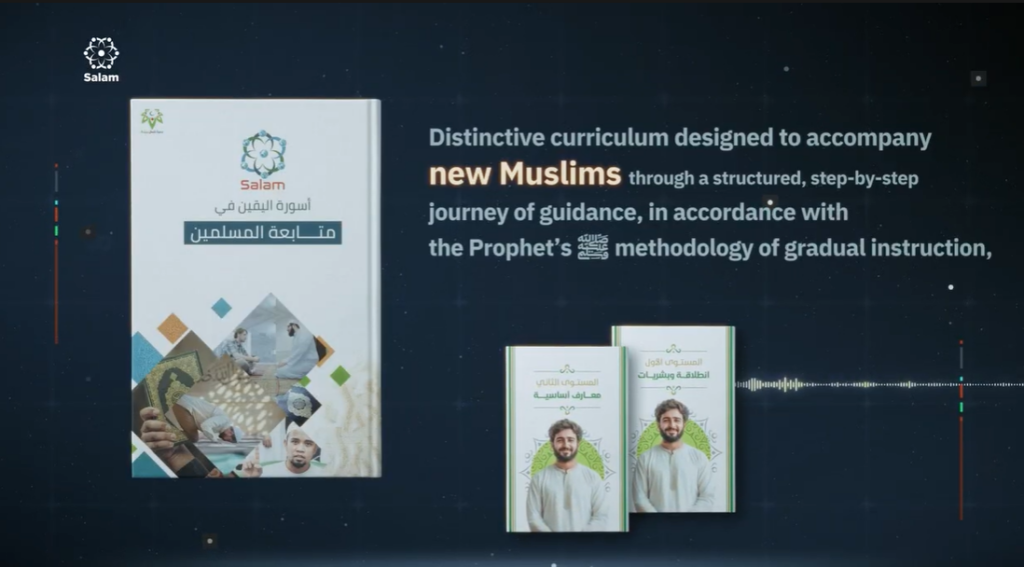
The Asawirat Al-Yaqeen (Bracelets of Certainty) program is the Salam Center‘s structured, four-stage curriculum designed specifically for new Muslims:
- Stage One — The Foundation: The Shahada, the five pillars, prayer, purification
- Stage Two — The Construction Phase: The six pillars of Iman, fasting, Zakat, Hajj
- Stage Three — The Consolidation Phase: Repentance, the Prophet’s biography, Islamic ethics
- Stage Four — The Empowerment Phase: Contemporary issues, theological foundations, a life roadmap from Surah Al-Asr
- Implemented with over 114,000 new Muslims across 140 countries
- Available in multiple languages, with a smart application in development
Reach out directly to the Salam Center team to start the Asawirat Al-Yaqeen (Bracelets of Certainty) program for FREE.
Summary
The Quran stands at the center of Muslim daily life because Muslims understand it as the direct, preserved word of Allah — the only unaltered divine book remaining on earth. From the seventeen-plus recitations of Al-Fatihah embedded in each day’s prayers, to its role as the governing source of Islamic law, ethics, and belief, the Quran is encountered not occasionally but continuously.
For new Muslims and sincere seekers, engaging with the Quran opens a living connection to fourteen centuries of an unbroken tradition. Its guidance — on character, community, worship, and the deepest questions of human existence — remains as immediate and applicable today as at the moment of its first revelation.
Frequently Asked Questions
Why is the Quran important in the daily life of Muslims?
The Quran is the literal word of Allah and the primary guide for all aspects of Muslim life — worship, ethics, law, and personal conduct. Muslims recite it in every daily prayer, seek its guidance in difficulty, and model their character on its teachings, as the Prophet (PBUH) himself did. (Sahih Muslim, 746)
Why is the Quran important to Muslims for kids?
For young Muslims, the Quran is the first book memorized and recited — even before full comprehension — because its words carry divine blessing with every letter. Prophet Muhammad (PBUH) confirmed that every single letter of the Quran earns ten good deeds (Sunan Al-Tirmidhi, 2910), making early recitation a foundation of spiritual upbringing.
How does the Quran guide Muslims in their everyday decisions?
The Quran provides direct rulings and principles covering commerce, family life, social ethics, and personal conduct. As Allah states in Quran 16:89, the Book was revealed as a clarification for all things. Islamic scholars derive legal and ethical rulings from its verses, making it the ultimate reference for everyday Muslim choices.
Curious about Islam?
Journey towards clarity and purpose. Our team is here to support you in your search for truth and spiritual guidance.
Embrace the Truth