
What Is the Definition of Muslim in the Quran?
| Key Takeaways |
| The word “Muslim” derives from the Arabic root s-l-m, meaning submission, and a Muslim is one who fully submits to the will of Allah. |
| Allah Himself named the believers “Muslims” in the Quran (22:78), making this title a divine designation, not a human invention. |
| The Quran reveals that Islam — and therefore the identity of a Muslim — predates the Prophet Muhammad (PBUH); Prophets Ibrahim, Musa, and Isa all called their people to this same submission. |
| The word “Muslim” appears in the Quran in multiple forms, including muslim, muslimoon, and muslimeen, derived from the same root that gives us the word “Islam.” |
A Muslim is one who submits entirely to Allah — inwardly through sincere belief, and outwardly through righteous action. This is not a modern religious label. It is a title Allah Himself assigned to those who carry the torch of monotheism across all of human history.
Understanding the definition of Muslim in the Quran pulls you past cultural assumptions and straight into the heart of what this identity has always meant.
What Is the Definition of Muslim in the Quran?
The Quranic definition of a Muslim is one who submits their will completely to Allah, obeys His commands, and commits to tawheed — the pure oneness of Allah — rejecting all forms of shirk (associating partners with Him). The word “Muslim” comes from the trilateral Arabic root s-l-m (س ل م), the same root that gives us Islam (submission), salam (peace), and istislam (total surrender).
Linguistically and theologically, these words are inseparable: a Muslim is one who has found peace precisely because they have submitted.
Allah makes the definition of Muslim explicit in Surah Al-Hajj:
وَجَاهِدُوا فِي اللَّهِ حَقَّ جِهَادِهِ ۚ هُوَ اجْتَبَاكُمْ وَمَا جَعَلَ عَلَيْكُمْ فِي الدِّينِ مِنْ حَرَجٍ ۚ مِّلَّةَ أَبِيكُمْ إِبْرَاهِيمَ ۚ هُوَ سَمَّاكُمُ الْمُسْلِمِينَ مِن قَبْلُ وَفِي هَٰذَا
“And strive for Allah with the striving due to Him. He has chosen you and has not placed upon you in the religion any difficulty. [It is] the religion of your father, Abraham. Allah named you ‘Muslims’ before [in former scriptures] and in this [revelation]…” (Quran 22:78)
Three facts emerge from this single verse that are essential to grasping the Quranic definition:
First, the title “Muslim” was given by Allah, not adopted by human beings.
Second, the title “Muslim” predates the Quran itself — former scriptures carried it.
Third, the title “Muslim” is rooted in the tradition of Prophet Ibrahim (AS), the father of monotheism.
A Muslim is therefore not someone who belongs to a 7th-century religious movement; they belong to an unbroken lineage of submission that stretches back to the very beginning of human prophethood.
Learn More About Islam
Discover the beauty, teachings, and wisdom of Islam in a clear and welcoming way. Start exploring and deepen your understanding today.
Learn MoreHow Does the Quran Tie the Muslim Identity to All Prophets?
One of the most striking features of the Quranic definition is its universality across prophetic history. The Quran does not present Islam as a new religion — it presents it as the religion, the eternal call that every prophet carried.
Consider Prophet Ibrahim (AS). When his Lord commanded him to submit, his response was immediate:
أَسْلَمْتُ لِرَبِّ الْعَالَمِينَ
“I have submitted myself to the Lord of the worlds.” (Quran 2:131)
He then prayed for his descendants:
رَبَّنَا وَاجْعَلْنَا مُسْلِمَيْنِ لَكَ وَمِن ذُرِّيَّتِنَا أُمَّةً مُّسْلِمَةً لَّكَ
“Our Lord, and make us Muslims [in submission] to You and from our descendants a Muslim nation [in submission] to You.” (Quran 2:128)
The tafsir of Imam Ibn Kathir — the celebrated 14th-century Quranic exegete — clarifies that Allah commanded Ibrahim to be sincere with Him and to submit, and that Ibrahim adhered to this command perfectly.
Ibrahim then passed this covenant to his sons and to Ya’qub (AS), making submission the inheritance of prophethood itself.
Prophet Musa (AS) called his people to the same:
يَا قَوْمِ إِن كُنتُمْ آمَنتُم بِاللَّهِ فَعَلَيْهِ تَوَكَّلُوا إِن كُنتُم مُّسْلِمِينَ
“O my people, if you have believed in Allah, then rely upon Him, if you should be Muslims.” (Quran 10:84)
And the disciples of Prophet Isa (AS) declared:
وَاشْهَدْ بِأَنَّا مُسْلِمُونَ
“And bear witness that we are Muslims [in submission to Allah].” (Quran 3:52)
This is the Quranic picture: every sincere prophet and every sincere follower across history was, by definition, a Muslim.
The one who submits to Allah alone belongs to the same spiritual family, regardless of the era in which they lived.
For a deeper understanding of how Islam views other faiths through this prophetic lens, you can explore how Islam views other religions.
Who Is a True Muslim According to the Quran?
In Surah Al-Ahzab, Allah describes the qualities of al-muslimoon and al-muslimaat — the Muslim men and women — in a powerful sequence:
they are those who submit, who believe, who are devout, truthful, patient, humble, charitable, fasting, chaste, and who remember Allah abundantly (Quran 33:35).
This verse from Surah Al-Imran then seals the essential Quranic command:
يَا أَيُّهَا الَّذِينَ آمَنُوا اتَّقُوا اللَّهَ حَقَّ تُقَاتِهِ وَلَا تَمُوتُنَّ إِلَّا وَأَنتُم مُّسْلِمُونَ
“O you who have believed, fear Allah as He should be feared and do not die except as Muslims [in submission to Him].” (Quran 3:102)
The instruction “do not die except as Muslims” means preserve your Islam while you are well and safe, so that you die in that state. Being a Muslim is a lifetime commitment, maintained consciously until the last breath.
The Prophetic Definition of a True Muslim
The Prophet Muhammad (PBUH) gave the Ummah a definition of the true Muslim that cuts straight to the ethical core. Narrated by Abdullah ibn Amr (RA) in Sahih al-Bukhari:
الْمُسْلِمُ مَنْ سَلِمَ الْمُسْلِمُونَ مِنْ لِسَانِهِ وَيَدِهِ
“A Muslim is the one from whose tongue and hand the Muslims are safe.”
This hadith reveals something profound: the truest mark of a Muslim’s submission is its effect on the people around them. Faith lived only inwardly, without producing safety and goodness for others, falls short of this Prophetic standard.
The true Muslim does not harm through words — no slander, no mockery, no lies. They do not harm through actions — no injustice, no violence, no transgression. Their Islam is a mercy that ripples outward.
To understand how this ethical framework connects to the broader pillars of faith that shape a Muslim’s life, see the Salam Platform’s guide to faith in Islam.
The Root Meaning of Muslim and Its Connection to Tawheed
The Arabic root s-l-m encodes a beautiful theological truth: submission to Allah is the source of peace, not its obstacle. When a person surrenders their will to the Creator, the inner conflict between ego and truth dissolves.
This is why salam — the Muslim greeting — comes from the same root. Peace among people flows from peace with Allah.
The Quran reinforces this in Surah Al-Jinn, where the jinn themselves distinguish between the muslimoon and those who deviate:
وَأَنَّا مِنَّا الْمُسْلِمُونَ وَمِنَّا الْقَاسِطُونَ ۖ فَمَنْ أَسْلَمَ فَأُولَٰئِكَ تَحَرَّوْا رَشَدًا
“And among us are Muslims [in submission to Allah], and among us are the unjust. And whoever has become Muslim — those have sought out the right course.” (Quran 72:14)
The contrast the Quran draws here — between al-muslimoon (those who submit) and al-qasitoon (those who deviate from the right course) — shows that being a Muslim is an active orientation toward correctness, not merely a label.
Tawheed Is the Foundation of the Muslim Identity
The Muslim’s submission is specifically to the One Allah, with no partners. This is the defining core, which is why the Shahada — the declaration that there is no deity worthy of worship except Allah, and that Muhammad (PBUH) is His Messenger — stands as the first and most essential pillar of Islam. Every dimension of Muslim identity rests on this singular foundation.
The principles of Islam all flow from this starting point, and the rejection of polytheism is intrinsic to what the Quran means when it uses the word “Muslim.”
You can also explore the concept of monotheism in depth on the Salam Platform to understand the theological architecture underlying this identity.
Read Also: The 5 Pillars of Islam in the Quran
How Many Times Is the Word “Muslim” Mentioned in the Quran?
The specific noun form muslim (مُسْلِم) along with its plural forms muslimoon (مُسْلِمُون) and muslimeen (مُسْلِمِين) appears across numerous verses of the Quran. The broader root s-l-m, from which all these forms derive, appears approximately 140 times in the Quran in 16 different grammatical forms.
These include the verb aslama (to submit), the noun islam, and the identifying noun muslim with all its plural and dual variants.
Some of the most significant Quranic occurrences of the word “Muslim” include:
The dual form muslimayni in the prayer of Ibrahim (AS) in 2:128, the plural muslimoon in the declaration of the disciples of Isa (AS) in 3:52, the direct divine naming of the believers as al-muslimeen in 22:78, the command to die only as muslimoon in 3:102, and the self-identification of the submitting jinn as al-muslimoon in 72:14.
Read Also: Why Do Muslims Read the Quran?
Learn More About Islam
Discover the beauty, teachings, and wisdom of Islam in a clear and welcoming way. Start exploring and deepen your understanding today.
Learn MoreLearn More Authentic Knowledge About Islam & Quran with Salam
If reading this article has stirred something in you — a question, a longing, or a desire to know more — the Salam Center is here for exactly that.
Explore more articles on Islam, faith, and life on the Salam Platform.
Read further on topics like this on the Salam blog.
Have a specific question, want to learn more about entering Islam, or simply want to talk? Reach out directly — our team is ready to listen.
Reach out directly — our team is ready to listen, guide, and welcome you.
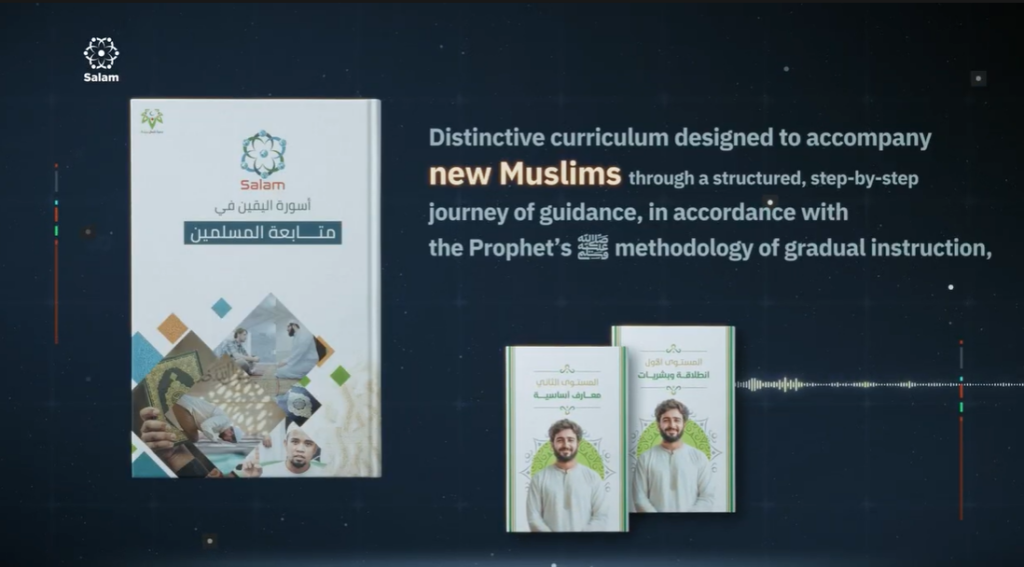
And if you have already embraced Islam and are looking for structured, compassionate guidance through your new life, we invite you to join the Asawirat Al-Yaqeen (Bracelets of Certainty) program — the Salam Center‘s flagship curriculum for new Muslims:
- A four-stage educational journey covering creed, worship, character, and life rulings
- Grounded in the methodology of Ahlus Sunnah wal Jama’ah
- Already completed by more than 114,000 new Muslims across 140 countries
- Designed with therapeutic, compassionate language that nurtures both heart and mind
- Structured assessments at every stage to track and consolidate your learning
This is knowledge for the soul — systematic, authentic, and beautifully human.
Reach out directly to the Salam Center team to start the Asawirat Al-Yaqeen (Bracelets of Certainty) program for FREE.
Summary
The Quranic definition of a Muslim centers on complete submission to Allah alone, rooted in tawheed and expressed through both belief and action. This identity was named by Allah Himself and carried by every prophet from Adam to Muhammad (PBUH).
A true Muslim, according to the Prophet (PBUH), is recognized by the safety they bring to those around them — proof that genuine faith transforms outward conduct. The Quran commands believers to hold this state of submission until their final breath.
Frequently Asked Questions
What is the Quranic definition of a Muslim?
A Muslim, in Quranic terms, is one who submits their will entirely to Allah, accepts His commands without reservation, and upholds tawheed — the pure oneness of Allah. The Quran establishes this in 22:78, where Allah states He named the believers “Muslims” both in previous scriptures and in the Quran. This submission encompasses belief, worship, and conduct.
Were prophets before Muhammad (PBUH) also called Muslims in the Quran?
Yes — the Quran explicitly identifies Ibrahim (AS), Musa (AS), and the disciples of Isa (AS) as Muslims, because they all submitted to Allah alone. In 2:131, Ibrahim (AS) declares “I have submitted to the Lord of the worlds.” In 3:52, the disciples of Isa (AS) say “bear witness that we are Muslims.” Islam, in the Quranic view, is the eternal religion of all prophets, not a new identity originating in the 7th century.
What is the difference between Muslim and Mu’min in the Quran?
In Quranic usage, Muslim (one who submits) and Mu’min (one who believes) represent two interconnected but distinct dimensions of the believer’s identity. Muslim refers to the outward submission expressed through deeds and declaration, while Mu’min refers to the depth of inner faith that has firmly taken root in the heart. The highest state of the believer encompasses both, as the five pillars of faith in Islam demonstrate across both the Quran and the authentic Sunnah.
Curious about Islam?
Journey towards clarity and purpose. Our team is here to support you in your search for truth and spiritual guidance.
Embrace the Truth