Why Is the Quran the Holy Book of Islam?
| Key Takeaways |
| The Quran is the Holy Book of Islam because it is the literal word of Allah, revealed to Prophet Muhammad (PBUH) through the Angel Jibreel over approximately 23 years. |
| The Quran is the Holy Book of Islam because it is the final and complete divine revelation, superseding all previous scriptures sent to earlier prophets. |
| The Quran functions as the supreme legislative, spiritual, and moral authority for over 2 billion Muslims worldwide. |
Muslims do not simply regard the Quran as a sacred text — they regard it as the direct, unmediated speech of Allah, transmitted to humanity through the final prophet. That conviction sits at the heart of why the Quran holds the position it does in Islam.
Every prayer, every ruling, every moral principle, every spiritual truth in the religion traces back to this single source.
1. The Quran Is the Holy Book of Islam Because it is the Direct Word of Allah
The most foundational reason the Quran occupies the position it does in Islam is its identity. Muslims believe the Quran is the literal, verbatim speech of Allah — not the Prophet’s (PBUH) own reflections, not scholarly interpretation, and not a record of his personal experiences.
Allah says in the Quran:
وَإِنَّهُ لَتَنزِيلُ رَبِّ الْعَالَمِينَ
“And indeed, the Quran is the revelation of the Lord of the worlds.” (Quran 26:192)
The Quran was revealed to Prophet Muhammad (PBUH) through the Angel Jibreel (Gabriel) over a period of approximately 23 years — beginning in the Cave of Hira in Makkah in 610 CE and concluding shortly before the Prophet’s death in 632 CE.
The revelation did not come as inspiration that the Prophet then put into his own words. It came as actual speech, which he then conveyed — letter by letter — to his companions.
This is why the Quran has always been preserved in Arabic: the language itself is part of the revelation, not a vessel for it.
This divine identity is precisely why the Quran cannot be placed alongside any other text in Islam. It is in a category entirely its own.
2. The Prophet Muhammad (PBUH) Was Chosen to Receive and Convey the Revelation
The Quran did not descend in isolation. It was entrusted to a specific human being — chosen, prepared, and morally authenticated by Allah — as the medium of delivery to all of humanity.
Prophet Muhammad (PBUH) was born in Makkah around 570 CE into the noble lineage of the Quraysh tribe, descended from Prophet Ibrahim (Abraham) through his son Ismail.
Long before prophethood, he was known among his people as Al-Amin — the Trustworthy. Prophet Muhammad’s childhood and character, well-documented in Islamic historical sources, established him as a man of exceptional moral standing.
At the age of forty, in the Cave of Hira, the first verses of the Quran descended. The story of how Muhammad became the Prophet of Islam is inseparable from the story of the Quran itself — the revelation was the prophethood, and the prophethood existed to deliver the revelation.
The Quran itself addresses this directly:
مَّا كَانَ مُحَمَّدٌ أَبَآ أَحَدٍ مِّن رِّجَالِكُمْ وَلَٰكِن رَّسُولَ ٱللَّهِ وَخَاتَمَ ٱلنَّبِيِّۦنَ
“Muhammad is not the father of any of your men, but he is the Messenger of Allah and the seal of the prophets.” (Quran 33:40)
The Prophet (PBUH) is the final messenger. There will be no revelation after him. The Quran he conveyed is therefore the final communication from Allah to humanity — complete, sealed, and preserved.
Learn More About Islam
Discover the beauty, teachings, and wisdom of Islam in a clear and welcoming way. Start exploring and deepen your understanding today.
Learn More3. The Quran Is the Holy Book of Islam Because its Miraculous Preservation
One of the most compelling reasons Muslims accept the Quran as Allah’s holy book is the miracle of its preservation. For over fourteen centuries, across wars, empires, civilizations, and the deaths of countless human traditions, the Quran has remained identical — letter for letter, vowel for vowel — to what was revealed to the Prophet (PBUH).
This is not accidental. Allah made an explicit promise in the text itself:
إِنَّا نَحْنُ نَزَّلْنَا الذِّكْرَ وَإِنَّا لَهُ لَحَافِظُونَ
“Indeed, it is We who sent down the Quran and indeed, We will be its guardian.” (Quran 15:9)
No other scripture in human history carries such a claim — and no other scripture has fulfilled such a claim. The Bible, the Torah, and other religious texts exist in multiple versions, translations, and variant manuscripts.
The Quran has one text, memorized by millions of people in every generation — a living chain of oral transmission that no other book possesses.
The full history of the Quran’s preservation — from the first compilations under Abu Bakr (RA) to the standardized Mushaf under Uthman (RA) — demonstrates how the Muslim community safeguarded revelation with extraordinary precision.
Sheikh Ibn Taymiyyah, the 13th–14th century Hanbali scholar, noted in his Majmu’ al-Fatawa that the Quran’s preservation through both written record and mass oral transmission (Tawatur) makes its authenticity categorically certain — a standard no other ancient text meets.
4. The Quran Is the Final Scripture in a Long Line of Divine Revelation
The Quran does not claim to be a new religion’s founding document. It claims to be the final chapter in a long sequence of divine guidance sent by Allah to humanity through a series of prophets.
Muslims believe that Allah sent scriptures before the Quran — the Tawrah (Torah) to Musa (Moses), the Zabur (Psalms) to Dawud (David), and the Injeel (Gospel) to Isa (Jesus). Each was the word of Allah for its time and its people.
The Quran came as the final, universal, and perfectly preserved successor — completing and superseding all that came before.
شَرَعَ لَكُم مِّنَ الدِّينِ مَا وَصَّىٰ بِهِ نُوحًا وَالَّذِي أَوْحَيْنَا إِلَيْكَ
“He has ordained for you of religion what He enjoined upon Noah and that which We have revealed to you.” (Quran 42:13)
This is why Muslims affirm belief in all previous prophets and all original scriptures as part of faith in Islam. The Quran corrects distortions that entered earlier texts, restores the original monotheistic message, and provides the final, comprehensive guidance for all of humanity — not one tribe, one nation, or one era.
Explorations of how Islam views other religions, including its relationship to Christianity and Judaism, are rooted in this understanding of sequential revelation.
5. The Quran’s Literary Miracle Is an Ongoing Challenge to Human Authorship
One of the Quran’s most enduring proofs of divine origin is its linguistic and literary inimitability — what Islamic scholarship calls I’jaz al-Quran. The Quran itself issued a direct challenge to its doubters:
قُل لَّئِنِ اجْتَمَعَتِ الْإِنسُ وَالْجِنُّ عَلَىٰ أَن يَأْتُوا بِمِثْلِ هَٰذَا الْقُرْآنِ لَا يَأْتُونَ بِمِثْلِهِ وَلَوْ كَانَ بَعْضُهُمْ لِبَعْضٍ ظَهِيرًا
“Say, ‘If mankind and the jinn gathered in order to produce the like of this Quran, they could not produce the like of it, even if they were to each other assistants.'” (Quran 17:88)
The Arabs of the 7th century were masters of oral poetry and eloquence — producing the Quran was a challenge issued to the greatest wordsmiths of the most language-obsessed civilization on earth. They could not meet it. And fourteen centuries later, that challenge remains open and unmet.
For anyone asking why Muslims believe in the Quran, this linguistic dimension is inseparable from the answer — because the Quran’s challenge was not issued to future generations alone, but to the people who would have been most capable of answering it.
6. The Quran Establishes and Defines All Core Islamic Beliefs
The Quran is the primary source from which every pillar of Islamic belief is derived. Every doctrine Muslims hold about Allah, prophethood, the afterlife, and moral responsibility originates in the Quran — with the Sunnah (the authenticated teachings and practices of the Prophet PBUH) functioning as its essential complement and explanation.
The Quran defines the pure monotheism (Tawhid) that is Islam’s central creed:
قُلْ هُوَ اللَّهُ أَحَدٌ
“Say, ‘He is Allah, [who is] One.'” (Quran 112:1)
The Quran defines the nature of Allah — transcendent, without partners, without offspring, and without equal — a theological position that distinguishes Islam fundamentally from religions that associate partners with the Divine.
The Quran establishes the moral framework, the legal principles, the rituals of worship, the ethics of society, and the vision of the afterlife that together constitute Islam as a complete way of life.
The nine core principles of Islam — from Tawhid to prophethood to the Day of Judgment — are not supplementary teachings drawn from secondary sources. They are Quranic at their root.
This is why Muslims cannot separate Islam from the Quran: the religion, in its entirety, emerges from the text.
7. The Quran Addresses All of Humanity Across All Time
A defining feature of the Quran — and a reason it holds the status it does — is its universal address. Unlike scriptures sent to specific nations or tribes, the Quran was revealed for all of humanity, across every time and every place.
تَبَارَكَ الَّذِي نَزَّلَ الْفُرْقَانَ عَلَىٰ عَبْدِهِ لِيَكُونَ لِلْعَالَمِينَ نَذِيرًا
“Blessed is He who sent down the Criterion upon His Servant that he may be to the worlds a warner.” (Quran 25:1)
The Quran addresses the human being as such — not as an Arab, not as a 7th-century Arabian, not as a member of any particular civilization.
Its questions are eternal: Who created you? What is your purpose? What awaits after death? How should you treat others? These questions belong to every human being who has ever lived.
The Quran itself speaks to what Muslims believe about the Quran — that it is a guidance (Huda), a mercy (Rahmah), a healing (Shifa), and a criterion (Furqan) for distinguishing truth from falsehood. These functions are not time-bound.
8. The Quran’s Internal Coherence Across 23 Years of Revelation Is Itself a Sign
The Quran was not revealed all at once. It came down over approximately 23 years — in Makkah and Madinah, in times of hardship and ease, in response to events and independent of them, addressing theology, law, history, ethics, and the unseen. Yet across all of this, the Quran contains zero internal contradiction.
Allah Himself draws attention to this:
أَفَلَا يَتَدَبَّرُونَ الْقُرْآنَ وَلَوْ كَانَ مِنْ عِندِ غَيْرِ اللَّهِ لَوَجَدُوا فِيهِ اخْتِلَافًا كَثِيرًا
“Then do they not reflect upon the Quran? If it had been from other than Allah, they would have found within it much contradiction.” (Quran 4:82)
No human author — composing across two decades, under radically changing social, political, and personal circumstances — produces a work of this internal consistency.
The Quran’s thematic coherence, its recurring conceptual threads, and its unified theological vision across 114 Surahs revealed piecemeal over a lifetime, stand as a rational argument for its divine authorship that has never been adequately answered by critics.
Read Also: When Was the Quran Revealed?
9. The Quran’s Moral and Legislative Authority Governs Muslim Life Completely
The final reason the Quran holds its singular status is its comprehensive authority over Muslim life. The Quran is not a text for Sunday reading or private meditation — it is the governing reference for personal conduct, family law, economic ethics, social justice, and the spiritual journey of every Muslim.
وَنَزَّلْنَا عَلَيْكَ الْكِتَابَ تِبْيَانًا لِّكُلِّ شَيْءٍ
“And We have sent down to you the Book as clarification for all things.” (Quran 16:89)
Islamic jurisprudence (Fiqh) derives its rulings from the Quran first, then the authenticated Sunnah, then scholarly consensus (Ijma’), and then analogical reasoning (Qiyas).
No ruling is valid if it contradicts a clear Quranic text. No authority — caliph, scholar, or institution — supersedes the Quran.
This comprehensive governance is precisely what Muslims believe about the Quran: that it is a complete way of life, not merely a religious text. It speaks to war and peace, marriage and divorce, commerce and charity, the rights of orphans and the dignity of women.
The God it describes is not a distant deity indifferent to human affairs, but a Deity who revealed a complete manual for human flourishing — because He is the One who created human beings and knows what they need.
Read Also: 30 Facts About the Quran
Learn More About Islam
Discover the beauty, teachings, and wisdom of Islam in a clear and welcoming way. Start exploring and deepen your understanding today.
Learn MoreRead Also: How Old Is Islam According to the Quran?
Explore More Authentic Knowledge About Islam & Quran with Salam
If this article raised deeper questions — about the Quran, about Islam, or about what it means to believe — the Salam Platform exists precisely for you.
Browse the full range of topics on the Salam blog, from the nature of Allah to the life of the Prophet (PBUH) to the questions that matter most to seekers and new Muslims.
If you’d like to speak directly with someone, ask questions privately, or learn more about Islam at your own pace, you’re welcome to reach out directly.
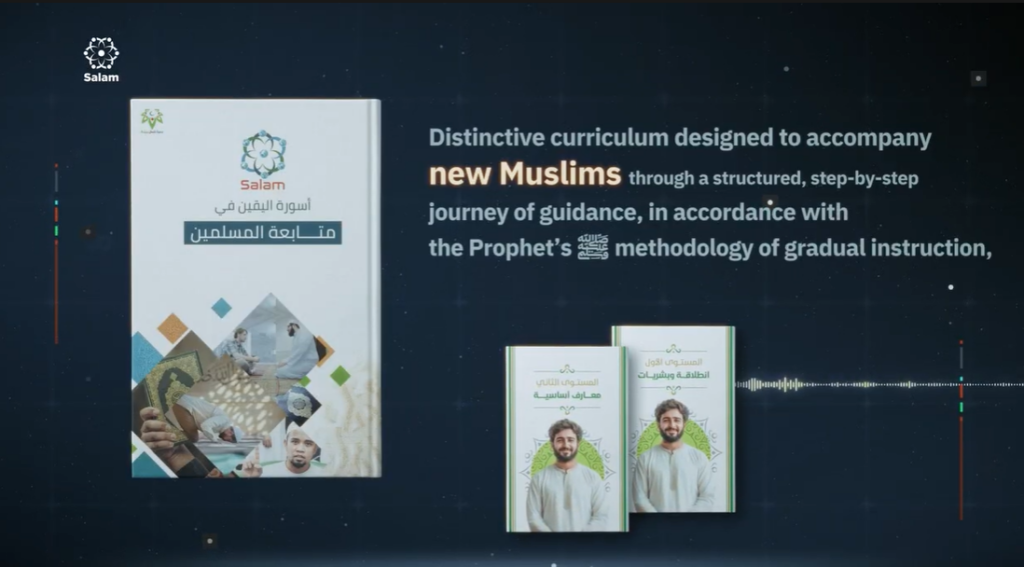
And if you’ve already taken your Shahada — or are seriously considering it — the Asawirat Al-Yaqeen (Bracelets of Certainty) program was built for exactly this moment. It is a structured, four-stage curriculum that walks new Muslims through everything they need to build a firm, grounded, and lasting faith:
- Stage One — The Foundation: The meaning of the Shahada, the pillars of Islam, and the essential acts of worship
- Stage Two — The Construction Phase: The six pillars of Iman, fasting, zakat, and the life of the Prophet (PBUH)
- Stage Three — The Consolidation Phase: Ethics, spiritual development, and practical life rulings
- Stage Four — The Empowerment Phase: Contemporary issues, theological grounding, and a life roadmap from the Quran
The program has guided 114,588 new Muslims across 140 countries. You are not alone on this path.
Reach out directly to the Salam Center team to start the Asawirat Al-Yaqeen (Bracelets of Certainty) program for FREE.
Summary
The Quran is Islam’s holy book because it is the direct, verbatim speech of Allah — revealed to Prophet Muhammad (PBUH) over 23 years, preserved without alteration across fourteen centuries, and constituting the final universal message to all of humanity after a long sequence of prophetic revelations.
Every pillar of Islamic belief, every act of worship, and every moral principle in Islam derives from the Quran as its primary authority. Its linguistic inimitability, internal coherence, fulfilled promise of preservation, and comprehensive governance of human life together confirm, across every era, why Muslims hold it as the word of Allah.
Frequently Asked Questions
Why do Muslims consider the Quran to be the word of Allah and not the words of Prophet Muhammad (PBUH)?
Muslims distinguish the Quran from the Prophet’s own speech because the Quran was revealed through the Angel Jibreel as Allah’s literal words, while the Prophet’s personal sayings form a separate body of literature called the Hadith. The Quran itself states it is a revelation from the Lord of the worlds (Quran 26:192), and the Prophet (PBUH) consistently conveyed it as received — not as his own composition.
Is the Quran the same text that was revealed 1,400 years ago?
Yes — the Quran in use today is letter-for-letter identical to what was revealed to Prophet Muhammad (PBUH). Allah promised its protection in Quran 15:9, and that promise has been fulfilled through an unbroken chain of millions of memorizers (Huffaz) across every generation, alongside written manuscripts. No other ancient text has been preserved through this combination of oral and written transmission.
How is the Quran different from the Bible or the Torah in Islam’s view?
The Quran is the final, perfectly preserved divine revelation, while Muslims believe earlier scriptures underwent human alteration over time. Islam affirms that the Torah, Psalms, and Gospel were originally from Allah, but their current forms contain changes introduced by human hands. The Quran came to restore, complete, and seal the divine message. This distinction shapes how Islam views the Bible and the broader comparison between Islam and Christianity.
Does the Quran address people of all religions and backgrounds?
Yes — the Quran explicitly describes itself as a guidance for all of humanity, sent through the final prophet to all peoples across all time. It directly addresses Jews, Christians, polytheists, and all human beings — inviting them to reflect on its message. The Quran’s own verses on what it says about other religions confirm this universal scope.
Why is the Quran recited in Arabic even by non-Arabic-speaking Muslims?
The Arabic of the Quran is itself part of the divine revelation — the specific words, sounds, and structure are inseparable from the message. Translations convey meaning but are not the Quran itself; they are interpretations. Muslims recite the original Arabic in prayer as an act of direct connection with Allah’s own words. This is why preserving the Arabic text has always been a core obligation of the Muslim community, embedded in the very history of the Quran’s preservation.
Curious about Islam?
Journey towards clarity and purpose. Our team is here to support you in your search for truth and spiritual guidance.
Embrace the Truth