Belief in Holy Books in Islam
| Key Takeaways |
| Muslims are required to believe in all divinely revealed scriptures, including the Torah, the Psalms, the Gospel, and the Quran — this belief is a pillar of Islamic faith. |
| The Quran is the only scripture preserved in its original form; earlier books were altered by human hands over centuries, which is why the Quran serves as the final, authoritative revelation. |
| Believing in previous scriptures does not mean following them — Muslims follow the Quran and the Sunnah of Prophet Muhammad (PBUH) as the final, complete guidance for humanity. |
| The Quran itself confirms the divine origin of earlier revelations while identifying the textual corruption (tahrif) that occurred in them over time. |
| Belief in Allah’s revealed books is the third of the six articles of faith in Islam, making it a foundational theological commitment — not a peripheral matter. |
Muslims believe in the Torah, the Psalms, the Gospel, and the Quran as divinely revealed books from Allah. This is not optional theology for the curious Muslim — it is a required pillar of faith, listed explicitly among the six articles of Islamic belief. Denying any one of these revelations, in their original divine form, places a person outside the fold of Islam.
What makes this belief fascinating to the outside observer is its scope. Islam does not restrict divine guidance to the Arabian Peninsula or to a single community. Allah sent messengers to every nation, and with many of those messengers came a revealed scripture.
The Quran affirms this pattern repeatedly, situating itself as the final link in a long chain of prophetic revelation — not an isolated phenomenon, but the completion of something far older and grander.
The Third Article of Islamic Faith Requires Belief in All Revealed Books
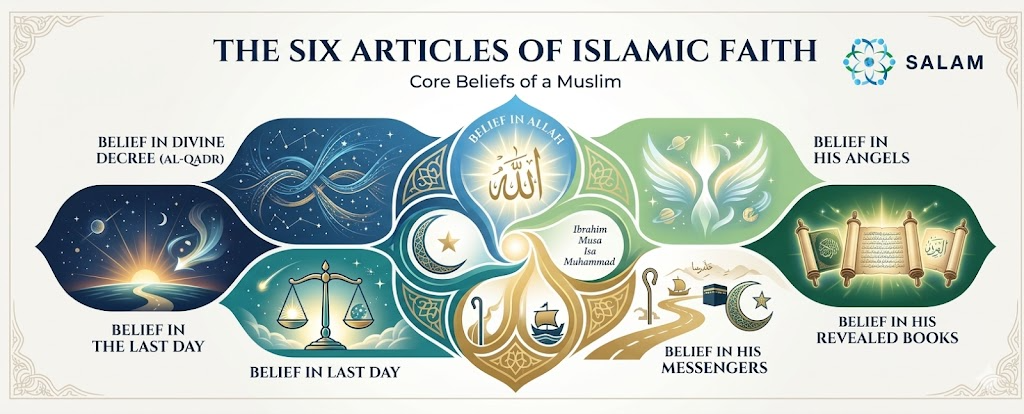
The six articles of Islamic faith (arkan al-iman) form the doctrinal skeleton of every Muslim’s worldview. A Muslim must believe in Allah, in His angels, in His revealed books, in His messengers, in the Last Day, and in divine decree. The belief in revealed books — al-kutub al-munazzalah — occupies the third position in this hierarchy.
Why Must Muslims Believe in Holy Books?
The books follow naturally from belief in Allah and His angels because revelation is the primary mechanism through which Allah communicates His will to humanity.
Angel Jibreel (Gabriel) served as the conduit, transmitting divine speech to the prophets, who then conveyed it to their communities. The entire chain — from Allah to humanity — runs through these revealed scriptures.
The Quran states this obligation with precision:
يَا أَيُّهَا الَّذِينَ آمَنُوا آمِنُوا بِاللَّهِ وَرَسُولِهِ وَالْكِتَابِ الَّذِي نَزَّلَ عَلَىٰ رَسُولِهِ وَالْكِتَابِ الَّذِي أَنزَلَ مِن قَبْلُ
“O you who have believed, believe in Allah and His Messenger and the Book that He sent down upon His Messenger and the Scripture which He sent down before.” (Quran 4:136)
The command here is addressed to believers themselves — a reminder that this is an ongoing, active commitment, not merely an inherited assumption.
To understand the fuller picture of faith in Islam, the belief in revealed books cannot be separated from the broader theological framework that holds it in place.
What are the Scriptures Islam Recognizes as Divinely Revealed?
Islamic scholarship identifies four primary scriptures by name in the Quran and authentic Sunnah. Each was sent to a specific prophet and community, carrying the divine guidance appropriate to that era.
1. The Suhuf Revealed Scriptures of Ibrahim and Musa (PBUT)
The Suhuf (singular: Sahifah) refers to revealed scrolls. The Quran mentions that Ibrahim (Abraham) and Musa (Moses) received such scrolls:
صُحُفِ إِبْرَاهِيمَ وَمُوسَىٰ
“The scriptures of Abraham and Moses.” (Quran 87:19)
These scrolls are not extant today in any verified form. Islamic theology holds that they were early divine communications, now lost to history — their content subsumed and superseded by later revelation.
2. The Torah (Tawrah) Revealed to Musa (AS)
The Torah (Tawrah in Arabic) was revealed to the Prophet Musa (Moses, peace be upon him) as guidance for the Children of Israel. The Quran speaks of it in terms of profound reverence:
إِنَّا أَنزَلْنَا التَّوْرَاةَ فِيهَا هُدًى وَنُورٌ
“Indeed, We sent down the Torah, in which was guidance and light.” (Quran 5:44)
Muslims believe the original Torah was a genuine revelation from Allah. The current Old Testament, however, underwent centuries of human transmission, editing, and alteration — a process Islamic theology describes as tahrif (textual corruption).
What remains in the Torah today contains elements of the original divine message alongside human additions and distortions.
3. The Psalms (Zabur) Revealed to Dawud (AS)
The Zabur was revealed to the Prophet Dawud (David, peace be upon him). The Quran references it briefly:
وَآتَيْنَا دَاوُودَ زَبُورًا
“and to David We gave the book [of Psalms].” (Quran 4:163)
Scholars generally identify the Zabur with the biblical Psalms, though — again — Muslims hold that the original revealed form has been subject to the same process of textual corruption that affected the other pre-Quranic scriptures.
4. The Gospel (Injeel) Revealed to Isa (AS)
The Injeel was revealed to the Prophet Isa (Jesus, peace be upon him) as confirmation of the Torah and as guidance for his community. The Quran describes it clearly:
وَقَفَّيْنَا بِعِيسَى ابْنِ مَرْيَمَ مُصَدِّقًا لِّمَا بَيْنَ يَدَيْهِ مِنَ التَّوْرَاةِ وَآتَيْنَاهُ الْإِنجِيلَ فِيهِ هُدًى وَنُورٌ
“And We sent, following in their footsteps, Jesus the son of Mary, confirming that which came before him in the Torah; and We gave him the Gospel, in which was guidance and light.” (Quran 5:46)
The Injeel referred to in the Quran is the original divine revelation given to Isa (AS) — a single, unified scripture from Allah. The four Gospels found in the current New Testament are human compositions written decades after Isa (AS), preserving some authentic teachings alongside theological additions that contradict the original message.
The question of whether Christians and Muslims worship the same Allah is often best understood by examining precisely this divergence in textual history.
5. The Quran Revealed to Muhammad (PBUH)
The Quran is the final and most comprehensive of all divine revelations. Revealed to Prophet Muhammad (PBUH) over twenty-three years through the Angel Jibreel, it was preserved with unparalleled care — memorized by thousands of companions during the Prophet’s own lifetime, compiled into a written Mushaf by Abu Bakr (RA), and standardized under Uthman ibn Affan (RA).
إِنَّا نَحْنُ نَزَّلْنَا الذِّكْرَ وَإِنَّا لَهُ لَحَافِظُونَ
“Indeed, it is We who sent down the Quran and indeed, We will be its guardian.” (Quran 15:9)
This verse contains a divine promise with a historical track record to match. No other ancient text comes close to the manuscript consistency and memorization tradition of the Quran.
To understand the extraordinary literary and spiritual dimensions of this book, exploring the nature and significance of the Quran reveals why Muslim scholars across fourteen centuries have regarded it as the definitive miracle of Islam.
Read also: Belief In The Day Of Judgement In Islam
Why Do Muslims Believe Earlier Scriptures Were Corrupted?
The concept of tahrif — textual corruption — is central to understanding why Muslims revere earlier scriptures while not following them in their current form. This is not a dismissal of Moses, David, or Jesus (peace be upon them all).
Every one of them is honored as a prophet of Allah in Islamic theology. The issue is with the human transmission and editing of the texts attributed to them.
The Quran explicitly charges some among the People of the Book with distorting the scripture:
مِّنَ الَّذِينَ هَادُوا يُحَرِّفُونَ الْكَلِمَ عَن مَّوَاضِعِهِ
“Among the Jews are those who distort words from their [proper] usages.” (Quran 4:46)
Contemporary biblical scholarship — entirely independent of Islamic sources — has arrived at remarkably convergent conclusions. Bart Ehrman, a prominent New Testament textual critic at the University of North Carolina, has documented in extensive academic detail how the New Testament manuscripts show thousands of variations introduced by scribal hands over centuries. The field of higher criticism of the Bible is built on this very premise.
Islamic theology, then, does not make a claim foreign to serious biblical scholarship. Both arrive at the same empirical observation: the texts have changed.
Read also: Do Muslims Believe in the Big Bang?
What is The Quran’s Relationship to Previous Scriptures?
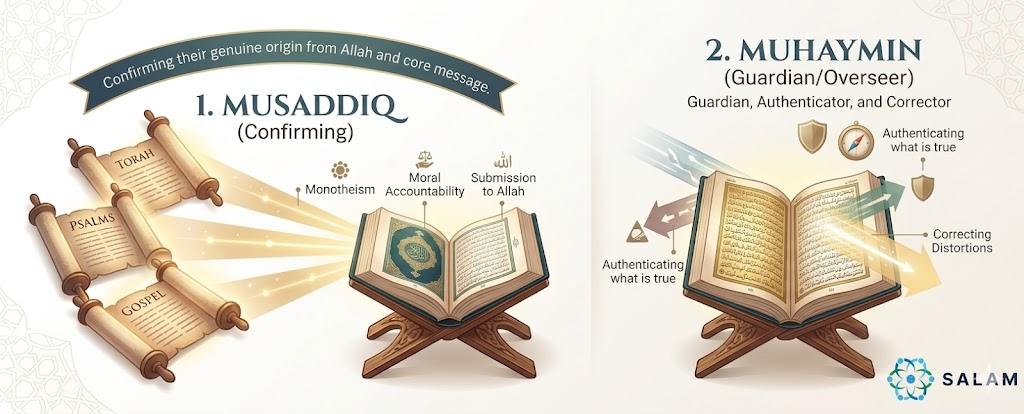
The Quran uses two key terms to describe its relationship with earlier revelations. The first is musaddiq — confirming. The Quran confirms that previous scriptures were genuinely from Allah and that the core message they carried — monotheism, moral accountability, submission to Allah — was true.
The second term is muhaymin — a guardian or overseer. The Quran stands over the previous scriptures, authenticating what is true in them and correcting what has been distorted.
وَأَنزَلْنَا إِلَيْكَ الْكِتَابَ بِالْحَقِّ مُصَدِّقًا لِّمَا بَيْنَ يَدَيْهِ مِنَ الْكِتَابِ وَمُهَيْمِنًا عَلَيْهِ
“And We have revealed to you the Book in truth, confirming that which preceded it of the Scripture and as a criterion over it.” (Quran 5:48)
This places the Quran in a unique position — simultaneously the most recent and the most authoritative of divine revelations. Earlier prophets, including Musa and Isa (peace be upon them), are said in authentic narrations to have foretold the coming of Prophet Muhammad (PBUH). The Quran references this prophetic foretelling:
الَّذِينَ يَتَّبِعُونَ الرَّسُولَ النَّبِيَّ الْأُمِّيَّ الَّذِي يَجِدُونَهُ مَكْتُوبًا عِندَهُمْ فِي التَّوْرَاةِ وَالْإِنجِيلِ
“Those who follow the Messenger, the unlettered prophet, whom they find written in what they have of the Torah and the Gospel.” (Quran 7:157)
This continuity — from Ibrahim to Musa to Isa to Muhammad (peace be upon them all) — is not coincidental in Islamic theology. It reflects the single, coherent divine project of guiding humanity. The five pillars of faith that every Muslim affirms are themselves the latest articulation of a message that predates them all.
What are the Implications of Belief in Holy Books in Islam for a Muslim’s Daily Life and Worldview?
Belief in previous scriptures shapes how a Muslim relates to followers of earlier religions. A Muslim cannot look at a practicing Jew or Christian with contempt, because Islamic theology holds their original scriptures in reverence and their prophets in profound respect.
The Islamic approach to other religions is neither syncretism nor hostility — it is a principled acknowledgment of shared prophetic heritage alongside a clear conviction about where the final, uncorrupted guidance now resides.
At the same time, this belief reinforces the Muslim’s commitment to the Quran as the living authority. Because earlier scriptures have been altered, a Muslim does not turn to the Bible or the Torah for religious rulings.
The Quran and the authenticated Sunnah of Prophet Muhammad (PBUH) are the governing sources. This is not a rejection of Moses or Jesus — it is a consequence of taking their divine origins seriously enough to insist on the integrity of revelation.
Prophet Muhammad (PBUH) himself modeled this balance. When Umar ibn al-Khattab (RA) once brought a page from the Torah, the Prophet (PBUH) expressed his disapproval — not because the Torah lacked divine origin, but because the community of believers had been given a revelation that superseded it. As recorded in Mishkat al-Masabih, the Prophet (PBUH) said:
“By Him in whose hand my soul is, if Musa were alive, he would have no choice but to follow me.” (Mishkat al-Masabih)
This Hadith encapsulates the Islamic position with remarkable clarity. Every prophet came with the same core message. The final prophet brought its final form.
Adherence to any earlier scripture — in its current, humanly altered state — when the Quran exists, would be a step backward even from the perspective of those earlier prophets themselves.
Read also: Do Muslims Believe in Christmas?
How Does This Belief Connect to the Broader Islamic Worldview on Monotheism?
The belief in revealed books cannot be fully appreciated in isolation from the Islamic understanding of Allah and His relationship with humanity. Islamic monotheism (tawhid) holds that Allah alone possesses divine attributes and that every prophet, without exception, called humanity to the same essential truth: worship Allah alone, without partners or intermediaries.
Every scripture, in its original form, carried this message. The corruption of earlier texts often involved precisely this point — the distortion of pure monotheism into trinitarianism, saint veneration, or other forms of what Islam classifies as shirk (associating partners with Allah). The stark contrast between Islamic monotheism and polytheistic or trinitarian frameworks is sharpest when examined through the lens of what the original revelations actually said.
The Quran presents itself as the restoration of that original message — the word of Allah returned to humanity in an inviolable form. This is why, in the Islamic framework, accepting the Quran is not replacing one religion with another. It is responding to the same call that every divine scripture ever issued, in the form that has been perfectly preserved to answer it.
Understanding the nature of Allah as Islam presents it is inseparable from understanding why revelation itself exists. An all-knowing, all-merciful Creator does not leave humanity without guidance. The books are that guidance — culminating in a final scripture that carries His divine guarantee of preservation until the Last Day.
The reward of holding this faith correctly, maintaining it with sincerity and knowledge, is described across Quranic passages with vivid and profound imagery. The promise of Jannah (Paradise) is consistently tied in the Quran to belief (iman) — and belief in the revealed books is one of its indispensable components.
For anyone exploring Islam’s comprehensive worldview, the nine core principles of Islam offer an excellent structural overview of how doctrines like belief in the books fit within the religion’s larger architecture.
Learn More About Islam
Discover the beauty, teachings, and wisdom of Islam in a clear and welcoming way. Start exploring and deepen your understanding today.
Learn MoreExplore More About Islam at Salam
If this topic has raised more questions than it answered — that is a good sign. The relationship between Islam and divine revelation is one of the deepest threads running through Islamic theology, and it rewards serious inquiry.
At the Salam Platform, you will find in-depth articles written for seekers, skeptics, and curious minds — no background in Islamic studies required.
Browse the full Salam blog for articles on Islamic beliefs, the life of Prophet Muhammad (PBUH), answers to common misconceptions, and more.
Have a specific question not addressed here? Want to learn more about what Islam teaches — or are you considering entering Islam yourself? Reach out directly. Every question deserves a thoughtful answer.

Frequently Asked Questions
Do Muslims believe the Bible is from Allah?
Muslims believe the original Torah and the original Gospel (Injeel) were genuine revelations from Allah, sent to the prophets Musa and Isa (peace be upon them) respectively. The current Bible — both Old and New Testaments — is a later human composition that contains remnants of those original revelations alongside centuries of editorial changes, additions, and theological distortions. Islamic theology calls this process tahrif (textual corruption). So the respect Muslims hold is for the divine originals, not for the current biblical texts in their altered form.
Is belief in holy books one of the pillars of faith in Islam?
Yes. Belief in all of Allah’s revealed scriptures is the third of the six pillars of Islamic faith (arkan al-iman). A Muslim must affirm that Allah revealed divine guidance through books sent to various prophets across history. Rejecting this belief — or rejecting even a single authenticated divine scripture — invalidates a person’s faith from an Islamic theological standpoint. The Quran commands this belief directly in Surah An-Nisa (4:136).
Why do Muslims follow only the Quran if they believe in earlier scriptures?
Muslims follow the Quran because it is the final, preserved, and uncorrupted divine revelation. Earlier scriptures served their communities and eras, but their textual integrity was not guaranteed — and historical and academic evidence confirms they were altered over time. The Quran, by contrast, carries a divine promise of preservation (Quran 15:9) and has remained unchanged since its revelation. Additionally, Prophet Muhammad (PBUH) is the final messenger sent to all of humanity, and his Sunnah, alongside the Quran, constitutes the complete and final divine guidance for all people until the Last Day.
Does Islam respect the prophets of earlier scriptures like Moses and Jesus?
Islam holds Moses (Musa), Jesus (Isa), David (Dawud), and all prophets mentioned in earlier scriptures in the highest regard. They are all recognized as genuine messengers of Allah who carried the same essential message of monotheism. Isa (AS) in particular holds a distinguished station in the Quran — born miraculously, described as the Messiah, and assigned the miracle of raising the dead by Allah’s permission. What Islam rejects is the theological elevation of these prophets beyond their proper human and prophetic status, such as attributing divinity to Isa (AS).
How many books does Islam say Allah revealed?
Islamic scholarship identifies four major scriptures by name: the Suhuf (scrolls of Ibrahim and Musa), the Torah (Tawrah) revealed to Musa, the Psalms (Zabur) revealed to Dawud, the Gospel (Injeel) revealed to Isa, and the Quran revealed to Muhammad (peace be upon them all). Beyond these, Islamic theology affirms that Allah sent messengers and guidance to every human community throughout history, meaning there may have been additional revealed texts whose names and details have not been specified in the Quran or authentic Hadith.
Does believing in previous scriptures make Muslims partial to Judaism or Christianity?
Belief in the divine origin of earlier scriptures is a theological position, not a sectarian affiliation. A Muslim’s reverence for the Torah does not make them Jewish, and respect for the original Injeel does not align them with Christian theology. Islam’s relationship with earlier Abrahamic traditions is one of principled acknowledgment — affirming shared prophetic roots while maintaining that the Quran is the final, authoritative, and uncorrupted divine word. Muslims regard themselves as followers of the same original monotheism that Ibrahim (AS) himself embodied, long before Judaism and Christianity emerged as distinct religious identities.
Curious about Islam?
Journey towards clarity and purpose. Our team is here to support you in your search for truth and spiritual guidance.
Embrace the Truth