
Islam Teachings on Respecting Other Religions
The Quran states there is no compulsion in religion, establishing freedom of belief as a foundational Islamic principle. Islam commands kindness and justice toward non-Muslims who are not hostile toward Muslims, as stated explicitly in Quran 60:8.
The Constitution of Medina, drafted by the Prophet (PBUH) in 622 CE, guaranteed Jewish tribes the right to practice their own religion within a shared civic community.
Respect in Islam means protecting the rights, safety, and dignity of people of other faiths — it does not mean agreeing that all religions are equally true.
Does Islam teach Muslims to respect other religions?
Yes, Islam commands Muslims to respect the rights, dignity, and freedom of belief of people from other religions, while maintaining that Islam itself is the only complete and final truth. This respect is built into specific, binding commands in the Quran and the practice of the Prophet Muhammad (PBUH).
The Quran declares outright that faith cannot be forced:
“لَا إِكْرَاهَ فِي الدِّينِ ۖ قَد تَّبَيَّنَ الرُّشْدُ مِنَ الْغَيِّ”
“There shall be no compulsion in [acceptance of] the religion. The right course has become clear from the wrong.” (Quran 2:256).
This verse reshapes how a Muslim is meant to relate to a neighbor, colleague, or family member of a different faith — not as someone to be pressured, but as someone whose free choice Allah Himself protects.
At the same time, respecting another person’s right to their belief is different from claiming their belief is equally correct. Islam holds firmly to monotheism as the only truth about the nature of God, and this conviction sits comfortably alongside kindness, fairness, and civic partnership with people who believe differently.
Understanding Islam’s view of the nature of God clarifies why Muslims can hold their faith with total confidence while still extending real respect to others.
1. No compulsion exists in matters of religious belief
The single clearest statement on this subject in the entire Quran is verse 2:256, and its wording leaves no room for ambiguity. Do not force anyone into Islam, because the truth of Islam is already clear through its own evidence, and coercion adds nothing to genuine conviction.
This principle is not isolated. Surah Al-Kafirun closes with words the Prophet (PBUH) recited to a group of Meccan leaders who proposed a compromise — that Muslims worship their idols for a season if they would worship Allah for a season in return.
قُلْ يَا أَيُّهَا الْكَافِرُونَ ﴿١﴾ لَا أَعْبُدُ مَا تَعْبُدُونَ ﴿٢﴾ وَلَا أَنتُمْ عَابِدُونَ مَا أَعْبُدُ ﴿٣﴾ وَلَا أَنَا عَابِدٌ مَّا عَبَدتُّمْ ﴿٤﴾ وَلَا أَنتُمْ عَابِدُونَ مَا أَعْبُدُ ﴿٥﴾ لَكُمْ دِينُكُمْ وَلِيَ دِينِ ﴿٦﴾
“Say, “O disbelievers, (1) I do not worship what you worship. (2) Nor are you worshippers of what I worship. (3) Nor will I be a worshipper of what you worship. (4) Nor will you be worshippers of what I worship. (5) For you is your religion, and for me is my religion.” (6)” (Quran 109:1-6).
This is why understanding faith in Islam matters — belief has to be a free, internal conviction, or it carries no spiritual weight at all.
2. Kindness and fairness toward non-hostile non-Muslims is a command in Islam
Allah does not merely permit kind treatment of non-Muslims — He commands it in explicit terms for anyone who is not waging war against Muslims. Quran 60:8 states:
“لَّا يَنْهَاكُمُ اللَّهُ عَنِ الَّذِينَ لَمْ يُقَاتِلُوكُمْ فِي الدِّينِ وَلَمْ يُخْرِجُوكُم مِّن دِيَارِكُمْ أَن تَبَرُّوهُمْ وَتُقْسِطُوا إِلَيْهِمْ ۚ إِنَّ اللَّهَ يُحِبُّ الْمُقْسِطِينَ”
“Allah does not forbid you from those who do not fight you because of religion and do not expel you from your homes – from being righteous toward them and acting justly toward them. Indeed, Allah loves those who act justly.”
This verse was revealed to correct a misunderstanding among early Muslims who assumed that hostility from persecutors in Mecca meant all non-Muslims should be treated with suspicion.
Allah clarified that justice is owed to anyone who is peaceful, regardless of their religion. Righteousness (birr) and justice (qist) toward a peaceful non-Muslim neighbor are not optional courtesies in Islam — they are acts Allah says He loves.
This has practical shape in daily life: honesty in business dealings with non-Muslims, kindness to a non-Muslim neighbor, fairness to a non-Muslim colleague, and respectful conduct with non-Muslim family members.
The nine principles of Islam that shape a Muslim’s worldview all flow from this same source — a comprehensive, evidence-based system rather than a patchwork of isolated rules.
Learn More About Islam
Discover the beauty, teachings, and wisdom of Islam in a clear and welcoming way. Start exploring and deepen your understanding today.
Learn More3. Human life carries sacred worth regardless of a person’s religion
The Quran states that unjustly taking a single human life is equivalent, in moral weight, to destroying all of humanity — and this statement makes no distinction based on religion. Quran 5:32 reads:
“مِنْ أَجْلِ ذَٰلِكَ كَتَبْنَا عَلَىٰ بَنِي إِسْرَائِيلَ أَنَّهُ مَن قَتَلَ نَفْسًا بِغَيْرِ نَفْسٍ أَوْ فَسَادٍ فِي الْأَرْضِ فَكَأَنَّمَا قَتَلَ النَّاسَ جَمِيعًا وَمَنْ أَحْيَاهَا فَكَأَنَّمَا أَحْيَا النَّاسَ جَمِيعًا”
“Because of that, We decreed upon the Children of Israel that whoever kills a soul unless for a soul or for corruption [done] in the land – it is as if he had slain mankind entirely. And whoever saves one – it is as if he had saved mankind entirely.” (Quran 5:32)
This verse establishes a foundational principle of sanctity of life (hurmat al-nafs) that undergirds the entire Islamic legal tradition.
A human soul has inherent worth before Allah, and that worth is not contingent on the person’s creed. This is the theological bedrock beneath every ruling Islam later builds regarding the treatment of non-Muslims living among or alongside Muslims.
4. The Prophet Muhammad stood for a Jewish funeral out of respect for the soul
One of the most striking recorded actions of the Prophet Muhammad (PBUH) shows this principle in practice, not just in words. A funeral procession once passed the Prophet (PBUH), and he stood up in a gesture of respect. When his companions told him it was the funeral of a Jewish man, he responded, “Is it not a living being (soul)?” (Sahih al-Bukhari 1312).
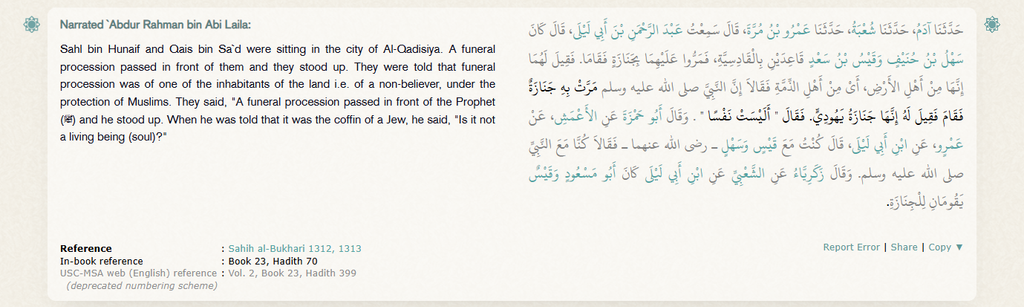
This narration is recorded by ‘Abdur Rahman bin Abi Laila from the companions Sahl bin Hunaif and Qais bin Sa’d, who stood for a funeral procession themselves in Al-Qadisiya and explained their action by recalling what the Prophet (PBUH) had done.
A related narration from Jabir bin ‘Abdullah records the Prophet (PBUH) giving the general instruction,
“Whenever you see a funeral procession, you should stand up” (Sahih al-Bukhari 1311).
Scholars have discussed the precise reasoning behind the gesture — whether it reflects honor for the human soul itself or reverence for the angels present at death — but either reading affirms the same underlying reality: a person’s worth as a human being does not disappear because they follow a different faith.
5. Harming a person under a covenant of protection carries severe consequences
Islam does not merely discourage harming non-Muslims who live peacefully among Muslims — it attaches one of the gravest warnings in the entire hadith corpus to this act. The Prophet (PBUH) said:
“Whoever killed a person having a treaty with the Muslims, shall not smell the smell of Paradise though its smell is perceived from a distance of forty years.” (Sahih al-Bukhari 3166)
This hadith refers to a mu’ahid — a non-Muslim living under a covenant of protection within a Muslim community.
The severity of this warning reflects how seriously Islam treats the safety of non-Muslims who are not combatants.
A covenant of protection in Islamic law is not a minor administrative arrangement; it is a sacred trust, and violating it is described as forfeiting the very fragrance of Paradise, detectable from a journey of forty years.
6. The Prophet Muhammad built a shared community with Jewish tribes in Medina
When the Prophet Muhammad (PBUH) arrived in Medina in 622 CE, one of his first acts of governance was to draft a written charter that included the Jewish tribes of the city as full partners in a shared civic order.
Known today as the Constitution of Medina, this document — among the earliest written constitutions in recorded history — established that the various tribes and religious communities of Medina, Muslim and non-Muslim alike, formed one political community with mutual rights and responsibilities, while each retained its own religious practice.
This set a precedent that shaped how later Islamic governance approached religious diversity: coexistence with legal protection, not forced uniformity.
7. The Christians of Najran were received, heard, and granted protection rather than forced to convert
A delegation of Christians from Najran traveled to Medina to meet the Prophet Muhammad (PBUH) directly, and what followed became one of the clearest examples of Islamic engagement with people of another faith.
The Prophet (PBUH) received them, engaged them in extended theological discussion regarding their beliefs about Jesus (peace be upon him), and when they did not accept Islam, he did not compel them.
Instead, a treaty was concluded granting the Najran Christians protection for their lives, their property, and their churches, in exchange for the jizyah — a arrangement that placed them under the legal protection of the Muslim state rather than under any threat.
This episode illustrates the same principle drawn from Quran 2:256 in real historical practice: dialogue and invitation, not coercion.
Understanding how does Islam view other religions more broadly shows that this pattern — respectful engagement paired with firm conviction — runs consistently through Islamic history rather than appearing as an isolated incident.
Read Also: What Do Unitarians Believe?
8. Respecting other religions does not mean claiming all religions are equally true
Genuine respect in Islam is rooted in protecting a person’s dignity, safety, and freedom of conscience — not in pretending that all religious claims carry equal truth. This distinction matters, because it is sometimes assumed that respect requires relativism. Islam rejects that assumption entirely.
The Quran affirms that Islam is the final and complete message from Allah, building upon and confirming the core message brought by earlier prophets, while correcting distortions that entered earlier scriptures over time.
A Muslim can hold this conviction with total confidence — believing Islam is true — while simultaneously upholding every command discussed above: no compulsion, justice toward the peaceful, protection of life, and honoring the human dignity of every person regardless of what they believe.
These two things are not in tension. They reflect the same underlying reality that emerges from studying what the Quran says about other religions: conviction and compassion were never meant to be separated.
Read Also: What Did the Hellenists Believe?
9. Respect for religious difference has practical rulings that guide daily interaction
Beyond the theological foundation, Islamic scholarship developed detailed guidance for everyday interactions between Muslims and people of other faiths — covering matters such as honesty in trade, keeping promises, visiting non-Muslim relatives, and general etiquette in mixed communities.
These rulings exist precisely because respect in Islam is meant to be lived out in ordinary moments, not confined to abstract theology.
A Muslim navigating a workplace, a neighborhood, or a family gathering with people of other faiths draws on this same body of guidance to know how to act with both integrity and warmth.
Read Also: What Do Animists Believe?
Learn More About Islam
Discover the beauty, teachings, and wisdom of Islam in a clear and welcoming way. Start exploring and deepen your understanding today.
Learn MoreLearn More About Faith, Certainty, and the Journey to Islam
Every question about Islam deserves a real, evidence-based answer — and this is only one piece of a much larger picture.
Explore more articles on the Salam blog to keep learning about Islamic beliefs, history, and practice.
If you’re considering Islam or simply want to talk something through, reach out directly — no pressure, just honest conversation.

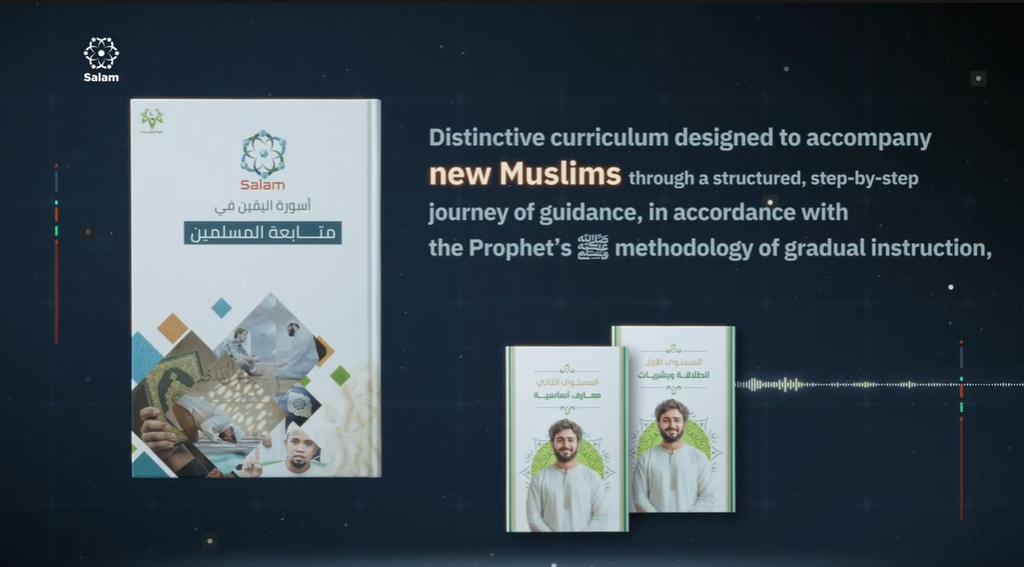
If you’ve already taken your shahada, the Salam Center team would love to walk with you through the next stage of your journey. The Asawirat Al-Yaqeen (Bracelets of Certainty) program was built exactly for this:
- A structured, four-stage curriculum grounded in the Quran, authentic Sunnah, and the creed of Ahlus Sunnah wal Jama’ah
- Covers everything from the basics of prayer and purification to Seerah, family rulings, and contemporary issues
- Delivered with warmth and patience, at a pace that respects where you are in your journey
- Already walked alongside new Muslims in 140 countries around the world
Whatever stage you’re at — curious, convinced, or newly Muslim — the door is open.
Reach out directly to the Salam Center team to start the Asawirat Al-Yaqeen (Bracelets of Certainty) program for FREE.
Summary
Islam grounds respect for other religions in clear, binding commands: no compulsion in belief, justice toward the peaceful, and sacred protection of every human life. The Prophet Muhammad’s own conduct, from standing for a Jewish funeral to sheltering the Salam Center’s own model — dialogue over pressure — brought these commands to life.
This respect never requires abandoning conviction. A Muslim can affirm Islam as the complete truth while protecting the dignity, safety, and freedom of belief of every person they meet, exactly as the Quran and the Prophet’s example require.
Frequently Asked Questions
Does the Quran really say there is no compulsion in religion?
Yes. Quran 2:256 states plainly, “There shall be no compulsion in [acceptance of] the religion.” Classical commentators confirm this means no one may be forced into Islam, since its truth is evident through its own proofs.
Did the Prophet Muhammad actually interact respectfully with non-Muslims?
Yes, repeatedly. He stood in respect for a Jewish funeral procession (Sahih al-Bukhari 1312), granted the Jewish tribes of Medina religious freedom under the Constitution of Medina, and received the Christian delegation from Najran with dialogue and a protective treaty rather than coercion.
What happens in Islam if someone harms a non-Muslim living peacefully under Muslim protection?
It is treated as an extremely grave sin. The Prophet (PBUH) warned that whoever kills a person having a treaty with the Muslims will not smell the fragrance of Paradise (Sahih al-Bukhari 3166), showing how seriously Islam protects the lives of non-hostile non-Muslims.
Does respecting other religions mean Islam teaches all religions are equally true?
No. Islam commands respect for people’s dignity, safety, and freedom to believe as they choose, while affirming that Islam itself is the complete and final truth. Respecting a person’s right to their belief is distinct from agreeing that belief is correct.
Curious about Islam?
Journey towards clarity and purpose. Our team is here to support you in your search for truth and spiritual guidance.
Embrace the Truth