What Are the Teachings of the Qur’an?
Key Takeaways The Qur’an’s central teaching is Tawhid, the absolute Oneness of Allah, from which every other doctrine flows. The Qur’an teaches that Prophet Muhammad…
Key Takeaways Islam teaches absolute monotheism (Tawheed), the belief that Allah alone deserves worship, with no partners, sons, or intermediaries. The Five Pillars — Shahada,…
Key Takeaways Islam teaches that pure monotheism (Tawhid) is the original human religion, taught by every prophet from Adam onward, not a doctrine invented in…
Key Takeaways Tawhid — belief in one God, Allah — was humanity’s original religion, beginning with Prophet Adam (peace be upon him). The Quran and…
Angel Gabriel (Jibril) served as the sole intermediary through whom Allah revealed the entire Quran to Prophet Muhammad (PBUH) over twenty-three years. The first revelation…
Key Takeaways Islam teaches that every prophet in human history, from Adam to Muhammad (PBUH), delivered the same core message of worshipping one Allah. Muslims…
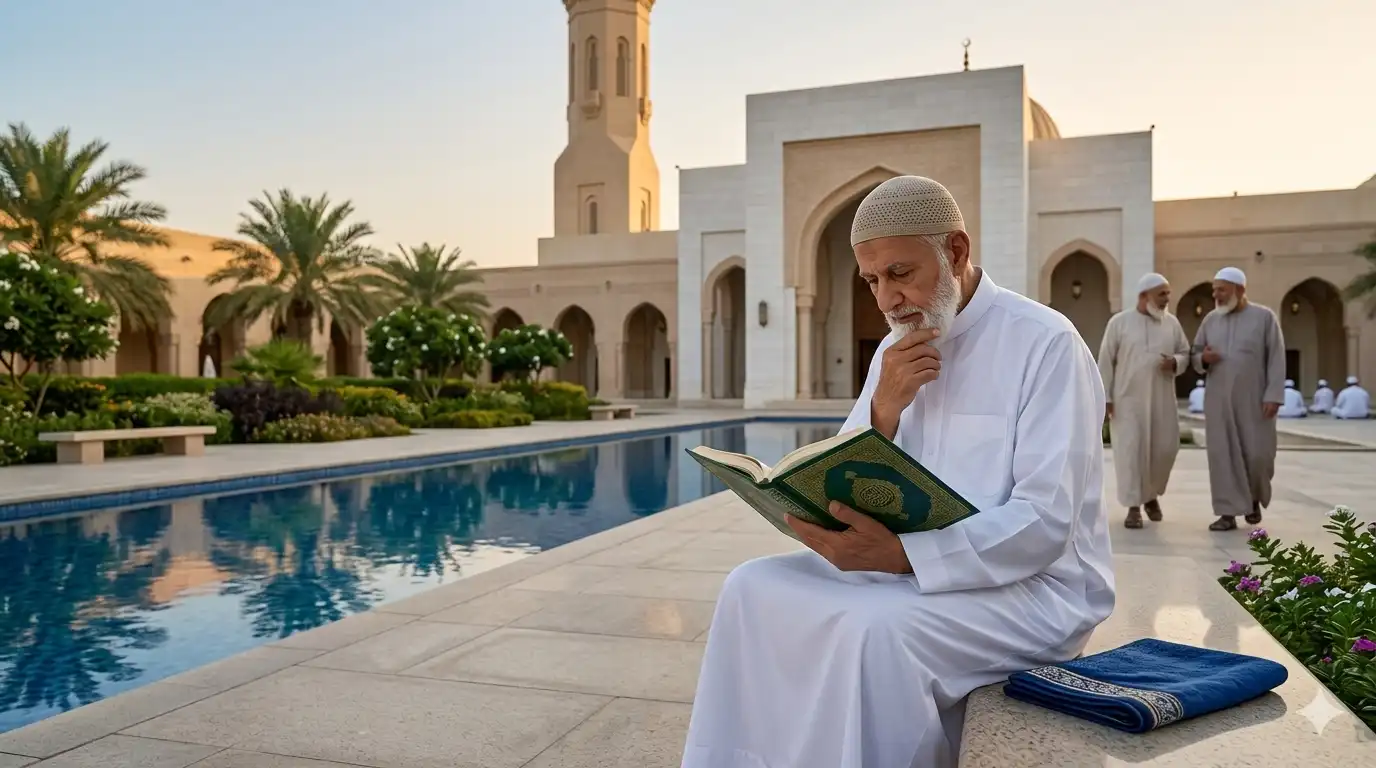
Key Takeaways Sufism emerged in early Islamic history as a movement emphasizing spiritual purification, but the term “Sufi” was not used during the Prophet’s (PBUH)…
Key Takeaways Islam teaches that every human being is born in a state of fitrah — pure, natural disposition — with no inherited sin or…
Key Takeaways Muslims believe Prophet Muhammad (PBUH) is the final messenger of Allah, sent to all of humanity until the Day of Judgment. The Prophet…
Key Takeaways Islam teaches that Allah created the universe in six days (ayyam) through His command “Be” (Kun), as stated explicitly in the Quran. The…
Key Takeaways In Islam, salvation means eternal success — entering Paradise — through sincere belief in Allah alone, righteous deeds, and His mercy, not through…
Key Takeaways Islam does not believe in rebirth or reincarnation — the soul lives once in this world, then passes to an eternal afterlife. The…
Key Takeaways Islam categorically rejects reincarnation — the soul lives once in this world, then proceeds to the afterlife after death. The Quran explicitly states…
Key Takeaways Islam permits polygamy with a strict maximum of four wives, subject to binding conditions of justice, financial capacity, and physical ability. The Quran…
Key Takeaways Islam acknowledges magic (sihr) as real — it exists, it harms, and the Quran addresses it directly with clear rulings. Practicing magic is…
Key Takeaways Muslims do not celebrate Christmas because it is a religious holiday rooted in the Christian belief that Jesus is the Son of God…
Key Takeaways Muslims are not required to believe in the Big Bang Theory — belief is obligated only by what Allah revealed in the Quran…
Key Takeaways Belief in the Day of Judgement (Yawm al-Qiyamah) is one of the six pillars of Islamic faith — rejecting it invalidates a Muslim’s…
Key Takeaways Muslims are required to believe in all divinely revealed scriptures, including the Torah, the Psalms, the Gospel, and the Quran — this belief…
Key Takeaways Islamic ethics are rooted in divine revelation — every moral principle traces back to the Quran or authenticated Sunnah, not human convention or…
Key Takeaways Muslims affirm the virgin birth of Jesus (Isa, peace be upon him) as a foundational article of Islamic faith, not merely a historical…
Key Takeaways Islam affirms the original Torah (Tawrah) as a divine revelation sent by Allah to Prophet Musa (Moses), peace be upon him. Muslims believe…
Key Takeaways Muslims believe Allah revealed a Gospel (Injeel) to Prophet Jesus (PBUH), which they consider a divine scripture distinct from the New Testament as…
Key Takeaways Muslims accept from the Ten Commandments whatever aligns with the Quran, and reject whatever contradicts it. The Quran affirms the original Torah as…
Key Takeaways Islam does not believe in original sin; Islam teaches that every human being is born in a state of pure, untainted nature called…
Key Takeaways Muslims believe the original Torah (Tawrah) and Gospel (Injeel) were genuine divine revelations from Allah, sent to Prophets Moses and Jesus (peace be…
Key Takeaways Islam rejects the belief that Jesus is the son of Allah, as divine parenthood contradicts the absolute oneness of Allah (Tawhid) at the…
Key Takeaways Islam affirms belief in a Messiah — Jesus son of Mary (Isa ibn Maryam), who was neither killed nor crucified but raised alive…
Key Takeaways Muslims recognize Jews and Christians as “People of the Book” (Ahl al-Kitab) — recipients of divine revelation who preceded Islam. The Quran explicitly…
Key Takeaways Islam affirms that Jesus (peace be upon him) is Al-Masih — the Messiah — a title the Quran uses for him directly and…
An exploration of Christianity from an Islamic perspective, highlighting key differences, shared roots, and how the two traditions understand God, scripture, and salvation.
Key Takeaways Catholics and Protestants both affirm the Trinity and the divinity of Jesus, but they split sharply on where religious authority ultimately rests. Protestants…
Key Takeaways Every Catholic is a Christian, but not every Christian is Catholic, since Christianity is the wider faith and Catholicism is its largest branch.…
Key Takeaways Islam teaches that every person is born in a state of fitrah, pure and free of inherited guilt, while mainstream Christian doctrine holds…
Key Takeaways A Muslim man is permitted to marry a chaste Christian or Jewish woman without her converting to Islam, based on Quran 5:5. A…
Key Takeaways Muslims affirm the virgin birth of Jesus (Isa, peace be upon him) as a foundational article of Islamic faith, not merely a historical…
Key Takeaways Muslims believe Allah revealed a Gospel (Injeel) to Prophet Jesus (PBUH), which they consider a divine scripture distinct from the New Testament as…
Key Takeaways Muslims accept from the Ten Commandments whatever aligns with the Quran, and reject whatever contradicts it. The Quran affirms the original Torah as…
Key Takeaways Islam does not believe in original sin; Islam teaches that every human being is born in a state of pure, untainted nature called…
A closer look at what faith means in Islam — not just belief, but trust, conviction, and a living connection between the heart and the Creator.
Key Takeaways Belief in the Quran as Allah’s literal, unaltered word is one of the six pillars of faith (Iman) in Islam, making it non-negotiable…
Faith in Islam isn’t a static possession—it rises and falls, strengthens and weakens, like the tide responding to the moon. The Prophet Muhammad ﷺ described…
Faith—or iman in Arabic—isn’t just a box to check or a label to wear in Islam. Faith in Islam is the living, breathing core of…
Faith in Islam isn’t a single, static concept—it’s a living reality with depth and layers. When we speak about types of faith in Islam, we’re…
Faith t is the quiet conviction that Allah is One, that His wisdom governs all things, and that our purpose is found in submission to…
Faith moves mountains — at least, that is how the saying goes. But in Islam, faith does something more fundamental than that. It reorganizes a…
At some point, almost every sincere believer has sat with a question they were afraid to ask out loud. A doubt that crept in during…
Every major tradition has something at its center — a beating heart that gives the rest of it life. For Islam, that center is the…
Key Takeaways Muslims believe Jesus (Isa) is a prophet and messenger of Allah, not divine and not the son of God. The Quran affirms his…
The core foundations that shape Islamic belief, outlining the essential doctrines that define a Muslim’s worldview and understanding of existence.
Islam’s sacred calendar marks moments when heaven’s gates open wider, when prayers carry greater weight, and when believers across the globe unite in worship. Unlike…
There’s a reason Islam has shaped civilizations, guided scholars, and transformed ordinary people into extraordinary human beings for over fourteen centuries. The principles of Islam…
There is a crescent on the mosque. Green banners and Arabic script flowing across walls and flags. For the outside observer, these images have become…
Islam arrived with a system of governance. Long before Enlightenment thinkers drafted social contracts, the Quran established the foundations of political life — accountability, justice,…
Stories and roles of the prophets in Islam, from Adam to Muhammad, showing how their messages form a continuous thread of guidance throughout human history.
Abraham is a central figure in the spiritual history of humanity, revered by billions across different faith traditions. But does Islam believe in Abraham, and…
The story of Adam and Eve is one of the most significant narratives in Islam, highlighting the creation of humanity, life in Paradise, and the…
Prophet Noah, known as Nuh in Arabic, holds a significant place in Islamic teachings as one of the earliest and most resolute prophets sent by…
Islam believes in every prophet sent by Allah, from Adam to Muhammad (peace be upon them all), without making any distinction between them. Muslims view…
Across faith traditions, Moses stands as a towering moral figure—one whose life speaks to liberation, justice, and unwavering trust in Allah. In Islam, Moses’ story…
You can ask any question without judgment. Start a private and respectful conversation whenever you are ready.