Judgment Day in Islam vs Christianity
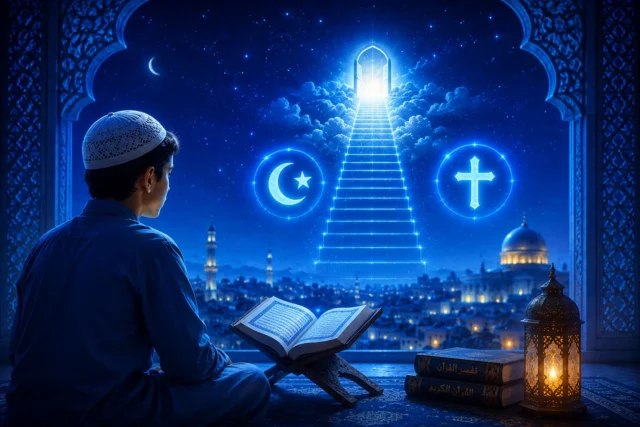
Key Takeaways Islam teaches that every soul stands individually before Allah on Yawm al-Qiyamah, with deeds weighed on a literal scale (mizan). Christianity’s judgment day…
Browse our complete collection of articles across all categories and topics.
404 articlesKey Takeaways Islam teaches that every soul stands individually before Allah on Yawm al-Qiyamah, with deeds weighed on a literal scale (mizan). Christianity’s judgment day…
Key Takeaways Mary, called Maryam in Arabic, is the only woman named directly in the Quran and the only one to have an entire surah,…
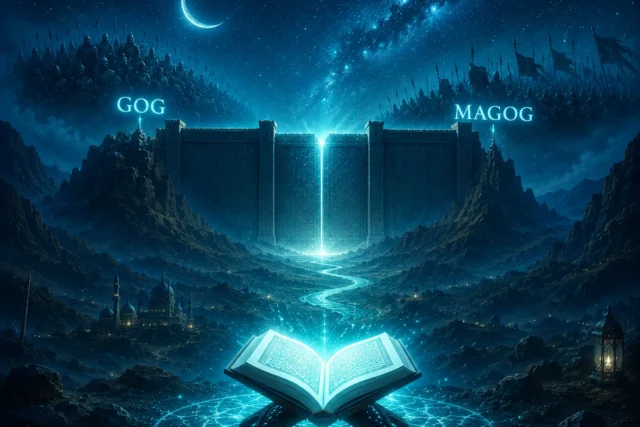
Key Takeaways Ya’juj wa Ma’juj (Gog and Magog) appear in the Quran in Surah Al-Kahf (18:83-98) and Surah Al-Anbiya (21:96-97), describing them as a real…
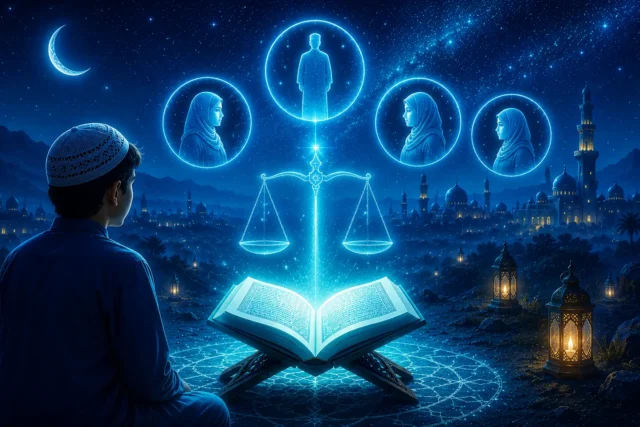
Key Takeaways The Quran permits a man to marry up to four wives in Surah An-Nisa 4:3, but only on the strict condition of equal…
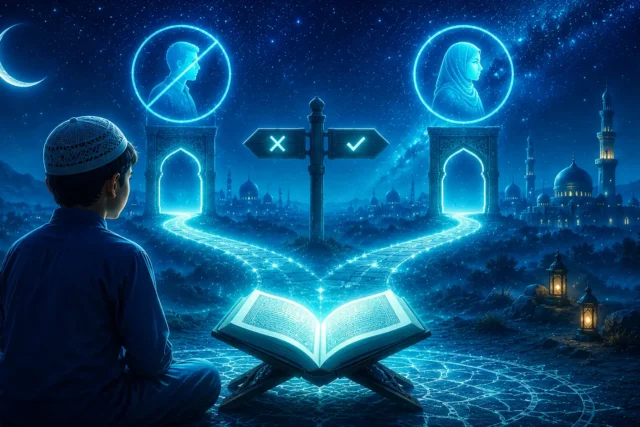
Key Takeaways Quran 5:5 permits Muslim men to marry chaste women from the People of the Book, meaning Jews and Christians. Quran 2:221 prohibits marriage…
The Quran commands Muslims to invite the People of the Book to a shared word of pure monotheism, found in Surah Al-Imran 3:64. “People of…
The Quran confirms that Allah originally revealed the Torah and the Gospel as authentic guidance before the Quran was sent down. The Quran instructs the…
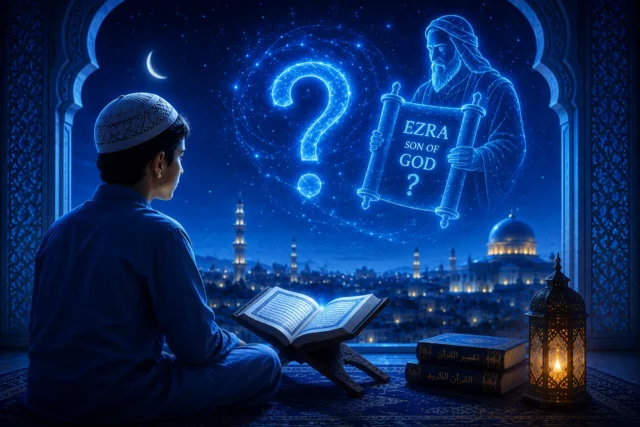
Key Takeaways The Quran states in Surah At-Tawbah (9:30) that a group among the Jews said Ezra is the son of Allah, and the Quran…
Key Takeaways No — the Quran does not teach that Christians, as a group, enter Paradise while holding Christian belief. Quran 2:111-112 directly addresses this…
Key Takeaways The Quran describes disbelief in Allah (kufr) as a rejection of clear truth after evidence has been presented, not an intellectual accident. Surah…
Key Takeaways Yes, the Quran explicitly states that some Jews and Christians distorted their scriptures, using the Arabic term tahrif in four core verses: 2:75,…
Key Takeaways The Quran addresses Bani Israel (the Children of Israel) across dozens of passages, covering their history, covenants, and relationship with the prophets sent…
Key Takeaways The Quran commands believing women to cover their adornments and draw their outer garments around themselves in two distinct verses in Surah An-Nur…
Key Takeaways The Quran commands all Muslims — male and female — to seek knowledge, with the Arabic word Muslim in key Hadith narrations covering…
Key Takeaways The Quran does not say the earth is flat — Islamic scholars have affirmed the earth’s spherical shape for over a thousand years.…
Key Takeaways Every alleged contradiction in the Quran dissolves under careful analysis of Arabic linguistic context and classical Islamic scholarly interpretation. The six-day creation narrative…
Key Takeaways The Quran describes the embryonic stages of human development — nutfa, alaqa, mudgha — with a precision that modern embryology has confirmed centuries…
Key Takeaways The Quran contains verses describing natural phenomena that some scholars and scientists view as consistent with discoveries made centuries after its revelation. Surah…
Key Takeaways Non-Muslims are permitted to read, hear, and study the Quran — Islam’s sacred scripture actively invites seekers to engage with it. Islamic scholars…
Key Takeaways Reading the Quran is not a condition for becoming a Muslim — entering Islam requires only the sincere utterance of the Shahada with…
Key Takeaways The five pillars of Islam — Shahada, Salah, Zakah, Sawm, and Hajj — are each established by explicit Quranic verses and confirmed by…
Key Takeaways The word “Muslim” derives from the Arabic root s-l-m, meaning submission, and a Muslim is one who fully submits to the will of…
Key Takeaways Muslims read the Quran because it is the literal, unaltered word of Allah revealed to Prophet Muhammad (PBUH) through the angel Gabriel. Reciting…
Key Takeaways The Quran mentions Jesus (Isa) by name 25 times, more than the name of Prophet Muhammad (PBUH). The Quran affirms the virgin birth…
Key Takeaways The Quran affirms the divine origin of the Torah (Tawrah), the Psalms (Zabur), and the Gospel (Injeel) as authentic revelations sent by Allah…
Key Takeaways The Quran was revealed to Prophet Muhammad (PBUH) gradually over approximately 23 years, beginning in 610 CE and concluding in 632 CE. The…
Key Takeaways The Quran’s revelation began in 610 CE during the month of Ramadan, when Angel Jibreel (Gabriel) delivered the first verses to Prophet Muhammad…
Key Takeaways The Quran was revealed in Arabic over approximately 23 years through the Angel Jibreel (Gabriel) to Prophet Muhammad (PBUH). The Quran is the…
Key Takeaways According to the Quran, Islam is not a religion that began with Prophet Muhammad (PBUH) — it is the original, eternal message that…
Key Takeaways The Quran is the Holy Book of Islam because it is the literal word of Allah, revealed to Prophet Muhammad (PBUH) through the…
Explore the teachings of Islam, the message of the Qur'an, and the life of Prophet Muhammad — through carefully curated articles sent directly to you.
No spam, just wisdom. Unsubscribe at any time.
You can ask any question without judgment. Start a private and respectful conversation whenever you are ready.