What Do Muslims Believe About the Quran?
There is a book that has been memorized in its entirety by millions of people across every continent, in a language most of them did…
Resources and insights designed to help Muslims strengthen their connection with the Qur'an through understanding, reflection, and daily practice.
Muslims are not required to memorize the entire Quran; this is a communal duty (Fard Kifayah), not a personal one. Every Muslim is personally obligated…
Key Takeaways Muslims memorize the Quran primarily because it is recited verbatim five times daily in salah, making memorization a functional necessity rather than an…
Key Takeaways The five pillars of Islam — Shahada, Salah, Zakah, Sawm, and Hajj — are each established by explicit Quranic verses and confirmed by…
Key Takeaways The word “Muslim” derives from the Arabic root s-l-m, meaning submission, and a Muslim is one who fully submits to the will of…
Key Takeaways Muslims read the Quran because it is the literal, unaltered word of Allah revealed to Prophet Muhammad (PBUH) through the angel Gabriel. Reciting…
Key Takeaways The Quran is the verbatim word of Allah, revealed to Prophet Muhammad (PBUH) as the primary and supreme source of guidance for all…
Key Takeaways The Quran is the direct, preserved word of Allah revealed to Prophet Muhammad (PBUH) and serves as the primary guide for every dimension…
An introduction to the Qur'an for readers who are new to Islam, covering its message, themes, history, and significance.
Key Takeaways Non-Muslims are permitted to read, hear, and study the Quran — Islam’s sacred scripture actively invites seekers to engage with it. Islamic scholars…
Key Takeaways Reading the Quran is not a condition for becoming a Muslim — entering Islam requires only the sincere utterance of the Shahada with…
In his description of the non-Muslim experience of reading the Quran, Dr. Jeffrey Lang, the former atheist, said: “When I read it for the first…
Key Takeaways The Arabic word kāfir (كافر), often translated as “infidel,” derives from the root k-f-r, meaning “to cover” — one who covers or conceals…
Key Takeaways The Quran establishes a clear framework for treating non-Muslims based on justice, fairness, and the recognition of their humanity. Muslims are commanded to…
Discover powerful verses and passages from the Qur'an that inspire reflection, provide guidance, and deepen understanding of Islam.
Key Takeaways The Quran states that Allah created human beings and jinn for the specific purpose of worship, as declared in Surah Adh-Dhariyat 51:56. Worldly…
Key Takeaways The Quran directly links lying to disbelief, stating that only those who reject Allah’s signs invent falsehood (Quran 16:105). Surah Al-Baqarah describes lying…
Key Takeaways The Quran does not call Prophet Muhammad (PBUH) the first human being ever to submit to Allah. In Quran 6:14 and 6:163, Muhammad…
Key Takeaways The Quran presents love as a signed proof of Allah’s design, most explicitly in Surah Ar-Rum 30:21, which links marital love to tranquility…
Key Takeaways The Quran permits fighting against those who initiate aggression, but forbids exceeding the bounds of that defense. Quran 22:39 grants permission to fight…
The Quran uses the word jihad in three main senses: striving through speech and argument, striving through wealth and life in armed struggle, and striving…
The Quran does not narrate the death of Prophet Muhammad (PBUH) the way a history book would. The Quran establishes Prophet Muhammad’s (PBUH) mortality as…
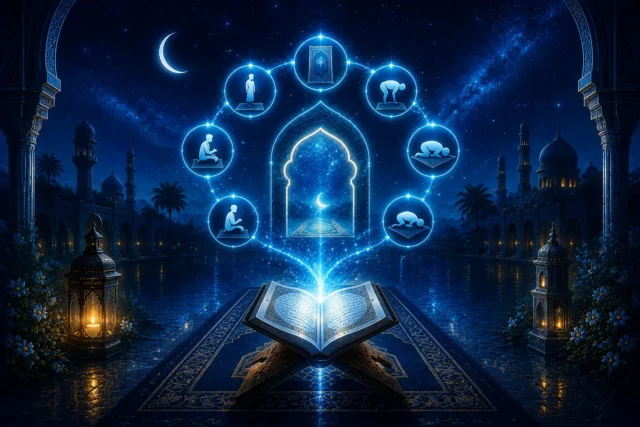
The Quran commands prayer (salah) explicitly in dozens of verses but does not describe its physical movements step-by-step. The number five daily prayers and their…
Examine verses that discuss the natural world and explore how Muslims have understood the relationship between the Qur'an and scientific discovery.
The Quran describes the universe’s origin as a unified mass later separated, a description that predates the expansion model of modern cosmology by over 1,400…
Key Takeaways The Quran does not say the earth is flat — Islamic scholars have affirmed the earth’s spherical shape for over a thousand years.…
Key Takeaways Every alleged contradiction in the Quran dissolves under careful analysis of Arabic linguistic context and classical Islamic scholarly interpretation. The six-day creation narrative…
Key Takeaways The Quran describes the embryonic stages of human development — nutfa, alaqa, mudgha — with a precision that modern embryology has confirmed centuries…
Key Takeaways The Quran contains verses describing natural phenomena that some scholars and scientists view as consistent with discoveries made centuries after its revelation. Surah…
Key Takeaways Every alleged scientific error in the Quran dissolves under careful linguistic and contextual analysis rooted in classical Islamic scholarship. The Quran’s descriptions of…
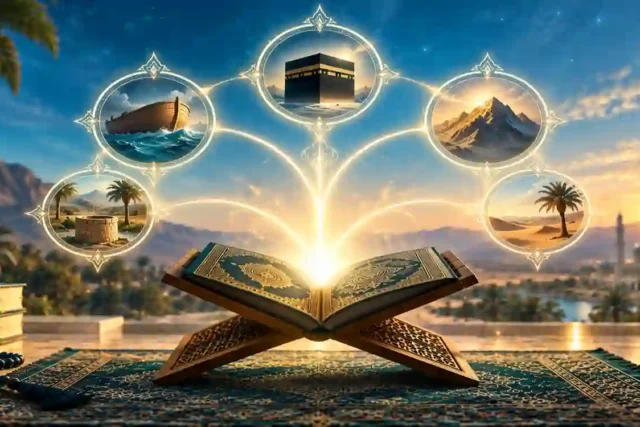
Explore the narratives of prophets, nations, and individuals mentioned in the Qur'an, and the timeless lessons they continue to offer.

Key Takeaways The story of Joseph in Islam appears in full in Surah Yusuf, the only chapter of the Quran devoted entirely to a single…
Key Takeaways The Quran confirms jinn as a real, separate creation made from smokeless fire, distinct from angels and humans. Surah Al-Jinn (72) records a…
The word “Dajjal” does not appear directly in the Quran text, but the Prophet Muhammad (PBUH) linked protection from him explicitly to Surah Al-Kahf. Sahih…
Key Takeaways The Quran names exactly 25 prophets, from Adam to Prophet Muhammad (PBUH). Eighteen of the 25 prophets appear together in one passage, Surah…
Key Takeaways The story of Abraham sacrificing his son in the Quran appears in Surah As-Saffat, verses 99 through 113, and centers on Prophet Ibrahim’s…
Key Takeaways Mary, called Maryam in Arabic, is the only woman named directly in the Quran and the only one to have an entire surah,…
Key Takeaways Ya’juj wa Ma’juj (Gog and Magog) appear in the Quran in Surah Al-Kahf (18:83-98) and Surah Al-Anbiya (21:96-97), describing them as a real…
Key Takeaways Ibrahim (Abraham) is mentioned by name 69 times in the Quran, making him one of the most frequently referenced prophets in the entire…
Learn how the Qur'an is organized, from its chapters and verses to its themes, literary style, and unique composition.
Key Takeaways Al-Fatihah, meaning “The Opening,” is the first surah of the Quran and consists of seven verses. The very first verses revealed were the…
Key Takeaways The Quran contains 6,236 ayahs according to the Kufan counting method, which is the basis of the standard Uthmani mushaf used across most…
Key Takeaways The Quran contains exactly 30 juz, a division established for practical recitation rather than one commanded within the Quranic text itself. Each juz…
Key Takeaways The standard printed Quran, known as the Madani Mushaf, contains 604 pages in the Uthmani script. The Quran in English translation typically runs…
Key Takeaways The Quran contains exactly 114 surahs, arranged mostly in descending order of length rather than by chronology of revelation. Of the 114 chapters,…
Key Takeaways An-Nas (Chapter 114) is the last surah in the Mus’haf’s standard written arrangement. An-Nasr (Chapter 110) is the last surah revealed to Prophet…
Key Takeaways The longest ayah in the Quran is verse 282 of Surah Al-Baqarah, known as Ayat al-Dayn (the Verse of Debt). Ayat al-Dayn contains…
Key Takeaways Surah Al-Baqarah is the longest surah in the Quran, containing 286 verses. Al-Baqarah is the second chapter of the Quran and was revealed…
You can ask any question without judgment. Start a private and respectful conversation whenever you are ready.